The story of the Jada for new mothers shows how bias holds back women’s health

The story of the Jada for new mothers shows how bias holds back women’s health

As she prepared her medical-device startup for a make-or-break clinical trial, one of Anne Morrissey’s first thoughts was, There’s no way we can do this clinical trial.

There were the usual challenges that test any health care startup, including financial worries—did they have enough money to hire a team, train staff, compensate investigators, gather sufficient data? But there were also some uniquely convoluted ones. Like: When and how could they get informed consent from patients on the verge of giving birth?

It was 2016, and Morrissey was the new CEO of Alydia Health, a five-year-old company with a novel device, known as the Jada System, to treat postpartum hemorrhage (PPH), or excessive bleeding after delivery. PPH is a potentially devastating complication of childbirth that affects 14 million women a year, including hundreds of thousands in the U.S. And while deaths from PPH are largely preventable—and rare, in rich nations—it still kills 70,000 women every year globally, ranking as the leading cause of maternal death worldwide. 

As medical devices go, Jada, a wand-like tool that is inserted in the uterus, was unbelievably simple. But as a device designed to address a pregnancy-related problem—an area of medicine rarely touched by innovation—its path to approval was anything but straightforward. 

PPH is an emergency complication—often sudden and hard to anticipate. A woman can’t volunteer for a trial while she’s rapidly losing blood and in need of lifesaving care. Nor it seemed, could she do so while in active labor, when she may be under duress. (FDA rules require that patients be given sufficient opportunity to consider participation in a trial, in a period of clear thinking where they’re free of coercion.) But it wouldn’t work to “consent” women at prenatal appointments, either, due to the paperwork nightmare of getting the relevant forms from doctors’ offices to hospitals.

By 2017, Alydia, the FDA, and the clinical trial sites had finally worked out an elaborate protocol around informed consent: allowing the process during the first stage of labor, but not the second, or while contractions or medical interventions were underway. 

A Jada System medical device
The Jada System helps stop postpartum hemorrhaging by creating gentle suction in the uterus.

Courtesy of Organon

That matter settled, Morrissey’s team moved onto the next doozy: how to sensitively discuss the benefits of participating in an experimental study—and raise the possibility of additional risks—with women who were about to undergo the physically intense and profoundly vulnerable experience of childbirth. And how many would you have to ask, given that only a fraction of them would suffer hemorrhage?

In the end, more than 7,000 women provided consent to reach the 107 U.S. PPH cases Alydia needed to power its study. “It was really slow,” remembers Morrissey—so slow that, in the beginning, the team celebrated each additional case by opening a bottle of champagne. But as word of success spread at trial sites, the pace of enrolling patients picked up.

In 2020, five painstaking years after the trial was first being planned, that success began to bear fruit. Data published in Obstetrics & Gynecology, a preeminent journal, showed Jada was effective in 94{35112b74ca1a6bc4decb6697edde3f9edcc1b44915f2ccb9995df8df6b4364bc} of the hemorrhage cases, controlling bleeding in a median time of just three minutes. That same year, Jada received FDA clearance. And in March 2021, Alydia sold for $240 million to Organon, a women’s health-focused company that was being spun out of Merck, the giant American drugmaker.

It was an eye-popping exit for Alydia, a crowning and previously almost unthinkable achievement for a team of people who willed the Jada, on a shoestring budget, through 10 twisty, turny years of development. The founders hadn’t doubted the technology, only that they’d ever get through the obstacle-laden path to bring it into the world.

The odds are long for most medical innovations, but especially so in women’s health, a field that remains underdeveloped—trapped by old-fashioned gender dynamics that still stubbornly guide the market today. 

Anne Morrissey, former CEO of Alydia Health, led the company through its pivotal clinical trial.

Photograph by Anastasiia Sapon for Fortune

Alydia was selling a product that had a potential market of millions of women a year, one that could save lives and money too. But up until Alydia’s acquisition, that was a value proposition that almost no one wanted to bet on. As a women’s health product—and not, say, a cancer drug—the Jada was an opportunity that simply didn’t compute in most investor models and mindsets.

That left Alydia, like a lot of companies in its neglected field, under-resourced for a development process that in nearly every aspect is tougher for women’s health companies: the science less clear, the regulators more demanding, the history more fraught. Even the hard-won success stories are modest, flotsam and jetsam in a multitrillion-dollar industry’s deal flow. The fate of Jada is a case in point: It’s now tied to the future of Organon, an ambitious but unproven company that’s arguably even more at the mercy of financial markets that haven’t shown much faith in women’s health.

There are signs—and certainly hopes—that such neglect and uninterest are giving way to something more equitable. And that makes the story of Alydia and Organon a parable of the women’s health business, emblematic of the challenges that have long thwarted innovation and the forces that could change the industry for the better.

Investing in women, in a system that doesn’t

“Here for Her Health,” proclaimed the banner on the façade of the New York Stock Exchange on the rainy morning in June 2021 that Organon made its public-market debut. The company’s arrival seemed well timed to capitalize on the cultural moment and the energies of #MeToo and FemTech—the name given to the women’s health startup industry.

More than a splash of marketing savvy went into the ceremony—Organon executives rang the opening bell and posed for photographs under fuchsia umbrellas. But the company’s launch also represented something bold and unusual, a fist raised to the male-centered medical establishment, in the form of a business with a $9.4 billion market cap that was proudly, explicitly investing in women’s health.

Organon’s ambitions for innovation are expansive, ranging from diagnostics and devices to drugs and digital therapeutics for conditions exclusive to women, like endometriosis, and to those that disproportionately affect them, like migraine or overactive bladder syndrome. The company has moved quickly, doing six deals in its first 16 months, a spree that included Alydia, a Finnish biopharma company, and an agreement to develop an on-demand, non-hormonal contraceptive. 

Organon executives, led by CEO Kevin Ali (center, with arms raised), ring the opening bell at the New York Stock Exchange on June 3, 2021, Organon’s IPO day.

Courtesy of NYSE

Sandy Milligan, the company’s R&D chief, has a lot more on her wish list. When Fortune spoke with her this fall, her team had already looked at 220 companies. She rattled through priorities—a diagnostic for preterm labor, treatment for preeclampsia, digital therapeutics for menopause—giving the sense that both the possibilities and needs are endless. “It’s blue sky,” says Milligan.

It’s a puzzle of the $4.3 trillion American health care market that investing in women’s health should be either novel or bold. After all, women account for more than half the population, and 80{35112b74ca1a6bc4decb6697edde3f9edcc1b44915f2ccb9995df8df6b4364bc} of all health care purchasing decisions. They take more prescription drugs and more often go to the doctor. But despite their market power, for much of history, women—their perspectives and biology—have largely been an afterthought or inconvenience for the broader industry. 

Medical education, diagnostics, devices, drugs—even some drugs intended for women—were largely developed using men and an understanding of male biology. It wasn’t until 1993 that the government required women to be included in the health studies it helped fund, and not until 2016 that it required the same of cells and animals used in research. 

Nor have their needs been the focus of much innovation. In 2020, just 1{35112b74ca1a6bc4decb6697edde3f9edcc1b44915f2ccb9995df8df6b4364bc} of all biopharma R&D spending went towards female-specific conditions, excluding oncology according to McKinsey. (Adding oncology, you get to 5{35112b74ca1a6bc4decb6697edde3f9edcc1b44915f2ccb9995df8df6b4364bc}.) In the medical-device industry, it was 4{35112b74ca1a6bc4decb6697edde3f9edcc1b44915f2ccb9995df8df6b4364bc}. The FemTech movement, which saw funding increase from $499 million in 2018 to $1.5 billion in 2021, still amounts to only 5{35112b74ca1a6bc4decb6697edde3f9edcc1b44915f2ccb9995df8df6b4364bc} of digital health investment in the U.S., according to venture fund Rock Health. Large corporate actors, meanwhile, have fled: “A lot of companies move away, as it’s proven challenging to innovate,” says Jason Gerberry, a Bank of America analyst who covers Organon. 

Challenging, and sometimes downright dangerous. The history of the women’s health business is littered with misguided products—like thalidomide, the anti-nausea drug for pregnant women that wound up causing birth defects, or the Dalkon Shield IUD, which was linked to problems like pelvic infection and infertility—and companies hobbled by litigation over them.

The costs of this longstanding bias are evident in statistics that show how poorly women have been served by centuries of medical development. Women suffer adverse drug reactions nearly twice as often as men. They must wait longer and work harder to get a diagnosis, and they are more often misdiagnosed or likely to have legitimate concerns—like a heart attack—dismissed. There’s a whole category of health issues that have been ignored, viewed as the unfortunate discomforts of aging or pregnancy, rather than as needs that could be met. And for conditions that haven’t been ignored, the solutions are often crude. “I can’t tell you the number of times I’ve heard male physicians say, ‘Oh, we’ll just take her ovaries out,’” says Surbhi Sarna, who founded a company focused on better detection of ovarian cancer.

The unjustness of this status quo has been a subject of advocacy for decades, but change has been halting and slow. Businesswoman Carolee Lee—she founded accessory company Carolee Designs—has long been an activist on this front. In 2020, her organization, Women’s Health Access Matters (WHAM) commissioned a study from RAND on the value of women’s health research. The firm found that investing just $300 million—a pittance by health care standards—would reap a $13 billion return on investment in terms of “quality of life, reduced healthcare costs and more productive years added back to our workforce.”

Lee’s instinct to focus on dollars is a smart one, as economic assumptions are perhaps the biggest barriers to innovation. “It’s believed you can’t make money in women’s health,” says Dr. Elizabeth Garner, chief scientific officer for Ferring, a privately held, 72-year-old Swiss company that’s a leader in the field. Garner and others describe that self-reinforcing notion as a brick wall that entrepreneurs and innovators consistently crash into. Valuations of women’s health companies are depressed because there are few success stories to point to, and there are few success stories because they struggle to get sufficient investor support. And with male investors and executives still far more likely than female ones to be calling the shots, women’s health has been that much more likely to wind up in the industry’s discard pile. 

This is the narrative that Organon is trying to change. At the company’s May 2021 Investor’s Day, Organon CEO Kevin Ali (yes, he’s a man, though 40{35112b74ca1a6bc4decb6697edde3f9edcc1b44915f2ccb9995df8df6b4364bc} of Organon’s executive leadership team and 70{35112b74ca1a6bc4decb6697edde3f9edcc1b44915f2ccb9995df8df6b4364bc} of its board are women) made the case for betting big on women’s health. He led investors through a data-packed spiel on the staggering market sizes, the wide-open playing field, the bounty of affordable valuations of acquisition targets, the spending power of women. In all, he described it as a $61 billion opportunity by 2026.

The analysts at the virtual event, almost all of them male, weren’t particularly curious about these ambitions. One, Steve Scala of Cowen, seemed bewildered and somewhat antagonistic towards them: “I would like to go back to the most basic of points and ask why it makes sense to focus predominantly on women’s health?” He pressed Ali on why a focus on cardiology or respiratory medicines wouldn’t be better. Like a polished executive, Ali said “great question” and went back to his talking points, with more feeling. (Scala declined to comment for this story.)

A year and a half later, the market has yet to match Ali’s enthusiasm. Organon’s current share price is 15{35112b74ca1a6bc4decb6697edde3f9edcc1b44915f2ccb9995df8df6b4364bc} off its June 2021 debut; that compares to -7{35112b74ca1a6bc4decb6697edde3f9edcc1b44915f2ccb9995df8df6b4364bc} for the S&P 500 and an 11{35112b74ca1a6bc4decb6697edde3f9edcc1b44915f2ccb9995df8df6b4364bc} return for an index of health care companies over the same period. In October, CNBC pundit Jim Cramer weighed in on the stock. “It’s been a real dog…no thank you,” he exclaimed, though he noted that it wasn’t obvious why that was the case. (The company notes that about 80{35112b74ca1a6bc4decb6697edde3f9edcc1b44915f2ccb9995df8df6b4364bc} of its revenue is from outside the U.S., so a strong dollar has impacted its top-line numbers.)

When Ali spoke to Fortune this fall, he expressed a certain impatience with the investment community—“it’s pretty much male-dominated,” he noted—and its failure to grasp what he does. “I think the market is a lagging indicator of what future performance is going to look like,” he said, adding that Organon has delivered on its earnings expectations quarter after quarter. Ali had grown resigned to the idea that, in terms of the promise of women’s health innovations, investors were going to have to see it to believe in it.

From student project to startup

Lack of imagination is a consistent theme in the women’s health field. Take the Jada. When asked about the device, obstetricians-gynecologists have a common response: “Why didn’t I think of that?” They often describe the tool as “elegant” and “basic.” Why it took until 2011 for someone to invent such a useful and obvious technology, they couldn’t tell me. 

All the more fascinating, then, is how the work on Jada began—not with an entrepreneurial physician or in a medical-device company’s R&D division, but as an undergraduate student project. 

The assignment, put to Alex Norred and his biomedical engineering classmates at California Polytechnic State University, had been to develop “a better balloon tamponade.” The goal was a noble one: The balloon tamponade had been an important tool for treating PPH since the late ‘90s, but marketed versions of the device were far too expensive for the low-resource health systems that most needed them.

Most often, when a woman experiences postpartum hemorrhage it’s because her uterus hasn’t contracted well after giving birth, a critical process that decreases the flow of blood to vessels that fed the placenta during pregnancy. Sometimes, particularly after difficult deliveries, the muscles are too tired to contract, and bleeding continues. Without speedy intervention, hemorrhage, which occurs in up to 10{35112b74ca1a6bc4decb6697edde3f9edcc1b44915f2ccb9995df8df6b4364bc} of pregnancies, can quickly escalate, resulting in shock, an emergency hysterectomy or death.

A diagram showing the Jada System at work. Jada’s inventors wondered why doctors would use tools to expand the uterus when they wanted it to do the opposite. Why not just follow the body’s natural physiology?

Courtesy of Organon

Providers have tools to treat PPH, but when those fail, there’s the uterine balloon tamponade, a device that’s inserted into the uterus and filled with saline liquid, expanding to apply pressure to the uterine wall and stanch the bleeding. While studies show it to be reasonably effective—and certainly preferable to emergency surgery—it raised a question: Why would you expand the uterus when you wanted it to do the opposite? Why not just follow the body’s natural physiology? Norred and his peers began kicking around an alternative idea: a device that used gentle suction to get the uterus to contract. 

Norred remembers the feedback from his professors and others as disbelieving and dismissive. Some feared the method would suck all the blood out of a woman’s body. But there were believers. Along the way, Norred had sought the advice of a family friend and ob/gyn, Dr. George Harper. Harper enlisted Dr. David Lagrew, a specialist in maternal fetal medicine who had recently led a California-wide hemorrhage task force. One gripe Lagrew heard repeatedly was about how cumbersome it could be to use a balloon tamponade—making the idea of an alternative approach especially appealing. The two doctors became advisors and co-inventors, working with Norred to conceptualize the device. Meanwhile Norred and his classmate, Davis Carlin, pressed on with a plan to make it a business.

The inventors found another champion in a 21-year-old go-getter named Jessie Becker Alexander, a business student who worked at Cal Poly’s innovation center, where Norred and Carlin had placed second in a competition and participated in a summer accelerator program. Becker Alexander says she “fell in love with what [the technology] could do for the world.” As Norred prepared to take a corporate job, she decided that if no one else was going to develop the device, she would. She became the CEO of the company, then named InPress Technologies, which she founded with Nathan Bair, a medical technology veteran who had recently begun advising startups at Cal Poly. Bair remembers thinking about the idea for the Jada device: “This is going to be a huge game changer.” 

Given the number of women’s lives at stake, Bair was confident the startup would find some grant support. But prospective funders wanted to see proven technology first. So, it turned out, did venture capital.

Instead, Bair describes this as one of the company’s “wandering in the desert periods,” in which they scraped together cash from friends and found ways to be resourceful. On the advice of an ob/gyn, they used crushed silken tofu and pulpy orange juice to simulate uterine blood product; they also used another company’s lab animals for testing before they were euthanized.

Nathan Bair outside his home in San Luis Obispo, CA. Bair remembers thinking about the idea for the Jada device: “This is going to be a huge game changer.”

Courtesy of Bair

That period also brought moments of serendipity. Early on, the founders discovered that the server at the coffee shop around the corner, Amelia Degenkolb, was a biomedical engineer. Degenkolb’s graduate thesis had focused on treating inguinal hemorrhage, or bleeding from the groin area, a battlefield injury that has become common with the proliferation of land mines. Her job options had been limited to weapons companies, and so she chose coffee—until InPress recruited her to be their lead engineer.  

Breakthroughs, but little funding

By 2014, the team was testing the Jada in its first-in-woman study, a 10-patient trial at a hospital in Jakarta, Indonesia. PPH was considered a national emergency in Indonesia, and the founders had connected with an eager physician-collaborator there. 

Degenkolb trained hospital staff on the device, and she was present for the first case. She watched anxiously as the doctor turned the device on, tending to a woman who was losing torrents of blood. The bleeding stopped almost instantly, and in that pause, Degenkolb was seized with terror—what had happened?—until she saw the attending physician’s expression, which went “from panic to calm to ecstatic. He had the biggest smile,” she says. Through light touch of the patient’s abdomen, he could feel the transformation of the uterus—it had contracted. 

In the Jakarta trial, Jada controlled bleeding quickly all 10 times. The study’s findings ran in Obstetrics & Gynecologyin 2016, generating excitement among practitioners. In other fields of medicine, that data might have been the cue for funders or companies to swoop in with capital or acquisition offers.  But Alydia still wasn’t generating much interest from investors. 

Those involved at the time attribute that struggle in part to the team’s inexperience and strategy, but also to the unspoken laws that govern women’s health. “I couldn’t wrap my brain around how few people were ready to fund a company doing this,” says Degenkolb. She describes the business case for Jada as “dummy economics”: “If you stop someone from hemorrhaging, if you stop one blood transfusion, you’ve saved massive amounts of money.” But she attended pitch meetings with Becker Alexander and Bair, and she could sense when they’d lost the room (typically, of men): “As soon as we would say the word ‘uterus,’ you would just see their eyes glaze over and they’d disconnect.”

In fact, the InPress team’s biggest coup may have been landing a meeting with Merck for Mothers, the $650 million philanthropic arm of the drug company dedicated to improving maternal health worldwide. From early on, they’d seen Merck for Mothers as a natural ally for its mission to treat PPH in low- and middle-income countries. In what seems a common strategy among young, scrappy entrepreneurs—they’d invented a trip to New York and finagled some time on the organization’s calendar. It went well—“these are our people,” Bair remembers thinking—and a grant followed.

Grant money only goes so far, however, and InPress, which had taken residence at Fogarty Innovation, a Mountain View-based medtech incubator, was almost out of money and appeared to be approaching a dead end.  

But at Fogarty, InPress also found crucial support, along with a new leader: Anne Morrissey, an industry veteran who had co-founded and sold device startups and worked in the women’s health space. At this precarious moment, Becker Alexander saw the best way to move the company forward was to put it in Morrissey’s more experienced hands.

Morrissey has three children, but until she met the InPress team she hadn’t thought much about PPH. From the outset, they’d discussed the complication as a “developing world problem” (indeed, that’s where most PPH-related deaths occur). But in talking with friends about the company, she’d inevitably learn about experiences of PPH within her own peer group, traumatic stories of women who, rather than spending their first hours with their newborns, were rushed off to receive emergency blood transfusions and found themselves packed with gauze, and tilted awkwardly in Trendelenberg position with their feet elevated above their heads.

Amelia Degenkolb, Alydia’s lead engineer, describes the business case for Jada as “dummy economics”: “If you stop someone from hemorrhaging, if you stop one blood transfusion, you’ve saved massive amounts of money.”

Photograph by Mary Fehr for Fortune

By some accounts, that was a trajectory-shifting insight for InPress. It turned out that the complications associated with PPH were an almost invisible issue. Many ob/gyns would tell the team that PPH wasn’t a problem in the U,.S. because deaths were few. (PPH was the cause of 11{35112b74ca1a6bc4decb6697edde3f9edcc1b44915f2ccb9995df8df6b4364bc} of America’s maternal deaths between 2016-18; as with other examples of America’s woeful maternal health statistics, Black women have a significantly higher risk of the worst outcomes.) 

But Morrissey and her team realized that while PPH-driven mortality was low in the U.S., the complication still affected up to 360,000 women every year. Yes, America’s better health care resources prevented deaths, but the health and financial impacts associated with PPH, like longer hospital stays and severe morbidities, were still substantial and widespread. Cases of PPH are being reported with increasing frequency, a phenomenon linked to higher C-section rates and more mothers at risk due to health issues and other factors. According to Premier, a company that works with 60{35112b74ca1a6bc4decb6697edde3f9edcc1b44915f2ccb9995df8df6b4364bc} of the nation’s health systems, deliveries that involve a hemorrhage cost $10,337 on average, 45{35112b74ca1a6bc4decb6697edde3f9edcc1b44915f2ccb9995df8df6b4364bc} more than those that don’t.

The team recalibrated its pitch, leaning into the idea that the Jada device could be an important tool for the U.S. market, too. (Around this time, the company also got a new name, Alydia.) With this strategy, the company at last got its first institutional investor, the impact-oriented Global Health Investment Fund, which critically stepped in with capital needed for its trial in 2018. And the team’s new message would help pave the way for a much bigger deal.

Organon: A women’s health ‘reboot’

Organon isn’t actually a new company, but a century-old reboot. Founded in 1923, the original company was started in a slaughterhouse in Oss, in the Netherlands, where an endocrinologist started experimenting with animal glands and hormone extraction. Over the years, the company became a reproductive health powerhouse, an innovator in at-home pregnancy tests, contraceptives, fertility drugs, and hormone replacement therapy. In 2006, those products generated $1.3 billion in revenue as scientists pursued innovations like male birth control and endometriosis meds.

Over the past 16 years, Organon was acquired by one American drug company and then sold to another, Merck. The important takeaway is that when Organon spun off from Merck in 2021, its women’s health portfolio was almost identical—essentially the same products, an additional $300 million in sales—to what it had in 2006. In the interim, its women’s health R&D had been shut down, with those dollars redirected to develop another of the assets Organon brought to Merck: the blockbuster cancer drug, Keytruda.

Merck’s calculation in deprioritizing women’s health research is one that other pharma companies have made as they’ve reoriented their portfolios around higher-priced specialty drugs. “All the money is chasing oncology,” acknowledges Organon’s Milligan. “And when it chases oncology, it walks away from other areas of therapeutic interest.”

The industry’s embrace of specialty drugs also signaled a pivot away from “primary care” categories, women’s health included, that required large sales forces, says Gerberry, the Bank of America analyst. He adds that the incentive to invest in innovation in traditional women’s health products, like birth control, has declined with those products’ genericization, since payers usually require the use of low-cost generics rather than more expensive new products.  

The field’s historical baggage and safety scandals, meanwhile, have scared some companies away from taking bigger swings at developing treatments for conditions like uterine fibroids and preterm labor, where treatments are lacking. And many in the industry say U.S. regulators in women’s health are conservative and more demanding in terms of safety and efficacy data from clinical trials. They appreciate the FDA’s rigor, but say the effects make the development process even more expensive, and the path to market even more challenging.  “You have to be a bit courageous,” explains Milligan. “Because you can’t go into women’s health if you are not going to go into those higher-risk areas…How can you be a women’s health company and just sit and do contraceptives?” 

While its ambitions (and deals) are real, Organon’s own women’s health branding is currently somewhat aspirational. Just a quarter of its $6.3 billion in annual revenue currently comes from that space; the majority of sales are generated by its “Established Brands” portfolio, which include dozens of Merck’s off-patent medicines, such as Nasonex and Propecia, that remain popular and important internationally. The company also has a third division—the one that seems to most excite those analysts—that will commercialize biosimilar drugs, essentially copies of biologic medicines like the blockbuster Humira, when they go off-patent. 

This motley package of businesses began taking shape in 2019 when Merck was looking to simplify its portfolio, and Ali, a longtime executive there, was tasked by Merck’s then-CEO Ken Frazier with figuring out a way to do it. Ali didn’t set out to create a women’s health company, but it’s where he saw potential.

Merck’s women’s health business, though dormant, offered the foundation of products developed by the old Organon years ago. Ali imagined that many, with some added marketing muscle and more focused business attention, could be blockbusters. Chief among them was Nexplanon, a highly effective contraceptive implant that earned Merck $787 million in revenue in 2019 and offers patent exclusivity through at least 2027. There was also a neglected fertility business that continued to perform well due to growing demand worldwide. 

Ali says he also felt cultural forces were shifting in favor of women’s health. Becoming the only publicly traded company focused on that field was a purpose he felt he could rally employees around, while the other divisions would generate a steady flow of cash to “give oxygen” to women’s health innovation.

Organon, was spun off as a purely commercial operation, created without its own drug pipeline or in-house R&D capabilities. Ali and Milligan say that’s a strength at this stage, allowing Organon to build out those features, both on its own and by acquiring the best assets from the growing women’s health field—in which there’s currently minimal competition.

Analysts don’t seem wild about Organon’s approach. Leadership is frequently asked on earnings calls about the likelihood that the company will make a “transformational” acquisition. Gerberry muses, for example, on whether Organon might get into the “women’s health adjacent” aesthetics category (think Botox). But he notes that Organon doesn’t have much leeway on that front. Merck spun off the company with debt (“about four times levered,” Gerberry says), leaving it with limited financial capacity for the sort of deal that could quickly make it a high-growth company.

In any case, Milligan sees a bright future, comparing the women’s health field’s now-percolating landscape to oncology’s a couple decades ago: “[It’s] a therapeutic area that had just a lack of investment, a lack of scientific progress, and all it took was a spark of a couple of successes,” she says. “I think about development as a relay race,” she adds, involving a chain of partners and investors to carry innovation along the way. She and others note that what’s really been lacking in women’s health are well-resourced companies like Organon that can take the baton and run, pulling the science through. 

There are already signs that Organon is nurturing that ecosystem. Various Alydia alums, armed with their experience, are now working on other women’s health ventures. Degenkolb is developing a device targeting preterm labor, the leading cause of infant death and morbidity, which costs the U.S. $13.8 billion annually. Morrissey now leads May Health, a company developing a treatment for polycystic ovary syndrome. They’re among the entrepreneurs, investors, and executives whose work and purpose have been boosted, directly or indirectly, by Organon’s reemergence.

Jada reaches the market

And of course, Organon’s arrival was game-changing for Jada itself. The Alydia team already had the relationship it had built with Merck for Mothers, Organon’s nonprofit corporate cousin. With Alydia’s sale to Organon—one of three companies that made a bid—the Jada now has the potential for a much wider reach, thanks to the acquirer’s global salesforce, which supplies products to 140 countries. The company acquired commitments to specific terms set by the Global Health Investment Fund, Alydia’s main investor, stipulating that it sell Jada in low- and middle-income countries at an affordable price and in a form that is viable in settings that lack electricity. (Alydia had already developed prototypes at the time of the sale.)

Organon says it’s working on that. For now, Jada is being rolled out across the U.S. and sold for about $1,000 per single-use device. It’s so far been used to treat more than 10,000 women in 800 hospitals and birth centers. The physicians and midwives Fortune contacted almost universally celebrated the device as an easy-to-use solution that has saved patients from emergency surgeries and hysterectomies, ICU stays, and more trauma in the delivery room. 

“We’ve had tremendous success with it,” says Dr. Angela Bianco, professor and director of maternal fetal medicine for Mount Sinai in New York City, where they’ve used the device on more than 200 occasions.  Bianco says the device has proven cost-effective, too; for her hospital, it’s only slightly more expensive than transfusing one unit of blood—and PPH patients usually need more blood than that, not to mention care for complications. At Northeast Georgia Medical Center, which sees many high-risk patients, they’ve used the device 34 times—it controlled the bleeding in 97{35112b74ca1a6bc4decb6697edde3f9edcc1b44915f2ccb9995df8df6b4364bc} of cases. Jada has also cut down on blood transfusions there, which Dr. Keshma Saujani notes is significant, especially amidst an ongoing national blood shortage. “It came to us at the right time. We needed this,” she says. 

Dr. Dilys Walker, a professor of Obstetrics, Gynecology and Reproductive Sciences at UCSF who serves on the World Health Organization’s PPH Guideline Development Group, describes herself as a “fan of Jada,” but also emphasizes that “PPH is a complex issue that requires a highly coordinated, efficient response to really be effective.” No individual tool is a silver bullet, Walker stresses: She’s leading a global research effort focused on how best to deploy new tools designed to address PPH, including Jada, more broadly in a way that avoids doing more harm than good.

Others, especially those who worked on Jada before Organon took over, express frustration that a lifesaving tool isn’t yet in use in parts of the world that could most benefit. Organon is in the early stages of its global rollout, launching in several countries, and pursuing regulatory approval in the EU. As for low- and middle-income countries, the company says it has its own global research effort underway: “It’s a high priority need and one where it is critical to fully understand how Jada can work in these settings,” writes an Organon spokesperson.

Dr. Othiniel Musana, an ob/gyn at St. Francis Hospital Nsambya in Kampala, Uganda, first used the Jada in 2018 as part of Alydia’s trial work. In his career, he’s become all too familiar with “the period of terror” that comes with PPH, in a hospital that delivers more than 4,000 babies per year. He’s also the president of the Association of Obstetricians and Gynecologists of Uganda and chairs a committee that investigates the cause of every maternal death in the country. PPH accounts for 40{35112b74ca1a6bc4decb6697edde3f9edcc1b44915f2ccb9995df8df6b4364bc} of the 6,000 that occur each year, a rate that remains stubbornly high due to shortages of personnel, medications, and blood.

All that made him enthusiastic to try the Jada. He was even more enthusiastic after using it. “Within about 30 seconds, the bleeding stopped,” he says. His hospital successfully treated multiple women as part of the study using Jada, but he hasn’t been able to get a device since. When Fortune mentioned its U.S. price, he noted that the sum is more than his monthly pay. 

Still, Musana wishes the company had sought approval in Uganda immediately. “It was easy to use—very easy, actually,” he told Fortune, before adding, “The science around it was very basic. It’s something that I think should have been thought of much, much earlier.” 

A grant from the NIHCM Foundation helped fund reporting for this story.
Movano unveils medical-grade smart ring for women’s health

Movano unveils medical-grade smart ring for women’s health
Movano Health Evie smart ring women's health
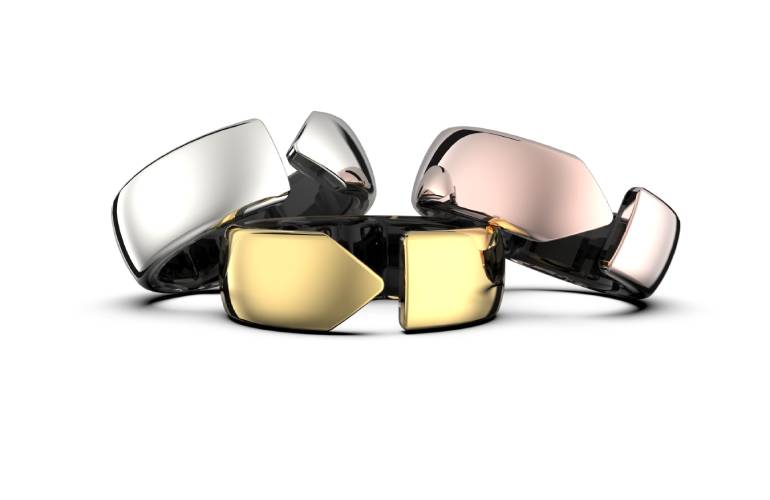
The Evie wise ring. [Image courtesy of Movano Health]

Movano Health (Nasdaq:Go) announced nowadays that it unveiled its Evie sensible ring intended exclusively for gals.

Pleasanton, California-centered Movano made Evie to offer you intelligence and comfortability in a smooth visual appearance. It gives people with health care-grade wellness data for translation into customized insights delivered by means of a cell app.

The method requires no regular membership, according to a news release.

Movano designs to request Fda clearance for Evie. It strategies to file for pulse oximetry metrics soon after finishing a hypoxia demo in Oct 2022. That demo demonstrated accuracy for scientific SpO2 and heart rate that arrived in commensurate with Fda benchmarks.

The business reported clearance would make it the to start with shopper wearable to double as a professional medical system. Wearables currently exist with Fda clearance for application that detects ECG and AFib, between other matters. Nonetheless, Movano reported Evie options a regulatory-conventional structure. It crafted the method in a production facility that fulfills ISO13485 and cGMP criteria.

What Movano states Evie can present

Evie could deliver ladies with personalised insights to support draw connections amongst induce and influence. It also presents facts for clinicians to deem trusted for affected individual treatment, Movano mentioned.

The system provides metrics for resting heart price variability, SpO2, respiration level and pores and skin temperature variability. It aids in period and ovulation monitoring, menstrual symptom tracking, action profile, rest monitoring and temper tracking. Evie delivers data by way of a mobile app to support ladies make workable lifestyle improvements and take a proactive tactic to mitigating hazards of persistent ailment.

“As a healthcare gadget, Evie will go further than the standing quo of other wearables on the industry, and we believe that it has the energy to renovate women’s lives and all round well being,” explained Dr. John Mastrototaro, CEO of Movano Health. “We are bringing together professional medical-quality biometric information and insights in a snug and up to date wearable that enables women of all ages to just take possession of their unique health and fitness journey.”

Movano designs to unveil Evie for the duration of CES 2023. It made the system with polished aluminum and programs to offer it in three distinctive finishes. The ring comes in measurements 5-11 for a at ease fit. Movano intends to demand under $300 for the wise ring with no extra month-to-month membership fees. It designs for availability in 2023.

Leah Williamson Women’s Health Cover

Leah Williamson Women’s Health Cover

If everyone can seem again on the yr that was with a pleased smile, it has to be England’s Lionesses. Their triumph at the Euros has been broadly cited as a big large level in an normally, er…testing calendar year.

A time when joy was sparked across the country – even in these not normally fond of the men’s video game – thanks to the team’s sporting results (it was in fact coming dwelling this time) but also the symbolism.

So, who superior to front Women’s Health and fitness‘s first issue of 2023 than their captain, the England skipper Leah Williamson.

It goes without having stating that Leah – who was born and elevated in Milton Keynes in a household of eager football admirers and who plays in defence for Arsenal in the Women’s Super League – is exceptionally gifted on the pitch. At just 25, she’s a formidable chief and figurehead for the women’s video game, way too.

So substantially so that she’s tipped (for every The Moments) to be named in the King’s New Yr Honours. That is together with fellow Lioness and Arsenal teammate Beth Mead (who took residence the Golden Boot at Euro 22 and was also awarded European Player of the Match) and the Lionesses head coach Sarina Wiegman.

As befits her position, Leah offers a persuasive job interview – one thing everyone who viewed her impassioned speech on the eve of the Euros remaining will know.

In the extremely different setting of a quiet café around her property, chatting in excess of coffee (me), incredibly hot chocolate (Leah – she’s not a espresso supporter) and assorted pastries, the Lionesses’ captain is just as remarkable.

The kind of human being who presents thoughtful responses devoid of overthinking. Someone who plainly values being – and this is an adjective she references often – ‘real’.

So, from levelling the actively playing discipline for female footballers to her expertise of crippling interval soreness, general performance stress and even her particular objectives away from the pitch, no subjects were being off restrictions in her interview.

You can examine the total thing in the January issue of Women’s Wellness. But, in the meantime, in this article are 6 factors I uncovered from obtaining breakfast with the smart, sensitive and steadfast Lioness-in-Chief.


1 Successful the Euros was a fairytale – and the comedown has been real

england v germany final uefa women's euro 2022

Naomi BakerGetty Images

                  ‘It scares the s**t out of me if I’m honest that every single day for the rest of my lifetime I will chase that sensation. I really don’t see how it could have been topped,’ states Leah.

                  ‘The only point I’d enjoy to do is go again and enjoy it from the stands. As the final whistle went, my grandma just put her head on my mum’s shoulder and went, “She did it.”‘

                  No, you’ve obtained some thing in your eye.

                  2 Leah has combined feelings about fame

                  ‘Well I enjoy it mainly because we can achieve so several people today. Like, girls’ mums and dads don’t have to look for us out like mine had to,’ she suggests, of the positives about her new profile.

                  But? ‘I hate the fame and that facet of it. I detest that to get from my car to you in the fastest time I want to put a cap on. But when you grow to be a experienced women’s footballer, like, that is your function, it’s a joint obligation.’

                  Rosaline Shahnavaz

                  ‘If you are not prepared to [be famous] you are undertaking a disservice to the match and all all those women that experienced to faux to be boys to be capable to engage in. I fully grasp that I stand on the shoulders of those people men and women.’

                  A group which includes Leah’s have mum, Mandy, and her footballing hero, Rachel Yankey.

                  ‘I do not want [fame] to transform me. For the previous two yrs, I’ve only actually put in time with men and women I currently knew,’ she carries on.

                  ‘I’m not fearful of creating new good friends, but I will not be held accountable the exact same way that I would with my individuals.’

                  3 Leah’s efficiency anxiety experienced her wishing absent her profession

                  The downside of actively playing for your girlhood club and the region you enjoy? For an individual as established to do as great a job as Leah, the psychological pressure threatened to overwhelm her.

                  ‘I felt like I wanted to acquire for my club and my nation, and if I felt that was less than menace, I’d be a wreck. I’d have thoughts like ‘well, when I retire, I won’t have to deal with these nerves’, which is f*cked! Like, I’m wishing absent my job due to the fact I just can’t offer with my individual overall performance anxiety.’

                  Rosaline Shahnavaz

                  Reduction came, ultimately, by way of periods with Arsenal and England psychologist Kate Environmentally friendly. Her method had Leah sensation back on form in just a fortnight – and she’s however doing the job with Eco-friendly these days. Of her working experience, Leah suggests: ‘I owe my daily life to my pysch’.

                  4 Leah was worried endometriosis would sabotage her Euros overall performance

                  Final yr, when out with a hamstring harm, Leah was diagnosed with endometriosis – something that made sense, given the agonizing periods she’s extensive experienced.

                  ‘Before the Euros I experienced a concussion, which they say can truly affect your future period, and it was poor – like, definitely bad. You know when you’re on the rest room ground and virtually like: “I just can’t move.” When it is far too late to get the tablets because I’m, like, in it now.’

                  She was specifically concerned about her endometriosis flaring up in advance of the England vs Norway semi closing.

                  ‘I was like, “it simply cannot transpire”. Like, I basically won’t be in a position to perform. [Having an endometriosis flare up] is a huge dread when you get to a tournament not injured…I really don’t change too much all around [my cycle] now. Unless of course I’m on the flooring. And then I’m like: “I won’t make it nowadays”,’ Leah describes.

                  ‘I’m a skilled athlete, I’ve often been like, “let us get on with it”,’ she states of how she’s dealt with the tough durations that characterise the issue.

                  ‘But you get to a particular age when you in fact say: “this is a definitely massive f*cking problem”. I’m pretty positive if males experienced periods we would have figured out a way to halt them by now with out executing any damage.’

                  Preach, captain.

                  5 Leah’s disappointed by how the women’s recreation has been held again…

                  …but happy of the way her club has taken practical measures in direction of enhanced parity concerning the men’s and women’s groups.

                  Of the way the men’s activity was traditionally prioritised about the women’s Leah says: ‘It wasn’t how Arsenal had been it was how football experienced been. The gentlemen are in this article and the females are right here.’

                  ‘And it’s like, no shit, for the reason that [the FA] stopped us enjoying [ON FOOTBALL LEAGUE GROUNDS] so we have been 50 yrs at the rear of,’ she provides.

                  ‘There’s no f*cking surprise that you have 60,000 men and women at games and we have a few…I imagine that filters into the club. It’s been like, “the boys are in the health club so you can’t go in”,’ she reveals.

                  But now? ‘Two many years on we’re moving to a new facility points have all adjusted.’

                  6 Leah has designed self have confidence in – on and off the pitch

                  The Lionesses captain is a lady with lots of strings to her proverbial bow – she even has ongoing accountancy scientific tests on the again-burner. Fittingly, she’s fairly non-prescriptive about her very long-time period objectives.

                  Rosaline Shahnavaz

                  ‘[Football] is not my every thing. To keep on to do this for an additional 10 years is really a overwhelming believed. If you requested me what I want to be in five yrs, I’d just say happy’

                  ‘I had my system from when I was a child: I was likely to get married at 24 I’d have a baby [at] 26. I seriously held on to that things,’ she recollects.

                  But now? ‘I’ve taken all that off [the timeline]. Since if it takes place, it occurs. I have learnt to genuinely have confidence in my inner thoughts and myself now.’

                  Particularly as she need to.

          Healthcare Access and Equity: Women’s Health and Technology Hold the Keys

          Healthcare Access and Equity: Women’s Health and Technology Hold the Keys

          Although the quality of U.S. healthcare and individual results has typically greater above time, obtain to treatment — and hence to favourable affected person outcomes — is not equitable to all persons. Over-all, one particular in 10 Individuals do not have health insurance coverage, which is fallout of a process breaking less than the excess weight of higher expenditures and deepening complexity.

          Diabetes prices are a lot more than 30{35112b74ca1a6bc4decb6697edde3f9edcc1b44915f2ccb9995df8df6b4364bc} increased among Indigenous People in america and Latinos than among the Whites. Charges of loss of life attributable to coronary heart illness, stroke, and prostate and breast cancers keep on being a lot larger in black populations.

          If you dwell in a rural spot and have a chronic disorder (or various ailments) supplier possibilities are extra restricted than in densely populated spots. That suggests availability of a expert or even the capability to get an appointment can be a problem.

          There are a lot of other variables that effects health care obtain and equity: socioeconomics, engineering, gender, language obstacles and extra. These things are even more complex by an individual’s precise care demands.

          Just set, men and women with out adequate health care coverage protection or proximity to good quality treatment really do not have the similar prospects to access treatment and their all round wellness may be adversely affected.

          Building points even worse, the U.S. healthcare method carries on to be extremely complicated to navigate and is fraught with administrative load. When it is a lot easier and a lot quicker to accessibility most primary human demands than it is to check out a care company, transform is necessary. In the search for significant solutions to these inequities, women’s overall health and technological financial investment are obvious sites to begin.

          The scenario for greater entry

          Nevertheless the U.S. health care program does have its faults, we are a global chief in investigation, teaching, treatment criteria, and scientific results. According to the World Index of Health care Innovation, the U.S. healthcare method ranked sixth for innovation in 2021 but third to very last in fiscal balance. Which is what will make obtain and fairness concerns disheartening. As treatment vendors, collectively we know we can be performing more for a lot more patients if our programs produced delivery and obtain to treatment less complicated.

          In an excellent earth, sufficient entry to healthcare would imply that all people is capable to get the treatment they need to have in a timely method and in a way that supports their most effective particular final result. That contains viewing a company quickly and at a sensible price tag. Greater access to preventive treatment would have an exponential benefit for people and for the healthcare method as a total. Skipped prevention opportunities alone value the U.S. $55 billion every single yr. When thinking about actual physical therapy as a frontline musculoskeletal intervention, analysis displays up to 26{35112b74ca1a6bc4decb6697edde3f9edcc1b44915f2ccb9995df8df6b4364bc} expense personal savings at over $1500/patient.

          Accessibility challenges are not minimal to checking out a medical professional. Frontline and preventative wellness expert services this kind of as physical remedy are also compromised. As Medicare reimbursement premiums for ancillary companies these as PT proceed to decrease, providers and individuals are caught in the conflict. Our objective is to assist persons sustain and get back again to their very best actual physical wellbeing though jogging a  national practice that relies on margin growth to battle macro traits and devote for the future.

          Access follows reimbursement and the services lined by insurance policy corporations. If providers are not able to produce services in business enterprise restrictions, contraction of expert services may perhaps consequence. Enterprise versions reliant on economies of scale may possibly be compelled to withdraw from a lot more rural and distant regions where by demand from customers for services is limited. That signifies even significantly less entry for people today in rural communities, and the cycle proceeds.

          Alternatively, if decreased reimbursement is passed together to people in the form of larger rates or out-of-pocket price tag, less folks will find or be equipped to afford care, further more restricting entry for the uninsured and the underinsured. When faced with spending constrained house pounds on food and housing vs. non-urgent medical care, the treatment will get rid of out each time — resulting in a less healthy populace.

          Make women’s wellbeing a precedence

          Women comprise fifty percent the world’s inhabitants but account for 80{35112b74ca1a6bc4decb6697edde3f9edcc1b44915f2ccb9995df8df6b4364bc} of buying decisions in the healthcare industry. And nonetheless, women’s health and fitness is regarded a area of interest market place and a subset of health care. Endorsing women’s wellbeing is the single most impactful alter we could make as girls engage in a disproportionate job in how and when others access care.

          When I was at Brigham and Women’s Clinic, I observed firsthand that improving upon the well being of all ladies could boost the health of an overall group or inhabitants. As advisors to a lot of on where and when to acquire treatment, we hardly ever admit the strong influence and affect girls have on the common wellbeing of their family members and acquaintances. Sad to say, quite a few gals generally put the care of other folks ahead of their individual.

          In our roles as mothers, daughters, companions and far more, we normally care for other individuals and have to have to do the exact for ourselves. In simple fact, 76{35112b74ca1a6bc4decb6697edde3f9edcc1b44915f2ccb9995df8df6b4364bc} of American gals invest up to 10 hours everyday caring for associates, spouses and/or kids, and one in 5 (19{35112b74ca1a6bc4decb6697edde3f9edcc1b44915f2ccb9995df8df6b4364bc}) women expend far more than 10 hrs a working day caring for other individuals. If ladies are the influential guideline for quite a few to access health care, we have to get the job done tougher to advertise the health and fitness of all women. Our potential to enjoy the purpose of care facilitator for other people is dependent on it.

          Plenty more we can do

          Outside of women’s health and fitness, we ought to discover workable solutions to other systemic inequities in the healthcare technique. We must reverse the unfavorable development that declining reimbursement premiums are possessing on preventative care and overall access to providers this sort of as physical remedy.

          Technological know-how is one more unlock to superior health care obtain. These innovations span breakthroughs to how, when and wherever care is sent. The Covid-19 pandemic showed us the ability and prospective of digital care delivery to strengthen accessibility, through telehealth movie or telephonically. As we consider about geographic limits that put a premium on availability of high quality care, telehealth can engage in an outsized role in serving these populations.

          In addition, telehealth can increase affected person results by means of advanced checking, cognitive affordances, clinical selection-assistance capabilities, and execution of lifestyle-saving and evidence-based vital treatment protocols, just to name a couple improvements. The to start with stage in continuing the enhancement and progression of telehealth is for the private and governing administration payers to permanently address these companies and to set reimbursement prices at parity with in-particular person payment schedules.

          We can do extra to take out charge and complexity inside the healthcare process, well balanced with enhancing accessibility to treatment for those who wrestle to get the treatment they need to have. As suppliers, we need to go on to establish and eliminate boundaries to treatment each time doable.

          We owe it to our clients.

          2022 Women’s Health Survey | KFF

          2022 Women’s Health Survey | KFF

          The 2022 KFF Women’s Health and fitness Study (WHS) is the newest in a sequence of nationally consultant surveys on women’s health and fitness executed by KFF periodically given that 2001. The survey’s aim is to better understand women’s activities with contraception, obtain to wellbeing care, and other problems associated to well being and well-being.

          The 2022 study consists of 6,442 people ages 18 to 64, such as 5,201 ladies (self-documented sexual intercourse at delivery) and 1,241 males, and was carried out from May well 10, 2022, to June 7, 2022. See the methodology for far more details.

          The briefs and experiences introduced listed here explore women’s encounters, tastes, and coverage for contraception, tastes for an over-the-counter contraceptive tablet, workplace rewards and family members treatment obligations, accessibility and affordability of treatment, and more.


          Obtain and Protection for Mental Wellness Care: Conclusions from the 2022 KFF Women’s Well being Survey

          Study the state of accessibility and coverage of psychological health and fitness products and services applying facts from the 2022 KFF Women’s Well being Study.

          Experiences with Wellness Treatment Access, Cost, and Coverage: Conclusions from the 2022 KFF Women’s Health Survey

          Get a glance at results on women’s health and fitness status, use of wellness care expert services, and expenses drawn from the 2022 Women’s Overall health Survey.

          Website Function: What is the foreseeable future of contraceptive care in a put up-Roe entire world?

          This net function examined how the pandemic, the overturning of Roe v. Wade, and new developments in health and fitness care shipping, this sort of as telemedicine, have reshaped access to contraceptive care, as perfectly as the implications of the survey conclusions for the 2023 national and point out coverage agenda for women’s well being.

          Contraception in the United States: A Nearer Seem at Ordeals, Choices, and Coverage

          Look at reproductive age (18-49) females’ (which includes individuals who discover as ladies and other genders) experiences with contraception, coverage protection, contraceptive choices, and interactions with the health treatment process from the 2022 KFF Women’s Wellbeing Survey. 

          Desire in Working with More than-the-Counter Oral Contraceptive Capsules: Findings from the 2022 KFF Women’s Overall health Study

          Explore data from the 2022 KFF Women’s Wellness Study about reproductive age (18-49) females’ preferences for an around-the-counter contraceptive pill.

          Place of work Positive aspects and Relatives Wellness Treatment Obligations: Crucial Results from the 2022 KFF Women’s Overall health Survey

          Study about how place of work advantages and caring for children’s health care differ by gender and among distinctive subpopulations of females in an examination of data from the 2022 Women’s Overall health Study.

          Access and Coverage for Mental Health Care: Findings from the 2022 KFF Women’s Health Survey

          Access and Coverage for Mental Health Care: Findings from the 2022 KFF Women’s Health Survey

          Vital Takeaways

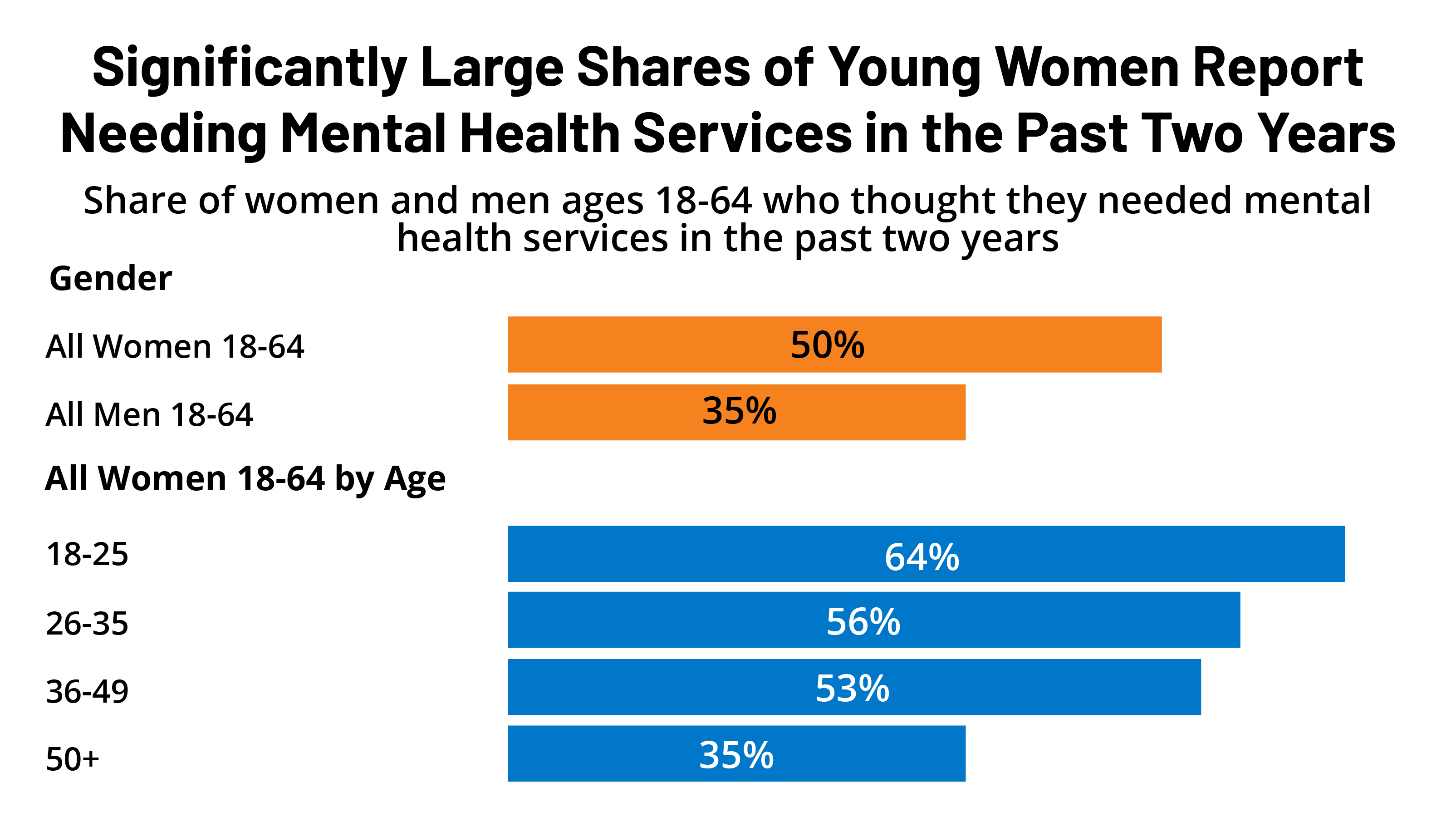
          • A noticeably bigger share of women (50{35112b74ca1a6bc4decb6697edde3f9edcc1b44915f2ccb9995df8df6b4364bc}) than guys (35{35112b74ca1a6bc4decb6697edde3f9edcc1b44915f2ccb9995df8df6b4364bc}) thought they required psychological wellness providers in the past two decades. Amid those who considered they essential mental wellbeing care, about six in ten women of all ages and guys sought treatment in the previous two yrs.
          • Just about two-thirds of youthful gals ages 18-25 report needing mental wellbeing care in the earlier two decades in comparison to one-3rd of women of all ages ages 50-64.
          • Among the all ladies ages 18-64 who believed they desired mental wellness services in the past two a long time, just half attempted and had been ready to get an appointment for psychological wellbeing treatment, 10{35112b74ca1a6bc4decb6697edde3f9edcc1b44915f2ccb9995df8df6b4364bc} tried out but were being not able to get an appointment, and 40{35112b74ca1a6bc4decb6697edde3f9edcc1b44915f2ccb9995df8df6b4364bc} did not request treatment.
          • Nearly 50 percent of girls who wanted mental overall health products and services and tried using to get care were being ready to get an appointment inside of a thirty day period, but more than just one-third of females experienced to wait around much more than a thirty day period. Among individuals who could not get an appointment, ladies cite limited supplier availability and cost as the key explanations they have been unable to obtain mental well being care.
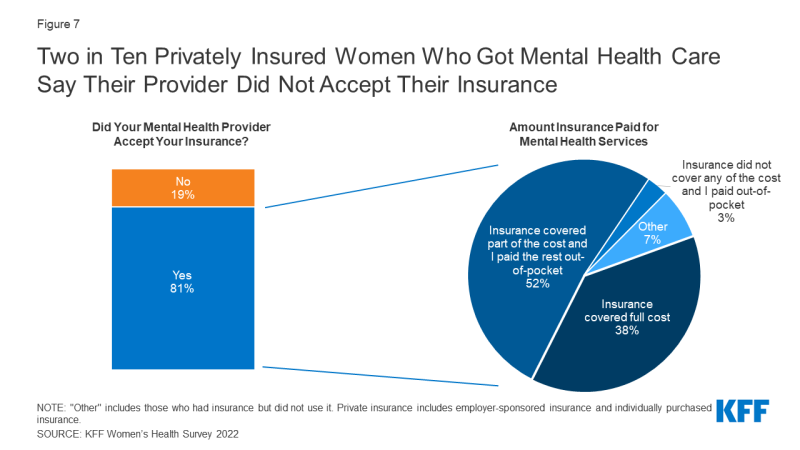
          • Two in 10 privately insured females with a mental overall health appointment in the earlier two many years say their service provider did not acknowledge their insurance.
          • Sixty percent of gals had a telemedicine/telehealth go to in the past two a long time. Psychological well being care was the third most typical purpose girls cited for accessing telehealth/telemedicine providers, with 17{35112b74ca1a6bc4decb6697edde3f9edcc1b44915f2ccb9995df8df6b4364bc} declaring it was the key intent of their most current telemedicine pay a visit to. The vast majority report that the excellent of their telehealth stop by was the exact same as an in-human being check out.

          Introduction

          Psychological overall health has emerged as a swiftly developing concern in recent years, with 90{35112b74ca1a6bc4decb6697edde3f9edcc1b44915f2ccb9995df8df6b4364bc} of Americans indicating there is a mental well being disaster in a modern KFF-CNN poll. Girls knowledge various psychological health circumstances a lot more usually than adult men, and some also expertise psychological well being problems that are special to girls, these as perinatal despair and premenstrual dysphoric ailments that may well come about when hormone degrees alter. Info from the National Middle for Health and fitness Stats present that across all age groups, ladies were almost 2 times as possible to have despair and stress than adult males. The COVID-19 pandemic, the opioid epidemic, and racism are amongst frequently cited stressors that have exacerbated extensive-standing psychological health challenges and prompted developing demand from customers for psychological health and fitness providers in the previous two a long time, specifically among females.

          This temporary delivers new facts from the 2022 KFF Women’s Health Study (WHS), a nationally representative survey of 5,145 women and 1,225 gentlemen ages 18-64 conducted mostly on line from May well 10, 2022, to June 7, 2022. In addition to several subject areas similar to reproductive health and perfectly-becoming, the survey questioned respondents about their experiences accessing mental well being providers in the previous two many years. This concern temporary offers KFF WHS data on mental wellbeing providers obtain between self-discovered women and guys ages 18-64, and it also normally takes a closer seem at mental overall health protection among the gals. People today of all genders, which include non-binary people today, had been requested these thoughts on the other hand, there are insufficient data to report on non-cisgendered men and women. See the Methodology section for aspects.

          Utilization of Mental Wellness Products and services

          Gender Distinctions

          Fifty percent of gals ages 18-64 (50{35112b74ca1a6bc4decb6697edde3f9edcc1b44915f2ccb9995df8df6b4364bc}) assumed they needed psychological overall health services in the past two decades (Determine 1) and a considerably lesser share of males report they essential mental wellbeing care (35{35112b74ca1a6bc4decb6697edde3f9edcc1b44915f2ccb9995df8df6b4364bc}).  Research have prolonged documented gender disparities in the premiums and forms of psychological wellness ailments. Amid those who imagined they essential care, nonetheless, identical fees of females and gentlemen report trying to get care. Sixty p.c of gals tried to make an appointment for psychological well being compared to 56{35112b74ca1a6bc4decb6697edde3f9edcc1b44915f2ccb9995df8df6b4364bc} of adult men.

          Will need and Care Trying to get

          Approximately two thirds (64{35112b74ca1a6bc4decb6697edde3f9edcc1b44915f2ccb9995df8df6b4364bc}) of gals ages 18-25 believed they needed psychological health and fitness products and services at some issue in the previous two many years in comparison to just 35{35112b74ca1a6bc4decb6697edde3f9edcc1b44915f2ccb9995df8df6b4364bc} of girls ages 50-64 (Determine 2). Previous results from the 2020 KFF WHS revealed that far more than half of females (51{35112b74ca1a6bc4decb6697edde3f9edcc1b44915f2ccb9995df8df6b4364bc}) mentioned that worry or pressure linked to the coronavirus had affected their psychological health. Other studies clearly show that younger grownups, especially gals, knowledgeable large incidence of depression and loneliness in the course of the early levels of the pandemic.

          Extra than half of gals with low incomes (< 200{35112b74ca1a6bc4decb6697edde3f9edcc1b44915f2ccb9995df8df6b4364bc} of the federal poverty level (FPL)) (55{35112b74ca1a6bc4decb6697edde3f9edcc1b44915f2ccb9995df8df6b4364bc}) and women with Medicaid coverage (58{35112b74ca1a6bc4decb6697edde3f9edcc1b44915f2ccb9995df8df6b4364bc}) thought they needed mental health care in the past two years compared to less than half (47{35112b74ca1a6bc4decb6697edde3f9edcc1b44915f2ccb9995df8df6b4364bc}) of women with higher incomes (≥ 200{35112b74ca1a6bc4decb6697edde3f9edcc1b44915f2ccb9995df8df6b4364bc} FPL) and those with private insurance (includes employer-sponsored insurance and individually purchased insurance) (47{35112b74ca1a6bc4decb6697edde3f9edcc1b44915f2ccb9995df8df6b4364bc}). The FPL in 2022 for an individual is $13,590 (Figure 2).

          Among those who thought they needed mental health care, larger shares of women ages 26-35 (63{35112b74ca1a6bc4decb6697edde3f9edcc1b44915f2ccb9995df8df6b4364bc}) and women ages 36-49 (64{35112b74ca1a6bc4decb6697edde3f9edcc1b44915f2ccb9995df8df6b4364bc}) sought care compared to 55{35112b74ca1a6bc4decb6697edde3f9edcc1b44915f2ccb9995df8df6b4364bc} of women ages 50-64. Larger shares of women enrolled in Medicaid (67{35112b74ca1a6bc4decb6697edde3f9edcc1b44915f2ccb9995df8df6b4364bc}) sought mental health services compared to women who have private insurance (58{35112b74ca1a6bc4decb6697edde3f9edcc1b44915f2ccb9995df8df6b4364bc}) and women who are uninsured (50{35112b74ca1a6bc4decb6697edde3f9edcc1b44915f2ccb9995df8df6b4364bc}) (Figure 3).

          A significantly lower share of Asian/Pacific Islander women (40{35112b74ca1a6bc4decb6697edde3f9edcc1b44915f2ccb9995df8df6b4364bc}) say they needed mental health services at some point in the past two years than their White counterparts (50{35112b74ca1a6bc4decb6697edde3f9edcc1b44915f2ccb9995df8df6b4364bc}). Although not statistically significant, smaller shares of Asian/Pacific Islander women report seeking care compared to White women (50{35112b74ca1a6bc4decb6697edde3f9edcc1b44915f2ccb9995df8df6b4364bc} vs. 62{35112b74ca1a6bc4decb6697edde3f9edcc1b44915f2ccb9995df8df6b4364bc}). While the pandemic fueled violence against Asians and subsequently worsened anxiety and mental health for many, studies have shown that Asians reported greater cultural barriers to help-seeking such as family stigma and concerns about “losing face.” Cultural barriers may influence perceived need of care in addition to help-seeking behaviors.

          Although the self-reported need for mental health care did not differ between Hispanic and White women (both 50{35112b74ca1a6bc4decb6697edde3f9edcc1b44915f2ccb9995df8df6b4364bc}), smaller shares of Hispanic women (56{35112b74ca1a6bc4decb6697edde3f9edcc1b44915f2ccb9995df8df6b4364bc}) sought care compared to White women (62{35112b74ca1a6bc4decb6697edde3f9edcc1b44915f2ccb9995df8df6b4364bc}). Despite high rates of depression among Hispanic women, studies have shown that stigma and perceived discrimination in health care settings can contribute to underutilization of mental health services within Hispanic communities. Hispanic women also have the highest uninsured rate, which may limit their access to care.

          Among the 50{35112b74ca1a6bc4decb6697edde3f9edcc1b44915f2ccb9995df8df6b4364bc} of women who thought they needed mental health services, half (50{35112b74ca1a6bc4decb6697edde3f9edcc1b44915f2ccb9995df8df6b4364bc}) were able to get an appointment, while another 40{35112b74ca1a6bc4decb6697edde3f9edcc1b44915f2ccb9995df8df6b4364bc} did not try to get mental health services (Figure 4). One in ten (10{35112b74ca1a6bc4decb6697edde3f9edcc1b44915f2ccb9995df8df6b4364bc}) who tried to get care were unable to make an appointment for mental health services. This suggests that the other half of women who report needing care may have unmet mental health needs.

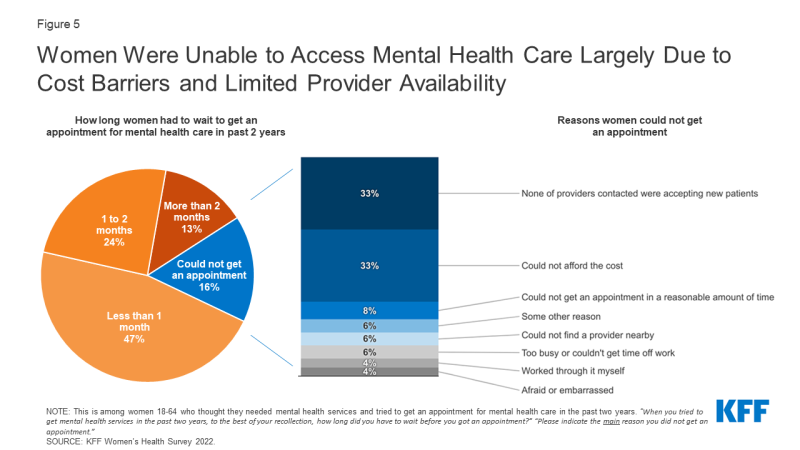
          Among all women who thought they needed mental health care and tried to get it in the past two years, nearly half (47{35112b74ca1a6bc4decb6697edde3f9edcc1b44915f2ccb9995df8df6b4364bc}) had to wait less than a month for an appointment (Figure 5). One-quarter (24{35112b74ca1a6bc4decb6697edde3f9edcc1b44915f2ccb9995df8df6b4364bc}) had to wait one to two months, and 13{35112b74ca1a6bc4decb6697edde3f9edcc1b44915f2ccb9995df8df6b4364bc} had to wait more than two months to get care. The remaining 16{35112b74ca1a6bc4decb6697edde3f9edcc1b44915f2ccb9995df8df6b4364bc} of those who sought mental health care could not get an appointment.

          Among the 16{35112b74ca1a6bc4decb6697edde3f9edcc1b44915f2ccb9995df8df6b4364bc} of women who needed care, sought care, and were unable to get an appointment for mental health services, the main reasons were limited provider availability and cost barriers. One-third of women who could not get an appointment say the main reasons were that they could not find a provider that was accepting new patients (33{35112b74ca1a6bc4decb6697edde3f9edcc1b44915f2ccb9995df8df6b4364bc}) or that they could not afford the cost of mental health services (33{35112b74ca1a6bc4decb6697edde3f9edcc1b44915f2ccb9995df8df6b4364bc}). Eight percent could not get an appointment in a reasonable amount of time and six percent say they could not find a provider nearby. Another 6{35112b74ca1a6bc4decb6697edde3f9edcc1b44915f2ccb9995df8df6b4364bc} say they could not get an appointment for another reason, such as not wanting to go in-person due to COVID-19.

          Our findings on provider availability are consistent with other studies on mental health access. A report from the U.S. Government Accountability Office found that many consumers with health insurance faced challenges finding in-network care. The country also faces a workforce shortage of behavioral health professionals in addition to other challenges with health care infrastructure that exacerbates issues with accessibility.

          Figure 5: Women Were Unable to Access Mental Health Care Largely Due to Cost Barriers and Limited Provider Availability

          Cost and Coverage for Mental Health Services

          Among those who sought care but could not get an appointment, one-third (33{35112b74ca1a6bc4decb6697edde3f9edcc1b44915f2ccb9995df8df6b4364bc}) say the main reason was that they could not afford it (Figure 5). Cost remains a barrier to mental health care access for some people with insurance and especially for those who lack coverage. Significantly larger shares of women who are uninsured (60{35112b74ca1a6bc4decb6697edde3f9edcc1b44915f2ccb9995df8df6b4364bc}) say they could not get an appointment due to affordability reasons, compared to those who have health insurance either through private plans (33{35112b74ca1a6bc4decb6697edde3f9edcc1b44915f2ccb9995df8df6b4364bc}) or Medicaid (30{35112b74ca1a6bc4decb6697edde3f9edcc1b44915f2ccb9995df8df6b4364bc}) (Figure 6). There were no significant differences between women who have private insurance and women covered by Medicaid.

          These findings on cost barriers are consistent with current literature, which has found that along with provider availability, affordability is one of the most prevalent barriers to mental health care.

          While federal laws require special insurance protections such as parity for mental health care, gaps in coverage remain. All state Medicaid programs provide coverage for mental health services, and the Affordable Care Act (ACA) requires most private insurers to cover mental health care. However, the scope of coverage varies, provider networks are limited in many plans, and mental health providers may not accept all insurance plans. Some mental health practitioners do not accept insurance of any kind.

          While most privately insured women who received mental health services in the past two years say their provider accepted their insurance for their most recent mental health visit (81{35112b74ca1a6bc4decb6697edde3f9edcc1b44915f2ccb9995df8df6b4364bc}), two in ten (19{35112b74ca1a6bc4decb6697edde3f9edcc1b44915f2ccb9995df8df6b4364bc}) say their provider did not. Among privately insured women who said their provider accepted their insurance, more than half report having out-of-pocket expenses for their most recent mental health visit. More than one-third (36{35112b74ca1a6bc4decb6697edde3f9edcc1b44915f2ccb9995df8df6b4364bc}) say their insurance covered the full cost and 52{35112b74ca1a6bc4decb6697edde3f9edcc1b44915f2ccb9995df8df6b4364bc} say their insurance covered some of the cost. Three percent say their insurance did not cover any of the cost. (Figure 7).

          Figure 7: Two in Ten Privately Insured Women Who Got Mental Health Care Say Their Provider Did Not Accept Their Insurance

          The Affordable Care Act requires that enrollees in most private health insurance plans have the right to appeal denied claims, though some evidence suggests that many are unfamiliar with appeals processes or are unaware of this protection. Among privately insured women whose insurance was not accepted by their mental health provider, 27{35112b74ca1a6bc4decb6697edde3f9edcc1b44915f2ccb9995df8df6b4364bc} filed a claim with the health insurance plan to try to get reimbursed for some or all the cost (data not shown).

          Telehealth

          Social distancing during the pandemic contributed to a sharp increase in the provision of telehealth services, widening the access of counseling, therapy, prescribing, and other services via remote methods such as video and telephone. The rapid expansion of telemedicine/telehealth over the course of the COVID-19 pandemic has broadened access to health care for many, including access to mental health services. Mental health services provided via telehealth include speaking to a mental health provider over telephone or video, or through online apps such as Talkspace.

          Sixty percent of women ages 18-64 had a telemedicine/telehealth visit in the past two years. Among these women, 17{35112b74ca1a6bc4decb6697edde3f9edcc1b44915f2ccb9995df8df6b4364bc} say the primary purpose of their most recent visit was for mental health services (Figure 8). Accessing mental health care services was the third most common reason for telehealth visits, following annual check-ups (18{35112b74ca1a6bc4decb6697edde3f9edcc1b44915f2ccb9995df8df6b4364bc}) and visits for minor illness or injury (18{35112b74ca1a6bc4decb6697edde3f9edcc1b44915f2ccb9995df8df6b4364bc}). Three in ten women ages 18-25 (29{35112b74ca1a6bc4decb6697edde3f9edcc1b44915f2ccb9995df8df6b4364bc}) say their most recent telehealth visit was for mental health services compared to 20{35112b74ca1a6bc4decb6697edde3f9edcc1b44915f2ccb9995df8df6b4364bc} of women ages 26 to 35, 18{35112b74ca1a6bc4decb6697edde3f9edcc1b44915f2ccb9995df8df6b4364bc} of women ages 36 to 49, and 10{35112b74ca1a6bc4decb6697edde3f9edcc1b44915f2ccb9995df8df6b4364bc} of women ages 50 to 64 and older. A larger share of White women (21{35112b74ca1a6bc4decb6697edde3f9edcc1b44915f2ccb9995df8df6b4364bc}) obtained mental health services at their most recent telehealth visit than Black women (13{35112b74ca1a6bc4decb6697edde3f9edcc1b44915f2ccb9995df8df6b4364bc}), Hispanic women (14{35112b74ca1a6bc4decb6697edde3f9edcc1b44915f2ccb9995df8df6b4364bc}), and Asian/Pacific Islander women (7{35112b74ca1a6bc4decb6697edde3f9edcc1b44915f2ccb9995df8df6b4364bc}).

          A larger share of women with Medicaid coverage (22{35112b74ca1a6bc4decb6697edde3f9edcc1b44915f2ccb9995df8df6b4364bc}) report that their most recent telemedicine or telehealth visit was for mental health services than women who are privately insured (15{35112b74ca1a6bc4decb6697edde3f9edcc1b44915f2ccb9995df8df6b4364bc}).

          A similar share of women living in rural (23{35112b74ca1a6bc4decb6697edde3f9edcc1b44915f2ccb9995df8df6b4364bc}) and urban/suburban (17{35112b74ca1a6bc4decb6697edde3f9edcc1b44915f2ccb9995df8df6b4364bc}) areas report that the primary purpose of their most recent telehealth or telemedicine visit was for mental health services.

          The majority (69{35112b74ca1a6bc4decb6697edde3f9edcc1b44915f2ccb9995df8df6b4364bc}) of women who had a telehealth or telemedicine visit in the past two years for mental health care say the quality of care they received at their most recent visit was the same as an in-person visit for this type of care (Figure 9). One-in-five (19{35112b74ca1a6bc4decb6697edde3f9edcc1b44915f2ccb9995df8df6b4364bc}) report receiving better quality of care during their telehealth visit, while 12{35112b74ca1a6bc4decb6697edde3f9edcc1b44915f2ccb9995df8df6b4364bc} report experiencing worse quality than an in-person visit. These findings suggest the quality of mental health care is typically not diminished when accessing care via telehealth.

          Conclusion

          The demand for mental health care continues to surge as wait lists for professional help grow. Recent reports reveal that mental health providers across the nation are facing an overwhelming demand for services, leaving many individuals without care. Our survey finds that among the half of women who report that they thought they needed mental health services in the past two years, only half got an appointment for care. Unmet mental health needs are known to affect the overall well-being and productivity of individuals, families, and society, and studies have consistently shown that women are disproportionately affected by these unmet needs. Data from the 2022 KFF WHS underscore that addressing issues with provider availability and cost could improve access to mental health care for some. Our findings suggest that affordability barriers are a substantial obstacle for uninsured women.

          In response to the COVID-19 pandemic and other changes in the health policy environment, larger shares of employers began expanding coverage of mental health services by including more providers for in-person and telehealth care. Telehealth and telemedicine services have been recognized as an evolving strategy to increase access to care and address health needs, including care for mental health. We found that most women who received mental health services via telehealth say the quality of care they received was the same as in-person care. Telehealth has and likely will continue to play a role in addressing mental health access concerns for women.

          Despite federal and state laws intended to expand and strengthen coverage for mental health care, gaps in coverage and problems with affordability continue to hinder access to mental health services even for those with private insurance and Medicaid. Our survey finds that in addition to challenges obtaining services, many women who have insurance faced at least some out-of-pocket costs for their visit. The findings from the 2022 KFF WHS suggest that future policies affecting telehealth, provider availability, health insurance coverage, and affordability will play a significant role in addressing the demand for mental health care.