Fentanyl addiction, homelessness haunt this New Mexico town

Fentanyl addiction, homelessness haunt this New Mexico town

The caretaker at the hillside cemetery braced against the cold and walked among the graves. Crosses cast shadows on bunched flowers. A strand of tinsel gleamed from a bare tree. He looked over the rows and shut the gate, his face red, his hands small and coarse.

“I’ve got to come back and pick up the garbage,” the caretaker said. “People leave it.”

He glanced at a visitor, anticipating the question.

“We had a few kids who overdosed,” he said, nodding toward the graves. “But none for a little while.”

He got into his truck and headed west into Española where a familiar scene unfolded.

A man under a blanket lights a pipe.

A man smokes fentanyl in Española, N.M., on March 8.

(Francine Orr / Los Angeles Times)

Shoppers and workers drove past addicts roaming Riverside Drive, the main drag in this town of 10,500. Kids played in trailer parks. Contractors loaded pickups. Cars came and went from a methadone clinic. Men wearing hoodies and expectant gazes drifted toward a house with barred windows. They rustled pockets for cash. Others headed toward the marshes on the city’s fringes, where, as the morning frost lifted, Cristian Madrid-Estrada, a bearded man of 23, sat with a gun holstered on his hip at the Española Pathways Shelter.

“You can’t believe it sometimes,” said Madrid-Estrada, the homeless shelter’s chief executive officer. “I was here last night when my fiancee called and told me someone was trying to break into our house. He was at the windows.”

Madrid-Estrada spends much of his time at the shelter, giving addicts beds and warmth on frigid nights. But like others in this city, he contends with burglaries, robberies and thefts carried out by fentanyl addicts desperate to fuel their next high. The state police and the county sheriff have been called in to help Española’s understaffed Police Department, which reported 224 burglary calls last year, up from from 155 in 2020.

Rallying voices are trying to fix this community under siege. But it’s unclear if the story of Española, where a quarter of the population is poor and the murals of the dead are painted on junction boxes, will be a narrative about how to save a town from addiction — or lose it. In a one-year period ending in June 2022, Rio Arriba County reported 50 fatal overdoses, giving it the highest rate in New Mexico. It was about four times the national rate of approximately 33 per 100,000.

Española is a troubling American tale. Its despair and suffering echo through cities large and small, from the pitched tents and open drug use in Los Angeles to the hamlets and hollows reeling from the opioid epidemic across Appalachia. The crisis is born from a decades-long misguided war on drugs, greed in the pharmaceutical industry, an ill-equipped prison system, failed treatment programs and a nation seemingly inured to the startling toll of addiction.

A man stands amid debris at a homeless camp

Española Pathways Shelter Chief Executive Officer Cristian Madrid-Estrada, 23, walks through a homeless encampment near his facility.

(Francine Orr / Los Angeles Times)

Espanola is located between Santa Fe and Taos, New Mexico on March 9, 2023,

Española sits between Santa Fe and Taos, amid tribal lands straddling the Rio Grande.

(Francine Orr / Los Angeles Times)

Sitting amid tribal lands straddling the Rio Grande, Española appears stranded between better known Santa Fe and Taos. More than a century ago, long before cartels trafficking fentanyl with nicknames like China White and Dance Fever crisscrossed New Mexico on Interstate 40 and Interstate 25, ranchers and farmers here loaded their wares on trains bound north and south in what was known as the Chili Line. That route ended decades ago; other small businesses and industries disappeared as well.

Drug addiction seeped into the Española Valley after the Vietnam War as heroin, cocaine and other drugs flowed in from Mexico. Heroin settled in hard for years, tearing through families, ravaging livelihoods and scattering lean-tos and broken men beneath bridges. But over the last two years, the market has been taken over by fentanyl, which is cut with other substances and at times is so potent that it can take at least two doses of Narcan to revive an overdose victim.

“I’ve had knives pointed at me. Pipes swung at me,” said Madrid-Estrada. “It’s insane how much has changed in the last year. It’s scary. We have generational drug use. Generational trauma. Half the kids I went to school with didn’t have parents. They were dead or in jail or gone.” But fentanyl, he added, “is a completely different animal. A whole new epidemic no one was prepared for.”

The town — which has drawn addicts and the homeless from other states — has too few detox and drug treatment centers. Grandparents are raising grandchildren, and a “baby box” has been built at the fire station to take in unwanted infants. Shoplifters haunt the aisles at Lowe’s and Walmart. Syringes for heroin that once littered sidewalks and riverbanks have often been replaced by glints of tin foil used for smoking fentanyl.

A person sits on the median of the roadway next to a suitcase

A person sits on a roadway median in Española with a sign asking for help.

(Francine Orr / Los Angeles Times)

“We don’t even really see heroin overdoses in New Mexico anymore,” said Miranda Lopez, the state’s public health analyst for the national Overdose Response Strategy. “Fentanyl has changed things in ways that are unimaginable. It’s evolving with so many novel substances coming into play. You’re constantly having to reevaluate.”

Chris Dewitt, a resident at Española Pathways Village, a converted motel the shelter has turned into transitional housing for recovering addicts, spoke of the disarray that had gripped him for years and led from heroin to meth to fentanyl: “I tried fentanyl. It made me sick. It hit different. Much stronger. I tried it again. I wanted to embrace the darkness,” he said.

“I was the monster. It took me a while to see myself as worth saving.”

Much of the addiction stems from family problems, including domestic violence and abuse, said Nicko Zamora, who used drugs for more than 40 years and now works to help addicts recover. “A lot of us got sick on our secrets,” he said. “Drugs were the Band-Aid. It goes with our heritage in a weird, crazy way. We’ve seen it happen to Great-Grandpa, Grandpa, Dad and all the uncles. Drug use became normal.”

Madrid-Estrada and Pathways co-founders Ralph Martinez and former state Rep. Roger Montoya are working to change things. Martinez and Montoya helped get a $1.8-million grant for the property that houses the shelter, a Goodwill, a wellness center and a food pantry. John Ramon Vigil, at 27 the youngest mayor in New Mexico, is proposing the state open a regional drug treatment center. And Jeramay Martinez, who sued OxyContin manufacturer Purdue Pharma, is raising the 4-year-old son of a fentanyl addict and plans to start an agency to help addicted mothers and children exposed to drugs in the womb.

 A man sits in an overturned shopping cart in a dry marsh amid little

Dylan Lujan, 34, rests in a dry marsh next to Española Pathways Shelter.

(Francine Orr / Los Angeles Times)

Madrid-Estrada often wonders, though, about the town’s fate. He estimates there are between 250 and 350 homeless people in the Española Valley, some wandering past scrap yards and cannabis shops, not far from the ancient cave dwellings of Native American spirit lands, emerging from the cold darkness and into the shelter’s dim porch light.

On a February night, with the temperature slipping below freezing, a row of men and women huddled beneath blankets like an army dispersed. They waited to check in at the shelter, where they would receive a bowl of chili, a shower and a bunk bed. They could watch “Blazing Saddles” or “The Karate Kid” or play Battleship or put together 1,000-piece jigsaw puzzles. In a common room, Roberta Walker, a 47-year-old mother of seven, wept, yelled and calmed, as if a sudden storm had swept through her.

“I did crack for six years, meth for two and then to opioids and now fentanyl. I’m actively using because that’s what I want to do,” she said. “I don’t know who I am sometimes. I’ve never been Black enough, Latina enough or white enough. I’m mixed. But I’ve got to find me. Who am I? I’m always fighting that anger. I’m a Christian. I’m an addict.”

Ralph Martinez was once a man under a bridge, sleeping on the dirt, shooting heroin into a neck vein, listening to men with liquor bottles murmuring around barrel fires in the night.

Ralph Martinez once lived under a bridge.

Ralph Martinez once lived under a bridge and had a heroin habit. “The deeper I got, the deeper I went,” said Martinez, 45, who now works as a government affairs specialist at Los Alamos National Laboratory.

(Francine Orr / Los Angeles Times)

He sat the other day in a hamburger joint on Riverside Drive, sipping a soda and planning events to raise money. His tattoos were the same — stars, a heart and daughters’ names scrolling up arms — but he was far from the man he was when he stole an Xbox from kids and jacked circular saws from Lowe’s to sell for drug money.

“The deeper I got, the deeper I went,” said Martinez, 45, who was homeless from 2006 to 2012, had five felony convictions and went through six rehabs before he got clean. “I lived under a hoodie and went months without changing underwear. I held people in my arms who OD’d and died. But fentanyl has made things different. The homeless population today is thicker, and no one cares about being seen in town. Before, you’d hide in the shadows of the night, take the back pathways. People had pride.”

He now works as a government affairs specialist at Los Alamos National Laboratory. He sits on community boards and drives around Española, trying to fix the blight, like the abandoned shopping carts left outside a boarded-up low-income apartment building. He said the city, which has a $12-million budget and not enough money coming in from a state that is one of the poorest in the country, needs to reduce the homeless and addicted populations by working more closely with churches and institutions like Pathways.

“The message our leaders want to put out to their constituents is that they have it under control,” he said. “They certainly don’t have it under control.”

Two men talk outdoors

Ralph Martinez, left, talks with Dante on March 9. Martinez, a formerly unhoused man who sits on community boards, drives around Española as he seeks solutions to blight.

(Francine Orr / Los Angeles Times)

He told a story about why homelessness appears intractable: The city manager asked for Martinez’s help in cleaning up an encampment behind an ice cream shop. Another enclave had been bulldozed and the city wanted to try a different approach. Martinez had attended elementary school with the “leader of the pack” at the encampment. The two met and worked out a system for trash collection and syringe retrieval. But the plan collapsed when the property owner — who had not stepped up earlier — demanded the city remove the encampment.

“The homeless are not going to just disappear,” said Martinez. “Where are they going to go?”

He drove over the bridge where he once lived. Parts of him, his past, the things he’d rather forget but doesn’t dare, appear like whispers, reminders. A young couple with tattered backpacks walked along the road, picking up half-smoked cigarettes in what homeless addicts call Easter egg hunts. The couple pressed on through the afternoon traffic as the sun shone on the snow of the distant Sangre de Cristo Mountains and winds blew across pueblo lands.

“You can’t go back in time and clean the generations that have already suffered,” he said. “But you can go in today and break that curse and stop it from infecting other generations. We have to figure out why addiction is prevalent here. If you don’t want any weeds in the ground, you have to pull them out by the roots.”

Mayor Vigil walked through Española’s historic downtown, a stretch of small businesses, abandoned buildings and murals of the Virgin Mary, low-rider cars and men planting fields. Vigil’s ancestors arrived in this valley 12 generations ago, and in 1939 his grandfather bought 2 acres and turned an old dance hall into a funeral business.

A man stands beneath a blue sky near a beige building

Española Mayor John Ramon Vigil, 27, is the youngest mayor in New Mexico.

(Francine Orr / Los Angeles Times)

“This street’s seen better days,” said Vigil, the third member of his family to be mayor. “There was once so much life here. I’m hoping for a revival. We have a rich culture. We are the access point to the north. It’s always been a hub. Santa Fe is too Disney-fied. We’re a blue-collar real McCoy.”

Dressed in a blue blazer and jeans, a trimmed mustache on his young face, Vigil strolled toward Riverside Drive. He went to college and came back to Española when a lot of his contemporaries moved away. He pointed to paintings in Plaza de Española that depicted a legacy of Spanish explorers who arrived here in 1598 with nine Franciscan priests, which led to immigration, churches and a pueblo revolt.

The surge in fentanyl addiction and homelessness is testing his town, whose economy is largely reliant on those commuting about 17 miles away to jobs at the Los Alamos lab. Farming work shrunk over the years — loosening family bonds to the land and leaving a questioned sense of identity — and most other jobs are in retail and government.

Murders are not common in Española, but last year three of the city’s five homicides, including one on tribal land, were drug-related. Neighborhoods are turning ragged. Businesses complain about vagrancy and theft. An addict recently stabbed a store security guard. From 2021 to last year, shoplifting calls increased 21{35112b74ca1a6bc4decb6697edde3f9edcc1b44915f2ccb9995df8df6b4364bc} from 693 to 837. In the same period, disorderly conduct calls jumped from 170 to 325.

The city’s new police chief, Mizel A. Garcia, was previously in charge of undercover units in Albuquerque, where he worked with the U.S. Drug Enforcement Administration. But his Española department has only 26 of the 40 officers he says he needs. Its pay of $25 an hour for new officers can’t compete with higher wages in larger cities.

Three men sit outdoors sharing a blanket

From left, Nicolas Martinez, 30, Christopher Martinez, 32, and Cassy Montoya, 31, wait to get inside Española Pathways Shelter for the night.

(Francine Orr / Los Angeles Times)

“Every city in the country is experiencing a fentanyl and homeless problem,” said Vigil. “But we’re a smaller town. We don’t have the resources that other communities do. Our budget’s extremely limited. We have a hard time just providing basic services.”

The problem is compounded by the overlapping jurisdictions — and competing interests — within the city. Española has parts of two tribes and two counties within its borders. “There’s a disconnect,” he said. “It’s hard getting everyone on the same page.” An example, he noted, is the difficulty of removing homeless people from tribal land in the city. Such a task would fall to tribal authorities, but they need assistance from the city to deal with nontribal people.

Vigil said another pressing concern is convincing the state to invest in a large drug treatment center for northern New Mexico. The city is expected to receive about $900,000 from statewide opioid settlements with a number of pharmacies, including CVS and Walmart. The mayor said the money will go to rehab programs and the Police Department. Local authorities, meanwhile, are putting together a team of firefighters, police officers, social and treatment workers and others to counsel and aid drug users to prevent overdoses.

“We’re trying to be proactive so we can lower our number of calls,” said Assistant Fire Chief John Wickersham. “We go to the same people for overdoses over and over. We’ve set up a QR code so they can find resources.”

A woman pours fluid into a fire inside a large barrel as a man sits next to her

Jimmy Walker sits as Rachel Salazar tends to an illegal barrel fire, which prompted a visit by the Fire Department.

(Francine Orr / Los Angeles Times)

But ingrained ways are stubborn to change. The mayor, like many people here, spoke of the close family ties that enable users and prevent them from entering rehab. He said he’ll hear people say: “Not my son. I’m going to get him through it. I’m going to pray the addiction goes away.” He added, “Honestly, we have to be realistic. They need treatment services to get off their drugs.”

Family, faith and weathered crosses marking roadside fatalities are potent on these lands. When asked why he ran for office, Vigil said, “Since I was 6 or 7 years old I wanted to be mayor. … I prayed to God and I said, ‘God if this is what you want for me, please open the door and show me the way.’”

Jeramay Martinez drives the streets searching for the mother of the 4-year-old boy she is raising. His name is Domonic. His mother was addicted to heroin and other opioids. His father died of a blood infection from intravenous drug use. Martinez knows where to look, but it’s hard to find a nomad who meanders roadsides and through abandoned buildings.

“I want Domonic’s mom to get it together,” said Martinez, who is the boy’s legal guardian. “I want her to be part of his life. But I can’t let her sleep in my house. You never know. She goes MIA. I see her on the road and pull over. The last time it was snowing. I gave her the jacket I had on.”

A woman sits in a backseat as another woman drives

Jeramay Martinez drives her cousin Britney Valdez, left, and her dog, Jacks. Valdez is a fentanyl addict who was in court earlier in the day.

(Francine Orr / Los Angeles Times)

A woman holds a child while standing on a dirt path

Jeramay Martinez, 33, holds Domonic, the 4-year-old boy she is raising. His mother was addicted to opioids and his father died of an infection from intravenous drug use.

(Francine Orr / Los Angeles Times)

She paused and glimpsed the sky.

“I hate to answer the phone anymore,” she said. “It might be the call that she’s passed.”

She turned from the window and sipped her coffee. Martinez is 33. She wears fanned earrings, ripped jeans and boots. She moves with swift grace, and her eyes hold the fierceness of a woman who doesn’t abide small talk. She opened a file of court papers. She was a plaintiff in a suit on behalf of children born to opioid-addicted mothers against Purdue Pharma before the company filed for bankruptcy protection.

“We’re losing our families and our friends,” she said. “No one is listening. We have to talk about drugs, social issues, domestic violence. People I went to high school with have done oxy, heroin and fentanyl. They look 60. No teeth. Bodies deteriorating.”

Many families here keep an invisible map of addiction — lines leading to death, sometimes with sudden tragedy, other times with sad familiarity.

Martinez’s mother’s boyfriend was a heavy drinker. He was arrested for DUI, she said, and was going through withdrawal in jail when he got hooked on heroin. Two weeks after he finished serving his sentence, he OD’d in her mother’s house. Another line traces to Domonic’s grandmother, who couldn’t take him in because she already was caring for three of his father’s orphaned children. Two more lines lead to Martinez’s stepmother, who was prescribed OxyContin after a car accident and is now on fentanyl, and to her cousin, an addict who recently bore her second baby.

Two men stand in a litter-strewn area outdoors

Nicko Zamora, left, a behavior health coach, and Española Pathways Shelter CEO Cristian Madrid-Estrada visit a homeless campsite.

(Francine Orr / Los Angeles Times)

Troubled histories twist and turn in her telling. Domonic was exposed to drugs in utero and was diagnosed with neonatal abstinence syndrome. A report from New Mexico’s Children, Youth and Families Department shortly after his birth reads: “Son born positive for heroin. … will be discharged today; mom admitted to using heroin throughout pregnancy & was high when [she] went to hospital.”

Domonic has had massage, physical and speech therapy. He’s in preschool and doing well, but sometimes he gets agitated and hyperactive at night. “He has meltdowns.” Martinez reached for her phone. She scrolled the cracked screen and pulled up the website for Brigid’s Path, an organization in Kettering, Ohio, that helps drug-addicted mothers and their newborn babies.

“I want to do this here. We need more support groups,” she said. “I’m getting a license to become a certified foster parent. I’m working with caseworkers. I want to start a nonprofit. We have to take away the stigma from these moms. We can’t make them feel less.”

Cristian Madrid-Estrada walked out of the Pathways Shelter and through the parking lot. A casino run by the Santa Clara Pueblo rose in the short distance to his left. To his right, colors bloomed in the marshes, the tents of homeless people. He guessed there were dozens living amid the muck and reeds. No one wanders too far back there. A tree exploded into fire one night.

Madrid-Estrada was homeless for a spell when he was a child. He was 3 when his father, an addict at the time, kicked him, his mother and 4-year-old brother out of the house. They spent six months at a shelter for battered women: “That time is burned into my mind,” he said. “My mom was so strong, doing everything for us. That inspired me to do this kind of work.”

The Pathways Shelter — an old chiropractor’s office — sleeps about 30 people and last year served about 17,000 meals. Most of those who come are drug users. The shelter’s staff, some of whom are recovering addicts, is accustomed to reviving overdose victims with Narcan. The shelter forbids drug use inside, which means many fentanyl addicts, who need frequent fixes, will stay outside the shelter even in the snow rather than go through a night without using.

“Their behavior is aggressive and erratic,” said Madrid-Estrada. “You just don’t know.”

Horses graze in an open field

Horses graze in an open field in Española.

(Francine Orr / Los Angeles Times)

A man props his bare foot up as another man sits on a bed and another watches

Paul Vigil, who is unhoused, has his blistered feet treated at Española Pathways Shelter by Nicko Zamora as Nate Gay, a shelter manager, looks on.

(Francine Orr / Los Angeles Times)

Pathways follows a holistic approach: It does its own case management on clients and has begun a pilot project to access Medicaid through collaboration with other agencies. “We started with nothing,” he said. “We’re now in sprint mode.” The shelter is also attempting to raise $1.7 million to renovate an old motel into transitional housing for 24 people — a project that is vital to Madrid-Estrada and senior case manager Rob Vigil as a sign a community can heal and thrive if attention is paid.

“It does take a village,” Madrid-Estrada said. “Everyone is just trying to figure out how to handle it all. We’re the only shelter and transitional housing around.” But Española is likely to need a more intensified effort by government agencies, police, social and health services.

At 7:40 p.m. on a winter night, the homeless gathered at the shelter. They were let in one by one, stripping off coats, emptying pockets, giving names and telling stories. “This is my first time here,” said Sebastian, who drifted up from Santa Fe. “I want to be clean and get a job. … Is that chili? Can I get a shower?”

He sat next to a shelf that held a bottle of Hershey’s syrup, a can of Barbasol shaving cream and “The Way of the Cross” by Fulton J. Sheen.

Roberta Walker stepped in. She wore pajama pants, two coats and a knit yachting hat with the tag affixed. She was brash and broken. She’d been on the streets more than two years, since her stepfather died. The first of her seven children was born when she was 16. Walker was raised in foster homes. A boyfriend stabbed her. Her drug habit over the decades — her mother was a heroin addict — veered from Tylenol to crack to meth to fentanyl.

A woman covers herself in blankets

Carol Draper, 58, sits on a porch under layers of blankets as she waits to enter Española Pathways Shelter.

(Francine Orr / Los Angeles Times)

She opened a packet of crackers.

“I was a mom,” she said.

Her eyes filled with tears.

“They said I fell through the cracks,” she said, “but no one helped me when I was falling.”

She wiped her nose.

“I want to be alive,” she said. “I’ve seen so many people die. So many in one year. Fentanyl is like modern crack. If you don’t get the measurements just right, you go down like the volume on the radio.”

More people waited outside, wrapped in blankets, sitting against the wall, smoking, shivering, watching others come and go. One went to try his luck at the casino. A couple huddled near a battered car. A few headed toward the glow of tents in the cold stillness of the marshes.

Californians escape the state for Nevada, bring problems of ‘homelessness,’ ‘drug addiction’: report

Californians escape the state for Nevada, bring problems of ‘homelessness,’ ‘drug addiction’: report

Thousands of Californians are fleeing the state for a better existence in Nevada — only to uncover that they are bringing a lot of of the Golden State’s problems alongside with them, in accordance to a new report. 

The Los Angeles Moments unveiled that California firms and citizens are leaving the point out in droves in research of the “fantastic elixir — a California bender devoid of the hangover.” 

Having said that, the mass exodus has made targeted visitors additional “congested” and put town solutions to their limit. 

“Locals are finding priced out of properties and apartments by Californians who can spend better rents or drop more substantial down payments. Nevadans are struggling with homelessness and drug habit traces for meals and housing guidance are escalating,” the LA Periods wrote.

The Los Angeles Times revealed that California businesses and citizens are leaving the state in droves in search of the "perfect elixir — a California bender without the hangover." 

The Los Angeles Occasions revealed that California businesses and citizens are leaving the point out in droves in look for of the “great elixir — a California bender without having the hangover.”  (Image by Tayfun Coskun/Anadolu Agency through Getty Pictures)

CALIFORNIA Towns RATTLED BY PROSTITUTION, HUMAN TRAFFICKING IN Wide DAYLIGHT AS COPS PIN BLAME ON NEW Legislation

“It’s less costly, supposedly, but not truly,” a resort desk clerk from Southern California reportedly instructed the Los Angeles Times. 

“It’s obtaining pretty mad,” he additional. 

The amount of Californians reportedly leaving for Nevada has ballooned in recent several years, according to the Section of Motor Autos, with more than 85,000 folks swapping out their California driver’s license for a Nevada license in 2021 and 2022. 

Reports of theft have also skyrocketed in California after Proposition 47 passed, turning what used to be felony charges into misdemeanors for theft of goods valued at under $950 or less. 

Reports of theft have also skyrocketed in California following Proposition 47 passed, turning what utilized to be felony prices into misdemeanors for theft of items valued at below $950 or fewer.  (Fox Information)

Nonetheless, it is not just the people who are fleeing California businesses are leaving far too. 

Lots of of the organizations that have remaining California above the final 3 decades have preferred to go to Reno, Nevada, producing it a person of the most well-liked locations in the nation for ex-California firms, a Claremont McKenna examine uncovered. 

‘DEFUND POLICE’ LAWMAKER RIPPED FOR HYPOCRISY Just after LAPD WAS Referred to as TO Watch STAFFER’S LEXUS

Tesla declared in January that it would spend “above $3.6 billion” in Nevada to mature the company’s Gigafactory there, “introducing 3,000 new team customers and two new factories.” 

Tesla’s CEO, Elon Musk, manufactured countrywide headlines in 2021 when he officially moved the electric motor vehicle company’s headquarters from California to Texas. 

Tesla’s CEO, Elon Musk, made national headlines in 2021 when he officially moved the electric car company’s headquarters from California to Texas. 

Tesla’s CEO, Elon Musk, built countrywide headlines in 2021 when he formally moved the electrical car or truck company’s headquarters from California to Texas.  (SUZANNE CORDEIRO/AFP via Getty Images)

The Golden State has endured from an explosion in criminal offense after liberal lawmakers weakened the legislation governing prostitution and theft. 

Critics contend that considerably from strengthening lifestyle for citizens, one particular recent California law intended to secure transgender sex employees has allowed pimps and prostitutes to just take more than San Francisco and other significant towns.

There, citizens have said that prostitutes, some of whom look underage, twerk in public and use very little to no dresses. 

“I connect with the cops no one particular arrives. There’s nothing I can do,” one particular San Francisco resident reportedly explained to the San Francisco Chronicle after witnessing violence against females on the street. 

CALIFORNIA Seashore Town WILL NO For a longer period FLY LGBT Delight FLAG Outdoors Metropolis Hall ‘WE ARE ONE’ Metropolis States COUNCILMAN

In California, citizens have said that prostitutes, some of whom look underage, twerk in public and wear little to no clothes. 

In California, citizens have mentioned that prostitutes, some of whom glance underage, twerk in public and put on minor to no clothing.  (Robert Nickelsberg/Getty Visuals)

Reviews of theft have also skyrocketed in California immediately after Proposition 47 handed, turning what employed to be felony charges into misdemeanors for theft of merchandise valued at less than $950 or significantly less. 

The final result, opponents of the law argue, was a predictable raise in theft throughout the condition. 

Fox News’ Emma Colton contributed to this report. 

Simply click Listed here TO GET THE FOX Information App

Denby Fawcett: How One Man Overcame Addiction And Homelessness

Denby Fawcett: How One Man Overcame Addiction And Homelessness

Stan Webb’s determination to give up his lifetime as a transient and to quit using tobacco crystal meth is the tale of only one particular man’s restoration. But at a time when continual homelessness in Hawaii can seem overpowering, Webb’s choice to adjust his everyday living offers hope.

Opinion article badge

Currently Webb is the guide volunteer at HNL Tool Library in Kakaako, a nonprofit that provides its users the possibility to test out as several pricey instruments as they want, the identical way you borrow books at a library.

“Stan is an magnificent man or woman, a uncommon getting who is sweet, type, generous and caring to other folks. His assist, his knowledge of instruments has been a match changer for us,” states Resource Library founder Elia Bruno.

Webb’s practical experience exhibits how others whose lives have turn out to be fragmented by drugs, mental disease or other types of trauma can become whole once more, but the path back is under no circumstances simple and is different for just about every particular person.

I met Webb four a long time in the past immediately after he despatched me an electronic mail about 1 of my Civil Defeat columns on homelessness. We received together for coffee at Starbucks in Kakaako and have been corresponding by e-mail ever considering the fact that.

I informed him at that time I preferred to create about his return to a daily life as a effective citizen. This month he at last agreed to share his story. I am happy due to the fact his toughness of character reveals how a existence, any daily life that has veered off keep track of, ought to never be created off completely.

Webb can recite to precisely the working day when he woke up eight decades ago in his tent on the slopes of Diamond Head and determined he was going to stop crystal meth cold turkey and give up his homeless lifestyle.

“I realized I was destroying my well being, my mental ability. My kidneys were being setting up to shut down. I was in actual physical discomfort. I explained to myself, ‘That’s it. No a lot more,’” he claims.

Stan Webb rides his bicycle outside the Re-Use Hawaii Warehouse that residences the Resource Library, in which he spends several of his days as a volunteer. David Croxford/Civil Defeat/2022

Webb lived on the higher slopes of Diamond Head for nearly a 10 years. During that time, he claimed he was never ever frequented by any outreach worker simply because he purposefully pitched his tent extremely higher on the mauka slopes of the crater over the Diamond Head Lighthouse — a internet site attained only by a perilous climb.

‘Out Of Sight And Out Of Mind’

He became homeless in 2005 just after turning out to be addicted to crystal meth.

“I received fired. No one required to employ the service of me, I could no extended carry out my responsibilities. That place me in the avenue. I missing almost everything,” he suggests.

He came to Hawaii 30 a long time ago when he acquired fatigued of consistent vacation as a technological director for stage and lighting for Maritz Conversation Inc., an institution in St. Louis, Missouri, that organizes staff incentive trips and conferences for massive providers.

Webb experienced been a complex lights and audio expert for staged situations since he graduated with a bachelor’s diploma in theater generation from the College of Wyoming in Laramie.

Going from currently being a qualified person to the fragmented existence of a homeless man or woman was far more complicated than he initially imagined. He was stunned to come across out how complicated it was to get a excellent night’s relaxation.

“That’s the No. 1 concern of homeless men and women, to obtain somewhere to sleep where by you won’t be beaten up when you near your eyes or have all your stuff stolen. Some people are snug sleeping on a sidewalk in Waikiki but I was not 1 of them,” he claimed.

A further surprise, Webb stated, was the massive range of folks who glared at him with scorn or even backed absent from him in fear.

His to start with yr on the road he slept in bus stops. A beloved was at University Avenue and Day Street, the place he would go each individual evening at 9:30 p.m. following the last bus pulled out. To retain out of sight, he would pack up and depart early each individual morning before the initially bus of the day arrived. But 1 working day he overslept.

He remembers waking up on the bench to discover the bus riders standing in the rain outside the house of the protect of the bus halt, afraid to be anyplace close to him.

Tents found along the slopes of Diamond Head on outing with Denby's story.
Diamond Head is a well-liked hiking vacation spot, but a lot of homeless men and women also set up camp on its slopes. Cory Lum/Civil Beat/2016

“The contempt and the concern from the general public was one thing I did not hope,” Webb reported. That was when he made the decision to move to the seclusion of Diamond Head where he could be, as he place it: “Out of sight and out of intellect.”

A Satisfied Childhood

Residing as a solitary drug addict on a volcanic crater was a lengthy way from his kindly childhood.

Webb was born 69 many years in the past to a inadequate spouse and children in the tiny city of Union, Missouri, 40 miles west of St. Louis.

His parents went to faculty only as a result of eighth grade and married when they were being young people. His mom was a third-generation worker in a shoe manufacturing unit, and his father was a carpenter ahead of getting around a small farm inherited from his mothers and fathers.

&#13

“The nonprofits understand that to lower the numbers of homeless, you have to 1st address the leads to.” — Stan Webb

&#13

His father was so established that Stan and his brother get school educations that he bought male calves that ended up unwanted by a nearby dairy farm to nipple feed for a yr until finally he could provide them to a meat producer. The money from selling the calves was place into two separate college or university price savings accounts for the boys.

Webb claimed his relatives insisted that every morning he and his brother get up, get dressed, go to the barn to do their chores and eat breakfast in advance of using the bus to faculty. If they unsuccessful to do their chores his father designed them stroll to university.

He remembered waking up one early morning, furious since his father continue to insisted they do their farm chores even however it was Christmas Day. He and his brother, grumbling and mad, opened the door to the barn to come across a pony his moms and dads experienced purchased them as a surprise. “That’s the sort of folks they were being,” he said.

His homeless days grew to become a cycle of having incredibly hot meals at feeding stations run by churches and nonprofit teams as perfectly as recycling bottles for excess funds and getting other basic techniques to eat this sort of as getting a cup of warm h2o from Waikiki McDonald’s for 52 cents and applying it to make ramen noodles.

He spent every single day in Kapiolani Park on a mat at Queen’s Beach where he study novels he purchased at utilized-e-book retailers or borrowed from the library prior to heading back to Diamond Head for the night time.

A Turning Place

He mentioned turning 62 and qualifying for Social Stability was a different impetus to get off crystal meth and find housing. He imagined he would be capable to do well with a constant revenue from Social Stability merged with a small pension he would commence getting from his a long time as a theater complex director.

His praise is strong for Hawaii’s nonprofits, which he says have a considerably greater grip on the triggers of homelessness than politicians do.

“The nonprofits realize that to lessen the figures of homeless, you have to initially handle the triggers these types of as drug and alcoholic beverages habit, psychological health issues and financial strain, not the signs or symptoms by making an attempt to sweep folks off the streets, maintain them out of sight,” he claims.

But he provides that no subject how large the high quality of a application presented by a nonprofit, it will not do the job if a homeless individual doesn’t just take complete accountability for his or herself to see it by means of.

Stan Webb says he’s blessed that he got enable in getting off the streets. David Croxford/Civil Beat/2022

Kimo Carvalho, a former spokesman and chief fundraiser for the Institute for Human Providers, suggests a essential challenge in treating homelessness is that there aren’t more than enough outreach personnel to intervene and provide homeless people today like Webb who are ready to look for assist.

Webb states he was lucky. He specifically benefited from the professional medical intervention of the nonprofit Waikiki Well being Heart and Catholic Charities, which aided him come across a studio in sponsored housing in the Na Lei Hulu Kupuna building on Cooke Avenue in Kakaako.

He has develop into an advocate for the more mature inhabitants in the developing by composing letters and attending meetings to try out to get the town to reduce impacts of the rail venture to be manufactured 20 toes absent from the property for the elderly. He also checks in often with the Honolulu Police Department’s group services officer to report drug dealing and violent fights in Mom Waldron Park adjacent to the creating.

“I am civically engaged. I pay back interest,” he states.

Webb says he would tell anyone who wants to help the homeless to glance at individuals as human beings alternatively than untouchables to be scorned or feared. And to do what they can to guidance nonprofits that are engaged in hoping to decrease homelessness.

He is his possess very best instance that the trauma that drives a lot of folks into homelessness does not have to be long-lasting, that a particular person who is ready can have a satisfying daily life again.

Sam Quinones on Meth, Fentanyl, and Homelessness

Sam Quinones on Meth, Fentanyl, and Homelessness

Skid Row in Los Angeles.
Photo: David Swanson/Bloomberg via Getty Images

Sam Quinones has covered gangs, crime, and the border for 35 years, including a ten-year stint at the L.A. Times. He established himself as a leading voice on the opioid epidemic with the 2015 book Dreamland, which told the story of how prescription-drug companies and a sophisticated black-tar heroin operation in Mexico wreaked havoc across the U.S. In his follow-up, 2021’s The Least of Us, Quinones focused on the rise of two synthetic drugs: fentanyl, which had become ascendant in the intervening years, and a frighteningly potent form of meth that can quickly inflict tremendous damage on users. The extreme effects of these drugs, Quinones believes, has worsened the homelessness crisis in America. Recently, New York City Mayor Eric Adams unveiled a controversial plan to address that crisis by removing some people from the street involuntarily. I spoke with Quinones about the ravages of meth and fentanyl, how they have exacerbated social problems around the country, and what local and federal governments can do to stem the problem.

In your book The Least of Us and in an Atlantic piece last year, you wrote about the rise of very pure meth, which is produced in a different way than the variety that used to flow into the U.S. The effects have been devastating, but this still seems like a fairly under-the-radar phenomenon. Has it gotten more attention since you wrote about it?
My book highlighted this problem that people were seeing all across the country, and now people are trying to understand why it’s happening. And I think more and more people are coming to the conclusion that the meth coming from Mexico is being produced with much more potency. It used to be that a lot of the chemicals they couldn’t eliminate from the process were acting as diluting agents, and so people weren’t getting 99 percent meth when they bought this stuff, they were getting 50 percent or something like that. And now what you’re finding is that new ways of making meth get it to almost a hundred percent. That’s very difficult for a human brain to accommodate. I think all of this is coming out now because the book shone a light where none existed before, and showed that people are in fact entering into extreme psychosis. And once they stop using the drug, it takes a long time to move beyond it and for the brain to heal — months, perhaps. It’s not a day-to-day thing.

I’ve been hearing this from people who are chemists, people who are in law enforcement. With the attention from the book, you’re finding people who are in a position to do the kind of research that I am not in a position to do. As I said in the book, and as I’ve said pretty much every time I talk about this, I’m not a chemist. I’m not the scientist to understand why this is happening. I’m just the reporter saying this is happening, and it’s happening all across the country.

You’re describing a social fabric problem that’s been exacerbated by the availability of these extremely pure drugs that weren’t around before. That applies to fentanyl, too — heroin was bad enough, and now there’s something much stronger. 
And they’re similar in another way too, and that is that both of these drugs don’t correspond at all to what consumers are demanding. They correspond almost entirely to the interests, the profits, the lower risk of the drug traffickers involved. They don’t need land, they don’t need rainfall, they don’t need sunlight, they don’t need farmers, they don’t have any seasons. They can produce year-round as long as they can get the ingredients. And that’s the key thing. Mexican traffickers have been able to get ingredients from the world chemical markets through two ports in particular, but several ports probably overall, that allow them to make these quantities that are now covering the United States, coast to coast. That’s never happened before.

You write a fair bit about homelessness and how it intersects with drug addiction. You’ve observed that this meth renders people shells of themselves very quickly. Does fentanyl have the same effect? And how do those two drugs, in your view, exacerbate the problem of people living on the streets in places like L.A. and Portland, Oregon?
Both of them are intensely addictive, and both of them do a masterful job of what every drug of abuse has always done, and that is to hijack our instinct for self-preservation. These two drugs come in such enormous quantities and have such staggering potency that they do the job far more masterfully than drugs have done it before. So you have methamphetamine that is driving people to homelessness, and becoming incoherent and irrational and delusional and paranoid.

Fentanyl is highly, highly addictive, and it’s basically ridding our country of heroin. There’s very little heroin on the streets of America anymore, which is an amazing thing to say. Fentanyl has essentially outcompeted it. Both of those drugs, together and alone, make it so that people will literally refuse treatment, will literally refuse housing even when they’re living in tent encampments, even when they’re living in feces, in lethal temperatures, beaten, pimped out, because they do such a masterful job in potency and in supply of keeping, of thwarting that instinct to self-preservation.

Are there any places that have taken a particularly effective or ineffective approach to this problem, in your view — dealing with the humanity of these people whose lives have been shattered while getting them off the streets and somewhere better?
This is such a new problem, and we’ve been consumed with COVID for the last two years. Fentanyl was really mostly in the Midwest, and it was only by 2018, 2019 that it had really spread to both coasts and every place in between. Meth has been marching across the country in these staggering supplies since about 2012 or 2013, I would say, but it’s also a drug that really doesn’t create the headlines fentanyl does.

Because it doesn’t kill people as quickly, right?
It doesn’t kill people. It’s also like the pure raw face of addiction — people out of their minds wandering in the streets, screaming naked like some Allen Ginsberg poem. It’s something that people would prefer not to have to face, I think. It’s easier to send condolences to someone who’s dead than to deal with someone who is out in the streets, out of his mind. And so when it comes to meth, there hadn’t been the recognition as a major source of problems in so many parts of the country until my book came out. We’re all still talking about the opioid epidemic. And with fentanyl, it hasn’t reached national proportions until just before COVID hit, and then COVID took up all the conversation for the last two years.

We are just now trying to figure this all out. You’re seeing San Diego, you’re seeing L.A., you’re seeing New York and different places try to deal with it in one way or another. But it seems to me to have surpassed, in some fundamental way, the ability of any town or county to do much about it. It seems to have graduated to the level of the State Department or a national emergency, where it has to be dealt with via international diplomacy. Seriously, I mean, when you’re talking about the supply as being the major issue here, and I think it absolutely is, you’re standing in the tide and trying to keep the tide from going out. Since all this has developed, Obama, Trump, and now Biden — none of them has really dealt with this issue the way I think, internationally, the way it needs to be.

The scourge of meth and fentanyl is happening at the same time as a movement to legalize softer drugs. Marijuana is legal in 21 states, and Colorado legalized mushrooms last year. There’s long been a small group of people who want to go farther and legalize everything, with the idea that it would be a way of reducing suffering and also dealing a blow to sellers. I believe you’re against that approach of decriminalization of fentanyl and meth. Is that right?
I’m not necessarily against it. I’m saying that it doesn’t seem to make sense in a time of fentanyl and methamphetamine. You’re allowing people to remain on the street selling a drug that they know will hurt somebody and almost certainly kill somebody. To me, that is not a tenable solution long-term. And I think you’re seeing why as people die, because families are like, “Well, why are you allowing this?” They have a stake in this too. Their loved one died.

Does that extend your view of something like safe-injection sites, which New York is experimenting with now? 
I don’t believe we’re in a time where we should say no to any solution. I think we’ve got to try a lot of different things. But keeping people alive by reviving them with naloxone has its own risks. And the risks are that you will, over repeated overdoses, damage your brain, because your brain is getting a deprivation of oxygen each time you go into overdose. You’re seeing this now all across the country — we’ve probably never seen so many people overdose on an opioid in the history of the planet as have overdosed in the United States. And then so many of them are revived. But we’re seeing now that this is not risk-free — that you now have people who are overdosing and developing brain impairment.

I suppose there are ways to run those sites in ways that avoid overdose. But the idea of having a policy that says, “Well, we’re going to provide for you until you are ready for treatment,” flies in the face, I think, of a reality where people are on the street, living in degradation and exploitation of the most rank manner. So to me it’s an idea that maybe we should try, but I think we also need to have some real ideas. I think we need to keep in mind that keeping people on the street is going to be a death sentence. There’s a saying on the street, and I’ve heard it from several people, that there is no such thing as a long-term street-fentanyl user like there was with heroin. There are people who use heroin for 30, 40 years, but with fentanyl, everybody dies. There may be people using it who function in societies to some degree, but eventually everybody dies.

And the other part of fentanyl that I think safe-injection sites need to deal with is the fact that it’s a fantastic anesthetic. I’ve had fentanyl myself — used in surgery, it is a revolutionary drug that has made many surgeries possible that weren’t before. One way it does that is potency, but another way it does that is that it gets you in and out of anesthesia very quickly. That’s the whole benefit of it. Within minutes of having my surgery, where I had a stent put in, I was lucid, talking, “Hello, how you doing?” That was not the case with morphine.

And I would say that the mere fact of its ability to bring you in and out very quickly of its effects is what makes it an absolute torment for users. So people who would inject or use heroin twice or three times a day are now finding that they have to use fentanyl four, five, six times a day. That means you basically have to live near the safe-injection site. Your life has to revolve around it. If you have to use fentanyl four, five, six times a day, you’re never really moving anywhere away from those sites. That’s something like every two, three hours. It’s exactly that component of fentanyl that makes it an enormous boon to drug dealers and traffickers, because now you’ve got people who have to use more often. If they had to use a certain amount of heroin to stay well through the day, to keep the drug sickness away, now you’re seeing them use maybe two, three times as much fentanyl.

That means more sales and a more regular customer for the traffickers. It’s a torment for users. This is about supply creating demand. There’s no heroin addict in America who wanted to be a fentanyl addict. They were transitioned to fentanyl by mixing it into the supply either sloppily or intentionally, and I think a lot of both. And now you’ve got a whole bunch of people nationwide that are using and demanding fentanyl.

New York City mayor Eric Adams recently announced a plan to remove some people from the streets involuntarily. Does that kind of approach strike you as wise?
Well, I suppose the devil’s in the details in all this stuff. If you provide a place where people can’t leave, where they receive significant treatment and a continuum of care that lasts, then I’d say, yeah, this is what needs to happen. If you’re just saying, “We’re going to take you out of the street, put you in a place where you can’t leave, but you’re just going to sit there,” I’m not sure how that’s going to help anybody in the long run, either the city or the person. This debate over involuntary commitment was not really the debate it is now before fentanyl and before methamphetamine. And I believe that’s very natural because these drugs have clearly made it so that people are, without a doubt, incapable so often of caring for themselves. And what’s more, they provide real public-health hazards through tent encampments and just being on the street. There’s more than just that person whose safety is at stake, it frequently seems to me. But it just depends on how you do it. And I suppose that that’s what the city of New York’s going to be dealing with.

Have you seen any promising approaches in terms of cutting out the supply of this stuff? Has anyone come up with any kind of workable idea?
No. I lived in Mexico for ten years, 1994 to 2004. I wrote two books about the country. But at no point in the history of the so-called drug war have we seen the kind of collaborative efforts that must take place, that can take place, between Mexico and the United States nationally. And it seems to me that this has to do with complicated issues of history and goes back a long, long way.

But I do believe that this now requires a collaborative relationship between the two countries, but one that does not tiptoe around the truth, which is that Mexico has a real problem with deep corruption in the criminal-justice system. And we have a problem with guns that are being bought here and smuggled south into Mexico, principally assault weapons. The wars between the Mexican drug-trafficking groups erupted in 2005 one year after we allowed our ban on the sale of assault weapons to lapse. That ban lasted from 1994 to 2004. It’s not that they couldn’t get access to assault weapons, it’s just that the numbers were not what it is now.

So they have their issues with corruption. We have our issues with gun trafficking and gun flow, and both of those are part of what creates the impunity down in Mexico that allows these guys to create huge quantities of methamphetamine and fentanyl that now cover the country. I believe this needs to be handled with far more urgency than it ever has been by any American president up to now, and certainly by the Mexican authorities as well. It needs to be made into the issue that it should be, that it can be. And without that, it’s almost like any city or county is, again going to be out in the middle of the ocean trying to keep back the tide.

This interview has been edited for length and clarity. 

Alberta announces funding for addiction and homelessness

Alberta announces funding for addiction and homelessness

&#13
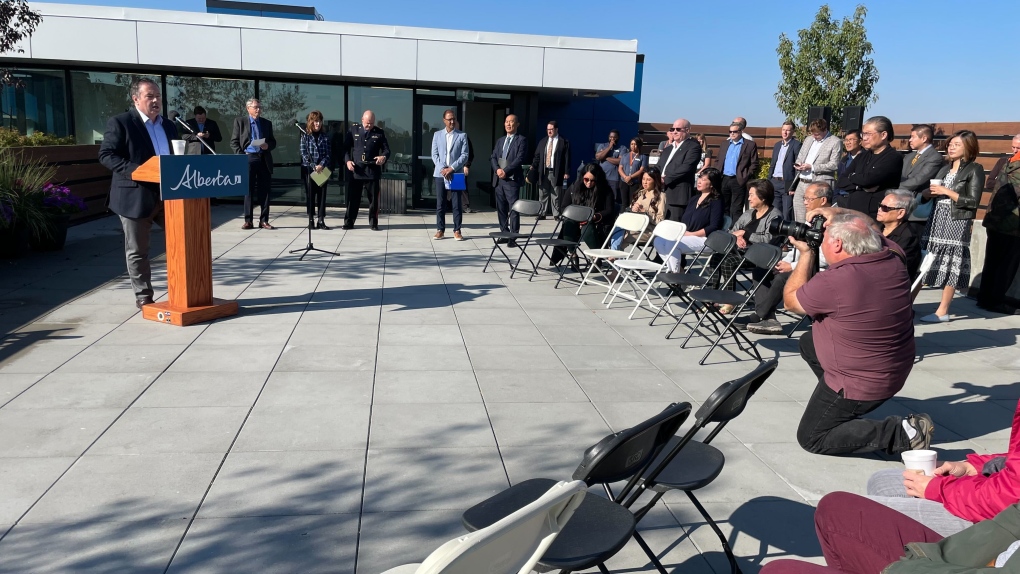
The Government of Alberta has declared a new program to help communities across the province tackle addiction and homelessness.

&#13
The Action Strategy on Homelessness was announced Saturday, with $187 million more than two several years to be put in on habit products and services and housing supports.

&#13
The program is centered on suggestions by the Co-ordinated Local community Reaction to Homelessness Undertaking Force — announced in November 2022 — and is what the Alberta government phone calls a “housing-centered, recovery-oriented design.”

&#13
Provincial figures recorded far more than 6,400 Albertans suffering from homelessness as just lately as January.

&#13
FUNDING BREAKDOWN

&#13
The plan will consist of $48.7 million to assistance 3,500 areas at 27 shelters in 8 Alberta communities and $89.6 million in funding to neighborhood companies in the province’s seven significant metropolitan areas.

&#13
In Edmonton, $5 million will be used to build up to 450 extra shelter areas, the Alberta governing administration stated, and $12 million will be provided to Edmonton to address a 10 years of funding inequalities.

&#13
“Nowadays is a great working day for our town,” mentioned Edmonton Mayor Amarjeet Sohi.

&#13
“These sizeable investments declared now will support a range of vital initiatives and also support shut the funding gap in between Edmonton and Calgary, to help Edmonton’s houseless individuals,” Sohi claimed.

&#13
Two new very long-term remedy services were also declared, with the to start with 75-bed co-ed facility to be operational in Edmonton by the conclusion of 2023, and a second to open in Calgary by early 2024.

&#13
As section of the 2022-23 price range, a new Support Hub Model will be piloted at two shelters in Edmonton and Calgary. The hubs will provide on-internet site companies and aid obtain to detox and dependancy treatment, monetary aid, wellness treatment and harm reduction expert services. The six-month pilots will expense a blended $2.5 million and get started this drop.

&#13
In addition, the plan’s addictions design consists of $65 million for two restoration communities in Edmonton and Calgary, and will reduce daily consumer service fees for household addiction remedy. Addiction funding will also go to outreach and damage reduction teams in Calgary and Edmonton.

&#13
The Alberta govt stated it will also include charges for the opioid addiction drug Sublocade and shell out $12 million on therapeutic living models in correctional services.

&#13
“We have to break the cycle. The aim is to join inmates with addiction treatment help though they are continue to incarcerated and present them with a very clear route to restoration,” Premier Jason Kenney mentioned.

&#13
CALGARY REACTS

&#13
Calgary Mayor Jyoti Gondek viewed the provincial announcement with others from the aged City Hall.

&#13
“My council colleagues and I are delighted to see a coordinated response to the intersectional crisis that Calgarians in positions of vulnerability are facing,” she reported. “On the homelessness side, growing shelter assistance to be 24/7 is substantial. That is quite substantial for both of those towns.”

&#13
Gondek extra that when Edmonton is acquiring much more funding, it can be only correcting historic inequities.

&#13
Metropolis council just lately moved to update the Calgary shelter process.

&#13
Particulars CRITICIZED

&#13
But Saturday’s announcement even now drew queries.

&#13
The UCP’s recovery-oriented technique to addictions has been closely opposed in the previous, with several arguing it is a a single-dimension-suits-all method that won’t handle the specific.

&#13
“Do (the metropolis and province) have, ideologically, a prevalent path ahead? Possibly not. There are men and women that believe that in hurt reduction and some others that do not,” Gondek said. “There are men and women who will inform you a harmful supply is the concern and others who will not.”

&#13
Kenney did not mention the poisonous source Saturday.

&#13
“We support a continuum of treatment that involves discrete hurt reduction,” Kenney mentioned. “But compared with the hopeless look at of some, we believe that that restoration is feasible.”

&#13
Advocates continue to argue there demands to be a more nuanced plan.

&#13
Opposition housing critic Lori Sigurdson is one particular of them. She launched a assertion expressing the province should “encourage therapy and recovery whilst also preserving lives with proven and effectively-recognized hurt reduction expert services.”

&#13
The NDP also wrote that preceding provincial plan exacerbated industry issues.

&#13
“The UCP has cut funding for housing and homelessness has exploded,” Sigurdson claimed. “Buildings that could have started out housing Albertans months in the past are sitting empty for the reason that this authorities refuses to make investments in operational funding for them.”

&#13
“The income declared today does not even start to deal with the deeper need to have for long term supportive housing, social housing and inexpensive housing in this province.”