Long COVID Now Looks like a Neurological Disease, Helping Doctors to Focus Treatments

Long COVID Now Looks like a Neurological Disease, Helping Doctors to Focus Treatments

Tara Ghormley has always been an overachiever. She finished at the top of her class in high school, graduated summa cum laude from college and earned top honors in veterinary school. She went on to complete a rigorous training program and build a successful career as a veterinary internal medicine specialist. But in March 2020 she got infected with the SARS-CoV-2 virus—just the 24th case in the small, coastal central California town she lived in at the time, near the site of an early outbreak in the COVID pandemic. “I could have done without being first at this,” she says.

Almost three years after apparently clearing the virus from her body, Ghormley is still suffering. She gets exhausted quickly, her heartbeat suddenly races, and she goes through periods where she can’t concentrate or think clearly. Ghormley and her husband, who have relocated to a Los Angeles suburb, once spent their free time visiting their “happiest place on Earth”—Disneyland—but her health prevented that for more than a year. She still spends most of her days off resting in the dark or going to her many doctors’ appointments. Her early infection and ongoing symptoms make her one of the first people in the country with “long COVID,” a condition where symptoms persist for at least three months after the infection and can last for years. The syndrome is known by medical professionals as postacute sequelae of COVID-19, or PASC.

People with long COVID have symptoms such as pain, extreme fatigue and “brain fog,” or difficulty concentrating or remembering things. As of February 2022, the syndrome was estimated to affect about 16 million adults in the U.S. and had forced between two million and four million Americans out of the workforce, many of whom have yet to return. Long COVID often arises in otherwise healthy young people, and it can follow even a mild initial infection. The risk appears at least slightly higher in people who were hospitalized for COVID and in older adults (who end up in the hospital more often). Women and those at socioeconomic disadvantage also face higher risk, as do people who smoke, are obese, or have any of an array of health conditions, particularly autoimmune disease. Vaccination appears to reduce the danger but does not entirely prevent long COVID.

The most common, persistent and disabling symptoms of long COVID are neurological. Some are easily recognized as brain- or nerve-related: many people experience cognitive dysfunction in the form of difficulty with memory, attention, sleep and mood. Others may seem rooted more in the body than the brain, such as pain and postexertional malaise (PEM), a kind of “energy crash” that people experience after even mild exercise. But those, too, result from nerve dysfunction, often in the autonomic nervous system, which directs our bodies to breathe and digest food and generally runs our organs on autopilot. This so-called dysautonomia can lead to dizziness, a racing heart, high or low blood pressure, and gut disturbances, sometimes leaving people unable to work or even function independently.

The SARS-CoV-2 virus is new, but postviral syndromes are not. Research on other viruses, and on neurological damage from the human immunodeficiency virus (HIV) in particular, is guiding work on long COVID. And the recognition that the syndrome may cause its many effects through the brain and the nervous system is beginning to shape approaches to medical treatment. “I now think of COVID as a neurological disease as much as I think of it as a pulmonary disease, and that’s definitely true in long COVID,” says William Pittman, a physician at UCLA Health in Los Angeles, who treats Ghormley and many similar patients.

Although 16 million U.S. sufferers is a reasonable estimate of the condition’s toll, there are other, more dire assessments. A meta-analysis of 41 studies conducted in 2021 concluded that worldwide, 43 percent of people infected with SARS-CoV-2 may develop long COVID, with about 30 percent—translating to approximately 30 million people—affected in the U.S. Some studies have offered more conservative numbers. A June 2022 survey reported by the U.S. National Center for Health Statistics found that among adults who had had COVID, one in five was experiencing long COVID three months later; the U.K. Office for National Statistics put the estimate at one in 10. Even if only a small share of infections result in long COVID, experts say, they will add up to millions more people affected—and potentially disabled.

Most of the first recognized cases of long COVID were in patients who needed extended respiratory therapy or who had obvious organ damage that caused lasting symptoms. People reporting neurological symptoms were often overlooked or dismissed as traumatized by their initial illness and hospitalization. But as 2020 came to an end, says Helen Lavretsky, a psychiatrist at the University of California, Los Angeles, “we started getting to a place of sorting through what was really going on … and it became very evident at that time that neuropsychiatric symptoms were quite prevalent,” most commonly fatigue, malaise, brain fog, smell loss and post-traumatic stress disorder, as well as cognitive problems and even psychosis.

Ghormley was in her late 30s and relatively healthy when she caught the virus, but she had underlying conditions—including rheumatoid arthritis and asthma—that put her at risk for severe COVID. She spent several days at home, struggling to breathe, and then she went to the hospital, where her blood pressure soared and her blood glucose dropped precipitously. She mostly recovered from this acute phase within a few weeks, but, she says, “I never really got better.”

Soon after coming home from the hospital, Ghormley developed what her husband called “goldfish brain.” “I’d put something down and have no idea where I put it,” she recalls. “It kept happening over and over. I was thinking, ‘This is getting weird.’ My husband said I was not remembering anything. I’d try to talk, and I knew what I wanted to say, but I couldn’t think of the word.”
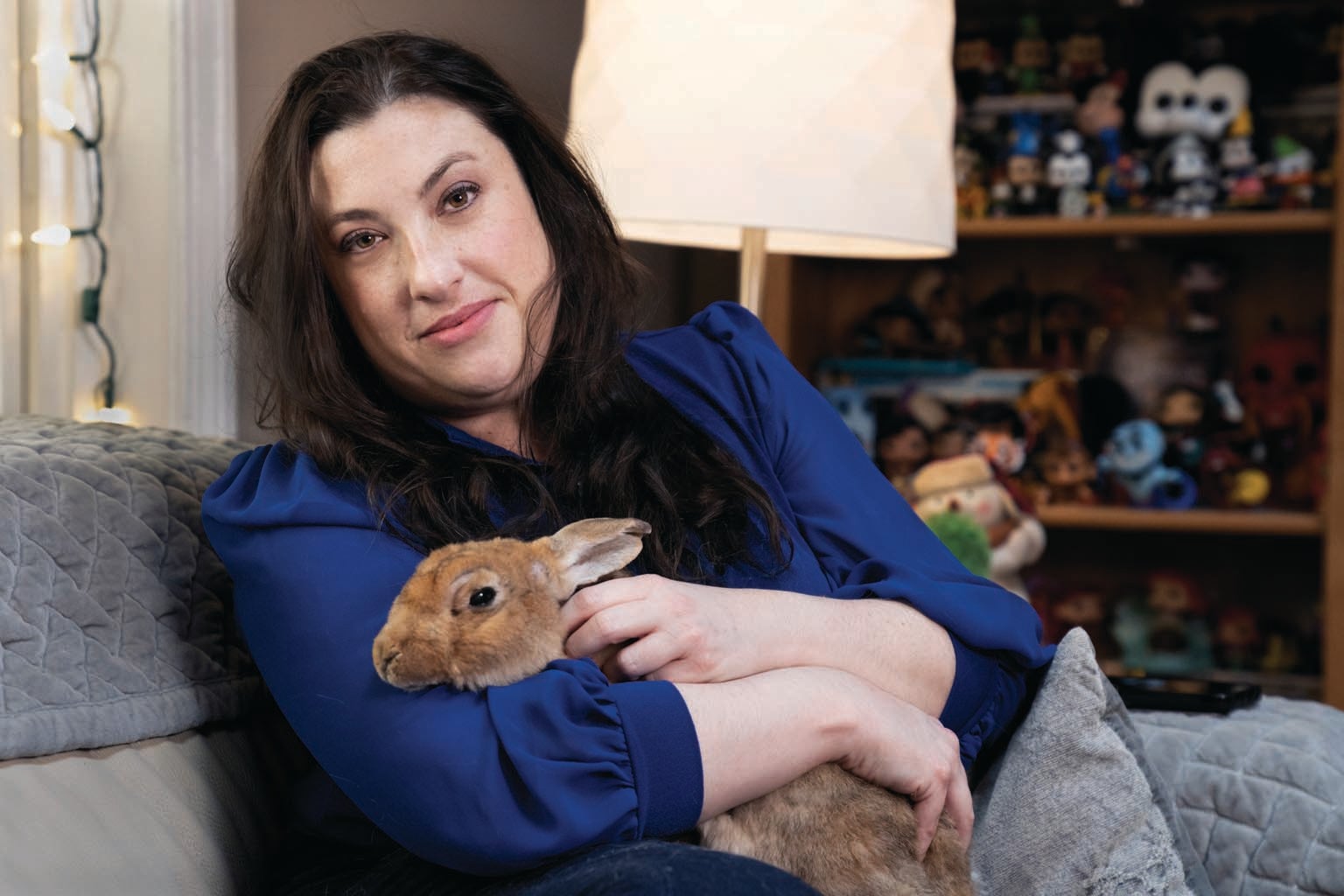
“Everything fell apart for me,” says Tara Ghormley, who has been struggling with long COVID since 2020. Credit: Ewan Burns

She also experienced tremors, dramatic mood swings and painful hypersensitivity to sounds. “My husband opening a paper bag felt like knives stabbing me in the ear,” she recounts. Any exertion—physical or mental—left her exhausted and in pain. The changes were jarring to Ghormley, who prided herself on her sharp mind. “The thing that bothered me the most was that I was really having trouble thinking, speaking, remembering—trying to complete a task and having no idea what it was. Suddenly I had quite profound neurological deficits. Everything fell apart for me at that time. That was horribly traumatic … it kind of broke me. I didn’t feel like me.”

Roots of Dysfunction

As a veterinary internist, Ghormley says, it’s her job to problem solve when mysterious symptoms arise, including her own. “I was actively trying to find reasons and find what I could do.” She theorized that some of her neurological symptoms might be the result of thrombotic events, blood clots that can cause ministrokes. Several early studies showed that COVID attacks endothelial cells, which line blood vessels. That can lead to clotting and oxygen deprivation in multiple organs, including the brain. Even subtle disruption of endothelial cells in the brain could contribute to cognitive dysfunction.

One study found that in people with neurological COVID symptoms, the immune system seems to be activated specifically in the central nervous system, creating inflammation. But brain inflammation is probably not caused by the virus infecting that organ directly. Avindra Nath, who has long studied postviral neurological syndromes at the National Institutes of Health, found something similar in an autopsy study of people who died of COVID. “When you look at the COVID brain, you don’t actually find [huge amounts of virus, but] we found a lot of immune activation,” he says, particularly around blood vessels. The examinations suggested that immune cells called macrophages had been stirred up. “Macrophages are not that precise in their attack,” Nath says. “They come and start chewing things up; they produce all kinds of free radicals, cytokines. It’s almost like blanket bombing—it ends up causing a lot of damage. And they’re very hard to shut down, so they persist for a long time. These are the unwelcome guests” that may be causing persistent inflammation in the brain.

Determining which patients have ongoing inflammation could help inform treatments. Early research identified markers that often are elevated in people with the condition, says Troy Torgerson, an immunologist at the Allen Institute in Seattle. Three cell-signaling molecules—tumor necrosis factor alpha, interleukin 6 and interferon beta—stood out in long COVID patients. But this pattern wasn’t found in absolutely everyone. “We’re trying to sort through long COVID patients and say, ‘This would be a good group to take to trials of an anti-inflammatory drug, whereas this group may need to focus more on rehabilitation,’” Torgerson says. He led a study (currently released as a preprint, without formal scientific review by a journal) in which his team measured proteins from the blood of 55 patients. The researchers found that a subset had persistent inflammation. Among those people, they saw a distinct immune pathway linked to a lasting response to infection. “One subset of patients does appear to have an ongoing response to some virus,” Torgerson says.

Isolated pockets of SARS-CoV-2 or even pieces of viral proteins may remain in the body well after the initial infection and continue to elicit an immune attack. The first solid evidence for “viral persistence” outside the lungs came in 2021 from researchers in Singapore who found viral proteins throughout the gut in five patients who had recovered from COVID as much as six months earlier. A study conducted at the University of California, San Francisco, found evidence for viral particles in the brains of people with long COVID. Scientists collected exosomes, or tiny packets of cellular material, released specifically from cells of the central nervous system. The exosomes contained pieces of viral proteins as well as mitochondrial proteins, which may indicate an immune attack on those vital cellular organelles. Amounts of such suspicious proteins were higher in patients with neuropsychiatric symptoms than in those without them.

The virus could linger in the brain for months, according to research conducted at the NIH and reported in Nature in December 2022. The autopsy study of 44 people who died of COVID found rampant inflammation mainly in the respiratory tract, but viral RNA was detected throughout the body, even in the brain, as long as 230 days after infection. Two other studies, both published last year in the Proceedings of the National Academy of Sciences USA, showed evidence that SARS-CoV-2 may infect astrocytes, a type of neural support cell, gaining entrance via neurons in the skin lining the nose.

Researchers are examining inflammatory signals in patients with long COVID in increasingly fine detail. A small study led by Joanna Hellmuth, a neurologist at U.C.S.F., found that patients with cognitive symptoms had immune-related abnormalities in their cerebrospinal fluid, whereas none of the patients without cognitive symptoms did. At the 2022 meeting of the Society for Neuroscience, Hellmuth reported that she had looked at more specific immune markers in people with cognitive symptoms and found that some patients had an elevated level of VEGF-C, a marker of endothelial dysfunction. Higher VEGF-C concentrations are associated with higher levels of immune cells getting into the brain, she says, and “they’re not doing their normal function of maintaining the blood-brain barrier; they’re distracted and perhaps activated.” Although the studies are small, Hellmuth adds, they reveal “real biological distinctions and inflammation in the brain. This is not a psychological or psychosomatic disorder; this is a neuroimmune disorder.”

What keeps the immune system in attack mode? According to Torgerson, “one option is that you’ve developed autoimmunity,” in which antibodies produced by the immune system to fight the virus also mark a person’s own cells for immune attack. The response to the virus “turns the autoimmunity on, and that doesn’t get better even when the virus goes away,” he says. Several studies have found evidence of autoimmune components called autoantibodies that interact with nerve cells in people with long COVID.

Clues about the inflammatory processes at work could point toward treatments for neurological symptoms. “If it’s a macrophage-mediated inflammatory process … intravenous immunoglobulin could make a difference [to] dampen the macrophages,” Nath says. The treatment, referred to as IVIg, contains a cocktail of proteins and antibodies that can mitigate an overactive immune response.

IVIg can also be used to block autoantibodies. And a therapy called rituximab that targets antibody-producing B cells provides “a time-tested therapy for a lot of autoantibody-mediated syndromes,” Nath says. Another strategy is to use corticosteroids to dampen immune activity altogether, although those drugs can be used for only a limited time. “That’s a sledgehammer approach, and you can see if it makes a difference. At least it gives you an idea that, yes, it’s an immune-mediated phenomenon, and now we need to find a better way to target it,” Nath says.

If the virus does hang around in some form, antiviral medications could potentially clear it, which might help resolve neurological symptoms. That’s the hope of scientists running a clinical trial of Paxlovid, Pfizer’s antiviral drug for acute COVID.

A Chronic Fatigue Connection?

Postviral syndromes have been documented for more than a century, arising after infection with viruses from HIV to the flu. Epstein-Barr virus, which causes mononucleosis, is one of several viruses linked to a condition called myalgic encephalomyelitis/chronic fatigue syndrome (ME/CFS), which is estimated to affect at least one and a half million people in the U.S. ME/CFS bears striking resemblances to long COVID, with symptoms such as immune system dysregulation, fatigue and cognitive dysfunction. “One of the patterns we see is patients who definitely meet the criteria for ME/CFS. This is something we are seeing and treating all the time” in long COVID patients, Pittman says. ME/CFS can be severe, with some people losing mobility and becoming bedbound.
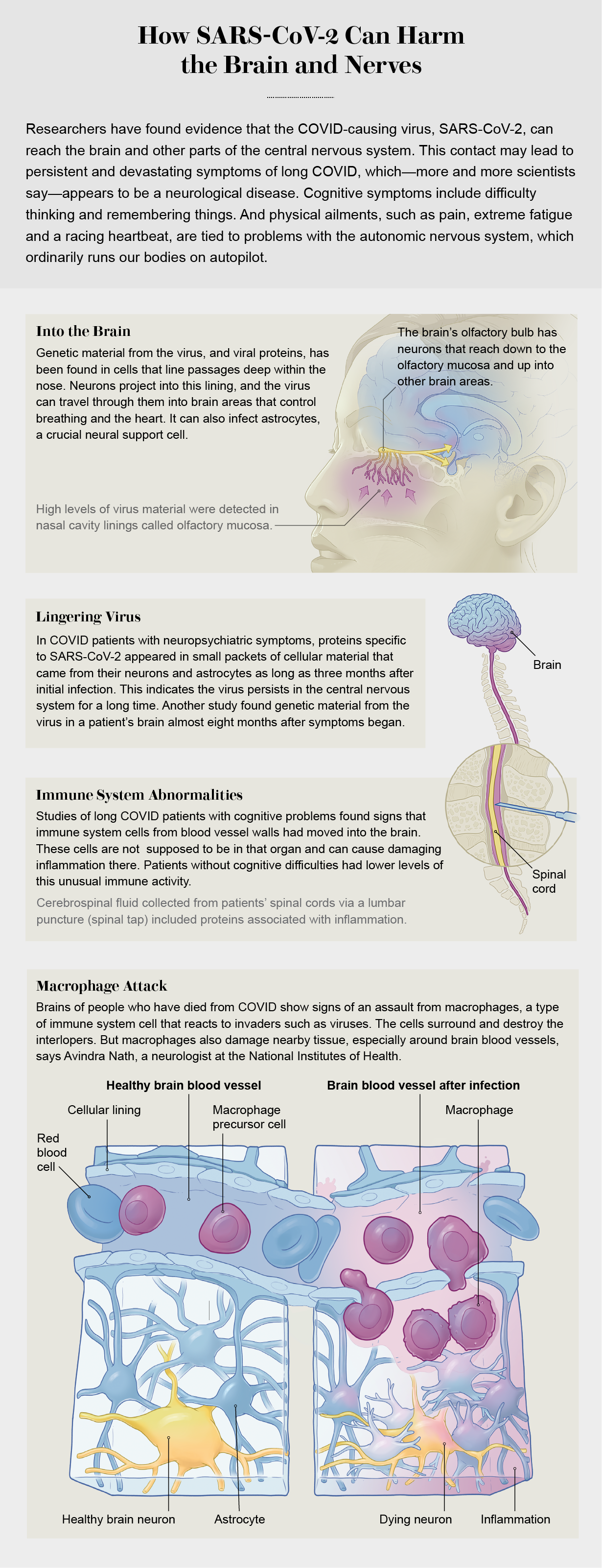
Graphic highlights various ways SARS-CoV-2 can affect the brain and nerves, either by accessing and lingering in nervous system tissues or by stimulating the immune system to react in ways that damage the brain.


Credit: Now Medical Studios; Sources: “Neurovascular Injury with Complement Activation and Inflammation in COVID-19,” by Myoung-Hwa Lee et al., in Brain, Vol. 145; July 2022 (blood vessel reference); “Olfactory Transmucosal SARS-CoV-2 Invasion as a Port of Central Nervous System Entry in Individuals with COVID-19,” by Jenny Meinhardt et al., in Nature Neuroscience, Vol. 24; February 2021 (nasal passage reference)

Nath, who also studies ME/CFS, says that “we think mechanistically they are going to be related.” Researchers suspect that ME/CFS, like some cases of long COVID, could be autoimmune in nature, with autoantibodies keeping the immune system activated. ME/CFS has been difficult to study because it often arises long after a mild infection, making it hard to identify a viral trigger. But with long COVID, Nath says, “the advantage is that we know exactly what started the process, and you can catch cases early in the [development of] ME/CFS-like symptoms.” In people who have had ME/CFS for years, “it’s done damage, and it’s hard to reverse that.” Nath speculates that for long COVID, if doctors could study people early in the illness, they would have a better chance of reversing the process.

Torgerson hopes that researchers will ultimately come to better understand ME/CFS because of COVID. “COVID has been more carefully studied with better technology in the time we’ve had it than any other infectious disease ever. I think we’ll learn things that will be applicable to other inflammatory diseases driven by infection followed by an autoimmune process.”

Team Treatment

Ghormley, after months of illness, sought care at UCLA Health’s long COVID clinic, among the country’s few comprehensive, multidisciplinary programs for people with this syndrome. Even though her symptoms are rooted in nervous system dysfunction, she needed an array of medical specialists to treat them. The clinic grew out of a program aimed at coordinating care for medically complex COVID patients, says its director Nisha Viswanathan, an internist and primary care physician. In following up with COVID patients after several months, she realized that “we had a group of patients who still had symptoms. There was no understanding around the condition; we were just trying to see what we could offer them.” Viswanathan and others convened a biweekly meeting of UCLA Health doctors in pulmonology, cardiology, neurology, psychiatry and other specialties to discuss individual cases and overall trends.

At UCLA Health, Pittman coordinates Ghormley’s treatment. He says the interdisciplinary team is crucial to getting patients the best possible care. “Oftentimes there are so many symptoms,” and some patients have seen multiple specialists before arriving, but not necessarily the right ones. As long COVID primary care providers, he says, “we do the initial testing and get them to the right person.” For Ghormley, that list of providers includes Pittman, along with a neurologist, a pulmonologist, a cardiologist, a psychiatrist, a trauma counselor, a rheumatologist and a gynecologist.

The team approach has also been critical for doctors trying to understand a brand-new disease, Pittman says. “It’s been a very interesting journey from knowing almost nothing to knowing a little bit now, and we’re learning more every day, every week, every month,” he says. The term “long COVID” “is an umbrella, and I think there are multiple diseases under that umbrella.” Although each long COVID patient is unique, Pittman says, “we start to see patterns developing. And with Ghormley, we saw a pattern of dysautonomia, which we see frequently.”

Dysautonomia impairs the autonomic nervous system, a network of nerves that branch out from the brain or spinal cord and extend through the body, controlling unconscious functions such as heartbeat, breathing, sweating and blood vessel dilation. For Ghormley, like many people with long COVID, dysautonomia takes the form of postural orthostatic tachycardia syndrome, or POTS. The syndrome encompasses a collection of symptoms that include a racing heart rate—particularly on standing—and fatigue, and it can cause bowel and bladder irregularities. POTS can also be a component of the exhaustion that comes with PEM. Although the symptoms may seem to affect the body, they stem from nervous system dysfunction.

Ghormley’s dysautonomia led her to see cardiologist Megha Agarwal at a UCLA clinic near her home. Many physicians are not familiar with POTS, but Agarwal is particularly attuned to it, having seen it in some of her patients before COVID hit. “There’s dysregulation of the nervous system, and so many things can cause it: some cancer therapies, viruses, autoimmune conditions.” Agarwal recognized POTS in Ghormley in the fall of 2020, when very little was known about long COVID. Now she believes “POTS is really what long-haul COVID is causing” in many patients. Luckily, Agarwal says, there are medical interventions that can help.

Tachycardia—the T in POTS—causes the heartbeat to speed up, contributing to exhaustion and fatigue in addition to stressing the heart itself. Drugs called beta-blockers (for the beta-adrenergic receptors they shut off in the heart) can lower the heart rate and improve symptoms. “When heart rate is controlled, not only does the pump improve,” Agarwal says, “[but people’s] energy improves, their fatigue is gone, and sometimes there’s better mental clarity.” For some patients like Ghormley, beta-blockers are not enough, so Agarwal adds a medication called ivabradine. “It’s a bit off-label, but it’s currently being aggressively studied” for POTS. For Ghormley, the combination led to real improvements, “so now she doesn’t feel like she ran the Boston Marathon when all she did was sit down and stand up at work or take a shower,” Agarwal says.

Among Ghormley’s toughest symptoms is her brain fog, a catchall term for a slew of cognitive problems that make it hard for her to function. For days when Ghormley works, her psychiatrist prescribes Adderall, a stimulant used to treat attention deficit hyperactivity disorder that helps her concentrate and stay focused. That has “helped immensely,” Ghormley says.

Ghormley credits her doctors and Agarwal in particular with doing the detective work to dig into her symptoms. “Nobody knew anything about it, but everyone listened to me,” Ghormley says. Perhaps because she was a professional from a medical field, no one “brushed me aside.”

That’s unusual for people with long COVID, many of them women, who are often dismissed by physicians who doubt their complaints are real. “Patients just don’t feel heard,” Viswanathan says. “I had a patient who told me everything, and after, I just said, ‘This must be so hard for you. I want you to know that everything you’re feeling is real, and I’ve seen so many patients like you.’ And she started crying. She said, ‘No one has told me that. I can’t tell you the number of times I was told it was in my head.’”
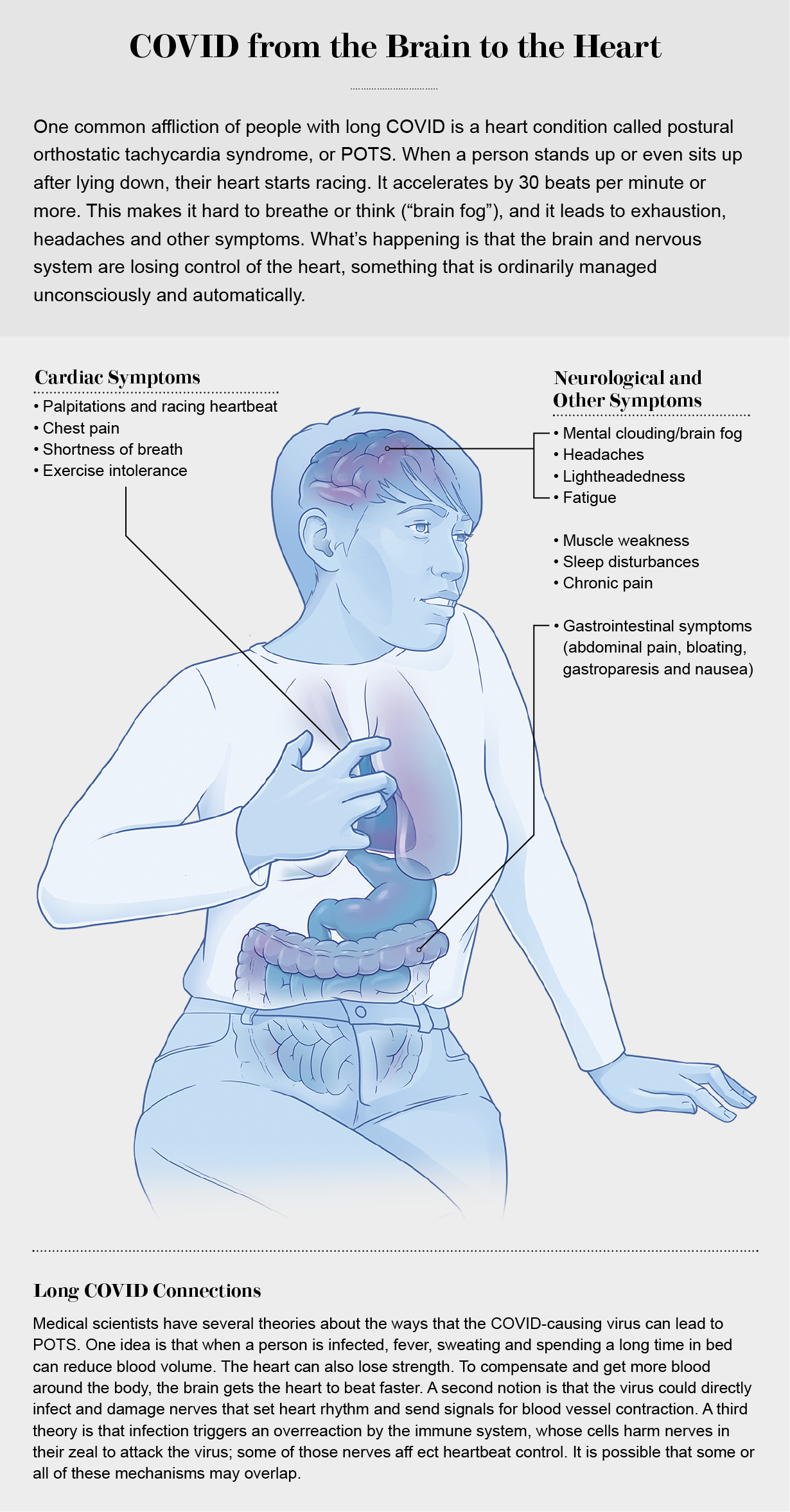
Graphic highlights cardiac, neurological and other types of symptoms associated with long COVID.


Credit: Now Medical Studio; Sources: “Postural Orthostatic Tachycardia Syndrome as a Sequela of COVID-19,” by Cameron K. Ormiston et al., in Heart Rhythm, Vol. 19; November 2022; “Long COVID-19 and Postural Orthostatic Tachycardia Syndrome—Is Dysautonomia to Be Blamed?” by Karan R. Chadda et al., in Frontiers in Cardiovascular Medicine; March 2022 (references)

In addition to drugs, other types of therapies, including physical therapy, can help improve some symptoms. But people who experience PEM face a particular challenge when using movement therapies. Pittman says the exertion can make these patients feel worse. “We don’t want patients to go to not moving at all, but sometimes the type of movement they’re doing may be flaring their symptoms.” He notes that often PEM strikes young, previously healthy people who will say, “‘I need to push myself,’ and then they go way too far and get worse. Our job is to try to find that middle ground and then make that consistent over time, so they’re not getting further deconditioned but they don’t have the PEM, which has been shown to set them back.”

The Long Haul

Some patients, Pittman says, “have the expectation that they’re going to come in, and within a month they’re going to be back to normal. And resetting those expectations can be really challenging. You have to be really empathetic because people’s lives have completely changed.” But sometimes patients’ quality of life can improve noticeably when they are able to adjust to a new normal. Still, he says, “patients have so many questions, and I can’t lead them down a physiological pathway. I can tell them there’s neuroinflammation, maybe there’s autoimmunity, but we still don’t have the answers. Sometimes it’s really tough for us to accept and for the patient to accept that we just have to try our best.”

A number of people, Viswanathan says, benefit from reducing various treatments they have accumulated. Some people become so desperate that they will try anything from supplements to off-label medications to untested potions from the Internet. Stopping those sometimes leads to improved symptoms, she says.

Psychological care and support groups can help. Lavretsky adds that “lifestyle choices can play a huge role in improvement,” particularly better sleep habits and the use of breathing exercises to control anxiety. She tells people their bodies can heal themselves if the patients and clinicians find the right tools.

Whether that’s true for everyone remains to be seen, Viswanathan says. “We see many patients who have gotten better with time. I have patients whose symptoms have disappeared in the course of a year, or they disappear and occasionally flare up again.” But for some, she says, “it could last many years.”

“We’re going to be addressing this for probably decades,” Viswanathan says. “COVID is not going to go away so much as we’re just going to get used to living with it, but part of [that] means that people will continue to develop long COVID.”

Vaccination appears to reduce the risk of long COVID. But a study published in May 2022 in Nature Medicine suggests the protection, though real, is not as good as one might hope. The survey of electronic health records from the U.S. Department of Veterans Affairs looked at the relatively small portion of vaccinated people who subsequently became infected. They developed long COVID only 15 percent less often than unvaccinated people. “These patients can have symptoms for one to two years or longer, and so every month you’re racking up more patients. Even if it’s 15 percent less, the total population of patients is still growing and exploding,” Pittman says. The best way to avoid getting long COVID, experts all agree, is to avoid getting COVID at all.

The syndrome is still mired in a lot of medical uncertainty. Patients might have one or a combination of the problems investigated so far: Long COVID might be caused by viral particles that persist in the brain or other parts of the nervous system. Or it might be an autoimmune disorder that lasts long after the virus has disappeared. Maybe overactive immune cells continue to perturb the nervous system and nearby blood vessels. Fortunately, the increasing ability to recognize specific problems is helping clinicians hone treatments that give patients the best chance of recovery.

Although Ghormley says her care has dramatically improved her symptoms and allowed her to “do some normal things again,” she continues to experience flare-ups that make it impossible for her to work for weeks at a time. One day last year she skipped a dose of her heart medication and made a Target run in the southern California heat. “I got home and basically collapsed in the hallway. Since then, everything has been out of whack. If I try to move around, my legs give out.” Most frustrating—and scary—to Ghormley is the unpredictability of her symptoms. “They have changed so much; some are manageable, some debilitating. One thing will get better, and another thing comes back. I’m always hopeful that it’s going to get better, but I just don’t know.”

Women’s pain often is dismissed by doctors

Women’s pain often is dismissed by doctors

One woman was told she was being “dramatic” when she pleaded for a brain scan after suffering months of headaches and pounding in her ears. It turned out she had a brain tumor.

Another was ignored as she cried out in pain during a 33-hour labor. She was supposed to be getting pain medication through her epidural, but it had fallen out.

Dozens of women complained of torturous pain as their vaginal walls were punctured during an egg retrieval process. They were told their pain was normal, but, in actuality, they were getting saline instead of anesthesia.

These are just some of the stories of women who say their pain and suffering has been dismissed or misdiagnosed by doctors. Although these are anecdotal reports, a number of studies support the claim that women in pain often are not taken as seriously as men.

This year, the Journal of the American Heart Association reported that women who visited emergency departments with chest pain waited 29 percent longer than men to be evaluated for possible heart attacks.

An analysis of 981 emergency room visits showed that women with acute abdominal pain were up to 25 percent less likely than their male counterparts to be treated with powerful opioid painkillers.

Another study showed that middle-aged women with chest pain and other symptoms of heart disease were twice as likely to be diagnosed with a mental illness compared with men who had the same symptoms.

“I was told I knew too much, that I was working too hard, that I was stressed out, that I was anxious,” said Ilene Ruhoy, a 53-year-old neurologist from Seattle, who had head pain and pounding in her ears.

Despite having a medical degree, Ruhoy said she struggled to get doctors to order a brain scan. By the time she got it in 2015, a tennis ball-sized tumor was pushing her brain to one side. She needed surgery, but first, she rushed home, hugged her 11-year-old daughter and wrote her a letter to tell her goodbye.

Ruhoy did not die on the operating table, but her tumor had grown so large it could not be entirely removed. Now, she has several smaller tumors that require radiation treatment.

She said many of her female patients have had experiences similar to hers. “They’re not validated with regards to their concerns; they’re gaslit; they’re not understood,” she said. “They feel like no one is listening to them.”

Doubts about women’s pain can affect treatment for a wide range of health issues, including heart problems, stroke, reproductive health, chronic illnesses, adolescent pain and physical pain, among other things, studies show.

Research also suggests that women are more sensitive to pain than men and are more likely to express it, so their pain is often seen as an overreaction rather than a reality, said Roger Fillingim, director of the Pain Research and Intervention Center of Excellence at the University of Florida.

Fillingim, who co-wrote a review article on sex differences in pain, said there are many possible explanations, including hormones, genetics and even social factors such as gender roles.

Regardless, he said, “you treat the pain that the patient has, not the pain that you think the patient should have.”

Women say reproductive health complaints are commonly ignored

Women often cite pain bias around areas of reproductive health, including endometriosis, labor pain and insertion of an intrauterine device, or IUD.

When Molly Hill made an appointment at a Connecticut clinic in 2017 to get an IUD, she said she was warned it would be uncomfortable, but she was not prepared for “horrific” pain. Hill, now 27 and living in San Francisco, recalled that during the procedure, she began crying in pain and shouted at the doctor to stop.

“We’re almost done,” she said the doctor told her and continued the procedure.

“It was full-body, electrifying, knife-stabbing pain,” she said. After it was done, she said she lay sobbing on the table in physical and emotional pain. “It felt violating, too, to have that pain that deep in your core where you feel the most vulnerable.”

Would you like to share your own experiences of coping with pain and navigating the medical system? Fill out this form, and we may include you in a collection of reader stories.

End of carousel

Studies consistently show that women who have not experienced vaginal birth have much higher pain during IUD insertion compared with women who have given birth. A Swedish study found that among 224 women who had not given birth, 89 percent reported moderate or severe pain. One in six of the women said the pain was severe.

Although numbing agents and local anesthetics are available, they are rarely used.

In some cases, women have sued physicians for ignoring their pain. Dozens of women sued Yale University claiming that during an egg harvesting procedure at its infertility clinic, they were supposed to be receiving the powerful painkiller fentanyl. But some women were getting only diluted pain medication or none at all, according to lawsuits filed in the state Superior Court in Connecticut.

Later, the clinic discovered a nurse had been stealing vials of fentanyl and replacing the painkiller with saline solution. The nurse pleaded guilty last year and was sentenced for tampering with the drugs.

One of the plaintiffs, Laura Czar, wrote about her experience for Elle magazine, describing it as “a horrible, gut-wrenching pain,” and told a doctor at the time, “I can feel everything you’re doing.” Despite her protests, the doctor continued.

Yale said in a statement that it “deeply regrets” the women’s distress and has “reviewed its procedures and made changes to further oversight of pain control and controlled substances.”

Racial disparities in pain management

For Sharee Turpin, the pain of sickle-cell disease sometimes feels like tiny knives slicing her open. Sickle cell disease is an inherited blood disorder that can cause suffering so severe, its attacks are called “pain crises.”

But when Turpin, who is Black, experiences a pain crisis, the 34-year-old does not rush to the ER in Rochester, N.Y. Instead, she combs her hair, mists some perfume and slips on her “Sunday best” in hopes that the doctors and nurses won’t peg her as a drug seeker, she said.

Sometimes, Turpin gets a care team that understands her pain. Other times, she is treated as a bother. “I’ve even been told ‘shut up’ by a nurse because I was screaming too loud while I was in pain,” she said.

Abundant research shows racial bias in pain treatment. A 2016 study found half of white medical students and residents held at least one false belief about biological differences between Blacks and Whites, and were more likely to underestimate Black patients’ pain.

“The management of pain is one of the largest disparities that we see between Black people and White people in the American health-care system,” said Tina Sacks, an associate professor at the University of California at Berkeley and author of “Invisible Visits: Black Middle-Class Women in the American Healthcare System.”

Labeling women “hysterical” or blaming psychological causes

Research shows men in chronic pain tend to be regarded as “stoic” while women are more likely to be considered “emotional” and “hysterical” and accused of “fabricating the pain.”

Carol Klay, a 68-year-old from Tampa, had endured years of chronic pain from arthritis, degenerative disk disease and spinal stenosis. During a hospital stay last year, her doctor noted in her medical record that she was crying “hysterically.”

Klay said she was crying because she was unable to sit, stand or walk without agony, and the doctor had removed morphine from her cocktail of pain medications. She wonders whether the doctor “would have called me hysterical if I was a man,” she said.

Tampa General Hospital said it could not discuss specific patients, but stated: “Patient treatment plans, including medication orders to reduce pain, are prescribed by multi-disciplinary clinical teams.”

Research shows women’s physical pain is also often attributed to psychological causes.

Jan Maderios, a 72-year-old Air Force veteran from Chipley, Fla., said the trauma of having pain dismissed by doctors has stayed with her for years. She saw about a dozen doctors in the early 1970s for pelvic pain. When clinicians could not identify the cause of her pain, she was referred to a psychiatrist.

“You start to doubt yourself after so many medical experts tell you there’s nothing wrong with you,” she said.

After a hysterectomy in 1976, Maderios learned that fibroid tumors in her uterus had been the source of her pain. She said learning her pain was real — and physical — “made all the difference in the world.”

Why women’s pain complaints often aren’t taken seriously

During a 33-hour labor with her first child in 2011, Anushay Hossain, 42, of D.C., opted for epidural pain relief but said she still felt it all — every contraction, every cramp and every dismissal of her pain by her medical team. The doctor reassured her that she was getting the maximum dosage of pain medication.

In fact, she wasn’t getting any at all. She said her epidural had slipped out. By the time the error was caught, she was shaking uncontrollably and in need of an emergency Caesarean section, she said.

“There’s a pain gap, but there’s also a credibility gap,” said Hossain, author of “The Pain Gap: How Sexism and Racism in Healthcare Kill Women.” “Women are not believed about their bodies — period.”

This pain gap may stem, in part, from the fact that women have historically been excluded from medical research. It wasn’t until 2016 that the National Institutes of Health (NIH) required sex to be considered as a biological variable in most studies it funded.

“We’re making progress,” said David Thomas, special adviser to the director of NIH’s Office of Research on Women’s Health. “But we do have a long way to go because there’s this whole institutional approach to doing research — pain and beyond — where it tends to be male-focused.”

Nearly 95 percent of U.S. medical school students said instruction on sex and gender differences in medicine should be included in curriculums, according to a 2015 survey. But only 43 percent said their curriculum had helped them understand those differences and only 34.5 percent said they felt prepared to manage them in a health-care setting.

“It is changing, but it’s changing very slowly,” said Janice Werbinski, immediate past president of the American Medical Women’s Association and chair of the mentorship committee of the association’s Sex and Gender Health Collaborative.

How women can advocate for better pain care

It took decades to solve the mystery of Maureen Woods’s chronic pain. Woods, 64, of Myersville, Md., started having joint pain in her teens and, over the years, told dozens of doctors her pain was “debilitating,” she said. Some told her it was all in her head. In 2017, she was diagnosed with hypermobile Ehlers-Danlos syndrome, a connective tissue disorder often causing loose joints, dislocations and chronic pain.

She said women who are not being heard should keep advocating for themselves. “You have to go with your gut — something is wrong and I need to find a doctor who can figure it out,” she said.

Marjorie Jenkins, dean of the University of South Carolina School of Medicine Greenville, urged women against feeling pressured to accept an “everything is normal” non-diagnosis.

“If your provider does not appear to be listening to you or believing what you’re saying, then you need a new provider,” Jenkins said. “You are the client, you are the customer and you are the owner of your health.”

Women can also take a family member, friend or other support person who can corroborate their stories, said Alyson McGregor, an emergency medicine professor at the University of South Carolina School of Medicine Greenville and author of the book “Sex Matters: How Male-Centric Medicine Endangers Women’s Health and What We Can Do About It.”

Particularly in emergency departments, she said, there can be an inherent bias. “There’s this assumption that women are emotional and they’re anxious and that that’s the main issue,” she said.

[Sign up for the Well+Being newsletter, your source of expert advice and simple tips to help you live well every day]

Filling gaps in care: Improving access to trusted information outside the doctor’s office

Filling gaps in care: Improving access to trusted information outside the doctor’s office

Around the earlier several a long time, the medical doctor-client partnership has undeniably transformed all around the globe. As many have started to argue that normal touchpoints like the yearly actual physical are starting to be obsolete, the moments wherever a patient has the opportunity to acquire steerage on their health from a source they have faith in grow to be more and more sporadic.

But for the duration of the weeks, months, or several years concerning visits, where do sufferers go to find answers to their wellbeing concerns? Online sources, buddies, household, social media, and information shops weave a patchwork of facts that guides our wellness conclusions day-to-day – nonetheless the trouble lies in comprehension which of these resources is credible. This is specially legitimate when we look at persons in beneath-resourced teams who, provided various cultural and socioeconomic components, mostly rely on the data accessible inside their current ecosystems.

Far more and a lot more, we’re seeing that entry to superior-high quality, useful data is found to be a social determinant of overall health, as it impacts results at the two the specific and the local community level. Not only does it impact one’s choices about when and exactly where they seek care, but also how they devote in items or select a well being plan, and no matter if they understand the advanced subjects similar to their wellbeing.

When we think about how exposure to misinformation or falsehoods can misguide individuals, it underscores the duty that we as providers have to guarantee we ourselves understand where by these sources lie, and how to use them as component of our follow.

But this is a new way of working. For decades, several of us in healthcare have been resistant to considering about how people obtain information. We acquire a complicated procedure and, in its place of breaking it down, we inquire sufferers to action into our environment crammed with jargon and paywalled investigate. When a individual leaves the emergency department, they are handed a long printout of discharge guidance, but they may perhaps not fully grasp the phrases or be ready to absorb it.

Further than this, there has also usually been a broader need for the shared experiences from sufferers or caregivers who have navigated a related health and fitness journey. We see this for people today across all walks of lifetime – no matter if it be a female who gets a cancer analysis and does not know who to question about the treatment practical experience, or a teenage boy who is silently struggling from melancholy and feels too anxious to switch to household or close friends with his feelings.

One particular of the lessons that we all acquired during the pandemic is that we require to believe tough not only about wherever and how a wellness information is shared, but who is sharing it. Who do folks believe in to listen to distinct items of information and facts from, and what format is most efficient in generating that stick? How can we build an ecosystem that permits patients to obtain answers, so they know how to just take treatment of on their own and what to watch for as they recover?

As a system that reaches billions of people every single month, we at YouTube understand the prospect we have to enjoy a position in answering that problem. This is specially important for BIPOC and underrepresented teams, who have been systematically underserved for a long time, ensuing in a deep-rooted mistrust in America’s health-related gurus and institutions. This is why we have spent the past two decades prioritizing our efforts all-around wellbeing info. From partnerships to create suggestions and rules with the world’s main well being organizations and providers, to dedicated teams that make certain the thoughts that men and women are looking for are answered in a way that is both participating and factual, to attributes that assist customers differentiate this articles from the floods of other movies on the platform – all working in the direction of our intention to rethink the position that our system has to perform in the public wellbeing ecosystem.

Even more, as the inequities in our international health care program were being laid bare more than the previous couple a long time, we’ve labored to establish how we can build a content ecosystem that is personalized toward closing these gaps in treatment. This calendar year, in partnership with the Kaiser Household Foundation, we introduced alongside one another a few exceptional businesses that are undertaking the do the job on the floor in these communities – the Loveland Foundation, the Nationwide Start Fairness Collaborative (NBEC) and the Satcher Wellness Leadership Institute at Morehouse Faculty of Drugs – and have presented every with seed funding and online video creation expertise, alongside with data and study, to assist them establish a existence on YouTube that reaches audiences at-scale.

At a global amount, health treatment methods, suppliers, govt entities, engineering organizations, non-gain organizations and church buildings all want to imagine of how data drives health and fitness results, and how we rethink overall health communications to set up a seamless world wide web of credible data, connecting the dots for all people.


Sponsored by

youtube

Find out more about YouTube Wellness in this article.

Doctor’s Tip: 22 tips for losing weight

Doctor’s Tip: 22 tips for losing weight

Doctor’s Tip: 22 tips for losing weight

It is the time of year when a lot of folks are considering about New Year’s resolutions. 1 of the most common of these is losing unwelcome pounds, specifically immediately after gaining a number of more lbs around the holidays. Pursuing are 22 suggestions, from Dr. Michael Greger’s evidence-based mostly 2000 e book “How Not to Food plan.”

1. Eat Foods Lower IN CALORIE DENSITY, this sort of as greens, fruit, and unprocessed grains — which also occur to be loaded with well being-endorsing fiber and micronutrients.


2. NUTS AND SEEDS are an exception to No. 1. Nuts are high in calorie density, but a handful a working day contributes to ideal overall health. Nuts trigger satiety (a experience of fulness), so that less calories are eaten following feeding on nuts. Seeds are also calorie-dense but unsalted sunflower and pumpkin seeds sprinkled on salads really don’t lead incredibly numerous energy, and assist take in unwanted fat-soluble vitamins. A tablespoon of ground flaxseeds a day reduces swelling and provides balanced omega-3 extra fat.

3. Try to eat LEGUMES Every day. Beans, lentils, chick peas, and split peas make you feel full, so you will eat much less calories the relaxation of the food. On top of that, they feed the health and fitness-marketing microbes in your intestine microbiome, which in flip make chemicals that lead to satiety, resulting in fewer calorie intake for several hours next feeding on legumes.


4. Stay away from High CALORIE-DENSITY Foods such a animal solutions (which include seafood), and included oil.

5. Stay away from ADDICTIVE Food items, these as salt, sugar and fat (the latter is frequently concealed in the variety of additional oil).

6. Stay away from PROCESSED Food items such as nearly anything manufactured from flour — doughnuts, pastries, cookies, cake, chips, most crackers (Wasa brand is an exception), and cereal that comes in a box.

7. Water Right before Foods: Consume 2 cups of amazing or cold, unflavored h2o before each and every food, which will lead to you to take in much less calories in the course of the meal.

8. Eat A CUP OR BOWL OF Low CALORIE VEGETALBE OR LEGUME SOUP Just before Just about every Food, slowly with a teaspoon, which brings about satiety so that you will take in fewer calories in the course of the remainder of the meal. One more choice is to pre-load meals with a salad with a very low calorie, oil and sugar-totally free dressing (recipes uncovered on the online).

9. VINEGAR: 2 teaspoons in advance of just about every meal causes satiety, so you will consume much less. In addition, it decreases blood sugar and insulin amounts. Utilizing vinegar as a salad dressing is one particular method — if you are heading to consume it, dilute the acidity with drinking water.

10. Eat MINDFULLY — really do not get distracted by your mobile phone, tablet or Television set in the course of foods.

11. Take in Bit by bit — devote at least 20 minutes having every single meal, which lets hormones to kick in that inform you you are whole. Chew your food stuff perfectly, and do not consume your nutrients (smoothies permit people today to unconsciously ingest a lot of energy quickly, before knowing they are entire).

12. BLACK CUMIN SEEDS (Nigella sativa) 1/4 teaspoon (get on world-wide-web) have been proven to assist excess weight decline. One-50 percent tsp of normal cumin with lunch and dinner does the exact matter.

13. GARLIC POWDER — at minimum 1/4 tsp day-to-day has been shown to lower entire body extra fat.

14. Floor GINGER — at least 1 tsp everyday — minimizes entire body body weight, in particular if taken in the morning.

15. BAKER’S, BREWER’S, OR Dietary YEAST — 2 tsp a day facilitates excess weight reduction.

16. Continue to be HYDRATED by consuming ample h2o or other calorie-totally free drinks to retain your urine clear to pale yellow. Keep away from synthetic sweeteners, which are related with excess weight attain.

17. DE-FLOUR YOUR Diet: As Dr. Greger claims in his guide, grinding grain into powdery flour leads to it to shed the fiber and resistant starch required to feed the wellbeing and weight reduction-marketing organisms in the bought microbiome. Additionally, flour enters the bloodstream fast, triggering unsafe blood sugar and insulin spikes.

18. Front-LOAD YOUR Calories: Consume breakfast like a king, lunch like a prince, and dinner like a pauper. Dr. Greger points out that “because of our circadian rhythms, foods eaten at evening is additional fattening than the specific exact food stuff eaten before in the working day.”

19. Really do not Consume Immediately after 7 P.M., AND Quickly FOR 12 Hours Amongst Evening meal AND BREAKFAST in purchase to be in sync with your pure, everyday biorhythms. If you brush your enamel appropriate following supper, you will be fewer apt to try to eat later on.

20. Training: Any physical exercise assists, but at minimum 30 minutes a working day of reasonable work out these types of as brisk walking is significant for ideal health and fitness and pounds.

21. WEIGH You every day.

22. Snooze: Get 7-8 hours of very good snooze a night.

Dr. Feinsinger is a retired relatives physician with special fascination in sickness prevention and reversal as a result of nutrition. Cost-free services by means of Centre For Prevention and The People’s Clinic consist of: just one-hour consultations, store-with-a-doc at Carbondale Metropolis Sector and cooking classes. Connect with 970-379-5718 for appointment, or email gfeinsinger@comcast.net

I was addicted to prescription drugs, and I tricked doctors into giving them to me. Now, I help others who are struggling like I have

I was addicted to prescription drugs, and I tricked doctors into giving them to me. Now, I help others who are struggling like I have

I grew up in the Seashores, on a huge road with significant homes and sprawling lawns. My father was the assistant manager at a lumberyard, and my mom stayed property to just take treatment of me. My mother and I experienced a limited bond and expended our times alongside one another, undertaking crafts and looking at films. But, as I acquired older, I began to observe some unusual improvements in her conduct.

My mom would vanish into her bedroom for days at a time, and her mood would fluctuate promptly, from upbeat and content to morose and flat. What I had thought have been eccentricities turned out to be clinically identified OCD, melancholy and panic. She self-medicated with clonazepam and cannabis, frequently to excess.

As her son, I felt obligation-bound to assistance her. I’d look at her for symptoms of sadness and talk to her regularly whether she was pleased. Even although she certain me she was, her actions—locking herself in her space, paying out days in bed—told a diverse story. I decided that, if I really wished to assist my mother, I required to comprehend exactly what she was likely through. I considered that, if I tried out these substances myself, I’d uncover why she took them and how she could cease. So, in 2004, at the age of 14, I began destroying my lifetime. Searching back, my rationale is nonsense, but I was youthful, fearful and determined to save my mother. In addition, I was having difficulties too: I had started to have panic assaults, and a health practitioner had diagnosed my stress and melancholy.

I’m not sure whether or not I inherited my mother’s psychological ailments or produced them by escalating up in very similar conditions. But, when I smoked weed for the 1st time, I felt my breathing rest and an ease settle into my overall body. It was such a reduction. I hadn’t even recognized I’d been in so considerably discomfort. Cigarette smoking rapidly became an each day practice. I would lift a very little weed from my mother’s stash and smoke it by itself in my bedroom.

As I commenced to smoke extra, my intervals of sobriety were marked by more and more critical despair and anxiousness. I ongoing to have panic assaults and was unable to leave the property, and I became dependent on weed to handle my signs and symptoms. By 2006, my drug use was no for a longer time just an experiment—it was my lifetime. Despite my parents’ pleas, I dropped out of superior faculty in Grade 10. I built up my personal curriculum composed of publications about human struggling, such as Osamu Dazai’s No Extended Human and the poetry of Georg Trakl. They built me sense less alone.

Inspite of her possess struggles, my mom never still left my side. She sat with me all day as I endured in silence, letting me know she was there. She tried out to get me skilled support and accompanied me to endless appointments with doctors, psychiatrists and social employees. I was approved antidepressants, but they didn’t help—I was still addicted to weed, which dampened the consequences of the medication.

In 2010, when I was 20, a close friend of the woman I was courting connected me to a dealer who bought OxyContin. At that position, I was prepared to check out anything at all. At first, the OxyContin felt like a magical response to all of my troubles. Then, the pursuing calendar year, there was an OxyContin drought I couldn’t obtain it any where. I went into an excruciating withdrawal that lasted weeks over and above the typical period of time of three or 4 days, so I went to see a medical professional. She stated there was almost nothing she could do to alleviate my symptoms, which integrated a fever, nausea and sleeplessness, and she told me to go back on the medicine. But she would not prescribe them to me and instructed that I get them illegally.

I went to see an additional provider, who told me that I was “too intelligent and very well set together” to be addicted to prescription drugs and refused to accept my dilemma. So I confirmed up to our following appointment wanting dishevelled, saying that I essential an OxyContin prescription to tide me over right until rehab—a lie—so that I wouldn’t have to buy medication off the road. She seemed to register the variation in my overall look and wrote me a prescription for morphine, a likewise efficient painkiller. This tactic, termed croaking—pretending to require medication for causes considered reputable by the system—would before long become my go-to for getting prescription drugs.

The author at 23

My stress and depression faded away whilst I was underneath the effects of the morphine, and I bought a position as a salesman for a printing agency on Bay Avenue. I travelled around the downtown core, peddling printing contracts whilst snorting crushed products in the lavatory. By then, I was living in a rooming house on Euclid Avenue, and my mom and I experienced grown distant as my drug use surpassed hers. She and my father were being frightened and nervous.

Later that calendar year, I remaining that career, and with nothing to fill my days, I turned a entire-time drug person. In addition to OxyContin, I was addicted to weed, clonazepam, heroin, cocaine and alcohol. When I couldn’t get my medicine of option, I took no matter what I could get my fingers on. I made use of on your own, in the stairwells of substantial-rises and espresso shop bathrooms. I stored sporting the accommodate and tie from my Bay Road times so I would not glance like what I thought of as a regular drug user.

By 2013, I was emaciated and oscillating in between worry assaults and a depression so extreme that I usually could not get out of bed. I experienced moved to one more rooming home, on Manning Avenue, and I funded my drug use with a mixture of ODSP payments and begging my parents for dollars. Desperate and uncertain of what to do, I commenced likely to the healthcare facility a number of times a 7 days to attempt to get some assistance. I insisted to any one who would pay attention that my addiction was the result of my inadequate mental wellness, but the healthcare facility would address only just one issue at a time. If I wished mental health and fitness treatment method, in other terms, I’d require to quit the medicines on my own—an impossibility. So, rather, I’d shell out 12 several hours in the ER getting intervals of diazepam, to simplicity my unpleasant withdrawal signs and symptoms, before remaining sent residence with disaster hotline pamphlets. I was turned absent from getting any authentic, lasting treatment method for my habit so quite a few instances that it felt like I had some kind of exceptional, incurable illness. It seemed like the only way to stop remaining unwell was to die.

In the ER, I found that all those who screamed the loudest ended up handled very first. But, in distinction to the men and women chugging drugs from prescription bottles or walking about with disconnected tubes hanging from their bodies, I was tranquil and gentle-mannered. I didn’t appear or act as determined as I felt. I remembered the very first time I had croaked, pretending to be a person I was not to get what I necessary, and how properly it experienced worked.

After, close to this time, I woke up freezing chilly in the psychiatric unit, where I had been admitted for self-harm, and politely asked a nurse for a blanket. She gave me a soiled seem and walked absent. Feeling helpless, I lashed out, calling her an asshole, and she begrudgingly gave me a bedsheet. This reinforced the notion that I necessary to act out in get to get what I wished. If I played the recreation, I imagined, the program would enjoy alongside. I stopped showering, exaggerated my tremors and blabbered incoherently in the grips of withdrawal, generating my issues as apparent as if they have been etched into my skin. As I suspected, I was found more speedily by specialists and supplied higher doses of diazepam.

I acquired that it wasn’t sufficient to simply just want aid. I necessary to in shape the health care system’s strategy of what a particular person who desired assistance looked like. Suppliers weren’t interviewing me as a man or woman but as a record of ‘yes’ or ‘no’ objects, and I hadn’t been examining the right packing containers. Regularly, they would observe that I experienced an condominium and entry to food items, was donning clean up garments and wasn’t bleeding out, so they would switch me absent. It appeared like my troubles were invisible to them.

The author at 23

In 2015, when I came throughout croaking—an early 20th century phrase for manipulating a service provider into producing you a prescription—in a William Burroughs novel, I recognized that it was the identify for what I had been performing, and it gave me an thought. I regarded the treatment I wanted—opiates for my depression and anxiety—and arrived up with a story about injuring my back again while going home furnishings. I instructed the doctor exactly what they wanted to listen to, throwing out important phrases they wanted to fill out their charts, like “unable to work or shop for groceries,” “dependent on family associates,” and something else to show that, because of the suffering, I was not able to perform. I had rehearsed the script ahead of time, getting ready for the functionality.

The medical doctor wrote me a prescription for Percocet, and it sustained me for around a 12 months. I croaked for refills by telling the health practitioner, at our regular checkups, that my situation wasn’t strengthening. The Percocet alleviated my melancholy, and I got a position stocking shelves at a garments retailer. I felt like I’d conned my way into turning out to be a functioning member of society.

I was not very pleased of my behaviour, but I experienced located myself with two undesirable selections: I could keep on lying and self-medicating for my depression with prescription medications, which would get rid of the chance of psychological well being remedy. Or I could fall again into heroin, which would ease my melancholy and depart me suitable for mental health treatment for my drug issue. My heroin dependancy was only marginally significantly less unbearable than my melancholy, so I made a decision that croaking for opiates was my best wager.

The observe of croaking has been all over for a long time, just underneath the surface area of any doctor’s workplace or clinic. It’s tricky to know accurately how a lot it happens since of its covert mother nature, but with drug use skyrocketing in the course of the pandemic, it is not tricky to think about that croaking has elevated along with it. And it is not just the stereotypical drug person residing on the road who’s doing it—it could be the middle-course mother who wounded her again and is now dependent on agony medication to get by means of the day. The current technique will be vulnerable to croaking as prolonged as it fails to handle the psychological health and fitness concerns underlying material use diseases.

On quite a few situations, I went to wander-in clinics and clinic ERs and tried out to croak but was unsuccessful. The suppliers possibly did not acquire my act, had blanket insurance policies from prescribing narcotics or provided not-habit-forming choice medicines that did not help my psychological wellness. It was a constant energy to get the prescription drugs I wanted, and it only obtained more challenging.


By 27, I experienced minimal my compound use to alcohol because croaking was no lengthier doing work and it was as well exhausting to observe down drug dealers. I lived on your own in a bachelor apartment compensated for by my parents, fully minimize off from anyone in my lifestyle. I’d wake up with distressing chest convulsions that felt like violent hiccups. If I went 30 minutes devoid of a consume, I felt like I was likely to die. I had long stopped caring if I missing my teeth or received cirrhosis. Each individual early morning, I’d consider a cab to the liquor keep a couple blocks away simply because I was also wobbly to walk. I had hit rock bottom.

I went to the clinic, exactly where a caseworker referred me to a detox centre. I didn’t want to keep, simply because my withdrawal symptoms had been unbearable, but my caseworker, Jay, sat me down and reported, “Take a excellent mental photograph of this place, for the reason that this is where what you are executing will land you once again and once more.” I understood that his bluntness was what authentic assistance seemed like. I could not steer clear of the fact of my predicament. My only possibilities have been demise or locating a purpose between the dwelling. I chose to reside.

Following four days of intensive withdrawal, my situation started improving. Following 7 days, I was nicely more than enough to leave the detox centre. I stayed in contact with Jay, who proposed that I turn out to be a peer aid employee, someone who makes use of their knowledge with psychological sickness and dependancy to help some others who are having difficulties. It appeared like a way to make some thing superior out of my wrestle, to make it indicate a little something, so that it was not just a wasted youth.

I went to peer training periods and received a placement at a shelter in downtown Toronto. I’ve since worked at secure injection internet sites, recovery faculties and road wellbeing clinics all in excess of the town, applying my knowledge to establish have confidence in with persons who really do not have a lot of faith in the overall health treatment technique and link them with assets. I act as an advocate for my clients—as a lacking url concerning people and providers. I try out to enable men and women above the systemic gaps that I fell by means of and that so many some others do. The function provides me a sense of reason and aids with my possess restoration.

My mom handed away from cancer in May possibly 2020. We’d begun to rebuild our marriage, but it was complicated with her deteriorating well being. My peer aid perform enables me to aid some others in the way that she assisted me. My mom taught me that, when each bridge has been burned and there is nowhere still left to transform, all you can do is be with any person. She taught me that there is no right or completely wrong, superior or bad—only people—and to normally go away the door open.

Carta Healthcare Survey Reveals 83{35112b74ca1a6bc4decb6697edde3f9edcc1b44915f2ccb9995df8df6b4364bc} of Patients Had to Provide the Same Health Information, or Duplicate Health Information, at a Doctor’s Office

Carta Healthcare Survey Reveals 83{35112b74ca1a6bc4decb6697edde3f9edcc1b44915f2ccb9995df8df6b4364bc} of Patients Had to Provide the Same Health Information, or Duplicate Health Information, at a Doctor’s Office

SAN FRANCISCO–(Business WIRE)–Carta Healthcare®, a pioneer in harnessing the electric power of clinical knowledge, these days announced the benefits of a study about patient healthcare knowledge in the United States. The final results demonstrate that people invested a sizeable time waiting around, filling out duplicate varieties and recounting earlier health-related history, resulting in destructive activities. The final results are from an on the net survey of 1,014 U.S. consumers done by Propeller Insights between October 13, 2022 and Oct 24, 2022.

Duplicate inputs

The results indicate client annoyance about duplicating efforts filling out sorts and recounting past health care historical past. Eighty-3 p.c of respondents documented they had to present the exact same health and fitness facts or duplicate forms with every single appointment. Virtually three-quarters of these surveyed noted finishing extra than two duplicate paperwork, and forty-two {35112b74ca1a6bc4decb6697edde3f9edcc1b44915f2ccb9995df8df6b4364bc} stated they spent 6 minutes or a lot more recounting previous medical history at every single appointment. These results point out that medical historical past is not shared in between units or exhibited in a time-productive manner. One in five respondents claimed having to repeat varieties at a doctor’s business helps make them significantly less most likely to return, which may impact healthcare fees due to the fact frequent exams and preventive treatment are significantly less expensive than urgent care.

“Physicians, nurses, and health-related office environment employees are hugely qualified, accomplished, and devoted individuals who truly care about their patients and present excellent care. However, healthcare information units usually drop short of their present capability to integrate knowledge among disparate programs, decrease details entry, and present a holistic watch of a patient’s clinical affliction and heritage,” mentioned Matt Hollingsworth, co-founder and CEO of Carta Healthcare. “This info integration challenge benefits in patients’ frustration with filling out copy sorts and recounting their clinical historical past, as documented in the study results, and has an in general damaging effect on the patients’ encounters, healthcare prices, and patient results.”

Practical experience at the doctor’s office and expense

The study also unveiled worries pertaining to the working experience at the doctor’s business and price. The foremost results in of a damaging ranking for a health care service provider bundled amount of time spent waiting around (53{35112b74ca1a6bc4decb6697edde3f9edcc1b44915f2ccb9995df8df6b4364bc}), the medical doctor not currently being ready to offer knowledge concerning results of their ailment (48{35112b74ca1a6bc4decb6697edde3f9edcc1b44915f2ccb9995df8df6b4364bc}), and value (48{35112b74ca1a6bc4decb6697edde3f9edcc1b44915f2ccb9995df8df6b4364bc}).

With regards to waiting, 54{35112b74ca1a6bc4decb6697edde3f9edcc1b44915f2ccb9995df8df6b4364bc} of respondents claimed they spent most of their time for the duration of a health care stop by waiting around for the doctor or nurse, while only 20{35112b74ca1a6bc4decb6697edde3f9edcc1b44915f2ccb9995df8df6b4364bc} claimed they spent most of their time speaking to doctors or nurses. Paying 10 to 20 minutes in a ready area ahead of seeing a medical professional was frequent for 50{35112b74ca1a6bc4decb6697edde3f9edcc1b44915f2ccb9995df8df6b4364bc} of people, while 23{35112b74ca1a6bc4decb6697edde3f9edcc1b44915f2ccb9995df8df6b4364bc} reported they waited additional than 30 minutes. Far more than 50 percent (53{35112b74ca1a6bc4decb6697edde3f9edcc1b44915f2ccb9995df8df6b4364bc}) would be ready to expend far more income on an appointment if it meant they bought a guaranteed amount of time with their health care provider. Whilst 57{35112b74ca1a6bc4decb6697edde3f9edcc1b44915f2ccb9995df8df6b4364bc} claimed that most suppliers do not appear to be understaffed, 66{35112b74ca1a6bc4decb6697edde3f9edcc1b44915f2ccb9995df8df6b4364bc} feel adding more staff would positively effects affected individual expertise and outcomes.

Concerning conversation through in-business office visits, the wide majority (80{35112b74ca1a6bc4decb6697edde3f9edcc1b44915f2ccb9995df8df6b4364bc}) of respondents explained that health care companies used additional than 50{35112b74ca1a6bc4decb6697edde3f9edcc1b44915f2ccb9995df8df6b4364bc} of their time searching at screens rather than at them. Much more than one particular-third (36{35112b74ca1a6bc4decb6697edde3f9edcc1b44915f2ccb9995df8df6b4364bc}) said their health care provider was unable to deliver them with outcomes for their ailment(s) based on other patients’ benefits. This is because of to troubles with health-details integration though it is now achievable to combine and mixture anonymized clinical data to aid in evaluation, final decision-creating and consequence predictions for clinical ailments, absence of adoption of reported engineering benefits in absence of insights with regards to present-day affected individual results based mostly on other patients’ historic outcomes. Sixty-four p.c stated their medical professional being trustworthy about their problem and how they can or simply cannot support would make them much more most likely to propose their health care provider to other individuals. This also can be supported with anonymized, built-in and aggregated scientific info from an endless amount of situations. Not surprising in the United States, 21{35112b74ca1a6bc4decb6697edde3f9edcc1b44915f2ccb9995df8df6b4364bc} of respondents truly feel they never have obtain to suitable health care.

Gender distinctions

The survey also discovered distinct tastes according to gender. One in four adult males (24{35112b74ca1a6bc4decb6697edde3f9edcc1b44915f2ccb9995df8df6b4364bc}) mentioned acquiring to repeat basic data entry at a doctor’s workplace would make them less probably to go again, when compared with just 14{35112b74ca1a6bc4decb6697edde3f9edcc1b44915f2ccb9995df8df6b4364bc} of ladies. Much more than one-50 percent of gentlemen stated they would be more likely to endorse their healthcare provider if they had much better access to their health care information, whilst just 38{35112b74ca1a6bc4decb6697edde3f9edcc1b44915f2ccb9995df8df6b4364bc} of ladies said the same. When requested what would lead them to propose their health care company to other folks, the optimum response for males was their potential to assistance with their complications (64{35112b74ca1a6bc4decb6697edde3f9edcc1b44915f2ccb9995df8df6b4364bc}) and for women of all ages was their honesty about their problems and how they can or simply cannot help (68{35112b74ca1a6bc4decb6697edde3f9edcc1b44915f2ccb9995df8df6b4364bc}). Men indicated they want to know the end result of conditions similar to theirs much more than women of all ages (72{35112b74ca1a6bc4decb6697edde3f9edcc1b44915f2ccb9995df8df6b4364bc} and 61{35112b74ca1a6bc4decb6697edde3f9edcc1b44915f2ccb9995df8df6b4364bc}, respectively).

Age insights

The study also exposed insights into the notion of healthcare by age. Respondents 35 to 44 yrs of age are more likely to believe that healthcare providers are corrupt (47{35112b74ca1a6bc4decb6697edde3f9edcc1b44915f2ccb9995df8df6b4364bc}). Most seniors ages 65 and more mature never believe that healthcare need to be free of charge (58{35112b74ca1a6bc4decb6697edde3f9edcc1b44915f2ccb9995df8df6b4364bc}), and more mature people today are additional very likely to imagine they have enough entry to health care: 93{35112b74ca1a6bc4decb6697edde3f9edcc1b44915f2ccb9995df8df6b4364bc} of respondents ages 75 and older stated they have satisfactory entry when compared to 67{35112b74ca1a6bc4decb6697edde3f9edcc1b44915f2ccb9995df8df6b4364bc} of respondents ages 18 to 24 decades. This might be because of to senior accessibility to Medicare.

Ethnicity final results

Ethnicity was a variable in some of the study responses. For instance, 45{35112b74ca1a6bc4decb6697edde3f9edcc1b44915f2ccb9995df8df6b4364bc} of Hispanics and Latinos consider that U.S. health care is improved for the reason that you get what you spend for. A lower, equivalent percentage of Caucasians (34{35112b74ca1a6bc4decb6697edde3f9edcc1b44915f2ccb9995df8df6b4364bc}) and African Us residents (34{35112b74ca1a6bc4decb6697edde3f9edcc1b44915f2ccb9995df8df6b4364bc}) share this view.

About Carta Healthcare

Started in 2017, Carta Healthcare’s mission is to enhance affected person care by harnessing the worth of clinical information. Through its combination of sector-primary, AI-pushed technological innovation, and multidisciplinary workforce of professionals, Carta Healthcare has reworked the classic medical knowledge abstraction process. The company’s agile, ground breaking solution to expertise and technologies makes it possible for health care businesses to accumulate, examine, and act on their medical and operational data in a fraction of the time. The final result is substantial-excellent, accurate, reliable datasets for use across a healthcare organization’s initiatives to function a lot more competently, optimize treatment supply, enhance individual results, and make it possible for clinicians to follow at the best of their license. For extra data, check out our new podcast, Charting the Waters pay a visit to www.carta.healthcare or get hold of us at hi@carta.health care.