

After years of disappointing results in her quest to treat heroin addiction, Marie Nyswander was more than ready to try something new. When she met a prominent doctor at the prestigious Rockefeller Institute, now the Rockefeller University, the two embarked on an experiment that would define both of their careers and revolutionize the treatment of addiction for decades to come. But not everyone was happy about it.
[New to this season of the Lost Women of Science? Listen to Episode One here first and then to Episode Two.]
EPISODE TRANSCRIPT
The Lost Women of Science podcast is made for the ear. We aim to make our transcripts as accurate as possible, but some errors may have occurred nonetheless. In addition, important aspects of speech, like tone and emphasis, may not be fully captured, so we recommend listening to episodes, rather than reading transcripts, when possible.
—-
KATIE HAFNER: Hey, this is the third episode in our series about Marie Nyswander. We want to remind you that there will be some adult content and some archival audio that includes pretty outdated language about drug addiction.
CAROL SUTTON LEWIS: In the early 1960s, a doctor named Vincent Dole commuted to work every day from Rye, a wealthy suburb north of New York City, to his office on Manhattan’s Upper East Side.
Life had gone well for Vince up to this point. He was born to a rich family in Chicago, went to Stanford, then Harvard Medical School, and now he was working at the prestigious Rockefeller Institute, specializing in obesity and metabolism. Vincent Dole was a big name in his field.
KATIE HAFNER: But his work had grown unfulfilling. He found himself going to the same conferences, meeting the same people over and over, and then there were his patients. In 1982, he told the historian David Courtwright, he’d help them lose weight, but then-
VINCENT DOLE: Invariably in a short time when you kind of relax the routine, they would return to just what they had before. In other words, they were like a thermostat set at a certain weight.
KATIE HAFNER: And often, it was sheer vanity that brought them to his office.
VINCENT DOLE: Ladies would come in and announce they wanted to lose weight or move it around to different locations, and uh, I just figured that I was being kind of utilized on a cosmetic basis. It really didn’t necessarily make medical sense.
KATIE HAFNER: Vince wasn’t just put off by the ladies who expected him to help them slim down. He was bored. And he might have stayed in his comfortable, boring bubble if it weren’t for a quirk of his daily commute. He’d get off the commuter train from Westchester at 125th Street, and then, he’d walk a few blocks through East Harlem to another train that would take him to Rockefeller. And that walk? It was eye-opening.
VINCENT DOLE: I kind of had this sense of commuting between two highly privileged oases through a truly epidemic sea of misery.
KATIE HAFNER: The epidemic was heroin addiction. As we discussed in the last episode, in the late 50s and early 1960s, East Harlem was particularly hard hit by heroin addiction, and the problem was growing.
And if he hadn’t changed trains, he might have never given this much thought—maybe just a glance out the window, forgotten by the time he got to work, like thousands of other commuters. But during that walk, Vince was forced to actually see what was happening in his city.
VINCENT DOLE: And I began to realize that nobody in my community of scientists or people in Rye had any concept of that world, even though the place was right in New York. And we were living in, essentially, living in the midst of an epidemic and ignoring it.
CAROL SUTTON LEWIS: Now, addiction was far outside of Vince’s specialty. But, he thought about what he did know, which was metabolism, and over time, an idea started forming. What if the desire for drugs had something in common with the desire for food? Many people had assumed that obesity was just the result of overeating, but several studies had found that there are people who gain weight without eating any more than other people, and their bodies expended less energy doing the same things. And Vince thought something about their metabolic state could also result in greater cravings for food.
What if something similar was going on here? Something about the metabolism of a person addicted to drugs that made their bodies crave drugs in a way that other people’s didn’t?
Now, here was a proper research puzzle, an opportunity to dive into relatively open scientific territory, an opportunity just waiting for someone to seize it. And maybe that person could be him. Maybe Vincent Dole, famed obesity expert, could even stop an epidemic. All he needed was to actually learn something about addiction.
CAROL SUTTON LEWIS: This is Lost Women of Science. I’m Carol Sutton Lewis.
KATIE HAFNER: And I’m Katie Hafner. This season, the Doctor and the Fix: how Marie Nyswander changed the landscape of addiction. And in today’s episode—an unlikely breakthrough.
EMILY DUFTON: Dole was very high level.
CAROL SUTTON LEWIS: That’s Emily Dufton, writer and drug historian.
EMILY DUFTON: I remember interviewing someone who said they really believed that if Dole had stayed with his work on obesity and metabolism, he would’ve been awarded a Nobel Prize. Like, that’s how well respected this work was, so for him to drop it and be like, mm-mm, heroin addiction—that’s the kind of stakes he was playing with.
CAROL SUTTON LEWIS: Vince was thinking about wading into a field where he had no experience. But even though he was very new to addiction, hadn’t done any of his own research, Vince had connections. And one day he was chatting with one of those connections when an opportunity landed in his lap.
The connection was Lew Thomas. Lewis Thomas was the chairman of the New York City Health Department’s Committee on Narcotics. And on that day, Vince was telling Lew about his new interest in addiction, and said, you know, isn’t it a shame there isn’t more good research in the field? And as Vincent tells it, that’s when Lew essentially handed him the keys to the kingdom.
VINCENT DOLE: He said, well, that’s a great thing. He says, I’m just gonna go off on a sabbatical to France, and I haven’t seen much come out of this committee. Why don’t you become the chairman of it? I said, all right, I’ll do it.
CAROL SUTTON LEWIS: And that was it.
KATIE HAFNER: Okay. I just need to interrupt for one sec and say, wait a minute, are you kidding me? And maybe this is because so little was known about addiction or he was so well connected, but he gets to just become the chairman of some committee on narcotics, knowing absolutely nothing about narcotics? And yet you’ve got Marie Nyswander having put in all this time — I mean, she’s, like, totally steeped in it. She’s published an entire book on addiction.
CAROL SUTTON LEWIS: Even more to your point, this shows you how much they cared about committees on addiction if they’re gonna put a guy in charge who has absolutely no background whatsoever. I mean, there was Dr. Marie Nyswander, I’m sure there were other people who were actually focused on it, but to just, to hand this guy the chairmanship because he was his bud?
KATIE HAFNER: Yeah, well it was a man’s world.
CAROL SUTTON LEWIS: Yep, he gets to stroll right in and he’s put in charge, but at least Vince knew enough to know that he had a lot to learn.
EMILY DUFTON: So he started reading about addiction on his own, just kind of giving himself like the survey of the available literature ‘cause he had never taken a class on addiction. He went to Harvard Medical, no one talked about it. He had no instruction in it whatsoever. There are no conversations about it at Rockefeller. So he began kind of teaching himself and he came across, uh, Marie’s article, and he also came across her book.
CAROL SUTTON LEWIS: In 1956, a few years before Marie published The Power of Sexual Surrender, she’d published a book about addiction called The Drug Addict as a Patient. In this book, Marie efficiently summarized everything she’d learned about addiction—the effect of drugs on the body, methods for easing withdrawal, the history of criminalization in the United States, and some of the theories of addiction from the day.
But most importantly, she argued that addiction was a sickness, not a criminal matter, and that punishing people or coercing them into treatment just didn’t work. Vince liked what he read. Years later he told David Courtwright that Marie Nyswander was the only person who made any sense to him. And he saw in her, not just an expert to consult, but a potential collaborator too. So, sometime in late 1962 or early 1963, Vince gave her a call. And he reached a very tired and frustrated Marie.
MARIE NYSWANDER: By that time, I had exhausted every psychiatric and psychological treatment modality that there was. You name it, hypnosis, group therapy, moving patients around the world.
CAROL SUTTON LEWIS: Almost seven years had passed since Marie had published her book on addiction. Professionally, she was doing well. She still had her private practice on Park Avenue, and an appointment as an assistant professor at New York Medical College. But all those years of treating addiction, they’d worn her down.
EMILY DUFTON: She’s been banging her head against the wall for years trying to, you know, help her patients get better and instead they’re dying. And so Vincent Dole says, you know, hey, come talk to me. I’ve got, um, the backing of Rockefeller University with the prestige and, uh, respectability that that offers. And I’ve got a whole lot of money from the City of New York to try to figure out how to solve addiction. Do you wanna come help me? Do you wanna become a Rockefeller University employee and help me try to solve addiction and we’ve got the money to do it? And she’s like, yes, I think that sounds like a really great idea. Because who wouldn’t?
KATIE HAFNER: And Vince was just as thrilled to work with Marie. Vince’s reaction to Marie would be echoed by others through the years. There was her charisma, for one thing, but also her straight up compassion for her patients, her determination to help them. While we’ve been working on this season, we’ve seen and heard this phrase over and over and over again: she saw her patients – from the outside to deep within.
VINCENT DOLE: She impressed me as a very intense and intelligent, uh, person who was working under absolutely hopeless disadvantages of just administratively ‘cause she was all alone with a good heart and a lot of spirit, uh, trying to fight the entire establishment up and down the line.
KATIE HAFNER: And Marie clearly saw something deep in Vince. From the beginning, let’s just say, they had chemistry. Though not everyone was happy about it. In particular, Marie’s husband, Leonard Wallace Robinson. Carol, remember how Leonard wrote that book we talked about earlier called The Man Who Loved Beauty all about his beloved?
CAROL SUTTON LEWIS: Mm-hmm.
KATIE HAFNER: Yeah. Well, ha- have you read it by the way?
CAROL SUTTON LEWIS: No.
KATIE HAFNER: Oh, okay. Let me just tell you. A fictionalized Vince features heavily in it. In the book, Vincent Dole becomes “Thurman Cantwell,” a New York physician who recruits “Elizabeth” aka Marie, who is also the Beauty in the book, to help him on his quest to find a treatment for alcoholism.
After “Thurman” invites “Elizabeth” to join the research team, Elizabeth is quote “glistening with excitement” – yes, you heard that right, glistening.
And clearly, Leonard is not a fan of the Vince slash Thurman character, so she’s Beauty, and Thurman is Beast. And he’s Beast for much of the book. Leonard’s descriptions of this man, Vince slash Thurman slash Beast, they’re not flattering. He describes him as slightly “cross-eyed” with a, shall we say, confusing body: “6 feet tall”, “a boxer’s nose”, and a curiously “long head, like an ant.” Little to no bedside manner with his patients. And unlike the literary Leonard, Thurman is super clumsy with words, but worst of all, Leonard writes that this man is a bore.
Again, I’ll stress, this is a fictional account. And perhaps a wishful one from a husband watching his wife get a little too glistening about a whole new world that he just wasn’t a part of.
CAROL SUTTON LEWIS: Mm-hmm. So back to the non-fictional account. Marie was officially hired in January 1964. And that same month, Vince brought another member onto the team – a second-year medical resident named Mary Jeanne Kreek.
MARY JEANNE KREEK: Now, you should ask me what it was like when I arrived at Rockefeller in 1964.
CAROL SUTTON LEWIS: In this oral history interview from 2017, a few years before she died, Mary Jeanne had a habit of acting as both interviewee and interviewer. And after posing this question to herself, she proceeded immediately to answer.
MARY JEANNE KREEK: Well, it was wonderful. There was a paucity of women to put it mildly. I was told by Professor Dole, whom I liked very much at the interviews, but I was told to put on a white dress.
KATIE HAFNER: A white dress.
CAROL SUTTON LEWIS: Yep, apparently, that was what women working at Rockefeller wore back then. There was a dress code. Women technicians wore white dresses, though doctors wore lab coats, which is what Mary Jeanne was, so it’s not clear why she was asked to wear the dress.
MARY JEANNE KREEK: I said no, and I was told to go downstairs in Founder’s to the ladies dining room where everyone had on white dresses. And I said, no and no. And as our current president, Rick Lifton, said when he first met me last September, he said, I hope you said ‘blank no.’ And I said, no, I didn’t have the blank in there, Rick, because I’d been taught not to at that point in my life. Now I would had the blank in there, but I just said no and no.
CAROL SUTTON LEWIS: So Mary Jeanne went on wearing her regular clothes. And fortunately, it turns out women could still do research in those.
Okay, that’s our research trio – Marie, Vince and Mary Jeanne. As Mary Jeanne explained it, she was the clinician on the team, meaning she did things like observing reactions and monitoring side effects.
Marie was the psychiatrist, the one who had access to patients and was most familiar with the behavior and psychology of people with addiction.
And Vince did most of the planning and research design, plotting what the experiments would look like
KATIE HAFNER: They started by going all over town, interviewing people with addictions. And pretty soon, it was clear they were about to wander way off script and try something very unorthodox, at least for the United States at the time: abandon the goal of abstinence.
MARY JEANNE KREEK: Marie and Vince and I used to have these think tanks after talking with patients and we’d hear the story – do you like heroin? Not really. You have to take more and more of it. You get high the highest 10 minutes, 20 minutes at most. Then, you’re okay for about an hour or two. If you take too much, you’re sleepy, nodding out. And then you go into withdrawal and you have to do this four to six times a day. It’s just terrible. But I don’t feel normal when I come off it. When they send me to jail and I don’t have any or put in a drug-free environment, I don’t feel normal. It was not that I can’t get high without it. Very important difference. It’s I don’t feel normal without it.
CAROL SUTTON LEWIS: It started to sound like a physical condition, rather than a psychological one. The way these patients described it, addiction wasn’t really about chasing the pleasure of a high. They were craving something they felt like they couldn’t function without, almost like some kind of deficiency.
KATIE HAFNER: Vince had actually been thinking about this for a while, and came up with what he would later call the “metabolic theory” of addiction to explain it. The idea was this: there’s something in the biochemistry of an addicted person that makes them crave drugs. Instead of some kind of personality defect, maybe a person with addiction has a “neurological susceptibility” to begin with, and after repeated drug use their neurons undergo metabolic changes—though what exactly those changes are, Vince couldn’t say at the time.
It was more of a vague concept than a properly worked out theory, but it pointed them in a particular direction—because if the problem was a biochemical imbalance, then the treatment probably needed to be pharmacological. The analogy the Rockefeller team and others would come back to over and over was diabetes. A person with diabetes needs insulin. The body can’t function without it, and a person with an opioid addiction might just need opioids. Indefinitely.
And from that perspective, the abstinence approach to drugs was just never going to work. But then what was the alternative?
CAROL SUTTON LEWIS: After years of trying everything and failing, Marie was very ready to try something new. And she wondered, what would happen if you just gave people drugs? Well, that was actually a question you could answer empirically.
Coming up: the experiment.
==== BREAK ====
CAROL SUTTON LEWIS: In the early 1960s, as the Rockefeller trio set out to run their first experiments, they dared to ask a question that was controversial then and is controversial now: what’s so wrong with heroin?
VINCENT DOLE: That was one of the first questions I asked, I said, gee, I don’t see what’s so bad about this if it’s not demonstrably, uh, killing these people. And surely, taking the junk on the street is killing them, and is killing society through the crime it’s generated by these high prices that they have to pay, and it’s a robbery. I said, I don’t see really what’s all the talk’s about. Let ’em have it.
CAROL SUTTON LEWIS: Yeah. I’m sure some of you are having strong reactions here. I want to be clear, heroin is definitely not good for you. Tens of thousands of people die each year from heroin and other opioid overdoses in the United States. Although fentanyl, a synthetic opioid, has dramatically overtaken heroin, heroin still kills thousands each year. It depresses your respiratory drive—and if you take too much, your breathing grows slower and shallower until you stop breathing altogether.
KATIE HAFNER: As Vince saw it, what compounded the danger was the criminalization, the lengths people were forced to go to get heroin. Add to that the unreliable quality of street drugs. Maybe, if drugs were administered in a safe and legal controlled setting—with careful dosing and without contamination—then those drugs didn’t have to be so dangerous?
And this is what we call maintenance: the idea that you can keep a person with a drug addiction comfortable and able to function well—or at least better—by keeping them on drugs. Under maintenance, patients wouldn’t have to deal with repeated withdrawal symptoms or the incessant cravings. They wouldn’t have to break the law to get drugs. They wouldn’t have to worry about what was actually in the drugs once they got them. And they could focus on other things. It was actually a well-established approach in the U.K. at the time.
As Marie tells it, her initial reaction to this idea was alarm. Once, she was meeting with a prominent medical writer named Blake Cabot. They’re sitting there talking and he says to Marie, did you ever stop to think what’s so wrong with giving addicts drugs?
MARIE NYSWANDER: And I almost fainted, and I almost threw ’em out of the house. And I left the room and it was just, I mean, it was like saying a prejudiced statement or something, you know. I just- I had to get hold of myself. So, I- obviously some kind of an emotional leap was made there. (Mm-hmm) And, uh, then I began picking up different information as you always do, you know, you exclude information that doesn’t fit in with your idea. (Mm-hmm)
KATIE HAFNER: And Carol here, I wanna talk about this whole concept. In fact, David Courtwright wrote a paper on it called “The Prepared Mind.” And that is what we see a lot in science, is it’s the prepared mind that leads you to discovery.
So after years of trying and failing with these other methods, she was ready to try something new and the team of Mary Jean and Marie and Vince decided to start with the basics – find out what drugs actually do to a person. Which meant bringing people to the very straight-laced Rockefeller Institute and giving them drugs.
MARY JEANNE KREEK: And think about that. This is a pristine environment, beautiful gardens, quiet scientists, and a lovely little hospital that was created in early 1900s. And we wanted to bring in active heroin addicts, oh my goodness.
KATIE HAFNER: Not only would it raise some eyebrows, but it was questionable on legal ground, or at least it was according to the Federal Bureau of Narcotics. They believed it was illegal under the Harrison Narcotic Act of 1914, that big federal anti-drug law that restricted the sale and prescription of narcotics.
CAROL SUTTON LEWIS: And the Bureau could be scary. For three decades, it was headed by a man named Harry Anslinger, one of the most powerful men in Washington and a larger than life figure in American history. The way Marie described him, he was like a cartoon villain.
MARIE NYSWANDER: Like a movie character of a despot [laughs]. He was kind of baldish, with a very thick neck, and very ruddy complexion, and didn’t smile very much.
CAROL SUTTON LEWIS: Under Anslinger, the Bureau arrested doctors for overprescribing opiates—and the Bureau decided what counted as overprescribing. Harry Anslinger finally retired in 1962, but that didn’t stop him from giving this interview to a Baltimore TV station a year later.
HARRY ANSLINGER: The average addict walking the streets of the cities in this country is just like a leper. He spreads the disease. Uh, he must be taken out of circulation.
CAROL SUTTON LEWIS: “Taken out of circulation.” It’s chilling.
KATIE HAFNER: And this is the context that Marie and her team are operating in. Marie had been having her own skirmishes with the Bureau for quite a few years at that point. She’d caught its attention because of her earlier work with addiction patients—agents had started coming to her office and meetings uninvited. What she and her new collaborators were planning was bold, to say the least, and they did not want any trouble. Luckily, the team had Vincent Dole, who tended to get his way.
VINCENT DOLE: I asked first of all, uh, that Bronk was president of Rockefeller, whether this would cause him any problems if I got into such a politically controversial field, and I said that this problem is too hot for any doctor or institution of the country to handle so far as I know. And he said, if that’s so, he said, then it’s our job to do it. And he didn’t ever raise any questions about any of the pressures that were on me and I suppose that he probably through his authority deflected.
KATIE HAFNER: So that was easy. And they had legal support too. Rockefeller’s lawyers concluded that contrary to what the Bureau was saying, the law was actually on the doctors’ side, that the Harrison Narcotic Act didn’t actually prohibit them from prescribing opioids if they thought it was necessary for treatment or clinical research. And yet, for decades, the Bureau had been intimidating and arresting physicians until they tried it with the esteemed Vincent Dole.
VINCENT DOLE: It wasn’t long before The Bureau of Narcotics sent an agent out who came in the most peremptory, arrogant way and hammered the table and says, you’re breaking the law. And I said, well, I have been looking into that and as far as I understand, I’m not. And they said, well, you are, and if you don’t stop, we’ll uh, put you outta business. So I said, well, then maybe that’s the proper thing to do. I said, the thing you ought to do, given the way you understand it, is to sue me.
KATIE HAFNER: It was as though he’d said a magic word– Vince completely disarmed the agent.
VINCENT DOLE: He abruptly left the discussion, and said that he would have to discuss it further with his superiors. This type of an interaction was repeated once or twice in one form or another until they became persuaded that there really was not an easy way to sort of force us out by threats.
CAROL SUTTON LEWIS: And that was that the team could get to work. They just needed research subjects. They started with two men, one, a 30-something Italian-American, and the other, a 20-something Irish-American, both addicted to heroin.
MARIE NYSWANDER: Anyway, brought in two [laughs] quiet and weak—well, not so weak—addicts, put them on narcotics, and I was allowed to put them on any narcotics I wanted, any amount. We just tried to keep them comfortable.
KATIE HAFNER: The plan was to have these patients live at Rockefeller, take various drugs, and allow the doctors to observe the effects. And as soon as the trials started, observing them became a full time job for the team. Vince and Marie and Mary Jeanne started to spend a lot of time at the clinic together, especially Marie and Vince.
In Leonard’s fictional account, he describes how Marie/Elizabeth’s social life began to shift. Again, I asked my husband, Bob, to do a reading. He’s gotten awfully confident with his reads.
BOB AS LEONARD: Her move to bio shook up our lives considerably. She had to work harder than I’d ever seen her work. She worked very late at night now, and our social life shifted dramatically. Her friends had become mine, and vice-versa – painters, poets, teachers, mainly. But now, scientists were added.
KATIE HAFNER (off-mic): Nice, nice.
BOB: Yeah, that’s pretty, that’s, that’s pretty good.
KATIE HAFNER: So, yes, she was drifting away from Leonard and into this new role, into this world of hard science and deeper into the world of her patients. Her old patients in Harlem had walked in and out of her life, but now her patients were research subjects in her full-time care.
MARIE NYSWANDER: I just tried to keep two patients comfortable on narcotics.
KATIE HAFNER: So what drugs would keep the patients comfortable? As Marie told David Courtwright years later, the team tried everything they could think of—morphine, dilaudid, cough medicine, even regular doses of heroin itself! But nothing was working.
MARIE NYSWANDER: The patients were not happy. They were looking at their watches and going in and out of withdrawal, comfortable for maybe an hour. Never got dressed. Never had any goals other than waiting for the next shot. The dosage went up and up, and this was not a program designed to make them high, but simply to keep them comfortable. I could not make them function. There was no way I could make them function. And so after this went on for several months and the dosage was so high, it was clear it was a failure.
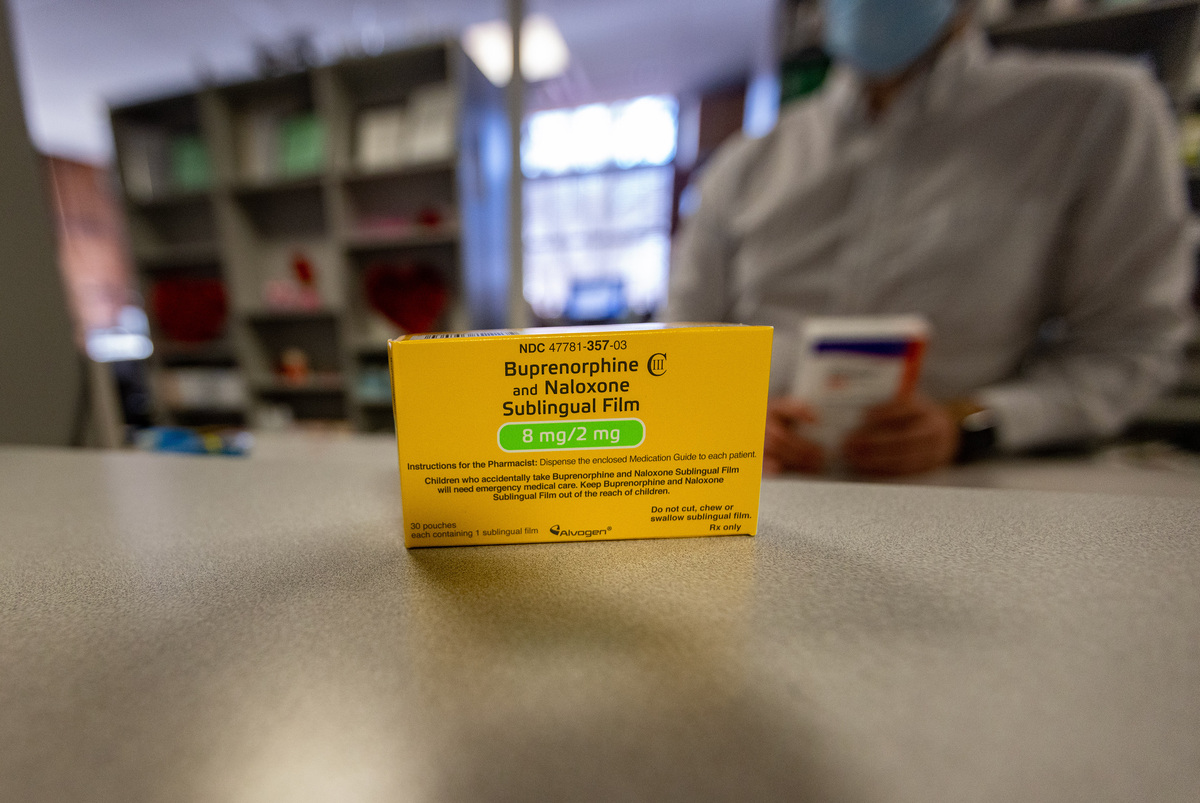
KATIE HAFNER: It seemed to Marie that they’d exhausted everything, but there was one drug the team hadn’t tried – methadone hydrochloride.
CAROL SUTTON LEWIS: Methadone had actually been around for a while by then. It had come to the US from post-war Germany almost two decades earlier.
DAVID COURTWRIGHT: Well, it’s a fascinating story. When the Americans start going through all of this technical and scientific information that they’ve hauled away from Germany, they discover, oh, hey, the Germans have got this new synthetic drug. And sure enough the tests quickly confirmed that it was morphine-like in its effect.
CAROL SUTTON LEWIS: It had been developed by I.G. Farben, a German company that had been so integral to the Nazi regime, it was sometimes called “the devil’s chemist.” I.G. Farben had used tens of thousands of slave laborers during the war, many from Auschwitz, to work in its factories. It manufactured Zyklon B – the poison used in the gas chambers.
CAROL SUTTON LEWIS: They also manufactured methadone, which the Germans called amidon. Like all opioids, it’s a powerful painkiller, much more powerful than morphine, as it would turn out.
DAVID COURTWRIGHT: And the implications of this, uh, quickly became apparent, both in the medical community and to the old Federal Bureau of Narcotics.
Um, the medical community saw it as a potentially valuable synthetic opioid analgesic, and the Bureau of Narcotics saw it as that, but also as a drug that presented, um, a threat of addiction or diversion and which needed to be regulated like other narcotic drugs.
So there was a bit of legal maneuvering, but ultimately the Bureau prevailed and got it classified as a narcotic drug like morphine.
CAROL SUTTON LEWIS: At Lexington, the Narcotic Farm in Kentucky, the research center had also been interested in methadone, and they’d run experiments on patients. This was close to—and maybe even at the same time—that Marie was there.
DAVID COURTWRIGHT: And sure enough, it satisfied their craving. It prevented them from going into withdrawal.
CAROL SUTTON LEWIS: The problem, at least according to an early study, was that some patients seemed to like methadone a little too much. When the researchers gave it to people addicted to morphine, they heard comments like: “That is great stuff.” “I wouldn’t have believed it possible for a synthetic drug to be so like morphine.” “Can you get it outside?” And the researchers concluded this drug was risky — it would surely be abused if it became freely available. And after that, methadone fell out of prominence.
KATIE HAFNER: So back in 1964, the Rockefeller team had been trying everything they could think of, and nothing was working. Their patients were getting high doses of opioids, but they were still irritable, distracted, and dissatisfied. And then, the doctors decide to try methadone. Since their patients had been on high doses of other opioids, they put them on equivalent high doses of methadone – presumably to avoid harsh withdrawal symptoms.
Now, when methadone was used for detox, the dose was something like 15 to 25 milligrams, maybe 40 milligrams tops. But to match the high levels of opioids they were already giving these two men, the team would have to up the methadone dose by a lot.
MARIE NYSWANDER: These were very large amounts in 90 milligrams, 80, 90, 100 milligrams. We were very scared of that amount.
KATIE HAFNER: But they went ahead with it. And the next day or the day after, there were two young men unlike anything that they had previously seen. The patients were dressed, their color was good. They seemed almost too good.
MARIE NYSWANDER: I didn’t believe it. I had been around too long and seen too many miracles which turned out not to work. So I think, in a way, Mary Jeanne Kreek, who had no such past failure experiences, noticed and believed it at first.
CAROL SUTTON LEWIS: Marie was reluctant to get her hopes up. But Mary Jeanne, she could see something significant was happening. And Vince noticed it too. He had gotten in the habit of chatting with the patients every day for about two or three hours. Just casual conversations to get to know them better. And when they started taking methadone, he noticed a shift.
VINCENT DOLE: Our conversations were moving into orbits, like, uh, baseball and politics and, and more general topics that you’re likely to come into rather than endlessly, endlessly recalling, uh, drug experiences.
CAROL SUTTON LEWIS: The patients seemed interested in their lives again. They were even asking to go back to school to finish their education. The Rockefeller doctors hadn’t seen this with anything else they’d tried.
KATIE HAFNER: So at this point, methadone looked promising. But so far, these patients had been living full time in this controlled hospital environment. Yes, this treatment seemed to have changed the patients. But what would happen if they actually went out into the world? There was only one way to find out. But, Marie was nervous.
MARIE NYSWANDER: I didn’t know how far I wanted to trust this. Uh, I could see now they said they didn’t want any drugs. Okay. But now when they’re out in the street, is this methadone gonna carry when they’re out in the street and then they see drug addicts? They still gonna come home without a shot, they’d come back?
KATIE HAFNER: Living outside the hospital, encountering all the hardships and temptations of the city, that was the real test. And it was about to begin. The patients would still sleep at the hospital, but during the day, they’d be free to go where they pleased. And one day, off they went.
MARIE NYSWANDER: I’d sit here at night waiting for them to come back, in total terror every night, and I wouldn’t go home until after they got back. And I couldn’t tell them because I didn’t want that pressure on them.
KATIE HAFNER: But they did come back that first day. And the second, and the day after that. Over and over, the patients came back. One time, they told Marie this story, they told her that, yeah, we saw people buying drugs across the street, but we didn’t feel tempted.
With methadone, they weren’t craving heroin. What were they craving instead on that day? Ice cream. Yep, instead of buying heroin, her patients told her they’d gone and bought ice cream cones.
CAROL SUTTON LEWIS: These results were astounding, but was it just a fluke? Next, the Rockefeller doctors expanded the study of methadone to six more patients, a varied group with different backgrounds, and different levels of education. And once again, same results.
MARIE NYSWANDER: They were all looking wonderful and going to school. And, and you never saw six such nice, attractive, uh, young men. And we had some narcotic agents up to meet them and talk to them. These days, we were inviting people in. So there were, I think two or three narcotic agents who came up and we were talking about narcotics, and then we introduced ’em to patients and said, well, here’s some drug addicts. Would you like to talk with them? And they said, oh, these aren’t addicts.
CAROL SUTTON LEWIS: It looked like Marie and her team had found a treatment plan that just might work. But had they?
Next time: Marie and Vincent share what they found with the world—but not everyone likes it.
KATIE HAFNER: The Lost Women of Science podcast is hosted by me, Katie Hafner-
CAROL SUTTON LEWIS: -and me, Carol Sutton Lewis. This episode was produced by Zoe Kurland, Nora Mathison and Elah Feder, our senior producer, with help from Alexa Lim, Emma Sullivan, Mackenzie Tatananni and Dominique Janee.
KATIE HAFNER: We had fact checking help from Danya AbdelHameid. All of our music is by Lizzy Younan. D Peterschmidt mixed and designed the sound for this episode.
CAROL SUTTON LEWIS: Once again, a big thank you to David Courtwright who shared his oral history collection with us. It’s called Addicts Who Survived, and includes the interviews you heard with Marie Nyswander and Vincent Dole and much more.
KATIE HAFNER: I want to thank my co-executive producer at Lost Women of Science, Amy Scharf. We are funded in part by the Alfred P. Sloan Foundation, and Schmidt Futures. Our podcast is distributed by PRX and published in partnership with Scientific American.
CAROL SUTTON LEWIS: For show notes and more about the whole team that makes this show happen, visit lost women of science dot org. Finally, if you like what you heard, please tell one person you know! Today! It really helps the show!
KATIE HAFNER: Yeah. You tell one person and then five people will know.
CAROL SUTTON LEWIS: [laughing] What? Katie’s lost it.
KATIE HAFNER: See you next week!