Recovery high schools build a culture of mental health to help kids thrive : Shots

Recovery high schools build a culture of mental health to help kids thrive : Shots

5280 High School in Denver is one of 43 secondary schools in the U.S. with a program designed for students recovering from substance use disorder and related mental health disorders.

Stephanie Daniel/KUNC


hide caption

toggle caption

Stephanie Daniel/KUNC
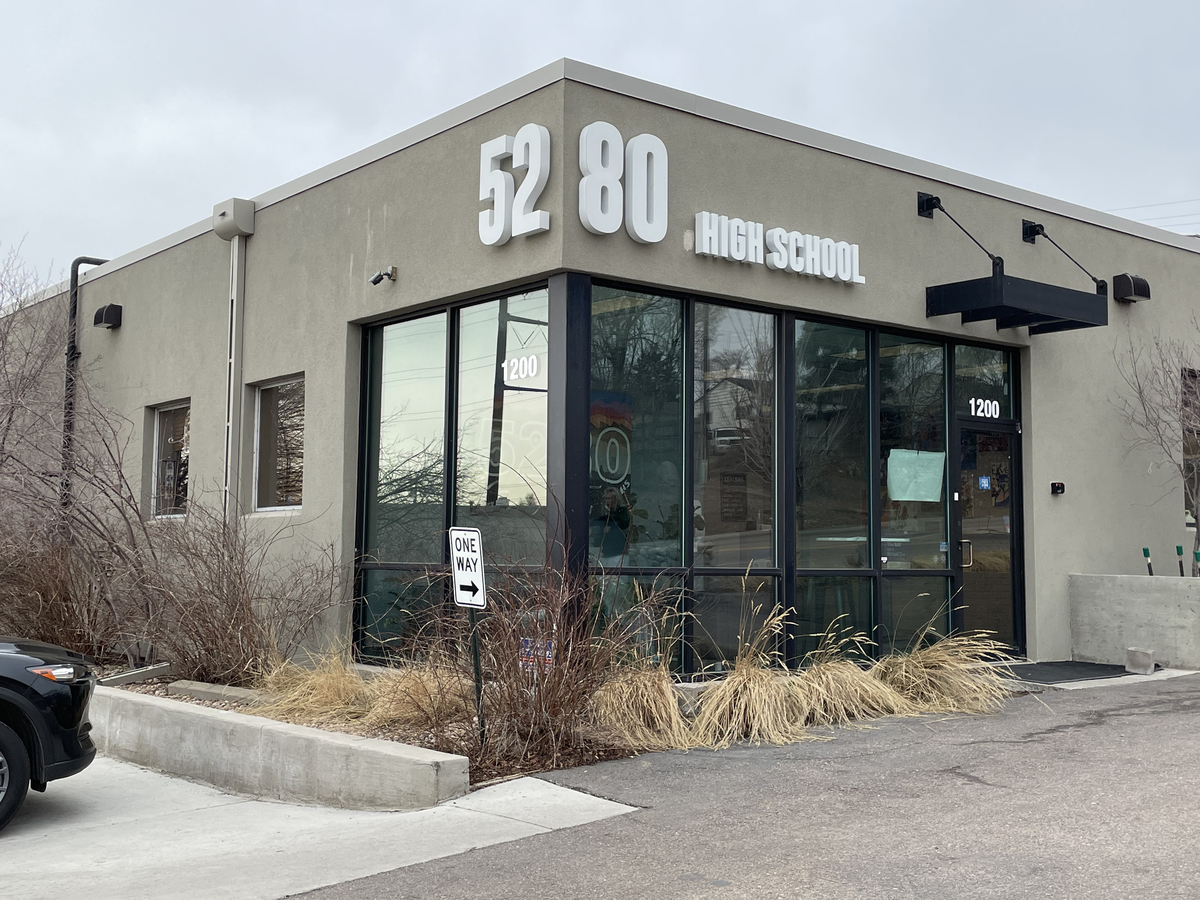

5280 High School in Denver is one of 43 secondary schools in the U.S. with a program designed for students recovering from substance use disorder and related mental health disorders.

Stephanie Daniel/KUNC

Every weekday at 5280 High School in Denver starts the same way.

Students in recovery from drug and alcohol addiction gather on the steps of the school’s indoor auditorium to discuss a topic chosen by staff members. One recent morning, they talked about mental health and sobriety. A teenage boy dressed in tan corduroys, a black hoodie, and sneakers went first.

“I didn’t want to have, like, any emotion,” he said. “So I thought, like, the best way to, like, put it down would be to do more and more and more drugs.”

A classmate said she started doing drugs for fun and then got hooked. Another student said his addiction negatively impacts his mental health. A third announced an upcoming milestone.

“In, like, two days, I’ll be six months sober,” she said, as her classmates cheered.

The students attend Colorado’s only recovery high school — one of 43 nationwide. These schools are designed for students who are recovering from substance use disorder and might also be dealing with related mental health disorders. The Denver school opened in 2018 as a public charter school that today enrolls more than 100 students.

KHN logo

One of those cheering classmates was sophomore Alexis Castillo, 16, who listened supportively during that recent morning meeting. She is in recovery for alcohol and fentanyl addictions. Several of her friends attended the school when she enrolled during her freshman year and initially loved it. But after a while some of Castillo’s friends left and she grew disillusioned. She stopped going to class and wasn’t motivated to work her recovery steps.

“They give you a lot of accountability,” she said. “That was not something I wanted.”

Castillo relapsed and school staffers helped her get into rehab. Three months later she was back at the school, in recovery and ready to do the work.

The school’s mission is to help kids learn to live a substance-free life while receiving an education. This includes attending recovery meetings and wellness activities, and taking traditional high school classes like English, math, and Spanish.

“They can go on to college or a career and really handle anything that life throws at them,” said 5280’s founder and executive director, Dr. Melissa Mouton.

In 2022, nearly a third of 12th graders and 1 in 5 10th graders reported using an illicit drug in the previous year, according to a national survey from the Monitoring the Future project conducted by the University of Michigan Survey Research Center. Those numbers have steadily decreased over the past 25 years. However, data from UCLA shows overdose deaths among teens doubled in the first year of the pandemic, mainly attributed to the increased prevalence of fentanyl-laced drugs.

The first recovery high school opened in Silver Spring, Md., in 1979 and similar programs now operate in 21 states. Compared with their peers at regular schools who have gone through treatment, recovery high school students have better attendance and are more likely to stay sober, and their graduation rate is at least 21{35112b74ca1a6bc4decb6697edde3f9edcc1b44915f2ccb9995df8df6b4364bc} higher, according to one study.

A mosaic in the computer lab at 5280 High School in Denver. Colorado’s only high school with a recovery program opened in 2018 as a public charter school and today enrolls more than 100 students.

Stephanie Daniel/KUNC


hide caption

toggle caption

Stephanie Daniel/KUNC


A mosaic in the computer lab at 5280 High School in Denver. Colorado’s only high school with a recovery program opened in 2018 as a public charter school and today enrolls more than 100 students.

Stephanie Daniel/KUNC

“For this particular group of young people who have these disorders, this can be a lifesaver,” said John Kelly, director of the Recovery Research Institute at Massachusetts General Hospital. “It can help them create a social norm of recovery.”

There are three components to effective drug and alcohol treatment, according to Dr. Sharon Levy, a pediatrician and addiction medicine specialist at Boston Children’s Hospital. The first part is medical, which includes seeing a doctor, drug testing, and using medications like buprenorphine to treat opioid addiction. The second is emotional support from counseling to address co-occurring mental health disorders. And there is a behavioral component that, for kids, can include receiving positive feedback from parents, peer support and recovery schools.

“Recovery schools offer an opportunity really for peer support and mutual aid in a kind of a supervised and structured way,” Levy said.

Recovery high schools often weave components of treatment into the school day — activities like 5280’s daily recovery program meeting. In the afternoon, the school offers wellness electives such as spiritual principles and journaling. The school also employs a director of recovery and recovery coach to work with and counsel the students individually.

Recovery schools do face challenges. Most are publicly funded charter or alternative schools that carry a higher cost of educating students than traditional schools do. This is due to a smaller enrollment, the need for mental health and recovery personnel, higher faculty-to-student ratios, and other factors.

The Denver school enrolls about 100 students annually, making it one of the biggest recovery high schools in the nation. This year, the per-pupil cost is about $25,000 per student but the school receives only about $15,000 from federal, state, and local funding, according to Mouton. The remaining money comes from donors.

Given the complex needs of the students, “recovery schools will always be small,” she said.

Pooling such students together may also raise a concern that students will trigger one another to use drugs and alcohol and relapse, but, Levy said, that’s a risk with any social interaction.

“So, if you’re in an environment where the recovery is kind of front and center and people are watching and monitoring and supervising,” she said, “I think that’s helpful for a lot of kids.”

The school in Denver purposely keeps enrollment under capacity so additional teens can enroll anytime during the school year. A student won’t get kicked out if they relapse, but there are two requirements: They must want to be sober and attend an outside recovery program.

“The No. 1 step is just letting them know out of the gate, no matter what’s going on, that we love them,” said Brittany Kitchens, the school’s recovery coach. “We are here for them.”

Kitchens teaches students how to navigate recovery and regulate their emotions. She likens herself to a hall monitor, constantly checking in with students and looking for changes in behavior.

“I tend to be the first kind of line that the kids will come to when they’re experiencing something that is just a little bit too big for them to process,” she said.

Some of these difficulties stem from traumas students have experienced, including sex and drug trafficking, and abandonment. Students also deal with traumas they have caused, Kitchens said, actions that landed them in jail or on probation.

Kitchens, who is in recovery herself, shares coping mechanisms with the students.

“A lot of times it just starts with, ‘Hey, take a breath, breathe in through the nose and out through the mouth,'” she said.

Alexis has been in recovery for nearly a year, she said. The morning meetings where she and her classmates talk about mental health, sobriety, and other topics are an opportunity to build a community of friends who support one another, something she said she didn’t have when she was using drugs.

“It’s really hard to get sober young,” she said.

This article is part of a partnership that includes KUNC, NPR, and KHN.

KHN (Kaiser Health News) is a national newsroom that produces in-depth journalism about health issues. Together with Policy Analysis and Polling, KHN is one of the three major operating programs at KFF (Kaiser Family Foundation). KFF is an endowed nonprofit organization providing information on health issues to the nation.

Don’t Let Diet Culture Spoil Your Holidays

Don’t Let Diet Culture Spoil Your Holidays

Don’t Permit Diet Tradition Spoil Your Holiday seasons

3 strategies from an Eau Claire indigenous and registered dietician to appreciate your holiday break season – and meals – to the fullest

Isabel Markowski

EAT AND BE MERRY. The holiday season is riddled with all things sugary and salty, twinkling lights, family gatherings, and New Year resolutions. Typically a time of year where exercise and diets are at the top of such resolutions, a Chippewa Valley native and registered dietician talks how to avoid letting diet culture ruin your holiday season. (Photo via Unsplash)

Consume AND BE MERRY. The holiday time is riddled with all issues twinkling and snowy, household gatherings, and New Year’s resolutions. Generally it is a  time of yr wherever workout and diet regime are at the prime of this kind of resolutions, so we spoke with a registered dietician on eating plan tradition.  (Photograph by means of Unsplash)

It’s as ubiquitous as the sandhill cranes alongside the Chippewa River, peppering our life whether or not we observe it or not. It’s in each greeting with family in the course of the holiday seasons (“You seem very good, did you get rid of body weight?”), every single Google search with a side-webpage headline for juice “detoxes,” each individual exercise accomplished in buy to “earn” foodstuff. It is just about everywhere, primarily through the holidays: diet plan culture.

Even though this “health” concentrate may possibly appear to be great on the surface area, eating plan society has infiltrated everyday life and sits at the core of society’s claim that thinness is morally fantastic, that fatness – in any type – is sinful, and that the only way to be satisfied is to get slim via quick-expression, magical answers.

Diet program society is a $72 billion sector, with an believed 45 million Individuals dieting each year. However, investigate shows that dieting does not function, and that 95{35112b74ca1a6bc4decb6697edde3f9edcc1b44915f2ccb9995df8df6b4364bc} will get back all the weight back again in 1 to 5 decades. In addition, slipping shorter of these unrealistic expectations can guide to substantial psychological overall health and having disorder behaviors. Diet program lifestyle label or not, tying physical appearance and weight with morality in the guise of “health” permeates folks like the bitter chilly of Chippewa Valley winters: long-long lasting and to the bone.

But this is the vacation season, so how do we rejoice, be with individuals we like, and just be satisfied?

First, see where diet regime culture seems in daily discussions. Seem up frequent phrases and behaviors. Recognize so you can pause and evaluate if demonizing a cookie is definitely main to the distress that diet plan society wishes you to believe it will, or if the authentic distress is ignoring lifestyle, your physique, and something delicious.

Second, relearn to have faith in and regard your human body and its needs. This is a deceivingly hard process, in particular as the body originally recalibrates from a restricted, craving condition (inclined to overeating and elevated ranges of tension). Nonetheless, when we rebuild our self-instinct, food items turns again into just food items and we can honor our own demands about a set of exterior regulations designed with cash, not us, in head.

3rd, progress, not perfection. Your overall health is not established by 1 matter you ate. It’s a multitude of components that you can’t usually regulate like in which you reside, your career, genetics, and so on. There’s also a relearning of a whole connection here. Indicating, just take the techniques to recover from and guard against food plan culture, but give your self ample wiggle space and forgiveness to remember the intention: contentment. 


Isabel Markowski, RDN, LDN, was born and elevated in the Chippewa Valley in advance of heading off to Madison where by she gained a degree in nutritional sciences and environmental scientific studies at UW-Madison. She currently is operations supervisor at Frequent Pantry, Chicago’s oldest continuously functioning foodstuff pantry. 

How To Stop Diet Culture Talk Around The Holidays, According To RDs

How To Stop Diet Culture Talk Around The Holidays, According To RDs

Even though the holidays are a time of celebration and relationship with cherished kinds, it can also be a tough time, primarily for men and women who are presently struggling with their relationship with meals and self-esteem.

There is generally nervousness all over holiday getaway bodyweight acquire, which inevitably exhibits up in discussions. This potential customers to diet regime tradition speak, which refers to reviews other folks make on your weight, human body, or eating behavior. Statements like “Is that all you are ingesting?” and “You sure have a whole lot on your plate” are just two examples you may perhaps listen to for the duration of the vacations and can be immensely harmful not only to the particular person on the receiving conclusion but also to all people who is listening.

“What I frequently see in my personal observe is that when responses like these are created, even if they are not directed to my shopper, it creates much more panic all over food or system graphic, generating them really feel like they just cannot eat, sit, or take pleasure in the holiday seasons like they would if the remark had not been manufactured,” states disordered consuming expert Caitlin Mudd, RD, LDN. For illustration, you could grow to be nervous about what you’re placing on your plate, come to a decision not to go back again for seconds or dessert, or even commence worrying about how you glance in your clothing.


preview for Women's Health US Section - All Sections & Videos

Speaking about foodstuff possibilities and physique graphic, irrespective of whether it truly is about your self or an individual else, has turn out to be so normalized that quite a few people today might not even recognize they are performing it. That is why it is significant to set boundaries close to diet tradition discuss. It signals to these about you that you would relatively not engage in that this form of discussion while preserving your mental well being. Addressing comments close to food plan society will most very likely be not comfortable, but it’s a fantastic option to train favourable relationships with meals and human body picture.

Meet up with the gurus: Caitlin Mudd, RD, LDN, is a non-food plan dietitian and the owner of Caitlin Mudd Diet.

Francesca Alfano, CNS, CDN, is a New York-primarily based integrative nutritionist.

How to Established Nutritious Boundaries all over Diet plan Lifestyle Speak

To established healthful boundaries, Mudd likes to use the acronym ICE, which stands for Disregard, Adjust the subject matter, and Teach. Ignore is rather easy. Retain in brain that the reviews becoming produced have additional to do with the speaker’s romantic relationship with food stuff than your own, she provides.

Changing the issue may well seem hard to do, but you could do it in a refined way. For case in point, if someone states, “I cannot think how numerous sweets we are feeding on right now. I know I’ll have to make up for it tomorrow,” you could say, “I’m not as well worried about enjoying a handful of sweets around the holidays, but let’s communicate about a thing else. How has perform been?” Other matters you can pivot to include a pet, a child, or a new Television set clearly show or transfer, states nutritionist Francesca Alfano, CNS, CDN.

You can also say, “I recognize your feeling, but this calendar year I’m not concentrating on my bodyweight. There are considerably additional intriguing subject areas to discuss about.” Then, you can share a thing remarkable that you have carried out not too long ago or your ideas for the vacation season, states Alfano.

Of program, you can also teach the man or woman on why their comment is unhelpful, or if you are on your intuitive eating journey, you could clarify to them what you are undertaking and why that has been valuable for you.

Vacation-distinct Diet plan Tradition Converse You May possibly Hear and How You Can Reply

When it is hard to control what feedback men and women make all-around food or your overall body, you can get ready oneself to take care of scenarios that could appear up. Acquiring a couple responses all set can enable you reply in a calm and self-assured way. Let us glance at some situations.

“Wow, is that all you’re taking in? Are you on a diet regime?”

You can say: “No, this is how I consume. Have you viewed any great new shows recently?”

Why this performs: This very simple reaction allows you to solution the query in a easy way even though relocating away from further discussing it. Swiftly switching the matter may show to the particular person who created the comment that you’d somewhat explore a thing else.

“You ought to really try out Complete 30! I dropped so significantly pounds on it.”

You can say: “That’s great that it labored for you, but I’m going to adhere with what functions for me. By the way, how’s your pet dog?”

Why this is effective: This sets a distinct boundary for who you are talking to. Expressing that you know what performs for you rapidly lets the other human being know that you happen to be cozy with your current food plan. Following up with a private question directed at them allows steer the conversation in an additional path.

“Whoa, you are definitely loading up your plate there. You may want to enjoy what you eat.”

You can say: “Thanks for your concern about what I’m feeding on, but my body is actually seriously intelligent and very good at regulating my food items intake and I know what is very best for me. Let’s all go all-around and name what we are hoping for in the coming yr.”

Why this will work: This will firmly and politely exhibit the human being you are speaking with that you are thoroughly mindful of what you are putting in your physique and really don’t need their enter. After again, changing the subject is always a fantastic go to make when you’d no lengthier like to examine your taking in behaviors.

“Are you hitting the fitness center following having all this meals?”

You can say: “No, I’m not. I am pleased with the total I’m consuming and really do not come to feel the have to have to function it off.”

Why this functions: Functioning out soon after a large meal is not essential and responding this way will demonstrate the person that you are confident in the sum of food stuff you happen to be feeding on, and far more importantly, confident in your possibilities.


There is no one-dimension-suits-all method to managing food plan tradition communicate with mates and relatives. The holiday time is a wonderful time to join with cherished ones, but it is also the great time to apply self-treatment by safeguarding your psychological and bodily overall health. If you do not truly feel like switching the matter or setting boundaries or carrying out so does not enable in the scenario, eliminating yourself from the conversation and merely walking away is also really effective.