DOJ Signals Increased Scrutiny on Information Sharing

DOJ Signals Increased Scrutiny on Information Sharing

February 10, 2023

Click for PDF

On February 2, 2023, DOJ announced the withdrawal of three policy statements concerning healthcare markets[1]:

  1. the 1993 Department of Justice and FTC Antitrust Enforcement Policy Statements in the Health Care Area (“1993 Statement”);
  2. the 1996 Statements of Antitrust Enforcement Policy in Health Care (“1996 Statement”) (which revised and expanded the 1993 statement); and
  3. the 2011 Statement of Antitrust Enforcement Policy Regarding Accountable Care Organizations Participating in the Medicare Shared Savings Program (“2011 Statement”).[2]

Taken together, these statements provided guidance and safe harbors for information exchanges and other conduct governed by federal antitrust laws.  The withdrawal of the statements is effective immediately.  In lieu of the guidance, DOJ is evaluating conduct on a “case-by-case enforcement approach.”

The withdrawal creates uncertainty as to the kinds of information exchanges that may attract antitrust scrutiny.  While the withdrawal likely does not change the ultimate competitive implication for conduct covered by the statements—in that conformance to the safe harbor requirements would mitigate any potential competitive harm—trade associations and participants in industry surveys or other aggregations of sensitive information should review their existing procedures to confirm they do not raise competitive questions.  Looking forward, these same entities should consider the competitive ramifications of proposed information exchanges rather than relying solely on safety zones set out in the withdrawn policy statements.

The Previous Statements Provided Safe Harbor for Information Exchanges Meeting Specified Criteria.

The 1993 Statement set out safety zones in which DOJ and the Federal Trade Commission (FTC) would not challenge, inter alia, physicians’ provision of information to purchasers of health care services, and hospitals’ participation in exchanges of price and cost information.[3]

One of these safety zones permitted physicians to provide “non-price” information, including the collective provision of underlying medical data, and the development of suggested practice parameters to purchasers of healthcare services (such as insurance companies).[4]  The statement also specified that although the safety zone did not cover the collective provision of “fee-related information,” it did not consider sharing this information to be “necessarily illegal.”[5]

Taken together, the 1993 and 1996 Statements also set out three conditions to qualify for a safety zone when sharing pricing or cost related information[6]:

  1. the information must be collected and managed by a third party (such as a survey or similar program);
  2. the information collected must be at least three months old; and
  3. there must be at least five participants reporting data upon which each disseminated statistic is based, no individual provider’s data may represent more than 25 percent on a weighted basis of that statistic, and any information disseminated must be sufficiently aggregated such so that prices charged or compensation paid by particular participants cannot be identified.[7]

Finally, the 2011 Statement established a safety zone for sharing competitively sensitive information between participants in Accountable Care Organizations (ACOs).[8]  The Affordable Care Act enables groups of medical service providers and suppliers to work together to manage and coordinate care for Medicare fee-for-service beneficiaries through an ACO.[9]  The 2011 Statement permits ACO participants to share information if the independent ACO participants that provide the same service (a “common service”) have a combined share of 30 percent or less of each common service in each participant’s Primary Service Area (PSA).[10]  The PSA for each participant is defined as “the lowest number of postal zip codes from which the ACO participant draws at least 75 percent of its patients, separately for all physician, inpatient, or outpatient services.”[11]  DOJ’s remarks did not specifically address this safety zone.

The Withdrawal of the Healthcare Industry Statements Creates Uncertainty about the Agencies’ Human Resources Guidance.

The withdrawal of the Healthcare Industry Statements also casts doubt on safe harbors in related human resources guidance.  DOJ and FTC’s 2016 “Guidance For Human Resource Professionals” advises H.R. professionals that information exchanges of compensation and other information may be lawful if they satisfy the conditions articulated by the now-withdrawn 1996 Statement.[12]  The withdrawal of the 1996 Statement creates uncertainty about the conditions under which compensation and other human resources-related information can be safely shared between potential competitors for labor.

The Competitor Collaboration Guidelines Remain in Effect and will Serve as Guideposts for Proposed Information Exchanges.

The Competitor Collaboration Guidelines issued by DOJ and FTC in 2000 demonstrate that information exchanges are less likely to raise concerns if they adhere to the conditions that would have qualified them for safety zones under the Healthcare Industry Statements.[13]  First, the Guidelines advise that parties may reduce antitrust concerns by sharing sensitive information through independent third parties as opposed to sharing this information directly with competitors.[14]   Further, sharing historical information is less likely to raise competitive concerns than sharing information on current or future operations.[15]  Finally, the sharing of aggregated data which does not permit recipients to identify individual firm data will be subject to less antitrust scrutiny than the sharing of individual company data.[16]  These principles underlaid the safety zones from the Health Industry Statements.  As the Guidelines remain in effect even after the Statements’ withdrawal, conformance to these conditions should mitigate antitrust exposure.

Moreover, the Competitor Collaboration Guidelines make clear that conduct falling outside of safety zones can be competitively neutral or even procompetitive.[17]  The withdrawal of the safety zones does not necessarily raise heightened concerns about this conduct.

The Withdrawal of the Healthcare Industry Statements May Signal Criminal Enforcement by DOJ of Anticompetitive Information Sharing.

DOJ’s remarks that “information exchanges can facilitate full-blown criminal conspiracies” when they lead to conduct that is per se illegal, and, in other instances, may be evaluated under the rule of reason, suggest that DOJ may seek to pursue anticompetitive information sharing criminally.

DOJ Will Closely Scrutinize Mergers when There is a Prior History of Collusion.

DOJ also remarked that its investigations into anticompetitive information exchanges are not limited to Section 1 of the Sherman Act, and a history of collusion within an industry will serve as important context for the evaluations of mergers under Section 7 of the Clayton Act.[18]  In particular, when one or more merging parties has previously engaged in anticompetitive information exchange, DOJ may treat any past harm resulting from such exchanges as evidence of the potential harmful effects of the merger in the future.[19]

Takeaways.

The withdrawal of DOJ’s prior statements establishing information sharing safety zones creates uncertainty around whether DOJ will now treat exchanges of information that were encompassed by these safety zones as problematic.  Moreover, there is considerable doubt about what conditions must be satisfied for information sharing to be considered lawful by DOJ and the FTC, in the healthcare industry and other industries.  This includes heightened uncertainty around a range of previously presumptively lawful benchmarking related practices in the H.R. space and beyond.  Finally, it remains to be seen whether DOJ will seek to prosecute anticompetitive information sharing criminally.

Gibson Dunn attorneys are closely monitoring these developments and available to discuss these issues as applied to your particular business.

___________________________

[1] Doha Mekki, Principal Deputy Assistant Attorney General, Dept. of Justice, Keynote Address at GCR Live: Law Leaders Global (Feb. 2, 2023), https://www.justice.gov/opa/speech/principal-deputy-assistant-attorney-general-doha-mekki-antitrust-division-delivers-0#_ftnref19.

[2] Id.

[3] U.S. Dep’t of Justice, Department of Justice and FTC Antitrust Enforcement Policy Statements in the Health Care Area (Sept. 15, 1993), at 3, https://www.justice.gov/archive/atr/public/press_releases/1993/211661.htm.

[4] Id.

[5] Id. at 3-4.

[6] U.S. Dep’t of Justice & Fed. Trade Comm’n, Statements of Antitrust Enforcement Policy in Health Care (Aug. 1996), at 44, https://www.justice.gov/atr/page/file/1197731/download.

[7] Id. at 44-45.

[8] U.S. Dep’t of Justice & Fed. Trade Comm’n, Statement of Antitrust Enforcement Policy Regarding Accountable Care Organizations Participating in the Medicare Shared Savings Program (Oct. 28, 2011), at 2, https://www.justice.gov/‌sites/default/‌files/atr/legacy/2011/10/20/276458.pdf.

[9] Id.

[10] Id. at 7.

[11] Id.

[12] U.S. Dep’t of Justice & Fed. Trade Comm’n, Antitrust Guidance For Human Resource Professionals (Oct. 2016), at 5, https://www.justice.gov/atr/file/903511/download

[13] U.S. Dep’t of Justice, Department of Justice and Fed. Trade Comm’n, Antitrust Guidelines for Collaborations Among Competitors (Apr. 2000), at 15-16, https://www.ftc.gov/sites/default/files/documents/public_events/joint-venture-hearings-antitrust-guidelines-collaboration-among-competitors/ftcdojguidelines-2.pdf.

[14] Id. at 21.

[15] Id. at 14.

[16] Id. at 15.

[17] Id. at 25.


The following Gibson Dunn lawyers prepared this client alert:  Daniel Swanson, Chris Wilson, Caroline Ziser Smith, and Hadhy Ayaz.

Gibson Dunn’s lawyers are available to assist in addressing any questions you may have regarding the issues discussed in this update. Please contact the Gibson Dunn lawyer with whom you usually work, any member of the firm’s Antitrust and Competition practice group, or the following:

Daniel G. Swanson – Los Angeles (+1 213-229-7430, dswanson@gibsondunn.com)
Chris Wilson – Washington, D.C. (+1 202-955-8520, cwilson@gibsondunn.com)
Rachel S. Brass – Co-Chair, San Francisco (+1 415-393-8293, rbrass@gibsondunn.com)
Stephen Weissman – Co-Chair, Washington, D.C. (+1 202-955-8678, sweissman@gibsondunn.com)

© 2023 Gibson, Dunn & Crutcher LLP

Attorney Advertising:  The enclosed materials have been prepared for general informational purposes only and are not intended as legal advice. Please note, prior results do not guarantee a similar outcome.
Alex Murdaugh’s best friend testifies he admitted to drug addiction and stealing money

Alex Murdaugh’s best friend testifies he admitted to drug addiction and stealing money


CNN
 — 

An attorney who said he was Alex Murdaugh’s best friend testified at his murder trial Thursday that Murdaugh admitted he had a drug addiction and had been stealing money from his law firm and clients.

“He said, ‘I’m sorry I’ve had a drug problem, I’m addicted to opioids … for something like 20 years,’ ” the friend, Chris Wilson, testified. “He said he had a drug addiction and he admitted that he had been stealing money from his law firm and from clients.”

“I sh– you up,” Murdaugh said, according to Wilson. “I’ve sh– a lot of people up.”

The conversation occurred in September 2021, three months after the deaths of Murdaugh’s wife and son and after Murdaugh’s law firm said it had discovered extensive financial wrongdoing.

Wilson’s testimony comes three weeks into the murder trial for the killings of Maggie and Paul Murdaugh on June 7, 2021. Alex Murdaugh has pleaded not guilty to two counts of murder and two weapons charges.

Murdaugh, 53, called 911 and reported he found his wife and son dead of gunshot wounds outside of their home in Islandton.

Wilson is one of a series of witnesses who have accused Murdaugh of extensive financial wrongdoing at his namesake law firm. Prosecutors have argued Murdaugh killed his wife and son as an attempt to distract attention from his financial crimes and stave off a “day of reckoning.”

Prosecutors also have presented evidence that Murdaugh had opportunity to commit the murders. Audio from a Snapchat video recovered from his son’s phone places Murdaugh at the murder scene, prosecutors contend, contrary to his alibi to investigators that he was not there that night.

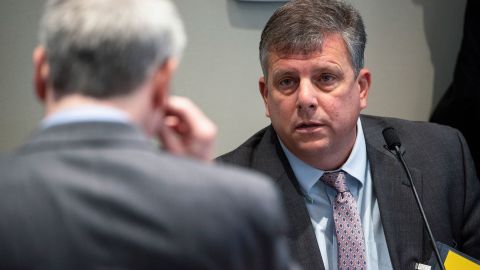
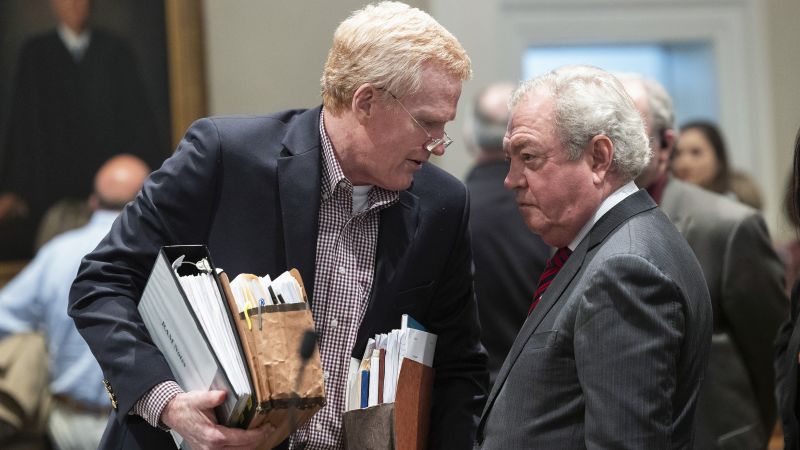
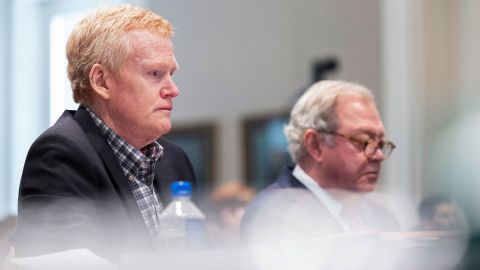
Alex Murdaugh listens in court Thursday as an attorney testifies about a case they worked on together.

However, there is effectively no direct evidence – no witnesses, no murder weapon, no DNA and no ballistics – that link Murdaugh to the murders. Instead, prosecutors have offered circumstantial evidence, such as the gunshot primer residue found on Murdaugh’s clothes and on a blue raincoat, and the financial motive.

The defense has argued this financial evidence is beside the point.

“They’ve got a whole lot more evidence about financial misconduct than they do about evidence of guilt in a murder case. And that’s what this is all about,” defense lawyer Jim Griffin said last week.

In court Thursday, Wilson, an attorney in Bamberg, South Carolina, testified he was one of Murdaugh’s financial victims.

He and Murdaugh had worked on a personal injury case together and won a verdict of $5.5 million, with each attorney earning about $792,000. Murdaugh asked Wilson to write the check to him personally rather than his law firm, and Wilson did as requested.

“I’ve known him for 30-plus years and didn’t have any reason not to trust him,” he said.

Witness Chris Wilson testifies during Alex Murdaugh's murder trial on Thursday.

Murdaugh later asked Wilson to rewrite the check and make it out to the law firm, he testified. Murdaugh wired him back $600,000 but said he didn’t have the full funds, so Wilson had to spend $192,000 of his own money to cover the difference, he said.

The checks ultimately played a key role in Murdaugh’s law firm’s discovery that he had been misappropriating funds, according to testimony from his coworkers.

Wilson also testified he spoke with Murdaugh on the phone at 9:11 p.m., 9:20 p.m. and 9:53 p.m. on June 7, 2021, around the time of the murders. In the short conversations, nothing sounded out of the ordinary, Wilson said.

Also in court Thursday, Michael “Tony” Satterfield, the son of Murdaugh’s former housekeeper Gloria Satterfield, testified about being defrauded by Murdaugh.

Gloria Satterfield had worked for the Murdaugh family for about 20 years and died in 2018 after a fall at the Murdaugh family’s home.

Murdaugh offered to file a claim against his insurance company to get money for his housekeeper’s sons, Michael Satterfield testified. However, Satterfield did not see any of that money and did not know Murdaugh had collected more than $4 million in settlements, he testified.

Satterfield testified that he learned of the settlement from his family, who heard about it through media reports. He said when he asked Murdaugh about it in June 2021, Murdaugh told him “it was still making progress” and to be ready to settle by the end of the year.

In December 2021, Satterfield and his brother received a settlement of $4.3 million and an apology from Murdaugh in a confession of judgment.

Further, the CEO of a local bank testified for the jury that Murdaugh’s account was overdrafted by about $350,000. As of August 2021, Murdaugh had a total debt to the bank of $4.2 million, according to Palmetto State Bank CEO Jan Malinowski.

All three witnesses previously testified outside of the jury’s presence last week.

Much of the testimony this week has focused on Murdaugh’s financial issues. The judge overseeing the case ruled on Monday to allow such evidence, saying it was “so intimately connected” with the state’s case “that proof of it is essential to complete the story.”

Thursday’s session ended with attorney Mark Tinsley on the stand. He represents the family of 19-year-old Mallory Beach, who was killed in February 2019 when a boat, owned by Murdaugh and allegedly driven by Paul, crashed.

At the time Maggie and Paul were killed, Murdaugh was facing a lawsuit from Beach’s family. A hearing in that civil case was scheduled for June 10, 2021, and had the potential to reveal Murdaugh’s financial problems, prosecutors have said.

But that hearing was delayed after Maggie and Paul were killed.

On Thursday, the prosecution asked Tinsley about how that lawsuit was proceeding. He testified he was seeking $10 million from Murdaugh, but was told Murdaugh was broke and might only be able to come up with $1 million. Tinsley was not cross-examined Thursday and is expected to resume his testimony Friday morning.

Another prosecution witness this week spoke about Murdaugh’s financial dealings. The chief financial officer of his law firm testified she had confronted Murdaugh about missing funds on the morning of June 7, hours before the killings. Afterward, his coworkers offered him sympathy and gave him a reprieve on the financial issues.

“We weren’t going to go in there and harass him about money when we were worried about his mental state and the fact that his family had been killed,” the CFO, Jeanne Seckinger, testified.

Indeed, that “day of reckoning” didn’t come for another three months, when his law firm again confronted him about misappropriated funds, leading to his resignation, a bizarre murder-for-hire and insurance scam plot, a stint in rehab, dozens of financial crimes, his disbarment and, ultimately, the murder charges.

The defense has said the June 10 civil hearing was not a “day of reckoning” but just one in a series of hearings. Murdaugh faces 99 charges for various financial crimes – but those charges will be adjudicated in a separate case and are unrelated to the murders.

Senators probe telehealth startups’ healthcare data sharing practices

Senators probe telehealth startups’ healthcare data sharing practices

A team of senators sent letters to three telehealth startups — Monument, Workit Well being and Cerebral — to ask for far more facts on how these firms are sharing their consumer overall health information. 

The probe comes as the senators express worry that these organizations could be tracking and sharing their customers’ individually identifiable wellness knowledge with social media platforms for marketing needs, in accordance to a Feb. 7 letter signed by U.S. Sens. Amy Klobuchar, D-Minn., Susan Collins, R-Maine, Maria Cantwell, D-Clean., and Cynthia Lummis, R-Wyo.

“Modern experiences emphasize how your corporation shares users’ get in touch with data and health and fitness care data that need to be confidential…this data is reportedly sent to promoting platforms, together with the data needed to recognize customers. This facts is incredibly private, and it can be employed to target adverts for products and services that may perhaps be avoidable or most likely harmful physically, psychologically, or emotionally,” the senators wrote to Cerebral CEO David Mou, MD, Monument CEO Mike Russell, and Workit Health and fitness CEO Robin McIntosh.

A Cerebral spokesperson told Becker’s in an emailed statement, “We take affected individual privacy pretty very seriously and share the Senators’ feelings about the great importance of privacy of patient data. We are doing work diligently to reply their important thoughts and are in the method of responding. We continue to be committed to doing the job with other accountable functions to establish distinct tips concerning the evolving technologies that increase the shipping of psychological overall health care.”

A Workit Overall health agent also told Becker’s that safeguarding its members’ privacy is the firm’s prime precedence. 

“We enjoy the Senate’s notice to the way tracking systems are used in digital health, as privacy is a main component of our ethos, and a single of the explanations our co-founders produced a discreet, on the net method. This letter generates an possibility to broach a conversation far more broadly about common business procedures in health care at big, and we are responding to the letter with the attentive diligence it demands,” the agent wrote to Becker’s. 

Monument did not react to Becker’s request for remark. 

This transfer will come shortly just after the Federal Trade Fee proposed a $1.5 million settlement with GoodRx Holdings for allegedly sharing patient knowledge to promote on Facebook and Google.

Sheboygan man spreads positivity after recovering from drug addiction

Sheboygan man spreads positivity after recovering from drug addiction

Love Your Heart Week of Action Promotes Heart Health with Events, Information & More | Video

Love Your Heart Week of Action Promotes Heart Health with Events, Information & More | Video

This year Really like Your Coronary heart occasions and no-expense blood stress screenings will be offered in excess of the training course of many days in locations through the county and Mexico.

Knowing your blood stress numbers is a essential initial step toward coronary heart wellbeing. Heart ailments are the top lead to of death in the United States, and the second main trigger of loss of life in San Diego County. In 2021, practically 5,000 persons died in San Diego County from heart conditions.

This yr the Like Your Heart Week of Motion runs Feb. 11 by means of Feb. 19 and will include two local community gatherings – 1 in Chula Vista and a further in Ramona – together with additional than 300 spots throughout San Diego County and Mexico the place you can get your blood stress checked for absolutely free. Check your closest location now.

“We all have a accountability to preserve ourselves and our family members balanced,” explained Nora Vargas, Chairwoman, San Diego County Board of Supervisors. “Through this application our county is expanding access to healthcare past our borders and earning it quick to get checked on your way to perform or house from the store. Take cost of your well being and continue to keep your heart healthy, a 5-minute verify can help save your existence! – ¡Cinco minutos pueden salvar tu vida!”

Launched 12 many years in the past, the Really like Your Coronary heart utilized the time period all around Valentine’s Working day to encourage a further comprehension of the importance of coronary heart overall health. This year it proceeds as an expanded 7 days of action to battle a person of the much more preventable results in of loss of life: heart sickness.  

“I’m proud to say about the past 12 decades we have been ready to enable countless numbers of individuals turn into informed of their blood stress, and in the system preserve lives when they went to their health practitioner for comply with up care,” Macchione mentioned. “Our successes happened mainly because of the diligent get the job done by the county and by means of our remarkable associates, but more wants to be finished and we go on to urge everyone to turn into additional coronary heart nutritious and aware.”   

Investigate showed three behaviors to be the most impactful on your wellbeing: 

  • Bad Food plan
  • Actual physical inactivity
  • Tobacco use

These behaviors add to four long-term illnesses: 

  • Most cancers
  • Coronary heart disorder and stroke
  • Form 2 Diabetic issues
  • Lung diseases (like asthma)

Mixed, all those 4 conditions lead to additional than 50 percent of all deaths worldwide. 

Among the men and women in San Diego County, coronary heart condition stays the next major induce of dying, equating to nearly 5,000 loved ones dropped in 2021.  

“While the studies could appear grim, initiatives like Enjoy Your Coronary heart have driven a 12 percent reduction in the proportion of fatalities involved with preventable demise threats from 2007 to 2019,” Dr. Ankita Kadakia, Deputy Community Wellbeing Officer. “By generating smaller lifestyle adjustments and realizing your blood force quantities you can just take command of your health.”  

Coronary heart overall health is prime of brain for many Americans just after NFL participant Damar Hamlin collapsed throughout the Buffalo Charges recreation previous month. That is why San Diego County and Dwell Effectively partners are also impressing the great importance of discovering CPR and realizing where AEDs are all around your place of work and in other general public spaces. 

For persons intrigued in discovering about CPR, the Community Crisis Reaction Workforce will exhibit fingers-only CPR at the Ramona Adore Your Coronary heart good.  

The two local community functions will convey Stay Very well companions collectively to supply blood pressure screenings, flu vaccines, Narcan distribution and other means to teach our neighbors and empower them to just take regulate of their health. 

Saturday, February 11, 2023
12 p.m. – 3 p.m.
San Diego Tempo Chula Vista
880 3rd Avenue, Chula Vista, CA, 91911
 

Saturday, February 25, 2023
12 p.m. – 3 p.m.
Ramona Library
1275 Main St. Ramona, CA, 92065 

The County appeared into the California Balanced Locations Index when scheduling the locale of local community events and screening websites to concentration on locations with an above-typical recorded incidence of superior blood pressure. 

Understanding your quantities and making modest modifications to your every day lifestyle, such as eating plan and physical exercise, vital in the avoidance of heart disease, cardiac arrest, and stroke. 

Very last year’s Appreciate Your Heart campaign attained additional than 7.5 million people today, by the combined mediums of print, radio, billboard, transit and social media. It gave local community associates more than 6,000 blood stress displays to give to underserved residents and supplied Love Your Coronary heart educational packets at all COVID-19 tests internet sites. The marketing campaign also attained more than 500 men and women by local community activities including the Refugee & Newcomer Truthful.

Oregon lawmakers consider cutting millions from addiction services after decriminalizing drugs

Oregon lawmakers consider cutting millions from addiction services after decriminalizing drugs

Two decades immediately after Oregon voters decriminalized possession of all drugs, lawmakers are debating using hundreds of thousands of bucks away from dependancy solutions and sending it again to regional governments.

Advocates for the proposal argue the state’s first-in-the-country drug decriminalization legislation took as well a great deal revenue away from metropolitan areas, counties and point out law enforcement to fund habit services. But opponents argue defunding restoration companies will have disastrous effects.

“At a time when lethal drugs are widespread and overdoses are skyrocketing, this is not the time to cut addiction restoration companies,” Ron Williams, director of outreach for the Overall health Justice Recovery Alliance, testified for the duration of the very first of various hearings on the proposed monthly bill.

Measure 110 passed with 58{35112b74ca1a6bc4decb6697edde3f9edcc1b44915f2ccb9995df8df6b4364bc} of the vote in 2020. It decriminalized possession of hard drugs and reallocated millions of dollars to fund addiction services.

Evaluate 110 passed with 58{35112b74ca1a6bc4decb6697edde3f9edcc1b44915f2ccb9995df8df6b4364bc} of the vote in 2020. It decriminalized possession of tricky medicine and reallocated tens of millions of dollars to fund addiction providers. (John Moore/Getty Photographs)

‘OUR Metropolis IS IN PERIL’: PORTLAND Small business Homeowners Demand Extra Motion AS CRIMINALS ‘WREAK HAVOC’

Voters passed Evaluate 110 in 2020, building Oregon the very first condition to decriminalize possession of personalized use amounts of really hard medicines which includes heroin, meth and fentanyl. The legislation redirected a great deal of the state’s marijuana tax profits — which had formerly benefited faculties, police and local governments — to fund grants for dependancy providers.

“As a outcome, our ability to pay for community health and fitness and community security providers has lessened,” a coalition symbolizing 25 mayors in the Portland metro spot wrote to lawmakers last 7 days, including that Measure 110 siphoned $45 million from cities and counties in excess of the previous number of a long time.

HOW HAS DRUG DECRIMINALIZATION Labored OUT FOR OREGON? Watch:

Enjoy A lot more FOX News Electronic ORIGINALS In this article

Far more than $300 million has been allotted so considerably to solutions like thoroughly clean needles, naloxone, peer support and far more. The Oregon Health and fitness Authority mentioned funding has arrived at far more than 60,000 people today as of September.

HB 2089 proposes taking some of the cannabis tax income earmarked for dependancy and educational institutions and sending it back to regional governments and law enforcement.

At a time when deadly drugs are prevalent and overdoses are increasing, Measure 110 proponents say lawmakers should not cut funding to addiction services.

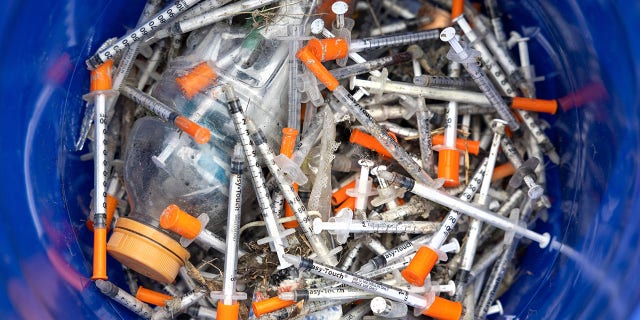
At a time when fatal prescription drugs are widespread and overdoses are escalating, Evaluate 110 proponents say lawmakers must not reduce funding to habit companies. (Gary Coronado/Los Angeles Times via Getty Photos)

Simply click Below TO GET THE FOX News App

Associates of Oregon’s hashish market have been between these who testified in assist of HB 2089 past week, arguing it would much better equilibrium funding priorities throughout the condition.

“For the financial viability of counties, the corporations that work within just them and the Oregon Cannabis Account, we want to be protected and area governments need to have to work efficiently,” said Amanda Metzler, founder of F.A.R.M.S. Inc.

The hearings on HB 2089 are scheduled to continue on Tuesday and Wednesday.

Ramiro Vargas contributed to the accompanying video.