

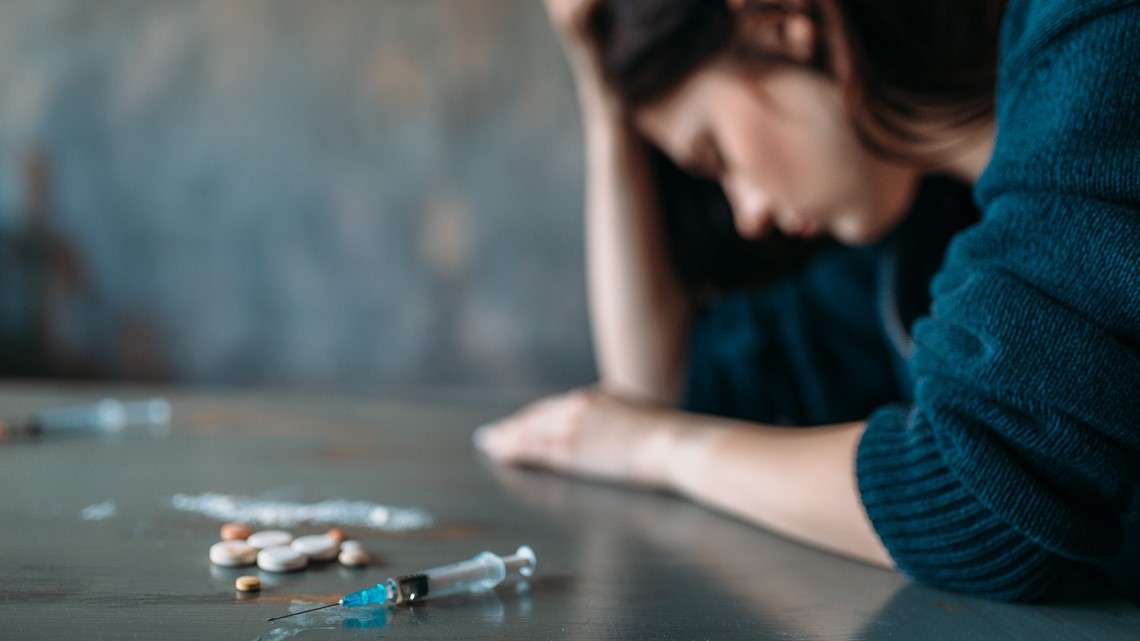
Shemia Fagan’s office has released an audit of Oregon’s implementation of Measure 110, which decriminalized user amounts of street drugs.
SALEM, Ore. — A measure approved by Oregon voters in 2020 with the mission of completely overhauling how the state approaches drug crimes and addiction treatment has not yet been given the chance to produce tangible results, according to the results of an audit released Thursday by the Oregon Secretary of State’s office.
There were two main aspects of Measure 110 when it was adopted just over two years ago: the decriminalization of user amounts of narcotics and a major allocation of funding toward addiction treatment programs from Oregon’s legal cannabis taxes.
Drug decriminalization went into effect almost immediately. By early 2021, minor drug possession crimes were no longer subject to the typical jail and court systems. Instead, law enforcement agencies were directed to greet these violations with a fine that could be dropped if the user seeks treatment. Positive results have not been quick to emerge.
But the other big part of Measure 110, the part that was supposed to fund addiction treatment programs so that they’d be readily available, took much longer to tackle. It wasn’t until September of 2022 that the Oregon Health Authority announced funds had gone out to each county in the state.
And this — the reason for this delay, that is — became the primary focus for the audit by Secretary of State Shemia Fagan’s office. After all, the Measure 110 framework has yet to produce much else for auditors to assess.
In a statement that accompanied the auditor’s report, Fagan openly expressed her feelings on Measure 110 — that she wants, and Oregon needs, to see it succeed.
“It is plain as day that Oregon’s drug treatment system is failing,” Fagan said. “This is incredibly frustrating for me, and many Oregonians, because treatment is a matter of life and death for people we know. I have a brother in recovery right now. I want to see Measure 110 work.”
RELATED: Peer mentors key to Measure 110 success are working in a broken addiction care system
‘Too early to tell’
Measure 110 passed in November 2020 with more than 58{35112b74ca1a6bc4decb6697edde3f9edcc1b44915f2ccb9995df8df6b4364bc} voter support. Like most ballot measures, the provisions didn’t really go into effect until a few months later, early 2021 — which means that it’s really been around for about two years, as of this audit’s release.
Regardless, the headline of the Secretary of State’s office audit is pretty straight and to the point: it’s too soon to know whether it’s actually working.
“We got off to a rough start,” said Audits Director Kip Memmott during a Thursday press briefing. “Some of this government-by-ballot-initiative causes some problems, and it takes time to structure government properly which can be frustrating. But auditors, you know, we talk a little bit wonky about controls and governance and outcome measures, but you really have to have those in place to assess performance.”
What Measure 110 didn’t require as a provision are tools for entities like the Secretary of State’s office to gather data on how it’s progressing. Much of the program is still a black box, so auditors couldn’t get an accurate assessment of how many people are being helped or if the money is going where it’s needed.
As of this phase of the rollout, $302 million in Oregon’s marijuana tax money has been diverted to Measure 110.
Of that total funding, $32 million in “access care grants” were awarded by the Oregon Health Authority early in the process in provide some funding while the more permanent programs were still being developed. However, little to no data was collected by the OHA, and auditors were unable to determine if the grants were effective or how they were spent. There was no data on whether the grants actually improved access to addiction care.
Many of the service providers were small and unfamiliar with state-run programs, the OHA told auditors, so health officials determined that forcing them to report more data would be “unduly burdensome.”
The misfortunes of being a trail blazer
In embarking on the implementation of Measure 110, the state had to do something that was not only new to Oregon, but something new to the U.S. As a result, it seems to have suffered from the novelty of it all.
The measure required that Oregon create an Oversight and Accountability Council, one that the audit said has “ultimate decision-making authority” in implementing programs and handing out grants. OAC councilors were all appointed at the same time and have the same term length, serving on a volunteer basis. Council members, many of whom had full-time jobs outside of the OAC, reported spending 40-hour weeks on their Measure 110 tasks.
At the same time, the council struggled to find its footing alongside the Oregon Health Authority, resulting in “delays, confusion, and strained relations between OHA and the OAC.” The audit describes an ill-defined relationship between the council and the OHA, resulting in many dropped balls and occasional head-butting.
Often lacking the expertise that the work required, things like grant-making, council members had to lean on OHA staff. But, the audit found, OHA’s facilitation was often ad hoc and its obligations not clearly defined by the measure itself.
“Staffing resources dedicated to M110 have ranged from a handful of people to dozens of staff,” the report said. “For example, in February 2022, eight OHA staff were assigned to M110 work. Although OHA has since increased staffing resources toward M110 implementation, key roles continue to experience staff turnover.”
Meanwhile, tasked with coming up with grant applications from scratch, the OAC designed a 240-point application, sometimes requiring long responses, that was “burdensome to complete and challenging to navigate” for service providers. Confused applicants who reached out for help then often received conflicting guidance from OHA staff.
“It had too many elements that needed to be evaluated, too many reviews that needed to take place before they could make those funding decisions, and they didn’t have the staff support from OHA to get to those reviews and make recommendations,” said Audit Manager Ian Green, “so that’s what led to months-long delays.”
Too many cooks
Measure 110’s fledgling programs have also suffered from issues already replete in Oregon’s addiction recovery and mental health systems: redundancy and a lack of integration with other, similar services.
For an example, the audit looked at a Recovery Center Hotline that Measure 110 required OHA to establish. The agency did get the hotline set up, but had only received 119 calls related to the drug treatment program as of June 2022, at an estimated cost to the program of more than $7,000 per call.
Of those calls, only 27 people were interested in drug treatment resources.
There are multiple hotlines in Oregon that already cover similar issues, including the statewide Alcohol & Drug Helpline and the Oregon Behavioral Health Support Line, both of which were better established and received substantially more calls. And some of the providers responsible for actually providing the services funded by Measure 110 have their own hotlines, the report pointed out.
“These services may be duplicative since current law requires such support also be provided through a statewide hotline,” the report said. “At the time of this report’s release, OHA still had plans to continue the statewide hotline in addition to any redundant hotline services provided by (service providers). OHA told auditors reducing potential hotline redundancy is not its legal responsibility, and it does not plan to work to prevent the risk of such redundancy as a result.”
The audit also underlined that Measure 110 did not direct the OAC to collaborate with other, potentially major partners, like the Oregon Department of Corrections and Oregon Housing Community Services; both of which often intersect with substance use through the criminal justice system and housing programs.
More than 63{35112b74ca1a6bc4decb6697edde3f9edcc1b44915f2ccb9995df8df6b4364bc} of inmates experience substance use disorders, the report noted, but less than 5{35112b74ca1a6bc4decb6697edde3f9edcc1b44915f2ccb9995df8df6b4364bc} have access to intensive treatment while in custody.
“The lack of access to treatment in and out of custody has been a missed opportunity for the state,” the report said.
There’s also the issue of law enforcement, which is still supposed to have a role in the process despite Measure 110’s drug decriminalization. Through the measure, officers are empowered to issue class E citations when they come into contact with someone in possession of user amounts of narcotics.
In spite of this, auditors were told by different jurisdictions they questioned that “they handled this process with some degree of variability.” Some issued many citations, while others “showed reluctance to engage.”
And even when law enforcement officers do issue citations, they may or may not provide the Measure 110 hotline number to the drug user and encourage them to call it, the report said.
“Law enforcement agencies sharing limited information with providers may help increase outreach to individuals who may need help taking the first step to recovery,” the report continued. “Steps to unify statewide process for issuing class E citations and promoting the hotline should also be taken.”
According to OHA data from the first year of decriminalization, 16,000 people accessed services, but only 0.85{35112b74ca1a6bc4decb6697edde3f9edcc1b44915f2ccb9995df8df6b4364bc} entered treatment. A total of 60{35112b74ca1a6bc4decb6697edde3f9edcc1b44915f2ccb9995df8df6b4364bc} received “harm reduction” like syringe exchanges and overdose medications. An additional 15{35112b74ca1a6bc4decb6697edde3f9edcc1b44915f2ccb9995df8df6b4364bc} got help with housing needs, and 12{35112b74ca1a6bc4decb6697edde3f9edcc1b44915f2ccb9995df8df6b4364bc} obtained peer support.
A problem or a solution?
Depending on who you ask, Measure 110 is either the cause of, or solution to, Oregon’s rampant substance abuse and addiction over the last several years. Thus far, there’s not enough data to support either argument.
In 2022, KGW’s The Story spoke to an officer with the Multnomah County Sheriff’s Office, who said that Measure 110 had “everything to do with” the explosion in fentanyl use on the streets of the Portland metro area.
“By decriminalizing that, it’s basically legitimized criminal organizations,” he said. “Drug possession, use and sale is just rampant, with very little consequences, and it’s taken away our tools as police officers to sort of interdict that.”
A member of the OAC, herself a recovering addict, pushed back on that characterization at the time— noting that the surge in fentanyl has been a nationwide phenomenon, not specific to Oregon.
An interesting fact identified by the Secretary of State’s office audit is that, even prior to Measure 110, Oregon had no adults in custody serving prison time solely for drug possession charges.
“The Oregon Department of Corrections noted that existing sentencing guidelines would have prevented someone from serving time for drug possession alone,” the report said. “Department officials reported other crimes, such as property or people crimes, would need to be committed to end up in their custody.”
In that sense, very little has changed. People committing crimes related to substance abuse and addiction are being arrested and prosecuted for the other crimes, not for drug possession — if they’re being arrested and prosecuted at all.
Regardless, as Fagan underlined in her preamble to the audit report, the need for what Measure 110 was supposed to provide is clear. As of 2020, Oregon had the second-highest substance use disorder rate in the nation, and ranked last for access to treatment. At least two people die each day from unintentional opioid overdoses in Oregon, and another five die of alcohol-related causes.
Looking at the entire U.S., a report by the National Institute on Drug Abuse found over $700 billion in associated costs relating to crime, poor health, and lost work productivity due to substance use disorder.
“With Measure 110, voters, myself included, sent a clear message to state leaders that we need a new, more effective plan for drug treatment in Oregon,” Secretary Fagan said. “OHA and the State Legislature must continue working to make the new program work for our families and our communities.”
In a statement released Thursday, brand new OHA Director James Schroeder largely agreed with the audit’s assessment and pledged to take action on the report’s four main recommendations for improvement:
“The Secretary of State is right: It is too soon to measure the success of Measure 110. However, OHA recognizes that Measure 110 can only achieve the voters’ intent and reduce the harms from untreated substance use if OHA provides timely, robust support to its implementation and effective, reliable assistance to the Measure 110 Oversight and Accountability Council. OHA will deliver on that commitment.
“Measure 110 represents a new approach to reducing the terrible toll illicit substance use takes on people and families in communities statewide. Measure 110’s first-in-the-nation approach provides more resources for harm reduction, treatment, peer counseling, housing and other services that will give people with substance use disorders the services and support they need to recover, prevent relapse and live heathier lives.
“Under Measure 110, these services are provided through locally coordinated Behavioral Health Resource Networks (BHRNs). Last fall, BHRNs in every Oregon county received funding from OHA to begin delivering more comprehensive and integrated services at the local level.
“The launch of these networks represents the real start of Measure 110 in Oregon.
“OHA agrees with all the Secretary of State’s recommendations directed toward our role in implementing Measure 110. We will pursue each recommendation with urgency and focus.
“Governor Kotek has made it a top priority to make the behavioral health system and Measure 110 work better for communities statewide. I recognize that Measure 110’s success depends on Oregon’s ability to solve many larger challenges in the behavioral health system, such as the need to expand treatment capacity and better support counselors and other workers. I’m committed to getting better outcomes for people with substance use disorders and other behavioral health needs. I look forward to reporting on our progress.”