A Dietitian’s Flavor-Forward Meal Plan for 2023

A Dietitian’s Flavor-Forward Meal Plan for 2023
What if, this January, you ignored all the voices telling you what you “should be” and instead focused on finding the healthful habits that feel right for *you*? With ReNew Year, the only thing we’re detoxing from is a restrictive mindset. Pick a goal—movement, food, self care, or all three—and hit refresh. Get the Program

I’ve heard it so many times: New Year, New You. As a trained nutrition professional and cookbook author who works with individuals from diverse backgrounds, I have learned that dominant Western social norms have taught us to believe that come January 1st, we are expected to attempt to transform ourselves into a whole new person—crash dieting and exercising with extreme fervor included. Toxic diet culture has an unfortunate tendency to praise individuals for engaging in restriction and shame those who choose to nourish and rest their bodies. No longer. This year, we’re encouraging you to take it easy and hone in on healthy habits that you can live with for an entire trip around the sun—and beyond.

Before we jump into Well+Good’s annual ReNew Year food program, allow me to introduce myself. I’m Maya Feller, RD, a registered dietitian nutritionist, on-air food and nutrition expert, and author. I am the founder of Maya Feller Nutrition, a private nutrition practice based in Brooklyn, New York, that offers nutrition counseling and wellness coaching from a patient-centered, anti-bias approach to provide culturally-relevant, evidence-based care.

To help you kick your year off feeling energized, balanced, and well-fed, I’ll be sharing some of my key nutrition pillars, customizable tips for cooking and shopping, and deliciously nourishing recipes with you daily throughout the month of January. Over the course of the next four weeks, we’ll take a gentler and more sustainable approach to your new year together. This approach aims to celebrate you, the individual, in all of your glory, respect your heritage and culture, encourage gratitude, and, most importantly, ask you to prioritize the culturally-relevant foods and routines that can be added to your nutrition and wellness routine.

I also want to challenge you to reframe how you think about and define what foods are “good” for you. There are many healthy foods that are not kale, brown rice, and grilled protein. In fact, many of the foods outside of the Western “wellness” scope come from countries and cultures that have historically been marginalized. It’s time to branch out and expand what’s showing up on your plate.

In my upcoming cookbook, Eating From Our Roots (out January 24), I ask readers to shed the negative and harmful social norms around food and nutrition while encouraging them to spend time in the kitchen creating nourishing, nutrient-dense dishes. No more restriction or feeling like you aren’t part of the nutrition elite; no more shame for enjoying foods that haven’t been crowned with a health halo. There is space to include a variety of grains, starchy and non-starchy vegetables, fruits, proteins (yes, both plant- and animal-based), herbs, spices, and so much more in your pattern of eating.

This month, together, we will celebrate flavor! I will encourage you to make mindful and intentional choices about food based on what is accessible to you. You’ll have the opportunity to explore all parts of the grocery store as well as farmer’s markets when available. Additionally, I’ll help you make culturally-relevant food choices that are free of shame or guilt—all while reminding you that you deserve to be well-nourished and satisfied.

Ready to get started? Let’s jump in.
renew year food plan
W+G Creative

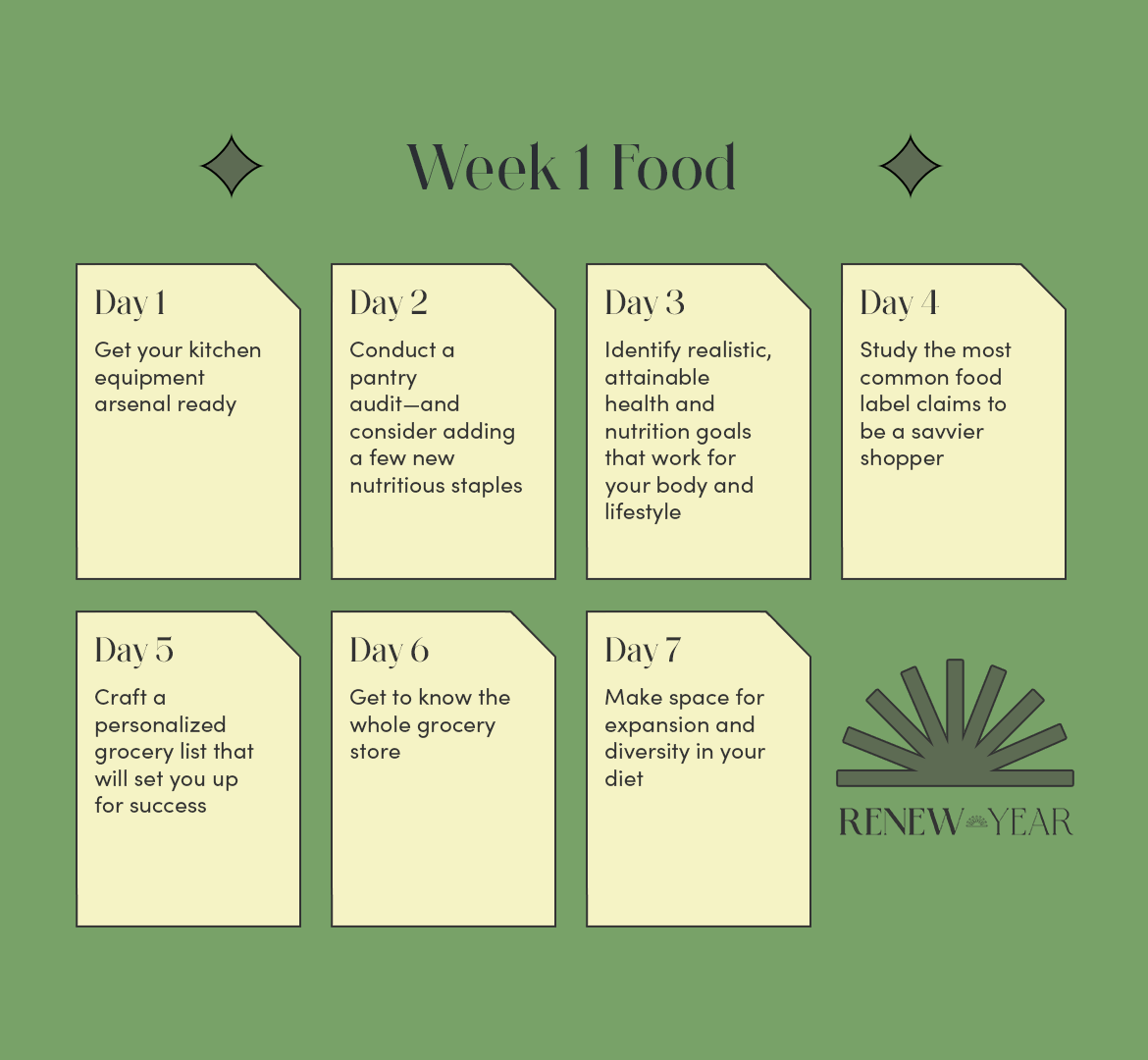
Day 1: Get your kitchen equipment arsenal ready

The many delicious dishes you’ll be making this month require a well-equipped kitchen. Having a reliable supply of basic kitchen gadgets on hand—including pots, pans, sharp knives, cutting boards, and storage containers—and keeping them well-organized will make it so much easier to prepare and serve homemade meals.

Start by surveying your pots and pans. Do you see any rusty spots or places where the surface is peeling? If so, you might need a replacement. (Pro tip: Cast iron pots and pans are brilliant when it comes to longevity; they work on the stovetop as well as the oven and they last a lifetime if well-maintained.) Find a chef’s go-to guide for what pieces of cookware every kitchen needs here.

Next, check your knives—sharp knives are a must, especially when it comes to slicing and dicing fresh produce safely and efficiently. If your knives are not sharp, it is time to invest in a sharpening tool.

A few good cutting boards of varying sizes are always good to have at home, too. And lastly, reusable storage containers allow you to meal-prep dishes ahead of time and safely keep them in the fridge or freezer for later use.

Day 2: Conduct a pantry audit—and consider adding a few new nutritious staples

Now that your kitchen tools are stocked and ready for use, we can focus on your pantry. If you ask me, a well-stocked pantry can save a meal; it can take it from lackluster to spectacular. You don’t need to have an abundance of items, though—it’s all about the curation of ingredients you keep on hand.

Just as you did with your kitchen tools, take stock of what dry and canned goods you already own before buying anything new. See a can of tomato sauce from the ‘90s? Toss it. Discover an unopened, still-fresh jar of chicken broth? Don’t buy a new one this week. Get in the habit of surveying your pantry, fridge, and freezer before you go grocery shopping to cut down on food cost and waste.

Now, onto the fun part—what I recommend adding to your pantry for flavorful, nutritious, and fuss-free meals. Consider stocking up on these options:

  • Grains: Fonio, black rice
  • Beans: Low-sodium canned beans (if you can’t find low-sodium beans, rinse your beans to reduce the sodium content) and dried beans
  • Tinned fish: SMASH fish (this stands for sardines, mackerel, anchovies, salmon, and herring; each of these options contains high amounts of brain-boosting omega-3 fatty acids) and sustainably-caught tuna (look for an MSC certification on the label)
  • Nuts and seeds: No nuts or seeds are off limits; choose the ones that are culturally relevant to you
  • Jarred tomatoes
  • Oils: Plant-based oils are excellent for cooking and finishing; choose the options that fit within your flavor profile and budget. Pumpkin seed oil is one of my personal favorites—it’s an excellent finishing oil and tastes delicious on everything from yogurt to roasted vegetables
  • Dried herbs: These can add major flavor without being costly. Look for dried herbs that don’t contain added sodium (and season on your own if you want to dial up the saltiness)

Day 3: Identify realistic, attainable health and nutrition goals that work for your body and lifestyle

Now that your kitchen is ready for action, I recommend level-setting with yourself by setting intentions for the weeks ahead. When identifying and setting a health goal, I like to remind my patients that it should be realistic and attainable. So rather than trying to turn back the clock or striving for something insurmountable, let’s work from the “now.”

In my practice, I often work with people who are at risk of developing (or have already developed) a chronic condition. I remind these patients that while a cure or reversal of their diagnosis may be possible, in the event that isn’t, living with a well-managed diagnosis is.

I encourage you to think about your current health situation. Do you have any diagnoses or pre-diagnoses that would benefit from nutrition modification, and what are the small steps that you could take to move toward your goal? Would you benefit from having a consistent bedtime, reducing your alcohol intake on the weekends, or finding ways to include pleasurable and intentional movement into your day? Start by jotting down these health goals in a journal, then try brainstorming some ways to make progress on them that fit within your current lifestyle.

Day 4: Study the most common food label claims to be a savvier shopper

You can’t accomplish your goals without the proper tools, right? We already tackled the kitchen—now we’re diving into the task of understanding food label claims. Because let’s be honest: Grocery shopping has become increasingly complicated. Front-of-box labels on packages make so many claims, and they may or may not actually be relevant to consumers. In order to be a savvy shopper, it’s important to be able to parse out the important information from the superfluous claims. Ultimately, you will need to decide what is valuable to you. Below are some common claims and their current definitions.

Organic (as defined by the USDA):

  • Produce: “Produce can be called organic if it’s certified to have grown on soil that had no prohibited substances applied for three years prior to harvest. Prohibited substances include most synthetic fertilizers and pesticides.”
  • Animal proteins: “Regulations require that animals are raised in living conditions accommodating their natural behaviors (like the ability to graze on pasture), fed 100 percent organic feed and forage, and not administered antibiotics or hormones.”
  • Packaged and multi-ingredient foods: “Regulations prohibit organically processed foods from containing artificial preservatives, colors, or flavors and require that their ingredients are organic, with some minor exceptions.”

Non-GMO Project Verified (as defined by Non-GMO Project): “The Non-GMO Project Verified mark assures consumers that the product bearing the label has been evaluated for compliance with the Non-GMO Standard. The verification mark does not state that a product is ‘GMO Free,’ and it does not state that the product is safer, better, or healthier. It simply states the product is compliant with the Non-GMO Project Standard.”

Regenerative agriculture (as defined by California State University Chico Center for Regenerative Agriculture and Resilient Systems): “Regenerative Agriculture is an approach to farm and ranch management that aims to reverse climate change through practices that restore degraded soils. By rebuilding soil organic matter and soil biodiversity, we significantly increase the amount of carbon that can be drawn down from the atmosphere while greatly improving soil fertility and the water cycle.”

Natural (as defined by Consumer Reports): “Has no clear meaning on a majority of foods.”

Pasture raised (as reported by Certified Humane Raised and Handled): “There is currently no legal definition for ‘Free Range’ or ‘Pasture Raised’ in the United States, therefore these terms are often used on poultry packaging with no unilateral definitions for the consumer to trust.”

Grass fed (as defined by the USDA): “Grass (Forage) Fed means that grass and forage shall be the feed source consumed for the lifetime of the ruminant animal, with the exception of milk consumed prior to weaning. The diet shall be derived solely from forage consisting of grass (annual and perennial), forbs (e.g., legumes, Brassica), browse, or cereal grain crops in the vegetative (pre-grain) state. Animals cannot be fed grain or grain byproducts and must have continuous access to pasture during the growing season.”

Day 5: Craft a personalized grocery list that will set you up for success

We’re officially ready to hit the grocery store, which means it’s time to make a shopping list. Because you are your own individual, I encourage you to honor your likes, dislikes, current health status, finances, cooking abilities, culture, and so much more when deciding what foods to put into your grocery cart. For instance, when working with patients, I often speak with them about their favorite foods and the dishes they find most comforting so that we can find ways to incorporate these foods into their weekly grocery lists without guilt or shame.

Your grocery list should include foods that you are comfortable making, ones you enjoy, and familiar items. In addition, I encourage adding a few partially-prepared foods (or chef’s helpers, as I like to call them)—this might include bagged salad greens, pre-chopped vegetables, frozen fruit, marinades, simmer sauces, dips, and spreads.

Next, think through what boxed, jarred, and canned foods you might need this week, as well as fully-prepared items like rotisserie chicken or fresh bread. And don’t forget an assortment of fresh and dry herbs and spices!

Your grocery list should always reflect your current health needs as well as your personal preferences. Follow this template as a starting point:

Sample Grocery List

  • Fresh produce:
  • Frozen produce:
  • Canned goods:
  • Dry goods:
  • Boxed and jarred goods:
  • Fresh herbs and spices:
  • Dried herbs and spices:
  • Dairy products:
  • Meat and/or poultry:
  • Seafood:
  • Prepared foods:
  • Partially-prepared foods:
  • New-recipe needs:

Day 6: Get to know the whole grocery store

Nutrition providers—myself included—have been shouting the phrase “Shop the perimeter!” (aka the section of the grocery store where fresh fruits and vegetables are typically found) for many years now. But somewhere along the way, we forgot to remind folks that they should also shop the rest of the grocery store, too—not to mention prioritize food choices that support their current and desired health as well as their budget.

Let this be your reminder to explore all of the lovely aisles of your local grocery store. After all, food is expensive, and we need to find creative, nourishing, and delicious ways to stretch our food dollars. Packaged goods are not off-limits. Here are some tips to help you become an informed consumer when shopping for them:

  • When looking at the Daily Value (DV) percentage on a product’s Nutrition Facts panel for any given nutrient (i.e. carbohydrates, sodium, saturated fat, potassium, vitamin C, and so on), a number hovering around five percent of the DV would be considered low, and a number close to or above 20 percent of the DV would be considered high. So if the fiber content of the packaged goods is listed as 30 percent of the DV, then that would be considered a high-fiber item; if the sodium content is three percent of the DV, then that would be considered a low-sodium item.
  • Now that we’ve studied up on label claims, we know not to get too caught up on the front of package labeling like “organic” or “gluten-free.” All that tells you is that the product is organic or gluten-free, right? Instead, flip the package over and read the ingredient list. The first five ingredients make up the majority of packaged goods. If the first five ingredients are something that you want to eat (or have heard of), then great! If not, consider moving onto another option that better suits your needs.

Day 7: Make space for expansion and diversity in your diet

You officially have one inspired and important food shopping trip under your belt. Kudos! Today, as you dig into your delicious groceries, give yourself the space to think about what you can add to your diet (rather than remove) as you continue to introduce new ingredients and dishes into your meal rotation. The goal is to start a pattern of eating that includes all the foods you love and keeps you excited about the new flavors and nutrient-rich foods you might be trying—this is a more sustainable method, and therefore likelier to “stick” in the long term.

If your desire is to increase your intake of plant-based foods, expanding the varieties of plants that you consume is an excellent option. For example, leafy greens can mean collards, dandelion and beet greens, chard, taro leaves, and so much more—it’s not just kale, folks. Or, if you want to increase your intake of seafood, exploring smaller, more sustainable types of fish such as sardines and anchovies is a great place to start.

Considering ways to incorporate more diversity, exploration, and flavor into your meals is a pretty wonderful way to round out the first week of the year, no?


How To Make Every Meal More Nutritious? Follow These Tips To Make Your Food Healthier With Fewer Efforts

How To Make Every Meal More Nutritious? Follow These Tips To Make Your Food Healthier With Fewer Efforts

How To Make Every Meal More Nutritious? Follow These Tips To Make Your Food Healthier With Fewer Efforts

You can make your food stuff healthier by opting for healthier fats

You can reduce continual health conditions and preserve outstanding well being by having a variety of healthful meals. Healthful taking in does not require you to give up your favorite dishes. You can make prolonged-long lasting, healthful improvements to your food plan with a handful of simple modifications and some forward arranging.

It might look challenging in the commencing but little by little and slowly you can make the proper ways toward enhancing the excellent of your diet plan and lifetime. Enable us recognize methods in which you may be capable to make these constructive improvements toward a superior diet program. 

In this article are recommendations to assistance you make your diet program healthier:

1. Decide for more healthy fats

To reduce hidden fats, look at lean meats, and very low-unwanted fat dairy items, and stay clear of processed meals. Because they contain the essential prolonged-chain fatty acids and other beneficial factors, nuts, seeds, seafood, soy, olives, and avocados are all greater options. Use more healthy oils, such as olive and canola oil, if you determine to add fats to your cooking.

2. Don’t overcook and get rid of nutrients 

Nutritional vitamins that are water-soluble are sensitive and commonly missing for the duration of preparing and cooking. Vegetables should really be scrubbed fairly than peeled because several vitamins and minerals are contained in the vicinity of the skin. Instead of boiling veggies, steam or microwave them. Use a modest quantity of water when boiling veggies and be watchful not to overcook them. Improve your usage of stir-fry recipes. Veggies that are stir-fried are cooked speedy to maintain their crispness and critical vitamins and minerals.

3. Cut down salt intake

Several of our meals involve salt that is concealed, but feeding on a large amount of salt can result in a range of wellness difficulties, including hypertension. Since canned and pickled veggies usually incorporate salt in the packaging, choose contemporary or frozen vegetables alternatively. Limit your consumption of processed meats that are large in salts, this sort of as ham and salami. Numerous sauces and condiments might also be higher in sodium and should really be prevented. 

4. Try to eat much more herbs & spices 

With out making use of salt or oil, good flavours can be included by working with herbs and spices. Refreshing herbs have a sensitive flavour, so incorporate them to your meals just ahead of serving. Bread, mustard, salad dressing, vinegar, sweets, and beverages can all advantage from the addition of herbs and spices. Make a quick, healthy, and mouth watering stir-fry with vegetables by introducing coriander, ginger, garlic, chilli, and lemongrass.

5. Try to eat more refreshing make

The greater part of men and women commonly skip the veggie at breakfast in favour of fruit. They will also eat veggies at meal and lunch but under no circumstances for breakfast. To make guaranteed you get your encouraged day by day servings, it really is a good idea to include both options at every single meal and snack. Fruit possibilities incorporate a couple of berries or 50 {35112b74ca1a6bc4decb6697edde3f9edcc1b44915f2ccb9995df8df6b4364bc} an apple. A delicious option to include a vegetable in your breakfast is to insert some spinach to your eggs or breakfast sandwich.

6. Eat total food items as a substitute of refined

Pick out entire grains as an alternative of the traditional white choices whether deciding upon breakfast cereal, tortillas for a wrap, or bread for a sandwich. White bread and flours are less nutrient-dense and much less productive sources of fibre than total grains. You may get a healthy dosage of vitamins and minerals when remaining content for more time.

7. Eat at household

You have a lot far more affect in excess of what you happen to be consuming in your system when you prepare your personal foodstuff at household. It may possibly be demanding to recognize the healthiest menu alternatives at restaurants. A cafe salad that would seem wholesome to you may possibly be packed with sodium and have extra calories than you have to have from the dressing.

Next these recommendations will assure you have a healthier diet program which can gradually direct to a wholesome lifestyle and overall wellness. 

Disclaimer: This articles like suggestions delivers generic data only. It is in no way a substitute for a capable clinical viewpoint. Often check with a professional or your personal health care provider for additional info. NDTV does not assert obligation for this details.

Featured Online video Of The Day

On His 57th Birthday, Salman Khan Greets Lovers From His Balcony

Best Healthy Meal Plans, Recipes and Ideas for December

Best Healthy Meal Plans, Recipes and Ideas for December

Welcome to the Start off Nowadays Going for walks Obstacle! Indicator up for our free Commence Right now publication to sign up for the obstacle with Al Roker and obtain every day inspiration despatched to your inbox. Then, sign up for us on the Begin Right now Facebook group for suggestions and motivation, to join with others adhering to the system — and to get serious-time information from trainer Stephanie Mansour!

As tempting as it may perhaps be to get in or stay off the office cookie plate through the stressful holiday break season, preparing your individual foods can have major payoffs — for both equally your health and your wallet.

Just take lunch for case in point. In one particular survey, folks reported they shell out about $20 for every week on lunch, amounting to extra than one grand for each 12 months. Aspect in the pricier chains, dining out a lot more than a few of times for each week, or dwelling in a major town, and you could be paying much extra. Location your finances apart, it appears to be fairly obvious that routinely buying up lunch is a lot less balanced and additional high-priced than making ready foods at household, and science backs this up.

A minor bit of food prep and you could be on your way to a healthier, leaner physique. In a single review among a lot more than 100,000 participants, meal planning tactics were tied to advancements in eating plan top quality, enhanced diet plan variety and were linked to lower physique pounds. Here’s why: When you prepare your meals, you are considerably less likely to buy prepared foodstuff or dine on takeout dishes, which tend to be better in calories, sodium, included sugar and saturated unwanted fat.

How to food system like a pro

Meal planning is not as challenging as it appears. Expend just 10 or 15 minutes mapping out your meals, jot down what you need and head to the shop. That’s it. And given that the vacations are busy enough, we have also received tips for streamlining meal prep. Below are 6 basic methods that’ll help you get organized and take the overwhelm out of meal scheduling and prepping.

1. Determine on your food prep approach. One way to go is to pick out up to three breakfasts, lunches and dinners you will make this week. You are going to lower food prep if you strategy to have some meals on repeat. Also, for this phase, feel about regardless of whether your weekends glimpse distinctive than your week, and make sure you account for that in your prepare. For instance, probably you have time to cook breakfast or make a more elaborate evening meal above the weekend.

If you’d rather not dedicate to recipes, make a listing of basic, unseasoned, or lightly seasoned components (these types of as simple chickpea pasta, brown rice, rotisserie chicken, tofu, and roasted veggies like broccoli) that you can season and incorporate all through the week. (See food strategies for far more on this under.)

2. Fill your pantry with healthier benefit food items. Items such as canned tuna and salmon, canned beans (no- or small-sodium preferred), canned or boxed soups (once again, very low-sodium), microwavable full grains (together with brown rice and quinoa), bean-primarily based and full grain pastas, and nut butters (or nut-no cost butters) are quick ingredients that shave time off of meal prep. 

3. Inventory your fridge and freezer strategically. Stocking the essentials at property will make preparing, prepping, and last-moment food modifications even simpler. Some healthier choices contain eggs, Greek yogurt, cottage and/or ricotta cheese, shredded cheese, frozen fruits and veggies, frozen edamame and peas, frozen total grain waffles, and veggie burgers.

4. Make a record. Use whichever process is effective for you. Some individuals swear by a electronic reverse purchasing checklist, which is a learn doc of all the factors you frequently consume or cook dinner with. In essence, you’re using stock of your kitchen somewhat than just a record of foodstuff you will need. Then, spotlight or use an identifier (this sort of as an emoji) next to the products you have to have to buy. This presents you a massive image of almost everything you have in your fridge and pantry, producing it considerably less probably you neglect an crucial component (or overbuy some thing you now have).

5. Lean on quick seasonings. All the things but the bagel seasoning, Italian and Greek seasoning, dried herbs and spices, lemons, pesto, minimal-sugar marinara sauce, tahini, and coconut aminos or decrease-sodium soy sauce appear in useful when you want to improve a bland meal or immediately remodel unseasoned elements into a delicious entree.

6. Prep more veggies. Say you have received your chopping board out to chop broccoli — properly, never end there! For illustration, slice up some cucumbers to have as a snack or along with a sandwich, and make yet another veggie to use in salads and grain bowls throughout the 7 days. You are going to have the identical amount of money of cleanup on night one and limit cleanup (aka save time) later on in the week.

Breakfast

Make breakfast a no brainer. Have a very simple checklist of go-to alternatives or make-forward meals that make mornings simpler. Believe: Greek yogurt with berries and nuts, easy egg bite muffins, baked oats, smoothies, and higher-protein avocado toast (mash white beans or chickpeas into the avocado and serve with a sliced boiled egg on major or on the aspect).

Lunch

Continue to keep matters basic by producing some unseasoned foundational substances (these kinds of as baked or grilled chicken breasts, sauteed shrimp, quinoa, or brown rice) that you can dress up and mix and match as you make sure you. For instance, make a shrimp Caesar salad with pine nuts, parmesan, and bottled dressing 1 day and then a shrimp-veggie brown rice bowl a further working day. Or, have a tuna sandwich for a single lunch and then toss tuna into a veggie-loaded pasta for evening meal later on in the 7 days. Have to have additional inspiration? Pleasure Bauer’s Harvest Bowl and Burrito Bowl should to give you some contemporary strategies. Primary components like rotisserie or baked chicken, quinoa, and canned beans operate perfectly in these recipes.

Treats

Your best likelihood of getting by means of the day without the need of distracting hunger is to choose a protein- and fiber-abundant snack. Treats that comprise total meals resources of protein and fiber (say, from some combo of nuts, veggies, fruits, beans, eggs, or yogurt) provide a profitable system that keeps you entire for several hours. In addition, if your snack is dominant in protein- and fiber-wealthy foods sources, these healthful elements are probably crowding out much less healthful types, particularly extra sugar and refined grains. Right here are some tips for picking a healthful, superior protein, large fiber snack, together with some tasty options that in good shape the parameters.

What to seem for in a balanced snack

  • At the very least 3 grams of fiber (you want all-around 25-38 grams for each working day).
  • 5 or a lot more grams of protein (for reference, a boiled egg has about 6 grams).
  • No more than 6 grams of included sugar (about 1 ½ teaspoons, but decrease is superior).
  • Healthful substances, like beans, nuts, seeds, fruits, veggies, eggs, yogurt, and cheese.
  • No artificial sweeteners, like sucralose or aspartame (the stuff in the yellow and blue packets.
  • No artificial colors or preservatives (generally clues that anything is overly processed).

Of program, you can also make a wholesome snack working with rapid elements you have at dwelling. An excellent combo is a fruit or veggie paired with a protein resource, this sort of as nuts, seeds, Greek yogurt, cottage cheese, cheese, boiled eggs, canned tuna, or leftover chicken.

Here are a couple strategies to get you started out:

  • Sliced cucumbers with olive tapenade.
  • Child carrots with hummus or guacamole.
  • Sliced apple with a slice of cheese.
  • Sliced pears with nut or seed butter.
  • Plain or decrease-sugar Greek yogurt with berries or grapes.

Evening meal

Below, we’ve pulled alongside one another a list of some of our most popular healthy recipes on Currently.com to make food preparing much easier — come to feel no cost to swap out recipes for unique times of the 7 days or make sufficient of a person dish to serve as leftovers to conserve time on one more evening. To make dinners perfectly-balanced, we have supplied serving ideas, most of which require the ease products we’ve advised during.

What a nutritious food approach appears to be like like

Here’s a sample approach that serves as a blueprint for simple food prep. You will see that breakfasts entail some make-ahead foods and some early morning-of options. Lunches use the blend-and-match tactic outlined previously mentioned. Even though we have provided 5 diverse meal choices, you can streamline the menu by creating ample for leftovers.

Get the meal program for the 7 days of December 5th.

A meal plan for December that incorporates healthy options and easy to follow routine
Today Illustration / Getty Pictures


Heart healthy diet: Tips, meal plan to prevent heart diseases | Health

Heart healthy diet: Tips, meal plan to prevent heart diseases | Health

Coronary heart is one particular of the most very important organs of our overall body that allows in carrying pumped blood to make sure source of oxygen and nutrition to the human body though heart-balanced having, alongside with typical workout or actual physical exercise, can considerably lessen one’s possibility of experiencing coronary heart sickness or stroke. According to overall health authorities, adhering to a heart-nutritious diet on a typical basis can also enable to reduce the hazard of acquiring coronary coronary heart disease, as well as prevent us from attaining additional excess weight, thus decreasing possibility of diabetes, substantial blood pressure, cholesterol and inflammation.

In an job interview with HT Life style, Dr Varun Gupta, Health-related Advisor at Nutrabooti, echoed, “Your coronary heart is a single of the most complex and arguably the most important organ that is effective repeatedly to give your human body with a regular offer of oxygenated blood. If you want to cut down your chance of building coronary heart illness, there are quite a few straightforward ways to defend your cardiovascular process by way of diet plan and life-style modifications.” He prompt:

1. Stop cigarette smoking – Using tobacco considerably improves the hazard of creating coronary coronary heart sickness and can worsen heart ailment signs and symptoms. If you at the moment smoke, take into account quitting it.

2. Eat extra fiber-loaded plant foods – A eating plan substantial in fiber can lower “bad” cholesterol and provide nutrition that support to just take care of your cardiovascular health. For a nutritious coronary heart, you can include high-fiber food items like fruits, vegetables, nuts, seeds, and full grains to your diet program.

3. Sit fewer and shift far more – Sedentary conduct could increase your risk of producing coronary heart conditions, as currently being inactive can sometimes guide to fatty product constructing up in your arteries. So, normally consider to make an energy to sit less and transfer much more, if you can, by heading for common walks or partaking by yourself in taking part in outside online games of your interest.

4. Change to much healthier fats – Incorporating more healthy fat to your food plan can strengthen blood cholesterol degrees and lower your possibility of heart disease. Consider to consist of fatty fish these types of as salmon, trout, or herring, or flaxseed, kale, spinach, or walnuts in your food.

5. Manage worry – Chronic pressure or constant worry knowledgeable about a prolonged period negatively influences the body in a lot of strategies and may perhaps contribute to very long-phrase problems for the heart. Discovering ways to control or minimize tension every time achievable is a clever way to safeguard your cardiovascular process.

Dr Deeksha Katiyar, Consulting Doctor at WeClinic™ Homeopathy, suggested that to create your heart-healthier taking in system, you can include the next in your diet program:

  • Leafy green vegetables
  • Whole Grains
  • Avocados
  • Fish oil
  • Walnuts
  • Beans
  • Tomatoes
  • Almonds
  • Seeds
  • Garlic
  • Olive oil
  • Environmentally friendly tea

She unveiled a ‘heart-healthy’ diet regime prepare which you can abide by to allow your coronary heart to experience maximum gains:

  • Early Morning (5 am to 6 am)

Get 5-6 almonds walnuts with a glass of warm h2o

Breakfast

Selfmade breakfast these kinds of as poha, boiled moong, upma, dosa, dhokla, paratha, and many others .Use least oil throughout cooking .Just take a glass of milk or curd , or a protein rich meals these as boiled egg .

Eat 2-3 chapatis without ghee, or a medium bowl of rice, a cup of veggies curry, medium bowl of curd, along with a huge serving of salad .Swap dal with a hen or fish for non-vegetarians.

A bowl of soup or fruit. You can just take also a cup of inexperienced tea or coffee with a smaller bowl of bhel /chaat /khakhra.

2 multigrain chapatis or 2 jowar/bajra, bhakris with a bowl of vegetable curry, a plate of salad, and a bowl of dal or curd. Alternatively, 1 can have a bowl of khichdi or kadhi rice too.

She recommended that adapting the pursuing nutritious way of life behaviors can support to keep heart wellness –

  • Active way of living with typical exercise session
  • Maintain a healthier overall body excess weight
  • Steer clear of using tobacco and liquor
  • Take care of your strain
  • Get sufficient snooze every single day
  • Do normal verify-up
  • Take care of Diabetic issues, cholesterol and blood tension

In addition to the strategies outlined previously mentioned, there are numerous other approaches to care for your heart, including receiving adequate snooze and restricting your liquor ingestion.

Healthy Meal Planning: Tips for Older Adults

Healthy Meal Planning: Tips for Older Adults

Eating healthfully and possessing an active way of living can aid healthful getting older. Use the assets beneath to discover about distinctive designs of healthful eating and techniques to develop a wholesome meal approach.

Older adults’ one of a kind nourishment demands

Uncomplicated adjustments can go a long way toward making a more healthy consuming pattern. Abide by these suggestions to get the most out of meals and beverages though conference your nutrient requirements and cutting down the threat of sickness:

Infographic, Tips To boost Your Health As You Age. Click link for full infographic

Go through and share this infographic and spread the term about ways that may well help foster nutritious aging.
  • Take pleasure in a variety of foods from every single meals team to aid reduce the threat of producing health conditions this sort of as superior blood stress, diabetic issues, and coronary heart disorder. Decide on meals with minor to no added sugar, saturated fat, and sodium.
  • To get adequate protein throughout the day and sustain muscle, test incorporating seafood, dairy, or fortified soy items alongside with beans, peas, and lentils to your foods. Study additional about protein and other crucial vitamins.
  • Include sliced or chopped fruits and greens to foods and treats. Appear for pre-slice varieties if slicing and chopping are a obstacle for you.
  • Test food items fortified with vitamin B12, these types of as some cereals, or communicate to your physician about having a B12 complement. Learn a lot more about vital vitamins and minerals.
  • Reduce sodium consumption by seasoning meals with herbs and citrus these types of as lemon juice.
  • Consume plenty of water all over the day to assistance keep hydrated and aid in the digestion of food stuff and absorption of nutrients. Steer clear of sugary drinks.

It can be really hard for some folks to observe as a result of on clever food alternatives. Read through about widespread roadblocks and how to get over them and look at out the USDA’s recommendations for more mature older people.

Food planning

Answering the dilemma “what should I eat?” doesn’t require to leave you experience baffled and pissed off. In truth, when you have the correct data and motivation, you can come to feel great about making healthier possibilities. Use these strategies to system healthful and delightful foods:

  • Plan in progress. Meal preparing can take the guesswork out of ingesting and can support make certain you eat a wide range of nutritious meals all over the working day.
  • Obtain spending plan-friendly meals. Build a browsing record in advance to aid stick to a funds and abide by these SNAP-pleasant recipes.
  • Take into consideration preparation time. Some meals can be designed in as little as 5 minutes. If you appreciate cooking, or if you are planning a meal with or for pals or family members, you may well want to consider something a tiny far more tough.
  • Maintain calories in thoughts. The variety of energy individuals require each working day varies by specific. Always focus on your pounds and exercise objectives with your wellness care service provider just before making big alterations. Read through about calorie objectives and healthful meals swaps.

When you generate your buying list, really do not overlook healthy basics these kinds of as contemporary fruits and vegetables and full-grain bread. This sample buying checklist (PDF, 108 KB) consists of a assortment of nutritious foodstuff you may well want to have in your kitchen.

Sample menus

Listed here are some food choices for breakfast, lunch, meal, and snacks, like inbound links to recipes as very well as simpler selections that can be place with each other with out a recipe.

Sample Menu

Breakfast Lunch
Supper Snack

For extra information and facts on balanced having

This information is delivered by the NIH National Institute on Getting old (NIA). NIA experts and other specialists assessment this information to guarantee it is accurate and up to day.

HEALTH AND FITNESS: Breakfast often sweetest meal of the day | Features

HEALTH AND FITNESS: Breakfast often sweetest meal of the day | Features

Feeding on a wholesome breakfast offers strength to start off the working day and can support with pounds handle. In children, a wholesome breakfast is important for appropriate development and enhancement and is joined to improved awareness and discovering in school. Breakfast is usually assumed of as the most essential meal of the working day, for good reason. Regretably, a lot of widespread breakfast meals are a lot more identical to candy and soda than a healthy meal to start the day.

Some popular breakfast food items focused at youngsters include sugar-sweetened cereals, pastries and bars, quite a few of which glance like candy or dessert. Pop Tarts and some granola bars are included in frosting and cereals often contain marshmallows, chocolate or are shaped like cookies. No surprise that these food items are as higher in energy and sugar as cookies or some sweet bars.

Unhealthy possibilities sometimes come disguised as a thing balanced – juice. Quite a few “fruit” drinks consist of fewer than 5{35112b74ca1a6bc4decb6697edde3f9edcc1b44915f2ccb9995df8df6b4364bc} juice but a good deal of extra sugar, so they are primarily soda without bubbles. For instance, the orange drink Sunny D is a well-known substitute for orange juice, but it is much from a nutritional equal. The exact same is accurate for other beverages, including juice packing containers and pouches, that are commonly section of breakfast or treats.

Even even though the sugar and caloric written content of these beverages is similar to serious fruit juice, consuming food stuff and beverages that are flavored like fruit but are essentially a great deal sweeter may make real fruit much less palatable. Young children may establish an expectation that oranges or orange juice should really style as sweet as orange drinks and desire the sugar-sweetened version in excess of the true fruit. The similar is legitimate for food, as well. A child who is made use of to breakfast or snack foodstuff that style like candy or cookies might resist actual food stuff when it is presented.

This truly is not considerably distinctive for older people. Breakfast foodstuff like donuts and pastries are virtually normally topped with icing and it would be complicated to distinguish lots of muffins from cupcakes. For many persons, coffee is not just espresso any longer, but a consume that consists of as significantly sugar and as many energy as a milkshake, from time to time with whipped cream on prime.

A person of the largest offenders for equally little ones and grownups is yogurt. Lower-unwanted fat and excess fat-free flavored yogurt is pretty much always sweetened with sugar. This is real for the yogurt tubes that young children like and the Greek yogurt that is broadly considered to be healthful. Absolutely sure, it consists of protein and bacteria that may well be valuable, but the extra sugar makes it equal in phrases of calories and sugar to frozen yogurt or ice product. Some of these yogurts even occur with toppings, like bits of chocolate, just like fro-yo.

The good news is that you can make your breakfast healthier with out also a great deal effort. Although there is much debate about what constitutes a healthy breakfast, there is arrangement about what it doesn’t include – loads of included sugar. Search for cereals that are very low in extra sugars and higher in fiber. Involve authentic fruit, fruit juice and milk (or milk choices) anytime feasible. If you have time, eggs are an superb resource of protein and balanced fat. Yogurt is fantastic, as well, but watch out for additional sugars in flavored yogurt. Whole grain toast or a bagel with peanut or other nut butter makes a fantastic substitute to Pop Tarts or breakfast bars.

As a standard rule, steer obvious of meals that look like dessert. Marshmallows, chocolate chips and frosting are most effective remaining for immediately after a wholesome food, not a substitution for it.