
How WA’s plan to transform its mental health system has faltered

How WA’s plan to transform its mental health system has faltered

The Mental Health Project is a Seattle Times initiative focused on covering mental and behavioral health issues. It is funded by Ballmer Group, a national organization focused on economic mobility for children and families. The Seattle Times maintains editorial control over work produced by this team.

The suits were in town, prepping for a Friday news conference on the brick steps of Western State Hospital.

A photo from that day in Lakewood in May 2018 shows a united front. Hospital officials shoulder to shoulder with state lawmakers, and at the center, Gov. Jay Inslee. These officials were ready to “transform the state’s mental health system” after years of underfunding, lawsuits and federal warnings that threatened to close down Washington state’s largest psychiatric hospital — nearly 800 beds that served some of the most vulnerable residents.

“This is a heavy lift,” Inslee said.

He presented a plan that by 2023 would focus Western State on only serving patients who had been accused of crimes and were coming from jails. State agencies would build new, smaller centers across the state to serve people who weren’t facing charges but were sent for psychiatric commitment by the civil courts.

“It’s an aggressive timeline,” Inslee acknowledged. “2023 is tough, but doable. And it’s necessary.”

It is now 2023. The state failed to meet its goals.

In a quest to revamp mental health care, state officials made a challenging transition even harder — shutting down some of Western State’s wards without the planned community facilities that were supposed to take the people who relied on the state hospital. Combined with the unexpected effects of the pandemic, the resulting logjams have overloaded both jails and psychiatric facilities and left hundreds of incarcerated people languishing without mental health services.

The repercussions have left families and advocates frustrated and have embittered local law enforcement. Often the only two options seem to be either letting people struggle on the streets without care or criminalizing mental health and warehousing them in jail.

Staff and advocates say they warned state officials that the plan needed changes. Mike Yestramski, a social worker by training, remembers that day at Western State in 2018 clearly because he and other hospital union staff were asked to stand in that photo alongside the smiling politicians.

They refused.

“It’s not that we were not supportive of the vision,” explained Yestramski — though union leaders were also concerned that the plan could lead to fewer union jobs in the future. “It was the details, the logistics being worked out … What we’re seeing now come true.”

“We’re moving along by shutting down the civil beds before the community beds were built and ready to go.”

Indeed, this June, another ward is slated for closure — and the patients must go somewhere.

The blueprint

Western State has historically served two main types of patients. Those coming from jails — the state calls them “forensic patients” — need basic mental health services, like evaluations to determine whether they’re competent to stand trial, and restoration treatment to get them back to competency. It also houses “civil patients,” who are not criminally detained but are so seriously sick that they meet the threshold for involuntary commitment through a separate civil court system.

In the past, most of the patients were on the civil side, but in 2015, moves began to shut down the wards where they stayed.

Washington officials were facing challenges on a couple of fronts: The Centers for Medicare & Medicaid Services was scrutinizing Western State more closely after patient-on-patient assaults, threatening a loss of accreditation and federal dollars.

We’d like to hear from you.

The Mental Health Project team is listening. We’d like to know what questions you have about mental health and which stories you’d suggest we cover.

Get in touch with us at mentalhealth@seattletimes.com.

Around the same time, state officials at the Department of Social and Health Services faced a federal lawsuit over allegations they were violating incarcerated people’s due-process rights. People deemed potentially incompetent to stand trial were being held in jail for weeks or months because the state was failing to get them to Western State to get them evaluated or treated.

A federal judge ultimately ordered hospital officials to provide timely services within one to two weeks. Even today, the state is still failing to meet those timelines: In January it was taking about 100 days for patients to receive treatment. Currently, about 464 people are detained in jails across Washington state awaiting competency or restoration mental health services — an additional 344 are waiting out of custody.

In response to these ongoing issues, Washington legislators by spring 2016 had convened a special committee to improve the state hospitals.

Consultants came back with a lengthy report that fall that included nine recommendations. Among their suggestions: Transition the state hospitals into facilities that focus on patients coming from the jails. Build six more long-term civil facilities for patients transitioning out of state hospitals and into the community. Add three mobile crisis teams, and two new crisis centers to pull off the transition. 

In May 2018, Inslee, state legislators and government officials announced a plan building off that blueprint, which included the construction of a new forensic hospital on the Western State campus with 350 beds for people coming from jail. 

Today, while some of Western State’s last civil wards are set to close in June (delayed from a previous April 1 deadline), few of the other solutions recommended by the consultants exist. Washington has built two of the six civil facilities, most notably a 16-bed facility that debuted in January at Maple Lane near Centralia. Another treatment center in Snohomish County will break ground this spring — with two more facilities in Clark County expected in the winter of 2024. 

Additional beds are expected to come online at the University of Washington’s new behavioral health teaching facility at the end of 2023 and at Western State’s forensic hospital in 2027, at the earliest. 

In the meantime, however, there are no walk-in crisis centers in King County and by and large, hospital emergency rooms and jails take the responsibility of caring for people, despite the high cost and being ill-equipped to treat people in psychiatric emergencies. Mobile crisis teams are limited in size and are siloed among mental health service providers, police and fire services. 

“Do I think everything that we contemplated five years ago is going to be done this year? No,” said Amber Leaders, the senior policy adviser on behavioral health, aging and disability with Inslee’s office. 

“We are at a pinch point,” she said, with the civil wards winding down while other housing and treatment options are still coming on line.

“We have made a lot of progress in terms of building up the community capacity that we’ve talked about. But building a brand-new, shiny new forensic hospital takes some time,” Leaders acknowledged. 

State Rep. Nicole Macri, who has been deeply involved in the transition of the mental health system since she joined the Legislature in 2017, acknowledged the plan is “behind schedule,” but said “we haven’t lost sight of the goal.”

“We invested over $800 million in behavioral health in the ‘21 and ‘22 sessions. We should have been investing at that scale for years before that,” added Macri, D-Seattle. 

She points to the ripple effects of the Great Recession and how it led to significant cuts in funding for these services through the following years. Around that time, under former Gov. Christine Gregoire, state leaders similarly tried to “transform” Washington’s ailing mental health system but found limited success in restitching a complex, fragmented system.

Still, others note missteps in the latest iteration: 

“Five years is never a long enough runway when you’re talking about problems that need to be faced with a complete systemic overhaul from top to bottom,” said Lauren Simonds, the executive director of the Washington chapter of the National Alliance on Mental Illness. 

Kim Mosolf, director of treatment facilities with the advocacy organization Disability Rights − Washington — which sued over the delays in mental health evaluations and treatment for people in jails — points out that the new community beds that have come up are at best a replacement for what was lost.

“HCA [Washington Health Care Authority] has opened roughly 190 long-term community civil commitment beds since 2018 when they started this project,” she said. “However, they’re [closing] 180 beds at Western State Hospital. So it appears to be a zero sum game.” 

Yestramski, the social worker and now president of the Washington Federation of State Employees, said the idea of small facilities closer to patients’ homes was a “great idea on paper” but as state officials soon found out, “the problem is once they set out to build those, you have a lot of issues with NIMBYism.” 

Indeed, the construction of a new civil facility in Snohomish County faced “not-in-my-backyard” pushback from the community. Similar attempts to build enhanced services facilities for people with mental illnesses in Auburn and Burien were floated in the last few years but failed when local residents objected. 

Kinks in the system

One of the biggest reasons for delays at Western State, though, is the rising number of a particular type of patient. In prioritizing patients coming from jails, officials didn’t account for the fact that the civil and forensic patient populations often intermingle; closing one door had ripple effects in the other. 

One perfect example of that is called a civil conversion. 

If a patient coming from jail cannot be restored to competency, their criminal charges are typically dropped. Prosecutors can then “flip” their case, kick-starting a separate process that sends the person back to a state hospital but this time for civil treatment. This occurs most often in serious, felony-level cases.

But flipped patients often take four times as long to go through treatment at Western State because they receive more thorough mental health treatment. In comparison, the medication and services given to their jail-based counterparts are often only enough to make them competent in court — meaning they can identify the role of a judge or how to communicate effectively with their attorney. 

While a patient coming from jail may spend up to 90 days at the hospital for services, a civil patient can stay for a year or longer. 

That valuable space at the hospital causes backlogs for people who are languishing in jail while they wait for a spot to open at Western State. The number of patients being civilly converted has grown dramatically.

On any given day, “That number in the last year has climbed from say traditionally about 30 to 175,” said Thomas Kinlen, the director of the DSHS Office of Forensic Mental Health Services.

Prosecutors increasingly opt for this practice to try to keep people who might be a public safety threat off the street. Both Seattle and King County prosecutors have told The Seattle Times that this method offers at least some treatment for people with severe mental illness — and some respite from community complaints. 

However, even when community beds are present, another barrier exists for people discharging from state hospitals — especially if they have complicated backgrounds, like developmental disabilities or a history of violence. The facilities meant to house those civil patients can often decline to take certain people or rescind their placement, a practice common in other parts of the behavioral health system. 

Often it’s not financially or logistically feasible for providers to take those patients because they require more staff time and services. That means some of the most vulnerable patients go without appropriate long-term care or housing. 

Rick Deluga, a clinical supervisor on the community outreach and assessment team at Downtown Emergency Service Center, sees this first hand. Most of his clients are coming from jails or the hospital, and “they’re basically just getting stabilized and then being returned to where they came from,” he said.

“That’s usually an environment that continues to induce trauma, whether it’s because they’re on the street or they are released to a housing site or a shelter that may not be the best place for them to be due to the level of vulnerability,” he said. 

In a 2021 report, the Washington Health Care Authority told legislators about those concerns, saying that some people’s “complex and challenging needs” exceeded what community-based resources could provide.

The report cites the need for better payment rates for these hard-to-place patients, further training for the staff handling their care, specialized facilities for geriatric populations or those with additional needs, and the creation of “no-refusal” facilities who would be forced to accept all patients — essentially, state-run services like those Western State and Eastern State used to provide. 

Lisa Corthell, a psychiatrist working at DSHS’ Maple Lane residential treatment facility, said the Western State backlogs are trickling into her work as well. 

“Historically, [Western State has] been pretty good about freeing up a bed for us,” Corthell said. Her facility typically takes patients who are considered less acute or sick than the patients who go to the state hospitals. 

But in December, a patient of hers had to be transferred to a higher level of care at Western State and she found herself negotiating with the staff: “They said, ‘We can’t take them unless you take one of ours,’” she explained. 

“We’re going ‘What?’ We’re not supposed to be getting patients from Western. We’re supposed to be taking patients in from the jails.”

Moving forward

For Western State, the 2018 plan was a little too much, too late. By that summer, the hospital lost the federal accreditation it had hoped to earn back, and with it, about $53 million of funding. Still, the state poured millions into programs to ameliorate delays for mental health services for incarcerated people, and those time frames were starting to improve at last. 

Then the pandemic decimated the mental health sphere: More people sought care as workers simultaneously left the field for better pay and safety. 

Nevertheless, in 2021 the Legislature tasked DSHS with closing six of Western State’s civil wards in order to make room for the construction of the new forensic hospital that would focus on people coming from jails. In total, 180 people have been or will soon be transferred to community settings. 

King County behavioral health officials saw the challenge ahead and pleaded with state legislators not to close the wards before other facilities were in place

“Additional civil ward closures will leave individuals stuck on waiting lists, in community hospitals not designated for psychiatric care and, for some, in homelessness,” they wrote in a 2021 behavioral health agenda. 

Mental health resources from The Seattle Times

Police and prosecutors say we’re seeing the effects now. To keep the public safe even as mental health resources remain limited and local jail and police staff numbers drop, law enforcement has relied on arrests to keep people considered dangerous off the street, even as those same people fail to get proper care and get sicker in jail. 

Currently, at least 87 people in the King County Jail system are waiting for court-appointed mental health services, out of a population of about 1,200.

Seattle City Prosecutor Ann Davison, who ran on a platform of law and order, is especially frustrated with the inability to get misdemeanor-level detainees mental health services through the state hospitals. State officials chose to focus on providing mental health services to people accused of felonies instead, she said.

Often, if King County prosecutors don’t charge a person with a felony, their case “rolls downhill” to her office, she said. But then that person loses priority for restoration. If they’re not competent, that person will likely just cycle through the jail again.

“It’s as if we’re asking both the community and that person who is struggling to wait until they commit a more serious crime, “ said Davison. 

“Only then will we step in and say ‘Well now you are worth it, the problem is worth it.’” 

Residents, too, are reckoning with the consequences. 

“We feel helpless,” said Tanya Woo, a local volunteer with the CID Community Watch, a group that organizes weekly walks and provides homeless residents with basic needs like socks and food. 

Woo has seen residents with mental illnesses cycle through jails, hospitals, drug use and homelessness. While she doesn’t want police to be the first response, she also acknowledges the cycle takes a toll on the local neighborhood, especially when people in crisis become physically combative as a symptom of their illness. 

In one instance, Woo tells of a 49-year old man with a history of mental illness who’s had over two dozen interactions with police since the early 2000s — at times he’s spat on people or been arrested for harassment and assaultive behavior.

His charges are often dismissed and Woo wishes there was a way to get him treatment — or at least a heads-up when he is released. Prosecutors or judges tend to dismiss “less serious” charges precisely because of the deadlines that kick in if the detained person is not competent. 

Prosecutors then respond by focusing on offenders with the most serious charges, or by going the route of the civil conversion. 

Most recently, however, DSHS sent a memo to local officials in December stating the “ability to admit new patients to Eastern State Hospital and Western State Hospital has reached a critical point.” 

The state hospitals would no longer admit civil conversion patients, and those individuals could end up being “released from jail into the community.” 

While crisis facilities are being floated in King County, and agencies like the state Department of Commerce have invested $160 million in the last biennium to build up facilities, the mental health system transformation promised in 2018 remains stunted with years left to go. 

For Washington mental health professionals like Corthell, Yestramski and Deluga and their patients, change has been painstakingly slow. 

Still, state officials seem keen with their Sisyphean task. 

“This is the first time in quite a long time that I can remember that it feels like the Legislature is truly grasping that we are at an emergency sort of crisis level,” Yestramski said.

WHO renews alert on safeguards for health worker recruitment

WHO renews alert on safeguards for health worker recruitment

The Earth Wellbeing Organization (WHO) released now an up to date WHO well being workforce assist and safeguards listing 2023, identifying 55 nations as susceptible for availability of health employees required to attain the UN Sustainable Advancement Goal target for universal wellness coverage (UHC) by 2030.

The effects of COVID-19 and popular disruptions to overall health solutions has resulted in a speedy acceleration in the worldwide recruitment of wellness employees. For international locations losing health and fitness staff to international migration, this could negatively impression on overall health techniques and hinder their development towards obtaining UHC and overall health protection.

Of the 55 nations around the world, 37 are in the WHO African region, eight in the Western Pacific location, six in the Eastern Mediterranean area, a few in the South-East Asia location and one is in the Americas. 8 countries have been freshly additional to the WHO wellbeing workforce guidance and safeguards record 2023 since its original publication in 2020.

“Health workers are the spine of each and every wellbeing program, and yet 55 nations around the world with some of the world’s most fragile health devices do not have enough and lots of are getting rid of their health and fitness personnel to worldwide migration,” claimed Dr Tedros Adhanom Ghebreyesus, WHO Director-Normal. “WHO is performing with these countries to assistance them to improve their well being workforce, and we phone on all countries to respect the provisions in the WHO overall health workforce assistance and safeguards listing.”  The list should really be utilized to inform advocacy, coverage dialogue at all ranges and financing initiatives in guidance of wellness workforce education and work in these nations around the world.

The countries integrated in the WHO health workforce support and safeguards list 2023 have a UHC support protection index under 55 and overall health workforce density underneath the international median: 49 professional medical medical practitioners, nursing and midwifery personnel for each 10 000 persons. These countries need priority aid for well being workforce progress and overall health technique strengthening, alongside with extra safeguards that restrict energetic intercontinental recruitment.

The WHO health workforce guidance and safeguard listing 2023 does not prohibit worldwide recruitment, but suggests that govt-to-governing administration overall health worker migration agreements:

  • be informed by health and fitness labour market place examination and the adoption of steps to ensure satisfactory source of health and fitness employees in the resource nations around the world
  • interact Ministries of Wellness in the negotiation and implementation of agreements and
  • specify the well being procedure benefits of the arrangement to the two supply and desired destination international locations.

WHO also suggests that these safeguards be prolonged to all reduced- and middle-money countries.

Implementation of the WHO World wide code of observe on the international recruitment of well being personnel (WHO Global Code) can ensure that intercontinental motion of well being employees is ethically managed, supports the rights and welfare of migrant well being workers and maintains well being provider delivery aims.

The 2023 update is informed by the report of the WHO Professional Advisory Group on the Relevance and Success of the WHO Global Code. WHO will update the list every a few decades, with the following update scheduled for publication in 2026.

This difficulty will be reviewed at the impending Fifth Worldwide Discussion board on Human Assets for Well being, which will study the expected policy solutions, investments, and multi-sectoral partnerships to tackle wellbeing and treatment workforce difficulties to progress well being methods in direction of the attainment of UHC and well being stability. The results of the Forum will notify the United Nations Normal Assembly’s High-Stage Assembly on UHC in September 2023.

Sheriffs in rural counties call for better mental health call response protocols

Sheriffs in rural counties call for better mental health call response protocols

EAU CLAIRE, Wis. (WEAU) – It is the variety of connect with that will come with hazards for legislation enforcement and those people they are making an attempt to assistance, but sheriffs in Western Wisconsin are calling on legislators to make an previously difficult day for a person in disaster a tiny a lot easier.

“Imagine your loved a person calling for help. And now they are owning to be position in legislation enforcement custody for everywhere up to 8 – 12 several hours,” claimed Pepin County Sheriff Joel Wener.

He is chatting about emergency detentions for those people in disaster that pose a risk to them selves and or many others.

The protocols surrounding that while are the challenge, and that is why he and the Trempealeau County sheriff took the vacation to the point out capitol in Madison to contact for change.

“We’re attempting to give them some suggestions, some strategies on how we could acquire the human being in disaster out of law enforcement custody and transfer them to a psychological health professional’s custody,” claimed Sheriff Wener.

He also claimed these in crisis conclude up in police custody for nine hours on normal.

In that time, they go through a professional medical examine up prior to police drops them off at Winnebago Mental Overall health Institute in Oshkosh, all the way in Eastern Wisconsin.

That is why Sheriff Brett Semingson and Sheriff Wener advocate for regional services geared up with an emergency place to pace the approach up.

He reported this also retains law enforcement organizations from other counties from having to fall off people today at Winnebago Psychological Health Institute.

“By significantly this is far more of a humane matter than a price range matter. I just assume it’s dreadful that any individual that is possessing a undesirable day all of a unexpected has to be in police custody., in advance of they get help,” claimed Sheriff Semingson.

He explained the protocols are a dilemma for rural counties as opposed to city ones like Brown County.

“They have the hospitals inside of their personal county, and the procedures that they have let for those people crises conditions to be cleared up inside the make a difference of a couple of hours,” mentioned Sheriff Semignson.

The sheriffs say the present-day situation is not great for everyone concerned.

“They’re previously enduring crisis and now they think they are in difficulties with regulation enforcement,” claimed Wener.

“And that’s just way as well extensive. Not only for the agencies but it is incredibly draining for the person in crisis as perfectly,” mentioned Semingson.

Equally are hoping for transform to happen in advance of they retire.

They also add that it is uncommon for criminal rates to be included in crisis detentions for people today in disaster.

Sam Neill gives health update after revealing his cancer diagnosis as new film The Portable Door hits screens | Ents & Arts News

Sam Neill gives health update after revealing his cancer diagnosis as new film The Portable Door hits screens | Ents & Arts News

Sam Neill has informed Sky News he is “certainly great” pursuing the revelation he experienced been treated for blood cancer.

The Jurassic Park star mentioned he experienced been struggling from phase a few blood most cancers, when advertising and marketing his new e book – which he wrote while he was undergoing chemotherapy.

Talking to Sky Information in a Uk exclusive interview, he said: “The most cancers matter arrived out as a corollary to the launch of the e book, which is a memoir that I wrote when I was under chemo.

“I’m undertaking absolutely great now.

“What was a little troublesome was that the story was type of ‘cancer, cancer, cancer, cancer’, and genuinely the other 50 percent of the story is ‘remission, remission and remission – and I’m definitely high-quality.”

Sat up coming to his Portable Doorway co-star Patrick Gibson, the 75-yr-old extra: “Patrick and I have just long gone 3 rounds boxing and on a points foundation – I feel I am very well in advance of you.”

Gibson replied: “It is really not wanting great for me.”

Conversing about his newest movie The Transportable Doorway, Neill said it was the form of escapism we will need at the minute.

“This does seem like a a bit depressing minute in time,” he spelled out, incorporating: “But factors will decide up.”

“You have a ton to be explained for escapism – there is a extensive custom of escapism in British literature, is there not? And this is one of those people.”

Sam Neill and Patrick Gibson. Pic: Sky
Graphic:
Sam Neill and Patrick Gibson. Pic: Sky

Dependent on a guide of the very same identify, it sees Gibson’s character start operating at a London business that is attempting to alter the world of magic, and discovers a door that can be applied wherever to vacation by way of time and place.

Gibson informed Sky Information: “I browse an early draft of the script , and Tom [Holt]’s reserve, which is just wholly psychological, and it was so a lot fun, and it just exists in this amazing world in which anything at all can take place… and I was rather significantly quickly like, ‘I want to be a element of this no subject what’.

Neill added: “It really is the thing about magic realism… as opposed to kitchen area sink realism is that you perform greater than life figures.

“My character is not just larger sized than life, he is… greater than the area – more substantial than, more substantial than the area… It fills the total phase.”

And if they had a doorway capable of travelling by way of time and area, in which is it they would vacation to?

“I want to go to Sam’s farm, only since it is the only way I’m finding there,” Gibson reported.

“He’s not invited me out, so I will need the bloody portable door to get to you”.

The Moveable Doorway is out on Sky Cinema from 7 April.

Kate Beckinsale shares health update after ‘tough week or two’

Kate Beckinsale shares health update after ‘tough week or two’

All’s not perfectly in Kate Beckinsale’s house as the actress took to Instagram to document a thriller ailment that still left her down.

She posted a photograph of herself with an IV inserted into her arm at a clinic, even though it seemed like she was far more apprehensive about the fate of her cat, Clive, a glimpse of whom can be viewed in the video clip below.

Observe: Kate Beckinsale reveals shock less than sheer skirt in residence video clip

The viral pet, who has develop into a enthusiast favored for his outlandish costumes paired with his signature grumpy glance, was working with well being hassle of his have, as evidenced by two further shots in her carousel, resting in a kennel with a cone all around his neck.

A textual content discussion she provided confirmed so, while Clive appeared to be on the road to recovery even though his mom apprehensive from afar.

Additional: Kate Beckinsale reveals distressing new injuries that will make you look 2 times

A lot more: Kate Beckinsale shocks with bloody and bruised look in startling BTS photos

The 49-yr-outdated penned: “Challenging week or two for each of us. Thanks to absolutely everyone who has been loving us by. Prayers up for my Clive and brighter days ahead x”

Supporters wished her a speedy recovery, which includes a “Get perfectly” from Jamie Foxx, though Kate didn’t make clear what was incorrect with either her or Clive.

Kate and Clive’s mystery ailment sparked enthusiast problem

The star has mainly been absent from social media over the earlier couple weeks owing to her busy schedule and wellbeing problems, but has saved her followers on a regular basis up-to-date.

The Underworld star very last was on Instagram back again in March as the Uk celebrated Mother’s Working day, sharing a tear-jerker of a tribute to her mother Judith, 76, together with a nod to how she’s taken care of wellbeing difficulties in the earlier.

Far more: Kate Beckinsale shows two new tattoos committed to her mother and daughter

Far more: Kate Beckinsale reveals little regarded point about herself in sweet tribute to mother

Together with quite a few pictures that put their similarly quirky personalities on display, she lovingly wrote: “Ever due to the fact I was 5 you have been the [center] of my universe. Loving you fiercely and in terror that I would get rid of you much too. 

“We have experienced as several laughs as we have experienced genuinely tough seas and I genuinely believe that that that and your incredible grace and courage is what has aided me to survive.” 

The actress paid tribute to her mom Judith

She continued: “For all of my life, and most in particular in the previous 6 a long time, you have shown me that accurate warriors quietly do fight while caring for many others, treasuring life, retaining me abreast of bike lanes in Chiswick, finding out how to adapt to some powerful shit and continue to blaming any actual physical ailment I might have on the fact I wear substantial heels and drink as well a lot Perrier. I really like you much more than you have the faintest clue of. Happy Mother’s Working day to my extraordinary mama.”

Read a lot more Hello there! US tales right here

Sign up to our publication to get other stories like this delivered straight to your inbox.

Apple Health: Top feature for Watch and iPhone

Apple Health: Top feature for Watch and iPhone

Today, April 7 is World Health Day. With that in mind, we’ve got a round-up of some of the most valuable health features to check out (or revisit) on Apple Watch and iPhone, with third-party accessories and apps that sync with Apple Health, tips on avoiding back pain at your desk, and more.

We’ll start out looking at the native health and fitness features on iPhone and Apple Watch and finish up with some third-party accessories and apps that bring features and tracking Apple doesn’t offer. We’ll wrap up with with tips on preventing back pain and neck strain while at your computer and do’s and don’ts for keeping your iPhone clean.

iPhone health features

Apple Health features iPhone

The two main native places to dig into health features with iPhone are with Apple’s:

With the Fitness app, you’ve got a hub for all your fitness and movement data. Swipe down when looking at the main Summary tab to see your various Trends over time.

The Fitness app, naturally, includes Apple Fitness+ if you want to try out the service for the first time or give it another shot if it’s been a while.

Meanwhile, Apple’s Health app stores a broader range of data with categories including activity, body measurements, cycle tracking, hearing, heart, medications, mindfulness, mobility, nutrition, respiratory, sleep, symptoms, vitals, and other data.

All this health data can be manually or automatically saved when using iPhone, Apple Watch, and other Apple Health-supported accessories and apps.

One neat new option that arrived with iOS 16 is the ability to track and manage supplements and medications in Apple’s Health app.

Apple Watch health features

While you can view all of your health and fitness data on iPhone, Apple Watch is a seamless way to track activity, heart health, and much more – which is automatically saved with iPhone. Here are some valuable features to try out or revisit:

High and low heart rate notifications

Apple Health features Apple Watch
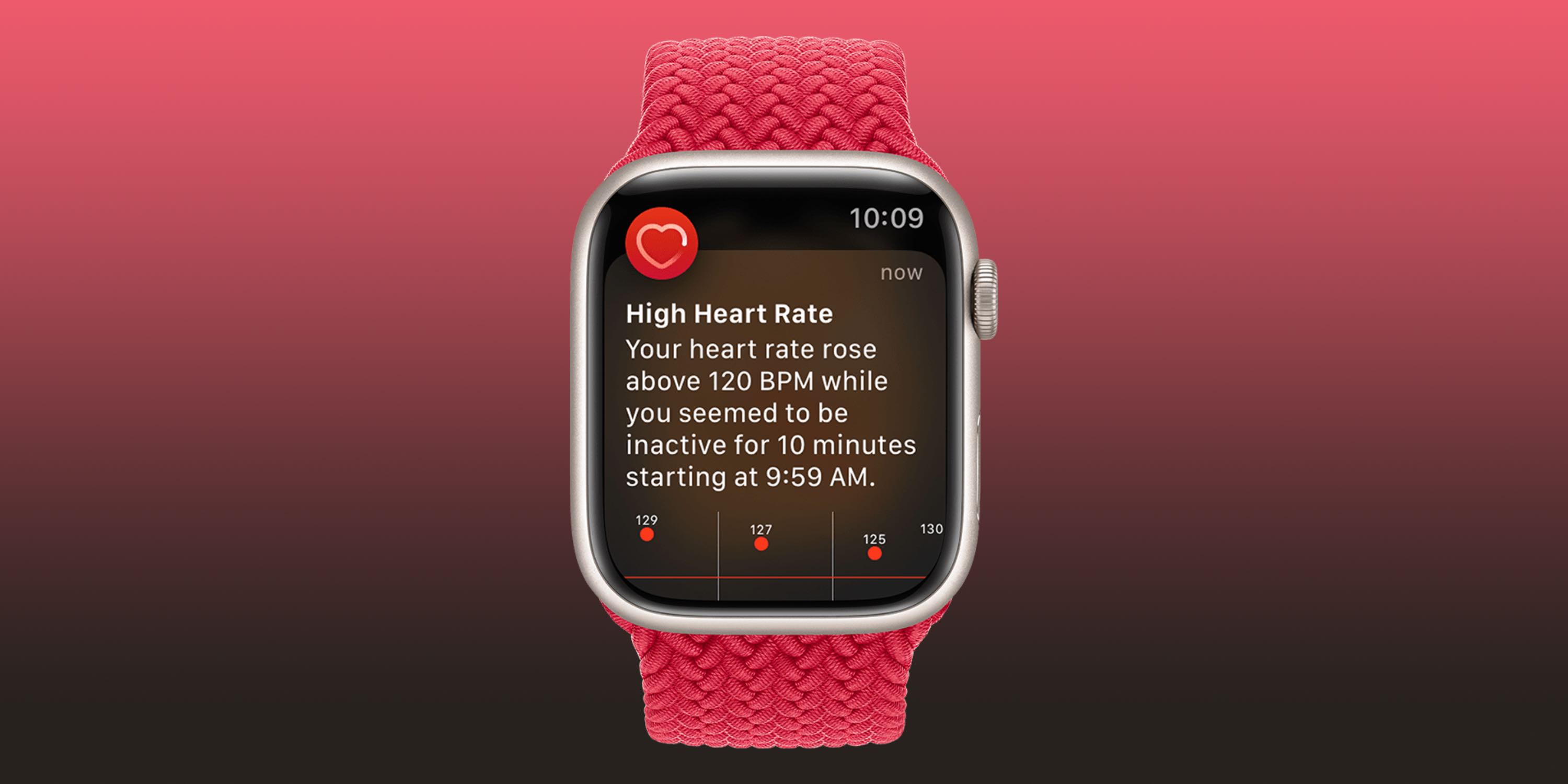
  • If you’d like an alert when your heart rate dips below or rises above a certain threshold and remains there for 10 minutes while inactive, this feature is available for those 13 years old and up.
  • If you didn’t turn it on the first time opening the Heart Rate app or want to change it:
  1. Open the Watch app on your iPhone
  2. Swipe down and choose Heart (under the My Watch tab)
  3. Tap High Heart Rate > pick a threshold
  4. Tap Low Heart Rate > pick a threshold

Irregular heart rhythm notifications

Here’s what this feature does:

“If you receive a notification, the irregular rhythm notification feature on your Apple Watch identified an irregular rhythm suggestive of AFib and confirmed it with multiple readings.
If you have not been diagnosed with AFib by a physician, you should talk to your doctor.

To make sure this feature is set up:

  1. Open the Health app on your iPhone
  2. Choose Browse in the bottom right corner
  3. Now tap Heart
  4. Swipe down and look for Set Up under Irregular Rhythm Notifications
  5. If you don’t see that in the Health app, open the Watch app on iPhone
  6. Swipe down and tap Heart (under the My Watch tab)
  7. Tap the toggle next to Irregular Rhythm

ECG and AFib History

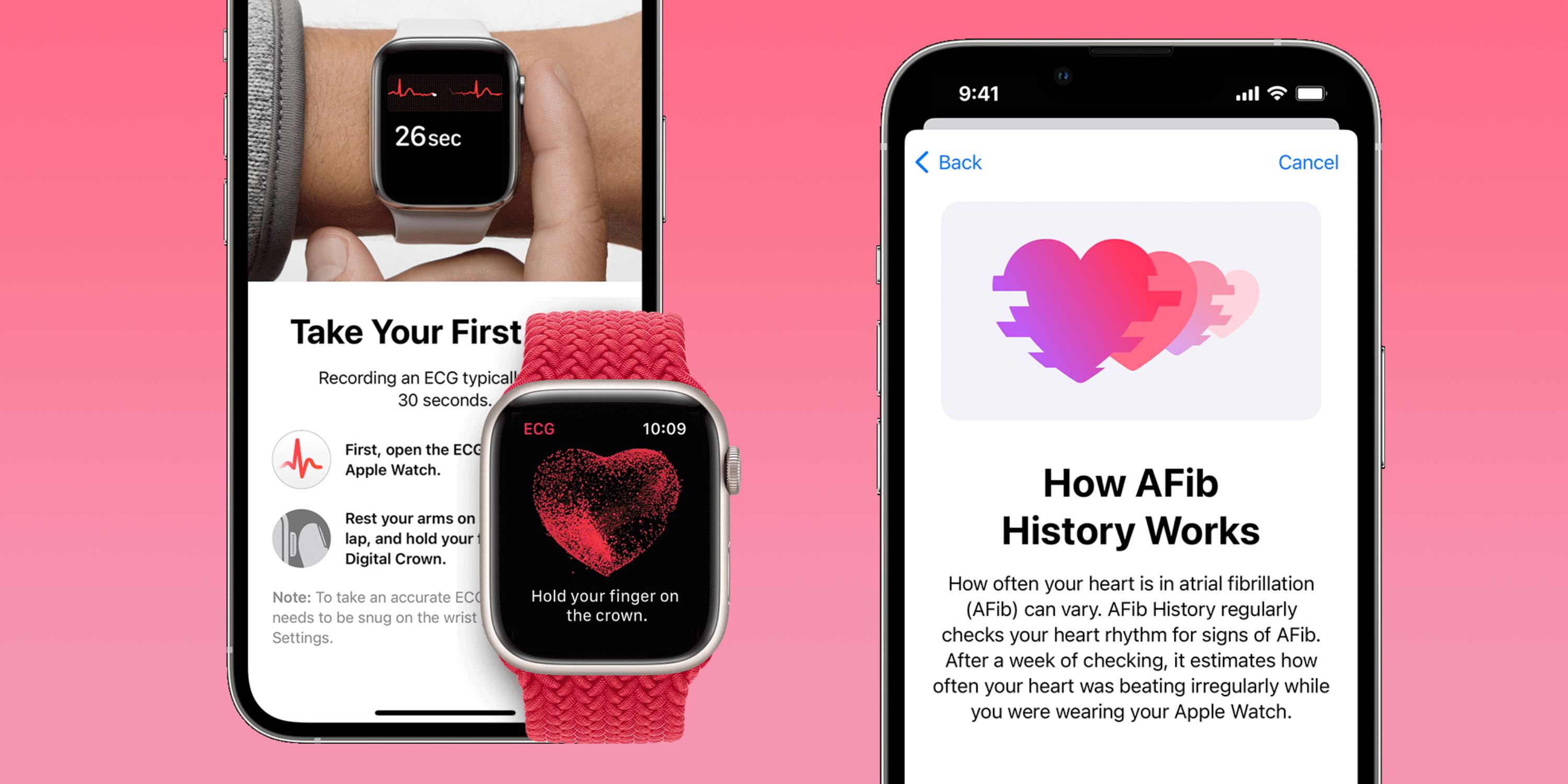
  • The ability to take ECGs with Apple Watch arrived with Apple Watch Series 4 in 2018 starting in the US. In the years since, the valuable and impressive feature has expanded to over 100 countries.
  • ECGs are for Apple Watch users at least 22 years old. If you haven’t used it before or didn’t set it up when you first got your watch:
  1. Open the Health app on your iPhone
  2. Choose Browse in the bottom right corner
  3. Now tap Heart > ECG > Set Up
  4. You can also set up the more recent AFib History feature – this regularly checks for signs of AFib in the background
  5. Head back to the Health app on your iPhone
  6. Browse > Heart > look for Set Up near the bottom under AFib History

Apple highlights that after an ECG “Regardless of the result, if you aren’t feeling well or are experiencing any symptoms, you should talk to your doctor.”

Cardio Fitness

Here’s how Apple describes Cardio Fitness (VO2 max):

“Cardio fitness is a measurement of your VO2 max, which is the maximum amount of oxygen your body can consume during exercise. Your cardio fitness level is a strong indicator of your overall physical health and a predictor of your long-term health.”

Check out how to get going with this or view your data in our full guide:

Cardio Recovery

Like HRV and VO2 max, Cardio Recovery or heart rate recovery is a lesser-known health metric that’s measured by Apple Watch every time you track a workout. Cardio Recovery measures how much your heart rate decreases immediately after exercise. As with heart rate variability, heart rate recovery (HRR) offers a look at your heart health by how fast it responds to the autonomic nervous system.

Learn how to set it up and more in our full guide:

Heart rate variability (HRV)

Heart rate variability (HRV) is automatically captured by Apple Watch but it’s not viewable in the wearable’s native Heart Rate app. You’ll need to head to the iPhone’s Health app > Browse > Heart.

What is HRV? It’s the measurement of how the interval of time between heartbeats changes, measured in milliseconds – notably this is a metric that changes a lot, so looking at broad trends, not daily numbers is most helpful.

HRV is considered by many in the medical field as a powerful indicator of not only current overall health and resilience of the heart and body but also a strong predictor of future mortality.

HRV is also often used as a signal to understand when the body is ready for exercise or rest. All of this is thanks to HRV showing how responsive the heart is to our autonomic nervous system.

Heart data history

On Apple Watch

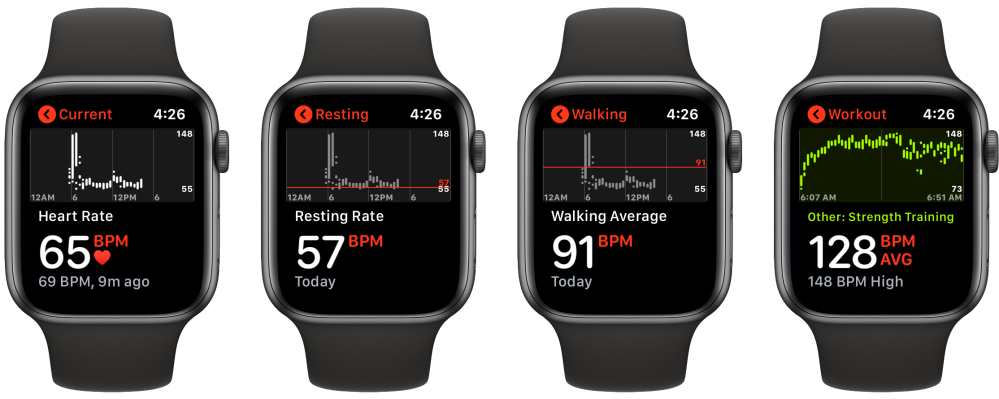
  1. Head to the Heart Rate app on your Apple Watch to see daily data (app with heart icon)
  2. You’ll see your current heart rate, swipe or scroll down with the Digital Crown
  3. Now you can see your resting rate, walking average, workout heart rate, and heart rate recovery data (if you’ve done a workout recently)
How to see heart rate history Apple Watch

Heart rate history on iPhone

Checking your heart rate history captured by Apple Watch on iPhone gives you the most data, here’s where to find it:

  1. Open the Health app on your iPhone
  2. Tap the Browse tab in the bottom right corner, then Heart
  3. On the main page, you’ll see the various heart rate categories. Tap one to see your history
  4. At the top, you can change the data window between hourly, daily, weekly, monthly, and yearly (H, D, W, M, Y)
  5. Toward the bottom, you’ll see heart rate highlights and more information about each type of heart rate data

Further down in the main Heart section, you’ll see more data like Cardio Fitness, ECG results, blood pressure readings, and low/high/irregular heart rate notifications.

Sleep-tracking

Apple Watch includes native sleep tracking but if you want to get richer data, there are a number of great third-party apps you can use. Check out all the details in our full guide:

Apple Health-supported accessories and apps

Compatible with Apple Health, the Withings Body Cardio smart scale is one of my favorite accessories. It even offers a Vascular Age feature that measures the “speed at which the blood pressure pulse propagates through the circulatory system.”

With those measurements, the smart scale is able to determine your arterial stiffness and health with a comparison to the average of people in your age group.

Body Cardio also tracks weight, BMI, body composition (water, fat, bone, and muscle), heart rate tracking, and more.

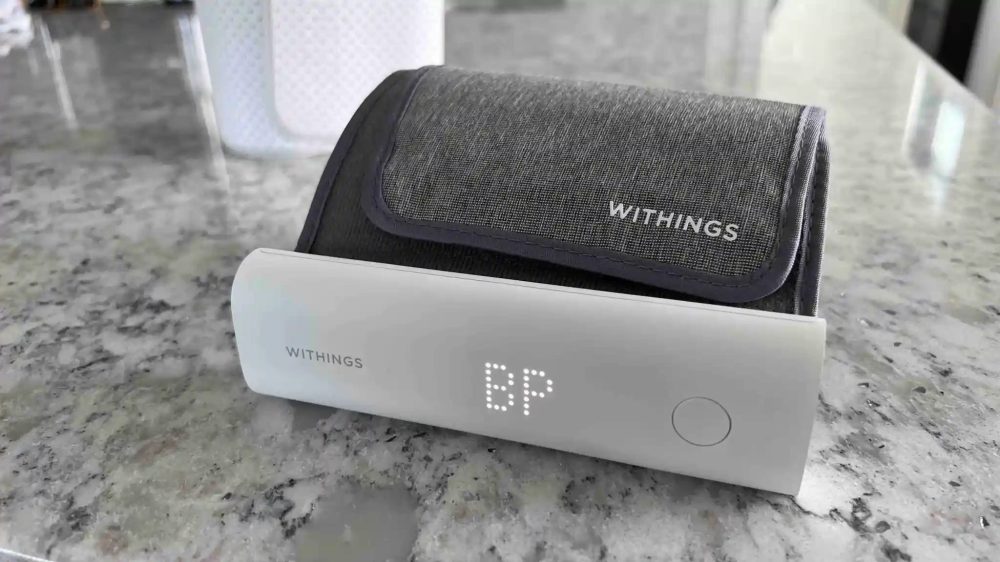
And if you want a seamless way to measure and track your blood pressure with Apple Health, the Withings BPM Connect is a great option.

There are of course many more accessories that record health data with iPhone, just look for the “works with Apple Health” when you’re looking around.

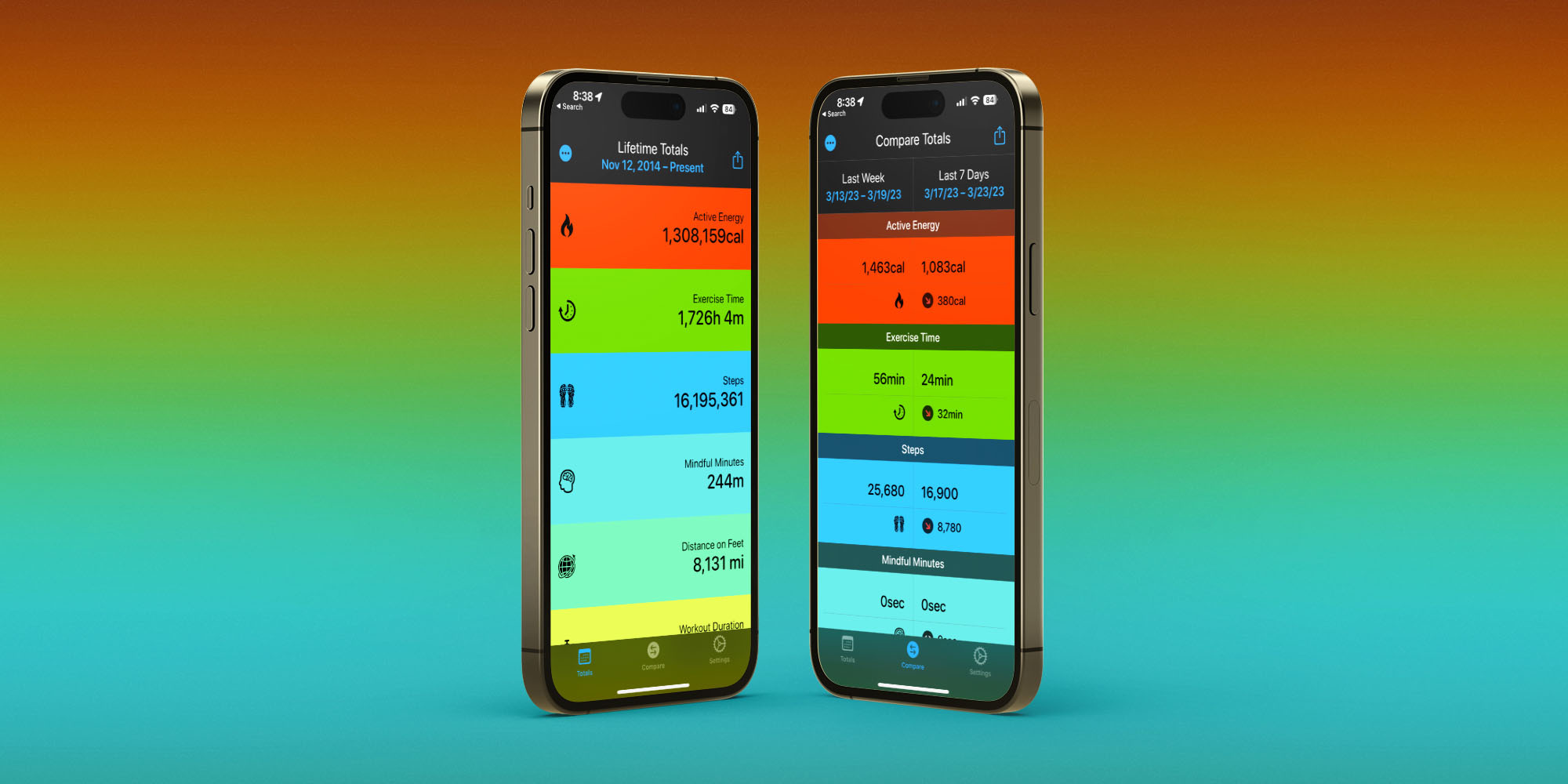
Some of my favorite apps that work with Apple Health include:

Fitness Stats 2

Posture, computer height, more

For tips and tricks on how to sit properly at your desk, do’s and don’ts for cleang your iPhone, and more, check our these guides:

FTC: We use income earning auto affiliate links. More.