The National Women’s Health Network Launches Pilot Program Helping Nonprofit Grassroots Health Organizations Make Change in the Policy Arena

The National Women’s Health Network Launches Pilot Program Helping Nonprofit Grassroots Health Organizations Make Change in the Policy Arena

Five community-based businesses to get funding and complex assistance as portion of the new Overall health Fairness & Access Leadership Education Hub, or The Health System.

Washington, D.C., Feb. 27, 2023 (World NEWSWIRE) — The Nationwide Women’s Health and fitness Network (NWHN), based mostly in Washington, D.C., introduced the Wellbeing Equity & Access Leadership Instruction Hub (The Wellbeing Method) early this yr. The Wellness Program is developed to shift paradigms and shape plan by partnering with grassroots wellbeing organizations throughout the country to:

  • Handle health inequities that disproportionately impression traditionally and systematically marginalized communities

  • Develop overall health care accessibility as a result of legislative advocacy!

  • Make improvements to well being outcomes for women throughout the lifespan and in all their diversities

The selection method for the pilot program began in June 2022. The NWHN seemed for companies that demonstrated a determination to health and fitness equity and aligned with the Network’s mission, eyesight, and values. In January 2023, the software introduced with an inaugural team of five organizations:

The Health Program’s Inaugural Team
Baobab Birth Collective (Montgomery, Alabama)
Modifying Female Initiative (Albuquerque, New Mexico)
New Voices for Reproductive Justice (Pennsylvania & Ohio)
Oshun Family Centre (Philadelphia, Pennsylvania)
Teen Wellness Mississippi (Jackson, Mississippi)

These organizations provide available, expansive, culturally congruent treatment and services with focuses ranging from group wellness, prenatal treatment, doula and lactation providers, psychological overall health and wellness, sexual and reproductive health and fitness schooling, and reproductive justice advocacy.

The Wellbeing Program’s grantee corporations obtain each funding and specialized help from the NWHN, such as:

  • $14,000 in unrestricted grant monies for their participation in the 6-month plan

  • Professional progress from Ms. Byllye Avery, preeminent general public health and fitness professional

  • Bi-weekly trainings on subject areas like translating follow to coverage, federal advocacy, strategic setting up, and sustainable improvement

  • Exclusive participation in an NWHN-organized and led Advocacy Working day on Capitol Hill

“For just about 50-years, the NWHN’s commitment to advancing reproductive well being, legal rights, and justice has remained unwavering,” said Denys Symonette Mitchell, NWHN’s Director of Federal Coverage and founder of The Wellness Program. “With the introduction of this system, we hope to aid rising and evolving businesses include their voices to the discussion and convert insight into influence on Capitol Hill and outside of by sharing our system and skills. Our eyesight of good quality, thorough, accessible, and equitable healthcare can only be recognized by ensuring an equitable distribution of methods, starting with our possess here at the National Women’s Overall health Community.”

###

The National Women’s Well being Community is a 501c3 nonprofit firm currently serving in excess of 2 million men and women nationwide. Our mission is to make improvements to health by strategically shaping policy, expanding accessibility, and furnishing correct, unbiased information and facts. If you’d like to master a lot more about our function, check out https://www.nwhn.org. 

Speak to: Adele Costa Nationwide Women's Health and fitness Network 6315386348 acosta@nwhn.org

Sharing health information will help patients. Blocking data remains a problem.

Sharing health information will help patients. Blocking data remains a problem.

Increased interoperability provides the prospective to remodel healthcare, but federal officers have received hundreds of issues about blocking. The govt has still to unveil penalties.

Healthcare leaders say the extensive exchange of healthcare information in between hospitals, insurers, techniques, and patients will sooner or later be a game-changer.

“We’re at a transformational moment in healthcare,” states Chad Dodd, vice president of product administration at athenahealth, a healthcare technological innovation organization that gives electronic wellness records.

The increased trade of data can aid patients be superior educated about their health, and allow techniques to get a a lot more in depth check out of their patients. “That’s necessary for improved client care and improved affected person outcomes,” Dodd suggests.

On the other hand, Dodd and other individuals say the crucial is to eliminate boundaries blocking well being details and making it possible for for genuine interoperability, exactly where devices can trade and use wellbeing info, he told Chief Health care Executive in a new interview. Federal officers say some corporations are not sharing overall health data.

In Oct 2022, a federal regulation took influence considerably growing the scope of health details to be shared by well being equities. It’s section of the 21st Century Cures Act, which then-President Barack Obama signed in December 2016.

The Cures Act also features a “blocking rule” to prohibit healthcare businesses from denying obtain to facts.

“Information blocking is a essential element of it. It is a significant driver for the accurate interoperability across health care,” Dodd states.

Hundreds of problems

The U.S. Office of Health and fitness and Human Services has still to introduce penalties for these refusing to share wellbeing data. The Cures Act technically allows the wellness office to challenge fines of up to $1 million, but the company still has to outline a system of penalties.

Federal officers say facts blocking is going on.

Since April 2021, 571 claims of achievable info blocking have been noted, the Workplace of the Countrywide Coordinator for Health and fitness Facts Technological innovation (ONC) suggests. In accordance to the agency’s information, 472 of those issues, or 82{35112b74ca1a6bc4decb6697edde3f9edcc1b44915f2ccb9995df8df6b4364bc}, entail health care vendors. Most of the issues have been issued by clients (352), or by third parties representing sufferers (84). Vendors have filed 67 complaints about denials of access to facts.

Dodd says it is apparent some healthcare organizations are blocking the sharing of info.

When requested about facts blocking, Dodd states, “It exists. It is a challenge. It is true.”

U.S. Overall health and Human Providers Secretary Xavier Becerra stated past March that the greater part of the complaints about information and facts staying blocked have concerned healthcare providers. One particular affected person wrote about waiting around to listen to about a biopsy and staying advised the outcomes are out there, but the individual couldn’t get the outcomes due to the fact the medical professional was out of city, Becerra mentioned at the HIMSS Convention.

The penalties have yet to be announced, but Becerra said previous March, “Closing this enforcement gap is an HHS priority.”

Micky Tripathi, head of ONC, informed Healthcare Dive in December that federal officers had been functioning on crafting penalties but didn’t have a timeline, owing to the complexity of the work.

The Business of Inspector Normal in the Office of Wellness & Human Solutions is drafting the penalties. When the penalties for information and facts blocking are announced, Dodd states, that’s when “the transform is going to occur.”

“When penalties are proven, we’ll see motion,” Dodd claims.

Overall health devices and hospitals have been battling to comply with the expanded demands for sharing data. Previous slide, 10 health care groups, which includes the American Hospital Association and the American Healthcare Association, amongst other folks, petitioned unsuccessfully for a hold off in the details blocking deadline.

‘Momentum and energy’

Despite some delays, which includes the COVID-19 pandemic, some health care technological innovation leaders say they are viewing considerably extra momentum constructing for correct interoperability in the business.

Previously this month, the federal federal government picked the very first batch of organizations as future Capable Wellness Information and facts Networks. Individuals businesses will inevitably be tasked with employing the Trusted Exchange Framework and Common Agreement (TEFCA), which establishes a set of governing principles for the exchange of wellbeing details.

“We carry on to make progress together the interoperability route,” Dodd states.

Critically, Dodd states that healthcare businesses are going outside of speaking about simply just sharing the information and are now focusing on exchanging information in methods that can be integrated into workflows.

“I think you see a momentum and electricity compared with at any time in advance of,” he adds. “Everyone is speaking the very same language.”

People are heading to be a key element towards a lot more interoperability since they want their healthcare information and facts, Dodd claims. Patients are in search of a distinct partnership with their health care companies, 1 that is not just transactional, he adds.

“Patients are getting to be customers of health care,” he claims.

As individuals can get information and facts before by viewing results on an app rather than ready to hear from a company, they can be a lot more proactive. Dodd states he has read of a situation exactly where a affected person been given lab outcomes around a weekend when the follow was shut and checked into a hospital, a determination that saved the patient’s lifetime.

“There are good results taking place by offering clients accessibility to details,” Dodd suggests.

Dodd suggests the larger exchange of wellbeing details could be a boon to aid independent methods and scaled-down health care companies.

“The independent observe can now have the similar information and facts as the principal treatment follow that sits inside the wellbeing method,” Dodd suggests.

“That’s essential for our unbiased techniques to thrive,” he states.

University of Tennessee lecturer shares health eating tips for National Nutrition Month

University of Tennessee lecturer shares health eating tips for National Nutrition Month

KNOXVILLE, Tenn. (WATE) — March is National Diet Month. It’s an exertion to distribute instruction and info by the Academy of Diet and Dietetics. Dieticians are contacting on people today to acquire ways at the grocery keep toward much better taking in.

“This is essentially the 50th anniversary of Nationwide Nourishment Month and the topic for this yr is Gasoline for the Potential and that speaks to the sustainability of the setting and how we eat but also probably far more importantly individually is fueling for just about every stage in our lifestyle,” stated Lee Murphy, a distinguished lecturer at the University of Tennessee’s Division of Diet.

Just like a new dad or mum will comply with the dietary stages for a newborn or toddler, adults must consume for every phase of lifestyle.

“Easy matters like taking in 5 fruits and greens a working day, concentrating on total grains, concentrating on lean proteins and unsaturated fats. People main messages to aim on each individual day. There are so several trend diets out there that we could all search at,” claimed Murphy.

She claimed to adhere to the basics. Dieticians made use of to suggest that all of the very good things was alongside the perimeter of the grocery retail outlet.

“There’s tons of excellent stuff in the middle, we just have to browse our labels and make sure we are searching for things that will influence our well being the best,” reported Murphy.

Also, seem out for balanced ideas like Dietician’s Choose that can be uncovered on Food Town shop cabinets. In accordance to Meals Metropolis, “foods that have the Dietitian’s Select shelf-tag meet specific nutrient conditions, designed the Food Town Registered Dietitian and Balanced Initiatives team.” 

“Registered dietitians have considerable academic schooling, as perfectly as scientific instruction and comprehensive perform in proof-centered analysis and usually and so they have been schooled to have medical exercise so that they know the finest items to suggest for folks,” mentioned Murphy.

Earlier mentioned all, be mindful of who you get your information and facts from mainly because undesirable facts can established your wellbeing journey back.

“If you go as a result of TikTok or Instagram or any social media you will see all sorts of recommendations and usually are not recognized registered dietitians. There are registered dietitians that have great social media, but you really don’t know that until you do your homework,” said Murphy.

For much more on how to bounce-begin your healthier life-style, test out the Knoxville Academy of Nutrition and Dietetics at eatrightknox.org for more facts on occasions, referral directory, and resources. 

Sen. Fetterman’s Staff Gives Update on Health While Hospitalized

Sen. Fetterman’s Staff Gives Update on Health While Hospitalized

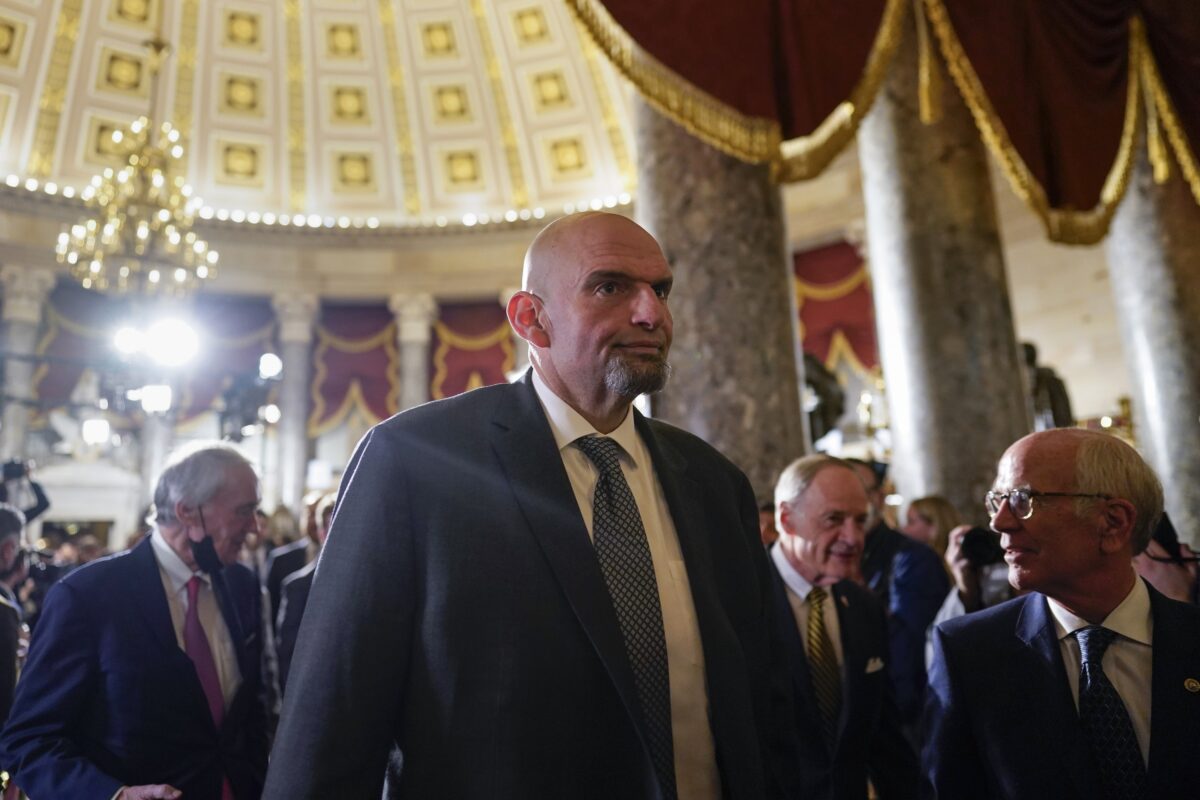
Sen. John Fetterman (D-Pa.) is “on a path to recovery” just after he was admitted to Walter Reed clinic for scientific despair, in accordance to his business in an update issued Monday.

“We do not have a ton to update people with since there is no actual information to report besides that John is performing properly, performing with the amazing doctors, and stays on a route to recovery,” a assertion from Fetterman’s workplace mentioned. “He is traveling to with workers and relatives each day, and his team are holding him updated on Senate enterprise and news.”

“Our staff is transferring whole speed ahead and doing work tirelessly for the people of Pennsylvania. Just final week we opened a new workplace in Erie and will be opening various much more places of work in the coming weeks,” the assertion said, including that his recovery will be a “weeks-very long process.”

“We will be certain to hold folks up-to-date as it progresses,” his personnel reported. “This is all there is to give by way of an update.”

Earlier in February, Fetterman checked himself into Walter Reed Nationwide Armed forces Professional medical Middle to search for procedure for scientific despair, which aides claimed grew to become far more significant in new times. It arrived just times right after he was hospitalized on Feb. 8 for lightheadedness.

His wellbeing has occur beneath intensive scrutiny soon after suffering a stroke previous May, though numerous issues emerged about his potential to accomplish his responsibilities as senator throughout his debate with Republican Mehmet Oz previous yr.

In the course of marketing campaign occasions, many discovered Fetterman’s speech had changed and generally slurred or stumbled around his phrases. After having business office before this calendar year, Fetterman has experienced to depend on closed caption exhibit to help him, in accordance to the Senate Sergeant at Arms in a the latest Time journal report.

“I am happy of the get the job done our group has accomplished to aid Senator Fetterman and am grateful to the lots of Sergeant at Arms experts who worked promptly to establish and employ these progressive alternatives,” Senate Sergeant at Arms Karen Gibson instructed the outlet in a assertion in early February right before Fetterman’s latest wellbeing woes.

Through his to start with hospital stint this month, his spokesman Joe Calvello said that “initial assessments did not clearly show proof of a new stroke, but doctors are working a lot more tests and John is remaining right away for observation.”

And on Feb. 15, his chief of workers, Adam Jentleson, stated that he’s “experienced depression off and on during his life” but “only grew to become severe in modern weeks.” He did not elaborate.

“Last night time, Senator John Fetterman checked himself into Walter Reed Nationwide Military Healthcare Center to receive procedure for scientific depression. When John has seasoned depression off and on through his everyday living, it only became serious in recent weeks,” Jentleson said in a Feb. 16 statement.

Right before his most recent hospital remain, Fetterman voted in the Senate to affirm three judicial nominees, which includes Gina R. Méndez-Miró of Puerto Rico to be a U.S. District Judge for the District of Puerto Rico Lindsay C. Jenkins of Illinois to be a U.S. District Decide for the Northern District of Illinois and Matthew L. Garcia of New Mexico to be a U.S. District Judge for the District of New Mexico.

In the meantime, Fetterman’s spouse, Gisele, claimed that she experienced to flee the United States to Canada to keep away from what she termed a “media circus” surrounding her husband’s hospitalization.

“I am not truly absolutely sure how to navigate this journey but am figuring it out little by little,” she wrote last Friday on Twitter. “One 7 days back currently when the news dropped, the youngsters ended up off from university and media vehicles circled our house. I did the first matter I could believe of—pack them in the auto and generate.”

Fetterman added that she and her small children “talked about plenty of tough items, and how we will all have to confront challenging points. About the want to be light, with all and with ourselves.”

Warren Salzman Day celebrates survival while promoting heart health advocacy

Warren Salzman Day celebrates survival while promoting heart health advocacy

Like any standard day, Warren Salzman of Standard was performing exercises at Carle Health & Physical fitness Center in Bloomington on Feb. 28, 2020. But this turned out to be a working day like no other.

Salzman experienced a unexpected cardiac arrest at the fitness heart and many thanks to a speedy reaction from the staff members and bystanders, he produced a complete recovery.

Carle Wellness & Health Centre has now declared Feb. 28 to be Warren Salzman Day. To celebrate, the fitness center invitations users and the group at massive to an open up property on Tuesday, the place they can take part in health screenings and educational activities relevant to heart wellness.

Warren Salzman has lifted weights most of his lifestyle and workout routines regularly. 3 yrs ago, he established out to obtain a cardio intention.

“One of my goals was to do 100 flights on the stair climber, which I managed to do that day,” he explained. “I received off and was patting myself on the again. That is the previous matter I try to remember.”

Beth Petersen is a registered nurse who works across the avenue from Carle Health & Health and fitness Centre. Her schedule lunchtime wander on the observe was interrupted on Feb. 28, 2020, when she discovered Salzman. He was unresponsive.

“We made the decision to occur about later that working day than standard,” Petersen mentioned. As she and a mate climbed the stairs to the observe, a lady stated that a person appeared to not really feel properly. It was Salzman.

“We place our coats down and walked all-around the keep track of. By then, he was now on the floor,” Petersen reported.

Petersen’s walking buddy transpires to be pediatrician Dr. Andrea Kane, who took manage of the scene.

“When I saw that Warren was facial area down on the ground, I instructed Beth to operate and call for an unexpected emergency,” she claimed. “I turned Warren above and felt for a pulse. At the time he experienced a weak pulse and was agonally breathing (quick of breath).”

Salzman dropped his pulse and an Automated Exterior Defibrillator (AED), which can assess coronary heart rhythms, established he required a shock. Dr. Kane executed CPR and a further shock was shipped in advance of Bloomington Fire arrived to go to to the scene.

“We had a full team there it was excellent. The reaction time was quick,” she explained.

Warren Salzman has experienced two previous coronary heart surgeries, the most latest of which was a valve substitute. He reported a complication from that surgical procedure is what led to this party. It is really also the cause he chose to develop into a member at Carle Wellness & Physical fitness.

“Apparently there were being some faults built,” he explained. “Something went completely wrong and my remaining ventricle was ruined. I went into coronary heart failure and experienced scar tissue on my heart that wasn’t there prior to that surgical treatment.”

Medical doctors told Salzman he could workout his way out of coronary heart failure in 6 months to a 12 months. Salzman pushed the limitations. 4 months write-up-surgical procedure, he was no lengthier in heart failure, but training too hard also contributed to the cardiac arrest.

“I can only place so a lot tension or expectations on my heart now,” he stated.

Lest you believe this tale is an justification to swear off that treadmill, Carle Health and fitness & Health Middle govt director Catherine Porter suggests training is virtually usually additional beneficial than damaging.

“Exercise is a worry, and it is a good worry,” Porter claimed. “But there are inherent challenges in exercising. Cardiac arrest is just one of them. It occurs very not often.”

Porter recommends discovering a harmless place to work out and consulting a doctor in advance of participating in an physical exercise program, specifically for those people who have experienced previous cardiovascular overall health troubles. Carle Health and fitness & Physical fitness Center is considered a health care fitness heart, that means all the workers have state-of-the-art instruction and qualifications to regulate health and fitness systems for people in different phases of well being.

“We coach for professional medical occasions,” Porter mentioned. “We have a whole method and a reaction crew. We go by CPR training on a quarterly foundation. In the celebration that something like this occurs, every person has a position, and they know what to do.”

Personal coach Jenna Souhrada had just completed a session with another client when Salzman collapsed.

“I was at our health desk and I see a member appear to the best of the stairs, not truly vocalizing what was taking place, but you could inform it was not fantastic,” Souhrada reported. She and an additional coach grabbed a 1st help bag and AED and ran to the track.

“I’ve under no circumstances been more thankful to see Beth and Dr. Kane,” claimed Souhrada.

Irrespective of their clinical knowledge, Dr. Kane, a pediatrician, and registered nurse Beth Petersen do not function in unexpected emergency drugs.

“I’ve been a nurse for pretty much 24 years, and I’ve never performed CPR,” Petersen mentioned. “I’ve labored in a mother/infant unit and an business. So I definitely was a small freaked out.”

Kane has beforehand stepped in for a person other resuscitation – on an plane on her honeymoon.

“Afterwards, when you are decompressing, which is when you get started to experience people emotions.”

Kane said she recognized that it can be challenging to act cool underneath force.

“Know that you are conserving them,” she said. “You are their only possibility at conserving them.”

Salzman did not know Petersen or Kane prior to Feb. 28, 2020. The two females are now a long-lasting fixture in his daily life tale.

“It’s tricky to put into phrases the feelings when you do realize that these are the folks who saved your existence,” he said. “It gave me a second probability. Indicating ‘thank you’ didn’t appear – but I believe they all realized how I felt.”

Carle Wellbeing & Physical fitness Middle commemorates Warren Salzman Working day from 9-11 a.m. and 4-6 p.m.on Tuesday, Feb. 28, with free blood stress screenings and exercise checks. People also can get discounted cholesterol and glucose assessments and show up at info classes about early coronary heart assault care and applying automatic exterior defibrillators.

As section of the festivities, nurse educators from Carle’s stroke method will be on web-site at Carle Health & Health and fitness Middle from 4-6 p.m. to reply queries about stroke avoidance. Visitors of honor Warren Salzman, Beth Petersen and Dr. Andrea Kane will cease by all-around lunchtime.

We depend on your guidance to hold telling stories like this just one. You – together with donors throughout the NPR Community – create a additional informed community. Simple fact by actuality, story by story. You should consider a instant to donate now and fund the regional information our community requirements. Your support actually tends to make a distinction.

Women’s Experiences with Provider Communication and Interactions in Health Care Settings: Findings from the 2022 KFF Women’s Health Survey

Women’s Experiences with Provider Communication and Interactions in Health Care Settings: Findings from the 2022 KFF Women’s Health Survey

Introduction

Women’s health outcomes are shaped not only by access to care, health insurance, and affordability, but also by the social and economic factors that drive health, discrimination, and experiences within the health care system, which have become a larger focus in providing equitable health care in recent years. One of the Institute of Medicine’s six domains of healthcare quality is patient-centered care: providing care that is respectful of and responsive to individual patient preferences, needs, and values and ensuring that patient values guide all clinical decisions. Measures of patient experience and Consumer Assessment of Healthcare Providers and Systems (CAHPS) Surveys have also become more widely used among health care organizations and clinics interested in assessing the patient-centeredness of the care they deliver and areas of improvement. in the health care system, which have become a larger focus in providing equitable health care in recent years.

This brief presents findings from the 2022 KFF Women’s Health Survey (WHS) on women’s experiences with the health care system including screening for social determinants of health, provider communication and interactions, and discrimination. The KFF WHS is a nationally representative survey of 5,145 self-identified women ages 18 to 64, conducted May 10 – June 7, 2022. See the Methodology section for more details.

Summary of Findings

  • Among women ages 18-64 who have seen a health care provider in the past two years:
    • Twenty-nine percent report that their doctor had dismissed their concerns in that time period, 15{35112b74ca1a6bc4decb6697edde3f9edcc1b44915f2ccb9995df8df6b4364bc} reported that a provider did not believe they were telling the truth, 19{35112b74ca1a6bc4decb6697edde3f9edcc1b44915f2ccb9995df8df6b4364bc} say their doctor assumed something about them without asking, and 13{35112b74ca1a6bc4decb6697edde3f9edcc1b44915f2ccb9995df8df6b4364bc} say that a provider suggested they were personally to blame for a health problem. A higher share of women (38{35112b74ca1a6bc4decb6697edde3f9edcc1b44915f2ccb9995df8df6b4364bc}) than men (32{35112b74ca1a6bc4decb6697edde3f9edcc1b44915f2ccb9995df8df6b4364bc}) report having had at least one of these negative experiences with a health care provider.
    • One in ten (9{35112b74ca1a6bc4decb6697edde3f9edcc1b44915f2ccb9995df8df6b4364bc}) women ages 18-64 say that they have experienced discrimination because of their age, gender, race, sexual orientation, religion, or some other personal characteristic during a health care visit in the past two years.
    • Few women report being asked about social and economic factors that may influence health. While 58{35112b74ca1a6bc4decb6697edde3f9edcc1b44915f2ccb9995df8df6b4364bc} report that in the past two years their provider asked them about what kind of work they do, far fewer report having been asked about their housing situation (30{35112b74ca1a6bc4decb6697edde3f9edcc1b44915f2ccb9995df8df6b4364bc}), their ability to afford food (20{35112b74ca1a6bc4decb6697edde3f9edcc1b44915f2ccb9995df8df6b4364bc}), or access to reliable transportation (20{35112b74ca1a6bc4decb6697edde3f9edcc1b44915f2ccb9995df8df6b4364bc}). Women with Medicaid and those with low incomes are more likely to say they have been asked about these last three indicators than women with private insurance and those with higher incomes.
  • Communication is an important component of health care quality; however, 21{35112b74ca1a6bc4decb6697edde3f9edcc1b44915f2ccb9995df8df6b4364bc} of women (including 38{35112b74ca1a6bc4decb6697edde3f9edcc1b44915f2ccb9995df8df6b4364bc} of uninsured women), say it is difficult to find a doctor who explains things in a way that is easy to understand.
  • Just over one-third (35{35112b74ca1a6bc4decb6697edde3f9edcc1b44915f2ccb9995df8df6b4364bc}) of women ages 40-64 say their health care provider ever talked to them about what to expect in menopause.

Screening for Social Determinants of Health

In recent years, the social determinants of health have been recognized as critical factors that shape health outcomes. These factors include housing, transportation, nutrition, and financial well-being. Although there are no formal recommendations for routine screening for social determinants of health, a recent review conducted for the U.S. Preventive Services Task Force found that screening for risk factors including housing, food security, and transportation shows positive effects on health outcomes. In fact, six health professional organizations specifically encourage social risk screening and referrals in clinical settings (American Academy of Family Physicians, American Academy of Pediatrics, American College of Obstetricians and Gynecologists, American College of Physicians, American Diabetes Association, and American Osteopathic Association).

HRSA-funded federally qualified health centers (FQHCs), which provide primary care services in underserved areas, must report whether they screen patients for social risk factors and if so, the total number of patients that screened positive for food insecurity, housing insecurity, financial strain, and lack of transportation/access to public transportation. One study found that the majority of FQHCs collected this type of information, but some evidence suggests these screenings may be less common in other health care settings. Medicaid contracts are also increasingly requiring managed care plans to screen for the social determinants of health and many plans report being engaged in activities to address enrollees’ social needs.

Nearly three in five (58{35112b74ca1a6bc4decb6697edde3f9edcc1b44915f2ccb9995df8df6b4364bc}) women who have visited a doctor in the past two years say they were asked about the kind of work they do, but only one in five were asked about their ability to afford food (20{35112b74ca1a6bc4decb6697edde3f9edcc1b44915f2ccb9995df8df6b4364bc}) or access to reliable transportation (20{35112b74ca1a6bc4decb6697edde3f9edcc1b44915f2ccb9995df8df6b4364bc}).

Fifty-eight percent of women who have seen a health care provider in the past two years report that their provider asked about what kind of work they do in the past two years (Table 1).

Three in ten (30{35112b74ca1a6bc4decb6697edde3f9edcc1b44915f2ccb9995df8df6b4364bc}) women who have seen a health care provider in the past two years report having been asked about their housing situation, with higher shares among uninsured women (32{35112b74ca1a6bc4decb6697edde3f9edcc1b44915f2ccb9995df8df6b4364bc}), women with Medicaid coverage (44{35112b74ca1a6bc4decb6697edde3f9edcc1b44915f2ccb9995df8df6b4364bc}), and women with low incomes (37{35112b74ca1a6bc4decb6697edde3f9edcc1b44915f2ccb9995df8df6b4364bc}).

Fewer women report that their provider asked them about their ability to afford food (20{35112b74ca1a6bc4decb6697edde3f9edcc1b44915f2ccb9995df8df6b4364bc}) or access to reliable transportation (20{35112b74ca1a6bc4decb6697edde3f9edcc1b44915f2ccb9995df8df6b4364bc}). A larger share of uninsured women (27{35112b74ca1a6bc4decb6697edde3f9edcc1b44915f2ccb9995df8df6b4364bc} and 23{35112b74ca1a6bc4decb6697edde3f9edcc1b44915f2ccb9995df8df6b4364bc}, respectively) and women with Medicaid (34{35112b74ca1a6bc4decb6697edde3f9edcc1b44915f2ccb9995df8df6b4364bc} and 33{35112b74ca1a6bc4decb6697edde3f9edcc1b44915f2ccb9995df8df6b4364bc}, respectively) say they were asked about these two topics than women with private insurance (15{35112b74ca1a6bc4decb6697edde3f9edcc1b44915f2ccb9995df8df6b4364bc} and 14{35112b74ca1a6bc4decb6697edde3f9edcc1b44915f2ccb9995df8df6b4364bc}, respectively).

Black and Hispanic women are more likely than White women to say they were asked about their housing situation, ability to afford food, and access to reliable transportation. Women ages 18-35 are more likely than women ages 50-64 to say they have been asked about all of these topics by their provider in the past two years.

A higher share of women in 2022 say that in the past two years their health care provider asked them about their housing, ability to afford food, and access to transportation than did in 2020 (19{35112b74ca1a6bc4decb6697edde3f9edcc1b44915f2ccb9995df8df6b4364bc}, 13{35112b74ca1a6bc4decb6697edde3f9edcc1b44915f2ccb9995df8df6b4364bc}, and 13{35112b74ca1a6bc4decb6697edde3f9edcc1b44915f2ccb9995df8df6b4364bc}, respectively).

Provider Communication

Communication is an important component of health care quality but one in five (21{35112b74ca1a6bc4decb6697edde3f9edcc1b44915f2ccb9995df8df6b4364bc}) women say it is difficult to find a doctor who explains things in a way that is easy to understand.

Approximately one in four younger women (23{35112b74ca1a6bc4decb6697edde3f9edcc1b44915f2ccb9995df8df6b4364bc}), women with a high school degree or less (23{35112b74ca1a6bc4decb6697edde3f9edcc1b44915f2ccb9995df8df6b4364bc}), Hispanic women (24{35112b74ca1a6bc4decb6697edde3f9edcc1b44915f2ccb9995df8df6b4364bc}), and women with low incomes (26{35112b74ca1a6bc4decb6697edde3f9edcc1b44915f2ccb9995df8df6b4364bc}) have found it difficult to find a doctor who explains things in a way that is easy to understand (Figure 1). This share was highest among uninsured women, where more than one-third (36{35112b74ca1a6bc4decb6697edde3f9edcc1b44915f2ccb9995df8df6b4364bc}) say it is difficult. These findings could reflect language barriers experienced by people with limited English proficiency, and difficulties faced by people with lower health literacy.

Menopause is a topic that has received little attention and there is a lack of information about what to expect during menopause.

One aspect of women’s health that is often not discussed with clinicians is menopause and what women can expect during this transition. Just over one-third (35{35112b74ca1a6bc4decb6697edde3f9edcc1b44915f2ccb9995df8df6b4364bc}) of women ages 40-64 say their health care provider ever talked to them about what to expect in menopause (Figure 2), with wide variation by current menstrual status. Forty-two percent of women who have gone through menopause, 39{35112b74ca1a6bc4decb6697edde3f9edcc1b44915f2ccb9995df8df6b4364bc} of those currently going through menopause, and 19{35112b74ca1a6bc4decb6697edde3f9edcc1b44915f2ccb9995df8df6b4364bc} of premenopausal women say a provider has ever talked to them about what to expect in menopause. Providing information about what to expect during menopause can ease women’s concerns about the changes they may experience after their reproductive years and offer women options for clinical interventions.

Provider Interactions

Women are more likely than men to report experiencing certain negative provider interactions.

Negative interactions within the health care system can contribute to poorer health outcomes, distrust of the health care system, and health inequities. Among women and men ages 18-64 who have visited a health care provider in the past two years, 29{35112b74ca1a6bc4decb6697edde3f9edcc1b44915f2ccb9995df8df6b4364bc} of women ages 18-64 report that their doctor had dismissed their concerns during that time, compared to 21{35112b74ca1a6bc4decb6697edde3f9edcc1b44915f2ccb9995df8df6b4364bc} of men (Figure 3). Fifteen percent of women said they have had a provider not believe they were telling the truth, compared to 12{35112b74ca1a6bc4decb6697edde3f9edcc1b44915f2ccb9995df8df6b4364bc} of men. Nine percent of women who have visited a health care provider in the past two years said they had experienced discrimination because of their age, gender, race, sexual orientation, religion, or some other personal characteristic, compared to 5{35112b74ca1a6bc4decb6697edde3f9edcc1b44915f2ccb9995df8df6b4364bc} of men.

A similar share of women (19{35112b74ca1a6bc4decb6697edde3f9edcc1b44915f2ccb9995df8df6b4364bc}) and men (16{35112b74ca1a6bc4decb6697edde3f9edcc1b44915f2ccb9995df8df6b4364bc}) who have been to a doctor in the past two years say their doctor assumed something about them without asking in the past two years. The same share of women and men say that a provider suggested they were personally to blame for a health problem (13{35112b74ca1a6bc4decb6697edde3f9edcc1b44915f2ccb9995df8df6b4364bc}). Overall, a higher share of women than men say they have had at least one of these experiences in the past two years (38{35112b74ca1a6bc4decb6697edde3f9edcc1b44915f2ccb9995df8df6b4364bc} vs. 32{35112b74ca1a6bc4decb6697edde3f9edcc1b44915f2ccb9995df8df6b4364bc}).

Among women who have visited a health care provider in the past two years, larger shares of those who are covered by Medicaid or uninsured, or who have low incomes, or a disability or ongoing health condition report having had each of these four negative experiences with their provider during that time period.

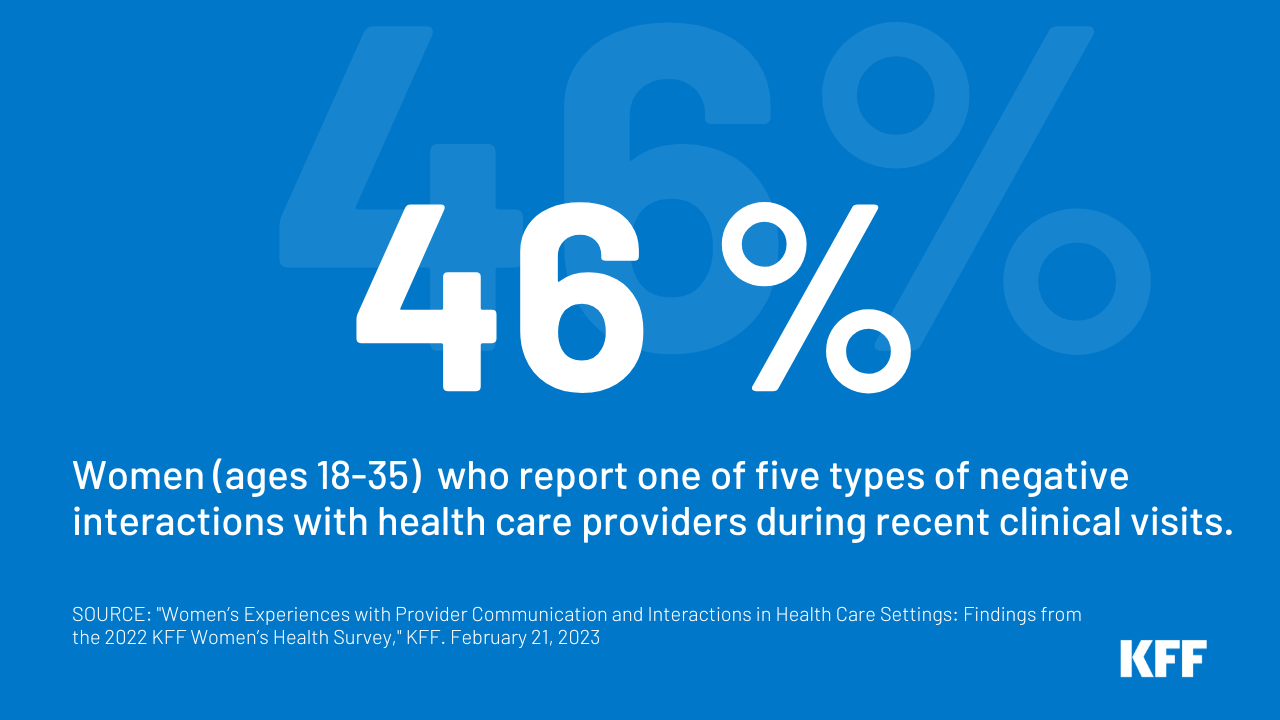
Thirty-six percent of women with a disability or ongoing health condition report that a health care provider had dismissed their concerns in the past two years compared to 22{35112b74ca1a6bc4decb6697edde3f9edcc1b44915f2ccb9995df8df6b4364bc} of women who do not (Table 2). A higher share of Black women (18{35112b74ca1a6bc4decb6697edde3f9edcc1b44915f2ccb9995df8df6b4364bc}) who have seen a provider in the past two years say that their provider did not believe they were telling the truth than White women (15{35112b74ca1a6bc4decb6697edde3f9edcc1b44915f2ccb9995df8df6b4364bc}), and a higher share of White women than Asian/Pacific Islander (7{35112b74ca1a6bc4decb6697edde3f9edcc1b44915f2ccb9995df8df6b4364bc}) women say the same. More than four in ten women ages 18-35 (46{35112b74ca1a6bc4decb6697edde3f9edcc1b44915f2ccb9995df8df6b4364bc}), uninsured (46{35112b74ca1a6bc4decb6697edde3f9edcc1b44915f2ccb9995df8df6b4364bc}), with Medicaid coverage (44{35112b74ca1a6bc4decb6697edde3f9edcc1b44915f2ccb9995df8df6b4364bc}), or with a disability or ongoing health condition (45{35112b74ca1a6bc4decb6697edde3f9edcc1b44915f2ccb9995df8df6b4364bc}) who have been to a doctor in the past two years report having had at least one of these interactions.

The impacts of bias, racism, and discrimination in health care has garnered increased attention in recent years and is recognized as having detrimental effects on women’s health. Some women report experiencing discrimination at higher rates than others. Twice as many women (10{35112b74ca1a6bc4decb6697edde3f9edcc1b44915f2ccb9995df8df6b4364bc}) ages 18-49 say they have experienced discrimination during a health care visit as women ages 50-64 (5{35112b74ca1a6bc4decb6697edde3f9edcc1b44915f2ccb9995df8df6b4364bc}) (Table 2). A larger share of Black women ages 18-64 who have visited a health care provider in the past two years reports experiencing discrimination than White women (13{35112b74ca1a6bc4decb6697edde3f9edcc1b44915f2ccb9995df8df6b4364bc} vs. 7{35112b74ca1a6bc4decb6697edde3f9edcc1b44915f2ccb9995df8df6b4364bc}). Women with low incomes and those with Medicaid or who are uninsured also report experiencing discrimination because of their age, gender, race, sexual orientation, religion, or some other personal characteristic at higher rates than their counterparts.

Our discrimination survey question aims to understand people’s perceptions of various actions and experiences as discrimination. Whereas some other surveys have asked respondents about experiencing “unfair treatment” in a variety of different settings or in general, our survey takes a different approach by asking one specific question about perceived discrimination in the context of a health care visit in the past two years. People may experience different types of unfair treatment but not necessarily describe it as discrimination. As a result, surveys that ask about unfair treatment more broadly tend to have higher shares of respondents who say they have experienced that.

Conclusion

The role of social determinants on health outcomes has garnered increased recognition in recent years. Providers are increasingly discussing factors with their patients that shape access to health care and health outcomes such as food insecurity and transportation challenges, although ensuring providers have resources with which to connect patients to address these social determinants is still a challenge. Gender bias and racial discrimination in the health care system can contribute to health disparities and poorer health outcomes. Women are more likely than men to report having experienced some type of health care bias, particularly those who are in poorer health, younger, or have low incomes.

Efforts to improve provider communication and interactions and address discrimination could improve women’s experiences with the health care system, alleviate some of the barriers many women still experience when they seek care, and reduce health disparities.