These Doctors Fought the Federal Bureau of Narcotics to Treat Addiction–With Drugs

These Doctors Fought the Federal Bureau of Narcotics to Treat Addiction–With Drugs

After years of disappointing results in her quest to treat heroin addiction, Marie Nyswander was more than ready to try something new. When she met a prominent doctor at the prestigious Rockefeller Institute, now the Rockefeller University, the two embarked on an experiment that would define both of their careers and revolutionize the treatment of addiction for decades to come. But not everyone was happy about it.

[New to this season of the Lost Women of Science? Listen to Episode One here first and then to Episode Two.]

EPISODE TRANSCRIPT

The Lost Women of Science podcast is made for the ear. We aim to make our transcripts as accurate as possible, but some errors may have occurred nonetheless. In addition, important aspects of speech, like tone and emphasis, may not be fully captured, so we recommend listening to episodes, rather than reading transcripts, when possible.

—-

KATIE HAFNER: Hey, this is the third episode in our series about Marie Nyswander. We want to remind you that there will be some adult content and some archival audio that includes pretty outdated language about drug addiction.

CAROL SUTTON LEWIS: In the early 1960s, a doctor named Vincent Dole commuted to work every day from Rye, a wealthy suburb north of New York City, to his office on Manhattan’s Upper East Side.

Life had gone well for Vince up to this point. He was born to a rich family in Chicago, went to Stanford, then Harvard Medical School, and now he was working at the prestigious Rockefeller Institute, specializing in obesity and metabolism. Vincent Dole was a big name in his field.

KATIE HAFNER: But his work had grown unfulfilling. He found himself going to the same conferences, meeting the same people over and over, and then there were his patients. In 1982, he told the historian David Courtwright, he’d help them lose weight, but then-

VINCENT DOLE: Invariably in a short time when you kind of relax the routine, they would return to just what they had before. In other words, they were like a thermostat set at a certain weight.

KATIE HAFNER: And often, it was sheer vanity that brought them to his office.

VINCENT DOLE: Ladies would come in and announce they wanted to lose weight or move it around to different locations, and uh, I just figured that I was being kind of utilized on a cosmetic basis. It really didn’t necessarily make medical sense.

KATIE HAFNER: Vince wasn’t just put off by the ladies who expected him to help them slim down. He was bored. And he might have stayed in his comfortable, boring bubble if it weren’t for a quirk of his daily commute. He’d get off the commuter train from Westchester at 125th Street, and then, he’d walk a few blocks through East Harlem to another train that would take him to Rockefeller. And that walk? It was eye-opening.

VINCENT DOLE: I kind of had this sense of commuting between two highly privileged oases through a truly epidemic sea of misery.

KATIE HAFNER: The epidemic was heroin addiction. As we discussed in the last episode, in the late 50s and early 1960s, East Harlem was particularly hard hit by heroin addiction, and the problem was growing.

And if he hadn’t changed trains, he might have never given this much thought—maybe just a glance out the window, forgotten by the time he got to work, like thousands of other commuters. But during that walk, Vince was forced to actually see what was happening in his city.

VINCENT DOLE: And I began to realize that nobody in my community of scientists or people in Rye had any concept of that world, even though the place was right in New York. And we were living in, essentially, living in the midst of an epidemic and ignoring it.

CAROL SUTTON LEWIS: Now, addiction was far outside of Vince’s specialty. But, he thought about what he did know, which was metabolism, and over time, an idea started forming. What if the desire for drugs had something in common with the desire for food? Many people had assumed that obesity was just the result of overeating, but several studies had found that there are people who gain weight without eating any more than other people, and their bodies expended less energy doing the same things. And Vince thought something about their metabolic state could also result in greater cravings for food. 

What if something similar was going on here? Something about the metabolism of a person addicted to drugs that made their bodies crave drugs in a way that other people’s didn’t? 

Now, here was a proper research puzzle, an opportunity to dive into relatively open scientific territory, an opportunity just waiting for someone to seize it. And maybe that person could be him. Maybe Vincent Dole, famed obesity expert, could even stop an epidemic. All he needed was to actually learn something about addiction.

CAROL SUTTON LEWIS: This is Lost Women of Science. I’m Carol Sutton Lewis.

KATIE HAFNER: And I’m Katie Hafner. This season, the Doctor and the Fix: how Marie Nyswander changed the landscape of addiction. And in today’s episode—an unlikely breakthrough.

EMILY DUFTON: Dole was very high level.

CAROL SUTTON LEWIS: That’s Emily Dufton, writer and drug historian.

EMILY DUFTON: I remember interviewing someone who said they really believed that if Dole had stayed with his work on obesity and metabolism, he would’ve been awarded a Nobel Prize. Like, that’s how well respected this work was, so for him to drop it and be like, mm-mm, heroin addiction—that’s the kind of stakes he was playing with.

CAROL SUTTON LEWIS: Vince was thinking about wading into a field where he had no experience. But even though he was very new to addiction, hadn’t done any of his own research, Vince had connections. And one day he was chatting with one of those connections when an opportunity landed in his lap. 

The connection was Lew Thomas. Lewis Thomas was the chairman of the New York City Health Department’s Committee on Narcotics. And on that day, Vince was telling Lew about his new interest in addiction, and said, you know, isn’t it a shame there isn’t more good research in the field? And as Vincent tells it, that’s when Lew essentially handed him the keys to the kingdom.

VINCENT DOLE: He said, well, that’s a great thing. He says, I’m just gonna go off on a sabbatical to France, and I haven’t seen much come out of this committee. Why don’t you become the chairman of it? I said, all right, I’ll do it.

CAROL SUTTON LEWIS: And that was it. 

KATIE HAFNER: Okay. I just need to interrupt for one sec and say, wait a minute, are you kidding me?  And maybe this is because so little was known about addiction or he was so well connected, but he gets to just become the chairman of some committee on narcotics, knowing absolutely nothing about narcotics? And yet you’ve got Marie Nyswander having put in all this time — I mean, she’s, like, totally steeped in it. She’s published an entire book on addiction.

CAROL SUTTON LEWIS: Even more to your point, this shows you how much they cared about committees on addiction if they’re gonna put a guy in charge who has absolutely no background  whatsoever. I mean, there was Dr. Marie Nyswander, I’m sure there were other people who were actually focused on it, but to just, to hand this guy the chairmanship because he was his bud?

KATIE HAFNER: Yeah, well it was a man’s world. 

CAROL SUTTON LEWIS: Yep, he gets to stroll right in and he’s put in charge, but at least Vince knew enough to know that he had a lot to learn.   

EMILY DUFTON: So he started reading about addiction on his own, just kind of giving himself like the survey of the available literature ‘cause he had never taken a class on addiction. He went to Harvard Medical, no one talked about it. He had no instruction in it whatsoever. There are no conversations about it at Rockefeller. So he began kind of teaching himself and he came across, uh, Marie’s article, and he also came across her book. 

CAROL SUTTON LEWIS: In 1956, a few years before Marie published The Power of Sexual Surrender, she’d published a book about addiction called The Drug Addict as a Patient. In this book, Marie efficiently summarized everything she’d learned about addiction—the effect of drugs on the body, methods for easing withdrawal, the history of criminalization in the United States, and some of the theories of addiction from the day. 

But most importantly, she argued that addiction was a sickness, not a criminal matter, and that punishing people or coercing them into treatment just didn’t work. Vince liked what he read. Years later he told David Courtwright that Marie Nyswander was the only person who made any sense to him. And he saw in her, not just an expert to consult, but a potential collaborator too. So, sometime in late 1962 or early 1963, Vince gave her a call. And he reached a very tired and frustrated Marie.

MARIE NYSWANDER: By that time, I had exhausted every psychiatric and psychological treatment modality that there was. You name it, hypnosis, group therapy, moving patients around the world.

CAROL SUTTON LEWIS: Almost seven years had passed since Marie had published her book on addiction. Professionally, she was doing well. She still had her private practice on Park Avenue, and an appointment as an assistant professor at New York Medical College. But all those years of treating addiction, they’d worn her down.

EMILY DUFTON: She’s been banging her head against the wall for years trying to, you know, help her patients get better and instead they’re dying. And so Vincent Dole says, you know, hey, come talk to me. I’ve got, um, the backing of Rockefeller University with the prestige and, uh, respectability that that offers. And I’ve got a whole lot of money from the City of New York to try to figure out how to solve addiction. Do you wanna come help me? Do you wanna become a Rockefeller University employee and help me try to solve addiction and we’ve got the money to do it? And she’s like, yes, I think that sounds like a really great idea. Because who wouldn’t? 

KATIE HAFNER: And Vince was just as thrilled to work with Marie. Vince’s reaction to Marie would be echoed by others through the years. There was her charisma, for one thing, but also her straight up compassion for her patients, her determination to help them. While we’ve been working on this season, we’ve seen and heard this phrase over and over and over again: she saw her patients – from the outside to deep within.

VINCENT DOLE: She impressed me as a very intense and intelligent, uh, person who was working under absolutely hopeless disadvantages of just administratively ‘cause she was all alone with a good heart and a lot of spirit, uh, trying to fight the entire establishment up and down the line.

KATIE HAFNER: And Marie clearly saw something deep in Vince. From the beginning, let’s just say, they had chemistry. Though not everyone was happy about it. In particular, Marie’s husband,  Leonard Wallace Robinson. Carol, remember how Leonard wrote that book we talked about earlier called The Man Who Loved Beauty all about his beloved? 

CAROL SUTTON LEWIS: Mm-hmm.

KATIE HAFNER: Yeah. Well, ha- have you read it by the way? 

CAROL SUTTON LEWIS: No.

KATIE HAFNER: Oh, okay. Let me just tell you. A fictionalized Vince features heavily in it. In the book, Vincent Dole becomes “Thurman Cantwell,” a New York physician who recruits “Elizabeth” aka Marie, who is also the Beauty in the book, to help him on his quest to find a treatment for alcoholism. 

After “Thurman” invites “Elizabeth” to join the research team, Elizabeth is quote “glistening with excitement” – yes, you heard that right, glistening.

And clearly, Leonard is not a fan of the Vince slash Thurman character, so she’s Beauty, and Thurman is Beast. And he’s Beast for much of the book. Leonard’s descriptions of this man, Vince slash Thurman slash Beast, they’re not flattering. He describes him as slightly “cross-eyed” with a, shall we say, confusing body: “6 feet tall”, “a boxer’s nose”, and a curiously “long head, like an ant.” Little to no bedside manner with his patients. And unlike the literary Leonard, Thurman is super clumsy with words, but worst of all, Leonard writes that this man is a bore.

Again, I’ll stress, this is a fictional account. And perhaps a wishful one from a husband watching his wife get a little too glistening about a whole new world that he just wasn’t a part of. 

CAROL SUTTON LEWIS: Mm-hmm. So back to the non-fictional account. Marie was officially hired in January 1964. And that same month, Vince brought another member onto the team – a second-year medical resident named Mary Jeanne Kreek.

MARY JEANNE KREEK: Now, you should ask me what it was like when I arrived at Rockefeller in 1964.

CAROL SUTTON LEWIS: In this oral history interview from 2017, a few years before she died, Mary Jeanne had a habit of acting as both interviewee and interviewer. And after posing this question to herself, she proceeded immediately to answer.

MARY JEANNE KREEK: Well, it was wonderful. There was a paucity of women to put it mildly. I was told by Professor Dole, whom I liked very much at the interviews, but I was told to put on a white dress.

KATIE HAFNER: A white dress.

CAROL SUTTON LEWIS: Yep, apparently, that was what women working at Rockefeller wore back then. There was a dress code. Women technicians wore white dresses, though doctors wore lab coats, which is what Mary Jeanne was, so it’s not clear why she was asked to wear the dress.

MARY JEANNE KREEK: I said no, and I was told to go downstairs in Founder’s to the ladies dining room where everyone had on white dresses. And I said, no and no. And as our current president, Rick Lifton, said when he first met me last September, he said, I hope you said ‘blank no.’ And I said, no, I didn’t have the blank in there, Rick, because I’d been taught not to at that point in my life. Now I would had the blank in there, but I just said no and no.

CAROL SUTTON LEWIS: So Mary Jeanne went on wearing her regular clothes. And fortunately, it turns out women could still do research in those.

Okay, that’s our research trio – Marie, Vince and Mary Jeanne. As Mary Jeanne explained it, she was the clinician on the team, meaning she did things like observing reactions and monitoring side effects.

Marie was the psychiatrist, the one who had access to patients and was most familiar with the behavior and psychology of people with addiction. 

And Vince did most of the planning and research design, plotting what the experiments would look like

KATIE HAFNER: They started by going all over town, interviewing people with addictions. And pretty soon, it was clear they were about to wander way off script and try something very unorthodox, at least for the United States at the time: abandon the goal of abstinence.

MARY JEANNE KREEK: Marie and Vince and I used to have these think tanks after talking with patients and we’d hear the story – do you like heroin? Not really. You have to take more and more of it. You get high the highest 10 minutes, 20 minutes at most. Then, you’re okay for about an hour or two. If you take too much, you’re sleepy, nodding out. And then you go into withdrawal and you have to do this four to six times a day. It’s just terrible. But I don’t feel normal when I come off it. When they send me to jail and I don’t have any or put in a drug-free environment, I don’t feel normal. It was not that I can’t get high without it. Very important difference. It’s I don’t feel normal without it.

CAROL SUTTON LEWIS: It started to sound like a physical condition, rather than a psychological one.  The way these patients described it, addiction wasn’t really about chasing the pleasure of a high. They were craving something they felt like they couldn’t function without, almost like some kind of deficiency.

KATIE HAFNER: Vince had actually been thinking about this for a while, and came up with what he would later call the “metabolic theory” of addiction to explain it. The idea was this: there’s something in the biochemistry of an addicted person that makes them crave drugs. Instead of some kind of personality defect, maybe a person with addiction has a “neurological susceptibility” to begin with, and after repeated drug use their neurons undergo metabolic changes—though what exactly those changes are, Vince couldn’t say at the time.

It was more of a vague concept than a properly worked out theory, but it pointed them in a particular direction—because if the problem was a biochemical imbalance, then the treatment probably needed to be pharmacological. The analogy the Rockefeller team and others would come back to over and over was diabetes. A person with diabetes needs insulin. The body can’t function without it, and a person with an opioid addiction might just need opioids. Indefinitely.

And from that perspective, the abstinence approach to drugs was just never going to work. But then what was the alternative?

CAROL SUTTON LEWIS: After years of trying everything and failing, Marie was very ready to try something new. And she wondered, what would happen if you just gave people drugs? Well, that was actually a question you could answer empirically.

Coming up: the experiment.

==== BREAK ====

CAROL SUTTON LEWIS: In the early 1960s, as the Rockefeller trio set out to run their first experiments, they dared to ask a question that was controversial then and is controversial now: what’s so wrong with heroin?

VINCENT DOLE: That was one of the first questions I asked, I said, gee, I don’t see what’s so bad about this if it’s not demonstrably, uh, killing these people. And surely, taking the junk on the street is killing them, and is killing society through the crime it’s generated by these high prices that they have to pay, and it’s a robbery. I said, I don’t see really what’s all the talk’s about. Let ’em have it.

CAROL SUTTON LEWIS: Yeah. I’m sure some of you are having strong reactions here. I want to be clear, heroin is definitely not good for you. Tens of thousands of people die each year from heroin and other opioid overdoses in the United States. Although fentanyl, a synthetic opioid, has dramatically overtaken heroin, heroin still kills thousands each year. It depresses your respiratory drive—and if you take too much, your breathing grows slower and shallower until you stop breathing altogether. 

KATIE HAFNER: As Vince saw it, what compounded the danger was the criminalization, the lengths people were forced to go to get heroin. Add to that the unreliable quality of street drugs. Maybe, if drugs were administered in a safe and legal controlled setting—with careful dosing and without contamination—then those drugs didn’t have to be so dangerous?

And this is what we call maintenance: the idea that you can keep a person with a drug addiction comfortable and able to function well—or at least better—by keeping them on drugs. Under maintenance, patients wouldn’t have to deal with repeated withdrawal symptoms or the incessant cravings. They wouldn’t have to break the law to get drugs. They wouldn’t have to worry about what was actually in the drugs once they got them. And they could focus on other things. It was actually a well-established approach in the U.K. at the time.

As Marie tells it, her initial reaction to this idea was alarm. Once, she was meeting with a prominent medical writer named Blake Cabot. They’re sitting there talking and he says to Marie, did you ever stop to think what’s so wrong with giving addicts drugs?

MARIE NYSWANDER: And I almost fainted, and I almost threw ’em out of the house. And I left the room and it was just, I mean, it was like saying a prejudiced statement or something, you know. I just- I had to get hold of myself. So, I- obviously some kind of an  emotional leap was made there. (Mm-hmm) And, uh, then I began picking up different information as you always do, you know, you exclude information that doesn’t fit in with your idea.  (Mm-hmm) 

KATIE HAFNER: And Carol here, I wanna talk about this whole concept. In fact, David Courtwright wrote a paper on it called “The Prepared Mind.” And that is what we see a lot in science, is it’s the prepared mind that leads you to discovery. 

So after years of trying and failing with these other methods, she was ready to try something new and the team of Mary Jean and Marie and Vince decided to start with the basics – find out what drugs actually do to a person. Which meant bringing people to the very straight-laced Rockefeller Institute and giving them drugs.

MARY JEANNE KREEK: And think about that. This is a pristine environment, beautiful gardens, quiet scientists, and a lovely little hospital that was created in early 1900s. And we wanted to bring in active heroin addicts, oh my goodness.

KATIE HAFNER: Not only would it raise some eyebrows, but it was questionable on legal ground, or at least it was according to the Federal Bureau of Narcotics. They believed it was illegal under the Harrison Narcotic Act of 1914, that big federal anti-drug law that restricted the sale and prescription of narcotics.

CAROL SUTTON LEWIS: And the Bureau could be scary. For three decades, it was headed by a man named Harry Anslinger, one of the most powerful men in Washington and a larger than life figure in American history. The way Marie described him, he was like a cartoon villain.

MARIE NYSWANDER: Like a movie character of a despot [laughs]. He was kind of baldish, with a very thick neck, and very ruddy complexion, and didn’t smile very much.

CAROL SUTTON LEWIS: Under Anslinger, the Bureau arrested doctors for overprescribing opiates—and the Bureau decided what counted as overprescribing. Harry Anslinger finally retired in 1962, but that didn’t stop him from giving this interview to a Baltimore TV station a year later.

HARRY ANSLINGER: The average addict walking the streets of the cities in this country is just like a leper. He spreads the disease. Uh, he must be taken out of circulation.

CAROL SUTTON LEWIS: “Taken out of circulation.” It’s chilling. 

KATIE HAFNER: And this is the context that Marie and her team are operating in. Marie had been having her own skirmishes with the Bureau for quite a few years at that point. She’d caught its attention because of her earlier work with addiction patients—agents had started coming to her office and meetings uninvited. What she and her new collaborators were planning was bold, to say the least, and they did not want any trouble. Luckily, the team had Vincent Dole, who tended to get his way.

VINCENT DOLE: I asked first of all, uh, that Bronk was president of Rockefeller, whether this would cause him any problems if I got into such a politically controversial field, and I said that this problem is too hot for any doctor or institution of the country to handle so far as I know. And he said, if that’s so, he said, then it’s our job to do it. And he didn’t ever raise any questions about any of the pressures that were on me and I suppose that he probably through his authority deflected.

KATIE HAFNER: So that was easy. And they had legal support too. Rockefeller’s lawyers concluded that contrary to what the Bureau was saying, the law was actually on the doctors’ side, that the Harrison Narcotic Act didn’t actually prohibit them from prescribing opioids if they thought it was necessary for treatment or clinical research. And yet, for decades, the Bureau had been intimidating and arresting physicians until they tried it with the esteemed Vincent Dole.

VINCENT DOLE: It wasn’t long before The Bureau of Narcotics sent an agent out who came in the most peremptory, arrogant way and hammered the table and says, you’re breaking the law. And I said, well, I have been looking into that and as far as I understand, I’m not. And they said, well, you are, and if you don’t stop, we’ll uh, put you outta business. So I said, well, then maybe that’s the proper thing to do. I said, the thing you ought to do, given the way you understand it, is to sue me. 

KATIE HAFNER: It was as though he’d said a magic word– Vince completely disarmed the agent. 

VINCENT DOLE: He abruptly left the discussion, and said that he would have to discuss it further with his superiors. This type of an interaction was repeated once or twice in one form or another until they became persuaded that there really was not an easy way to sort of  force us out by threats.

CAROL SUTTON LEWIS: And that was that the team could get to work. They just needed research subjects. They started with two men, one, a 30-something Italian-American, and the other, a 20-something Irish-American, both addicted to heroin. 

MARIE NYSWANDER: Anyway, brought in two [laughs] quiet and weak—well, not so weak—addicts, put them on narcotics, and I was allowed to put them on any narcotics I wanted, any amount. We just tried to keep them comfortable.

KATIE HAFNER: The plan was to have these patients live at Rockefeller, take various drugs, and allow the doctors to observe the effects. And as soon as the trials started, observing them became a full time job for the team. Vince and Marie and Mary Jeanne started to spend a lot of time at the clinic together, especially Marie and Vince. 

In Leonard’s fictional account, he describes how Marie/Elizabeth’s social life began to shift. Again, I asked my husband, Bob, to do a reading. He’s gotten awfully confident with his reads.

BOB AS LEONARD: Her move to bio shook up our lives considerably. She had to work harder than I’d ever seen her work. She worked very late at night now, and our social life shifted dramatically. Her friends had become mine, and vice-versa – painters, poets, teachers, mainly. But now, scientists were added.

KATIE HAFNER (off-mic): Nice, nice. 

BOB: Yeah, that’s pretty, that’s, that’s pretty good.

KATIE HAFNER: So, yes, she was drifting away from Leonard and into this new role, into this world of hard science and deeper into the world of her patients. Her old patients in Harlem had walked in and out of her life, but now her patients were research subjects in her full-time care. 

MARIE NYSWANDER: I just tried to keep two patients comfortable on narcotics.

KATIE HAFNER: So what drugs would keep the patients comfortable? As Marie told David Courtwright years later, the team tried everything they could think of—morphine, dilaudid, cough medicine, even regular doses of heroin itself! But nothing was working. 

MARIE NYSWANDER: The patients were not happy. They were looking at their watches and going in and out of withdrawal, comfortable for maybe an hour. Never got dressed. Never had any goals other than waiting for the next shot. The dosage went up and up, and this was not a program designed to make them high, but simply to keep them comfortable. I could not make them function. There was no way I could make them function. And so after this went on for several months and the dosage was so high, it was clear it was a failure.

KATIE HAFNER: It seemed to Marie that they’d exhausted everything, but there was one drug the team hadn’t tried – methadone hydrochloride. 

CAROL SUTTON LEWIS: Methadone had actually been around for a while by then. It had come to the US  from post-war Germany almost two decades earlier.

DAVID COURTWRIGHT: Well, it’s a fascinating story. When the Americans start going through all of this technical and scientific information that they’ve hauled away from Germany, they discover, oh, hey, the Germans have got this new synthetic drug. And sure enough the tests quickly confirmed that it was morphine-like in its effect.

CAROL SUTTON LEWIS: It had been developed by I.G. Farben, a German company that had been so integral to the Nazi regime, it was sometimes called “the devil’s chemist.” I.G. Farben had used tens of thousands of slave laborers during the war, many from Auschwitz, to work in its factories. It manufactured Zyklon B – the poison used in the gas chambers.

CAROL SUTTON LEWIS: They also manufactured methadone, which the Germans called amidon. Like all opioids, it’s a powerful painkiller, much more powerful than morphine, as it would turn out.

DAVID COURTWRIGHT: And the implications of this, uh, quickly became apparent, both in the medical community and to the old Federal Bureau of Narcotics.

Um, the medical community saw it as a potentially valuable synthetic opioid analgesic, and the Bureau of Narcotics saw it as that, but also as a drug that presented, um, a threat of addiction or diversion and which needed to be regulated like other narcotic drugs. 

So there was a bit of legal maneuvering, but ultimately the Bureau prevailed and got it classified as a narcotic drug like morphine. 

CAROL SUTTON LEWIS: At Lexington, the Narcotic Farm in Kentucky, the research center had also been interested in methadone, and they’d run experiments on patients. This was close to—and maybe even at the same time—that Marie was there.

DAVID COURTWRIGHT: And sure enough, it satisfied their craving. It prevented them from going into withdrawal.

CAROL SUTTON LEWIS: The problem, at least according to an early study, was that some patients seemed to like methadone a little too much. When the researchers gave it to people addicted to morphine, they heard comments like: “That is great stuff.” “I wouldn’t have believed it possible for a synthetic drug to be so like morphine.” “Can you get it outside?” And the researchers concluded this drug was risky — it would surely be abused if it became freely available. And after that, methadone fell out of prominence.

KATIE HAFNER: So back in 1964, the Rockefeller team had been trying everything they could think of, and nothing was working. Their patients were getting high doses of opioids, but they were still irritable, distracted, and dissatisfied. And then, the doctors decide to try methadone. Since their patients had been on high doses of other opioids, they put them on equivalent high doses of methadone – presumably to avoid harsh withdrawal symptoms.

Now, when methadone was used for detox, the dose was something like 15 to 25 milligrams, maybe 40 milligrams tops. But to match the high levels of opioids they were already giving these two men, the team would have to up the methadone dose by a lot.

MARIE NYSWANDER: These were very large amounts in 90 milligrams, 80, 90, 100 milligrams. We were very scared of that amount.

KATIE HAFNER: But they went ahead with it. And the next day or the day after, there were two young men unlike anything that they had previously seen. The patients were dressed, their color was good. They seemed almost too good.

MARIE NYSWANDER: I didn’t believe it. I had been around too long and seen too many miracles which turned out not to work. So I think, in a way, Mary Jeanne Kreek, who had no such past failure experiences, noticed and believed it at first.

CAROL SUTTON LEWIS: Marie was reluctant to get her hopes up. But Mary Jeanne, she could see something significant was happening. And Vince noticed it too. He had gotten in the habit of chatting with the patients every day for about two or three hours. Just casual conversations to get to know them better. And when they started taking methadone, he noticed a shift.

VINCENT DOLE: Our conversations were moving into orbits, like, uh, baseball and politics and, and more general topics that you’re likely to come into rather than endlessly, endlessly recalling, uh, drug experiences.

CAROL SUTTON LEWIS: The patients  seemed interested in their lives again. They were even asking to go back to school to finish their education. The Rockefeller doctors hadn’t seen this with anything else they’d tried.

KATIE HAFNER: So at this point, methadone looked promising. But so far, these patients had been living full time in this controlled hospital environment. Yes, this treatment seemed to have changed the patients. But what would happen if they actually went out into the world? There was only one way to find out. But, Marie was nervous.

MARIE NYSWANDER: I didn’t know how far I wanted to trust this. Uh, I could see now they said they didn’t want any drugs. Okay. But now when they’re out in the street, is this methadone gonna carry when they’re out in the street and then they see drug addicts? They still gonna come home without a shot, they’d come back?

KATIE HAFNER: Living outside the hospital, encountering all the hardships and temptations of the city, that was the real test. And it was about to begin. The patients would still sleep at the hospital, but during the day, they’d be free to go where they pleased. And one day, off they went.

MARIE NYSWANDER: I’d sit here at night waiting for them to come back, in total terror every night, and I wouldn’t go home until after they got back. And I couldn’t tell them because I didn’t want that pressure on them.

KATIE HAFNER: But they did come back that first day. And the second, and the day after that. Over and over, the patients came back. One time, they told Marie this story, they told her that, yeah, we saw people buying drugs across the street, but we didn’t feel tempted. 

With methadone, they weren’t craving heroin. What were they craving instead on that day? Ice cream. Yep, instead of buying heroin, her patients told her they’d gone and bought ice cream cones.

CAROL SUTTON LEWIS: These results were astounding, but was it just a fluke? Next, the Rockefeller doctors expanded the study of methadone to six more patients, a varied group with different backgrounds, and different levels of education. And once again, same results.

MARIE NYSWANDER: They were all looking wonderful and going to school. And, and you never saw six such nice, attractive, uh, young men. And we had some narcotic agents up to meet them and talk to them. These days, we were inviting people in. So there were, I think two or three narcotic agents who came up and we were talking about narcotics, and then we introduced ’em to patients and said, well, here’s some drug addicts. Would you like to talk with them? And they said, oh, these aren’t addicts.

CAROL SUTTON LEWIS: It looked like Marie and her team had found a treatment plan that just might work. But had they?

Next time: Marie and Vincent share what they found with the world—but not everyone likes it.

KATIE HAFNER: The Lost Women of Science podcast is hosted by me, Katie Hafner-

CAROL SUTTON LEWIS: -and me, Carol Sutton Lewis. This episode was produced by Zoe Kurland, Nora Mathison and Elah Feder, our senior producer, with help from Alexa Lim, Emma Sullivan, Mackenzie Tatananni and Dominique Janee.

KATIE HAFNER: We had fact checking help from Danya AbdelHameid. All of our music is by Lizzy Younan. D Peterschmidt mixed and designed the sound for this episode. 

CAROL SUTTON LEWIS: Once again, a big thank you to David Courtwright who shared his oral history collection with us. It’s called Addicts Who Survived, and includes the interviews you heard with Marie Nyswander and Vincent Dole and much more.

KATIE HAFNER: I want to thank my co-executive producer at Lost Women of Science, Amy Scharf. We are funded in part by the Alfred P. Sloan Foundation, and Schmidt Futures. Our podcast is distributed by PRX and published in partnership with Scientific American.

CAROL SUTTON LEWIS: For show notes and more about the whole team that makes this show happen, visit lost women of science dot org. Finally, if you like what you heard, please tell one person you know! Today! It really helps the show! 

KATIE HAFNER: Yeah. You tell one person and then five people will know. 

CAROL SUTTON LEWIS: [laughing] What? Katie’s lost it. 

KATIE HAFNER: See you next week!

Public Health Update: Possible New COVID-19 Booster Schedules; Federal & State Emergency Orders Ending – Larchmont Buzz

Public Health Update: Possible New COVID-19 Booster Schedules; Federal & State Emergency Orders Ending – Larchmont Buzz
CDC map showing current COVID-19 group stages throughout the United States. LA County, together with most of the western U.S., has been at the “low” amount for many months now.


“Here in LA County, I truly feel quite snug expressing we’re in a new stage.  Really at ease.”
– LA County Community Wellbeing Director Barbara Ferrer


Right after various weeks of typically falling COVID-19 case fees and an envisioned wintertime surge that in no way materialized, it’s starting up to come to feel that a tide is turning in the a few-year-previous pandemic, explained LA County Community Overall health Director in a primarily-forward on the lookout weekly update on Thursday.   Of class, COVID-19 is still with us, and Ferrer did provide the common present studies, but also it appears like officials’ interest is turning ever more to factors like the impending finishes of federal and state emergency wellbeing orders, and Food and drug administration conversations of opportunity new once-a-year vaccination schedules for COVID.

On the lookout at recent figures about the past week, Ferrer reported that COVID-19 conditions and hospitalizations were mainly stable, soaring just marginally, but not plenty of to point out new developments.  And deaths, which have remained stubbornly all around 20 for each day for the past couple of months, ultimately fell to about 15 for every working day, a welcome lower.


Also, wastewater sampling (which doesn’t count on claimed examination results) showed the exact same pattern – a slight maximize this 7 days, but nonetheless small sufficient to be fairly secure in the much larger plan of issues.


Seeking at the presently circulating variants of COVID-19, Ferrer said XBB.1.5 (orange bar in the vicinity of the best of the graph under) is the just one to watch at the second.  Its share of recent circumstances the two domestically and nationally has been doubling every single week for the last pair of weeks, so it will very likely be our dominant strain very quickly.  Also, another new variant, CH.1.1 (gentle blue at the major of the graph), which the CDC has only a short while ago begun monitoring, is now at just 2{35112b74ca1a6bc4decb6697edde3f9edcc1b44915f2ccb9995df8df6b4364bc} of the overall, but has the exact mutation as previous year’s popular Delta variant, which could make it worthy of attention…though Ferrer explained its improve has been comparatively gradual given that it was initial determined in December.


One particular sector in which LA County proceeds to see fairly substantial new figures of outbreaks, even so, is K-12 colleges.  But Ferrer reported this is reasonably usual following returning from the lengthy wintertime split, and has been witnessed following other holiday break breaks, also, this sort of as Thanksgiving in November.  To assistance decrease this development, Ferrer urged moms and dads to preserve students dwelling when ill, and to have them don masks at college if they’ve been uncovered to the virus, or if the loved ones has been touring a short while ago.


More excellent information that continued this 7 days is that the new bivalent boosters, launched this previous fall, are nonetheless proving to be quite effective against serious ailment that can guide to hospitalizations and deaths from COVID-19.  For the 30-working day time period ending January 10 (the most latest quantities readily available), Ferrer noted that persons who gained the most up-to-date bivalent boosters are practically seven situations less very likely to be hospitalized with COVID-19 than these who are unvaccinated…and practically 8 times significantly less likely to die from COVID-19.  Also, these who obtained earlier vaccines but not the bivalent boosters are continue to about 3 periods much less most likely to be hospitalized with COVID-19, and four moments fewer probable to die than the unvaccinated.


But Ferrer also acknowledged that the several COVID-19 boosters that have been launched over the very last three many years have unquestionably made some confusion about who should really receive which photographs and when. And this confusion, she mentioned, is why the Fda fulfilled this 7 days to go over the risk of introducing a single annually, or two times-yearly vaccine.  Ferrer explained, even so, that even though the Fda did frequently endorse the idea, conversations are continue to ongoing (and the virus is continually changing, which would make it trickier to build annual vaccines for COVID than the flu virus), so no policy selections have been built yet.

If a simplified vaccine routine is eventually instituted, on the other hand, Ferrer claimed it would likely seem one thing like this for individuals ages 12 and up:


And children would likely be vaccinated in accordance to this program:


Ferrer explained that if the Fda does institute the annually vaccine program, LA County will be organized for the transform, and will target on earning absolutely sure the once-a-year vaccines are distributed equitably, safely, and swiftly to all people, like these in underserved spots, and people who are homebound.

Some of this may possibly turn out to be a bit extra complicated, nevertheless, reported Ferrer, mainly because both condition and federal-amount crisis orders relating to COVID-19 are scheduled to conclude before long (the state order at the end of this month, and many federal orders in May perhaps).  And that means the federal government will no for a longer time offer COVID-19 vaccinations, tests, and therapies for absolutely free, so affordability will depend on no matter whether an person is insured, and what form of insurance policy they have. (Medicare and Medicaid will likely nonetheless be ready to offer cost-free or minimal charge vaccines, tests and remedies for individuals who take part in those applications, Ferrer said. But expenses for the uninsured, or these insured through private providers, could fluctuate extensively.)

Ferrer also described, having said that, that the LA County unexpected emergency declaration does not automatically expire when the condition or federal orders expire, and that LA County is normally free of charge to set its own procedures, primarily based on regional needs, which might be stricter than individuals executed by the condition or federal federal government.  So she mentioned the LA County Supervisors, who established county coverage, are now commencing to discuss no matter whether or not to continue area protections this kind of as the present-day eviction moratorium, and regardless of whether or not specified protecting steps instituted all through the emergency interval above the final a few years need to be ongoing into the forthcoming “non-crisis periods.”  (Ferrer also famous that LA County is expected to overview its very own unexpected emergency declaration just about every 30 days, so the wellness office has ongoing discussions with the Board of Supervisors to provide updates on our community disorders every single month.  She also explained that the department is not “lobbying” 1 way or one more on the problem of whether or not or not to continue on the declaration, but is supporting the the supervisors glance at protections that may possibly disappear right after the state and federal orders expire, and how the county may possibly continue on some of individuals protections if they’re however considered needed.)


“It’s a wonderful relief to see that LA County remains in the small local community amount, and my hope is that we’re moving into a new period, with considerably less devastation, fewer sever illness, and specially, a lot less death,” claimed Ferrer around the conclusion of her remarks on Thursday.  “It’s significant to acknowledge that the improvements we’re observing are a testomony to the way inhabitants have adapted, discovered and proceed to use the new resources and typical feeling protections when warranted.  Above the following few months, as crisis orders carry and new proposals are place into play, there will be a lot of facts circulating.  Let us not permit go of what we have realized so far, so that we can keep on to just take gain of the protections that are offered, including the bivalent boosters, therapeutics, and our county resources.  And, most of all, due to the fact COVID-19 will carry on to effect folks extensive just after it’s remaining the spotlight, let’s proceed to care for just about every other.”

Finally, in remedy to the problem of irrespective of whether the pandemic is around and we can now safely and securely refer to COVID-19 as “endemic,” Ferrer defined that a “pandemic” is an formal globally declaration manufactured by the Entire world Well being Organization, which has not but declared an conclude to the world COVID-19 pandemic.  Also, she reminded inhabitants that even if there is no crisis declaration, the virus is even now right here, and “we will have persons who will go on to have unfavorable results if they don’t go on to have access vaccines, protections and therapeutics.”  But she also said things are wanting fantastic domestically suitable now, and “Here in LA County, I experience quite comfy stating we’re in a new stage. Quite cozy.”


Print Friendly, PDF & Email

Federal law on emergency care is no end-run around abortion bans

Federal law on emergency care is no end-run around abortion bans

The unexpected emergency section is normally identified as a hospital’s entrance doorway. For numerous folks determined for reproductive care, it is being seen as their very last possibility. But these times, acquiring therapy for being pregnant-linked medical emergencies in the unexpected emergency section is difficult.

Condition abortion bans threaten accessibility to emergency reproductive treatment by introducing elaborate legislative constraints all around what counts as a health-related crisis. Which is a dilemma mainly because pregnant people encountering worrisome suffering and bleeding simply cannot be anticipated to know no matter whether or not they are struggling with a clinical crisis.

As practicing unexpected emergency doctors, we know how tricky this can be. Even we can’t know devoid of assessment and diagnostic checks if a thing is a clinical crisis, nor can we forecast with certainty when a medically urgent situation could come to be lifetime-threatening. This signifies condition legislators, attorneys, and coverage directors do not have the skill to do so both. The actuality that we let them is harming folks.

advertisement

Considering that the Supreme Court’s Dobbs v. Jackson Women’s Wellness Group ruling in June 2022, a quantity of states have handed incredibly restrictive, close to-entire bans on abortion with only a person exception: when a expecting particular person is enduring a everyday living-threatening unexpected emergency. In an hard work to reduce the very true potential risks of these serious bans, policymakers have made endeavours to lean on federal laws necessitating unexpected emergency health-related stabilization to safeguard some semblance of accessibility to abortion treatment in states the place abortion is so limited it places at hazard the life of expecting individuals.

The Emergency Medical Treatment and Labor Act (EMTALA), for example, necessitates hospitals that get funding from Medicare (which incorporates the large vast majority of U.S. hospitals) to give evaluation by a health practitioner and, if vital, stabilizing procedure to everyone who enters an emergency division with “emergency medical ailments.” The Biden administration has pointed to this as an avenue for superseding state legislation that prohibit and criminalize abortion. If a person who requirements an abortion to avert their wellness from getting jeopardized comes to an emergency office, the federal statute must theoretically consider precedence in excess of point out bans that let only for protection for lifestyle-threatening emergencies.

advertisement

All expecting individuals need to have a ideal to seek out treatment in an crisis office if they consider they are encountering a clinical emergency. But we’re anxious that tactics that count on delineating emergencies with restrictions on what counts as one particular produce ambiguities that produce functional obstacles to treatment and have the opportunity to deepen existing overall health inequities.

Necessitating that a ailment be “life-threatening to physical health” in buy to offer abortion treatment — a health-related procedure that is regarded by expert medical businesses as a typical, secure, and important standard of care — is antithetical to today’s clinical values that emphasize the require for prevention and illness progression. It is cruel to topic people to emotional struggling, bodily agony, and bodily personal injury. It is also unproductive. Forcing medical doctors to deny important care until finally an individual’s overall health or daily life is adequately at possibility to meet up with an arbitrary legislative threshold can threaten their long run reproductive wellbeing and could imply that men and women who would inevitably get rid of their pregnancy may well also shed their ovaries, uterus, and the capability to have young children in the upcoming.

The proof displays these legal guidelines are draconian. After a Texas law went into impact prohibiting abortion following six months of being pregnant — in advance of some ladies know they are expecting — a analyze of pregnant women of all ages at two hospitals in the point out found that mainly because their health professionals could not act on lively miscarriages right until something terrible occurred, costs of “significant” health care complications had been virtually 2 times as higher when compared to women of all ages in equivalent medical conditions residing in states devoid of these abortion rules. On typical, the men and women in the analyze experienced to wait around nine times for calamity to strike, which prompted just about 60{35112b74ca1a6bc4decb6697edde3f9edcc1b44915f2ccb9995df8df6b4364bc} of these Texans to experience infection, bleeding, admission to intense care, healthcare facility readmission, or important surgery. In short, waiting around people 9 times simply reached more ache, grief, incapacity, and hurt.

As a health care scholar, one particular of us (J.T.) once took care of a youthful woman who experienced arrive to the hospital in a coma with 1 of these troubles, endometritis, an an infection of the uterine lining. The an infection was so undesirable that her circulation collapsed and she formulated significant multi-organ system failure. This broken her limbs so a great deal they essential to be amputated.

A important challenge with the guidelines and polices that try to place limitations on what constitutes a health care crisis by defining it as “life-threatening” is that these rules and regulations can’t supply individuals and their medical professionals guidance on how these arbitrary restrictions can be operationalized in phrases of the signs and symptoms people might experience and the bodily symptoms medical practitioners depend on. That helps make definition far more a subject of semantics instead than qualified health care final decision-producing, which leaves the door large open for interpretation by a large wide variety of entities, together with doctors, clinic administrators, lawyers, judges, legislators, and coverage options, several of them missing the clinical encounter and skills important for nuanced knowledge of the continuum of emergency treatment.

From a realistic viewpoint, these ambiguities make folks trying to get abortion treatment very susceptible to many harms, like substandard clinical treatment, criminal proceedings, and personal bankruptcy from health-related expenses. They also can handcuff health treatment providers and expose them to criminal prosecution.

While all existence-threatening emergencies can be described as health-related emergencies, not all medical emergencies can be described as lifetime-threatening. Get the challenge of ectopic being pregnant, which occurs when an embryo implants alone outside the uterus. This can occur in the fallopian tubes that link the ovaries to the uterus, or even in the liver. Ectopic pregnancy happens in 1{35112b74ca1a6bc4decb6697edde3f9edcc1b44915f2ccb9995df8df6b4364bc} to 2{35112b74ca1a6bc4decb6697edde3f9edcc1b44915f2ccb9995df8df6b4364bc} of all U.S. pregnancies. It is definitely a health-related emergency: a fertilized egg escalating in a spot it is not meant to be is a ticking time bomb. It can injury nearby organs, rip by delicate tissue, and rupture blood vessels, creating a pregnant man or woman to bleed to demise. And due to the fact an embryo simply cannot endure outdoors the uterus, pregnancy loss is unavoidable. An ectopic pregnancy poses a risk to existence even if the expecting man or woman is not displaying discernable signals of dying.

As crisis health professionals, allow us be distinct: the definition of an crisis is elaborate, context-dependent, and clinically nuanced. Trying to draw the line in between an ectopic pregnancy that is quickly daily life-threatening and just one that will inevitably be existence-threatening is an unproductive delineation that plays with people’s life. This boundary-environment gets even messier in observe. When an ectopic being pregnant is diagnosed in the unexpected emergency area, an OB-GYN may possibly recommend sending the client property with a medication to cease the fetus from growing right before determining irrespective of whether it’s essential to pursue surgical procedures.

But some insurance plan designs may not address the treatment — or the requisite outpatient follow up take a look at — mainly because they determine emergencies as concerns that can be treated only in an emergency office. Even when an ectopic pregnancy is considered to involve urgent motion, some point out Medicaid designs demand prior authorization — which can acquire times — and so is impractical in emergency circumstances.

Billing and monetary functionality is a large portion of health and fitness care obtain in the United States. Devoid of coverage coverage, abortion providers expenditures countless numbers of bucks, which is prohibitive to many folks in the U.S. It is also noteworthy that just one-3rd of people who seek abortions depend on Medicaid, which would make them disproportionately susceptible to point out constraints on reproductive care due to the fact the Hyde Amendment specifies that federal resources simply cannot be utilized for the price tag of an abortion other than in the circumstance of rape, incest, or everyday living-threatening situation. This signifies that even if folks coated by Medicaid can plead that, underneath EMTALA, their conditions satisfy the specifications for reproductive challenges that characterize a “threat to health” demanding emergency stabilization, their treatment might not be included by point out Medicaid systems that call for a various, likewise undefined, and yet stricter position of “life-threatening” in order to qualify for protection.

Mainly because lots of state Medicaid systems and EMTALA address and pertain only to emergency health care circumstances, this arbitrary line — whether or not a little something is an crisis or not — is exceedingly critical. It results in being crucial, particularly for people with financial constraints, to know and be equipped to establish irrespective of whether they are dealing with a clinical unexpected emergency. But there is no concrete rubric. Navigating the method demands considerable health and fitness and bureaucratic literacy, and parts of this decision are out of patients’ control because they are in the arms of gamers like overall health care providers, as properly as insurance policies corporations that may well make coverage selections only extensive just after medical treatment has been offered. These dynamic variables shroud the overall method in thriller.

We’ll use Texas Medicaid restrictions as an example. The obligatory documentation for reimbursement on claims for abortion services is hyper-specific and involves a hand-signed health practitioner statement with no allowance for “substitute wording.” Faxed and email documentation are not approved, so paperwork must be despatched by mail. Precise billing codes and modifiers have to be utilized. And the clinic need to preserve original certifications of these data.

These particular requirements are incredibly complicated for clinicians to hold up with in the course of a hectic shift in the crisis division — if unexpected emergency clinicians even know about people specifications. Most have no thought they exist mainly because they are buried in Medicaid point out strategies that are dense and technically complicated, and that differ dramatically from condition to point out.

Some people may perhaps know they can acquire abortion coverage if it is a health care unexpected emergency. But they will not know the requirements to show it was a professional medical emergency until after the reality, indicating their assert can be denied later, leaving them with debilitating charges. Even worse, they risk accruing great health-related financial debt without even a guarantee that they’ll be in a position to access the care they want. Hospitals and insurance policies businesses may perhaps choose that their cause for trying to get treatment isn’t an emergency and for that reason doesn’t warrant abortion treatment or economical protection.

This kind of “system” targets younger and poor people today of colour who now bear bigger suffering. But this gray location may also have an effect on well being treatment vendors. Doctors could locate them selves in horrible ethical, professional, and judicial predicaments in which they are uncovered negligent for failing to deliver a standard of care, even in options exactly where an abortion will help you save a patient’s daily life, although simultaneously risking punishment in states that are exacting harsh penalties for performing this clinical method.

The outcomes for delivering abortion treatment are not modest: It may possibly be a $100,000 fine in Arkansas or up to a life time jail sentence in Texas. South Carolina not long ago passed a law that criminalizes speech about safe and sound reproductive treatment it’s so extraordinary that an person can be imprisoned for 25 many years just for giving another person else with data about how to get a protected abortion.

Presented the restrictions, an try to make crisis departments a last halt for furnishing reproductive treatment to susceptible clients is perfectly-intentioned but lacks feasibility if unqualified political, social, and legislative players are allowed to assert punitive, retroactive, and uninformed delineations on what constitutes a health-related crisis. Pregnant people today and their suppliers should not be penalized for failing to recognize esoteric needs for their visits to qualify as health care emergencies, especially when this sort of guidelines are at present ambiguous.

We’re not saying that EMTALA should really be eschewed as a prospective accessibility issue for abortion care. We are expressing that adjudicating what counts as a professional medical unexpected emergency is a complicated professional medical difference that requirements to be still left to the educated acumen and appraisal of physicians.

Jennifer W. Tsai is an unexpected emergency drugs health practitioner in New Haven, Connecticut, and a 2022 STAT Wunderkind. Hazar Khidir is an crisis medical professional and researcher in New Haven.


1st Feeling publication: If you get pleasure from looking at impression and standpoint essays, get a roundup of each week’s Initially Views delivered to your inbox just about every Sunday. Indication up below.

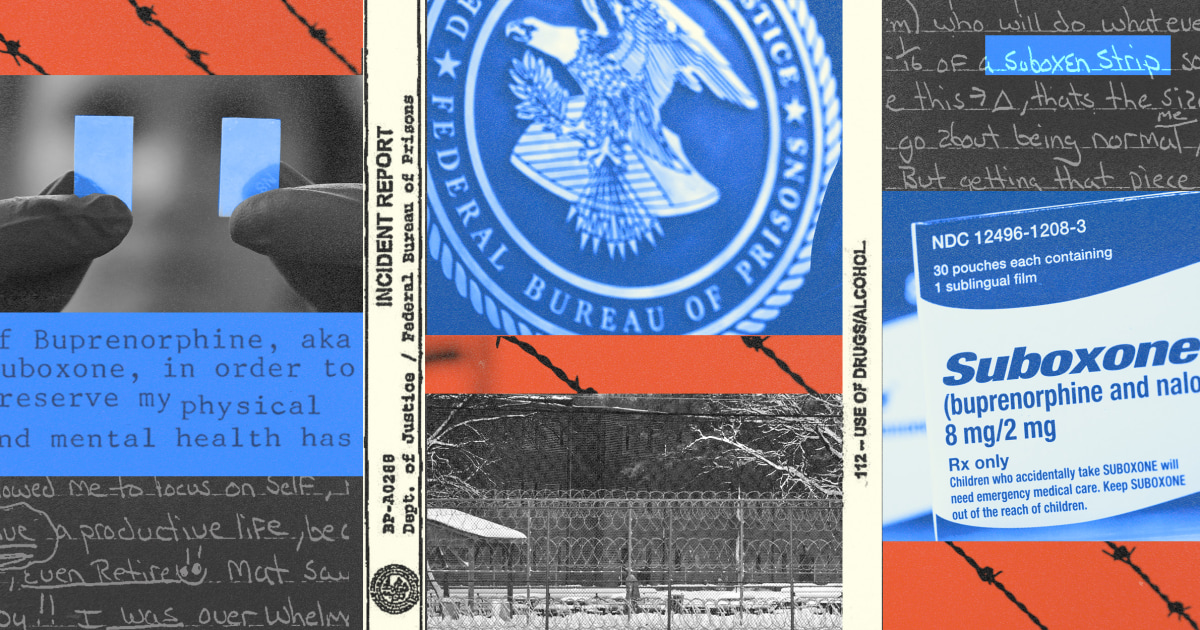
Federal prisoners are punished for using the addiction medication Suboxone

Federal prisoners are punished for using the addiction medication Suboxone

This article was published in partnership with The Marshall Project, a nonprofit news organization covering the U.S. criminal justice system. Sign up for its newsletters, and follow on Twitter, Instagram and Facebook.

Timothy York knows what works to treat his decadeslong opioid addiction: Suboxone, a medication that effectively quiets cravings. 

Since York arrived in federal prison in 2008, he has been held in a series of facilities awash with contraband drugs and violence. He’s spent tens of thousands of dollars buying the medication illicitly from prison dealers because Suboxone enables him to think and communicate clearly, he said. But he hasn’t been able to get it consistently. 

In 2019, he was relieved to learn that the federal Bureau of Prisons was starting a program to expand access to Suboxone, and the following year, a pharmacist at the federal prison in Sumterville, Florida, said he was “priority #1” for treatment, according to his medical records.

He’s still waiting. 

In the meantime, he’s been punished for using Suboxone without a prescription. Last year, after York, 46, was caught with the medication, he spent a month in solitary confinement and had his visitor privileges revoked for a year, according to his disciplinary log. He lost access to phone calls and email for four months. And he lost the chance to be released more than a month early. 

York is not alone.

The Marshall Project spoke to more than 20 people struggling with addictions in federal prison, and they described the dire consequences of being unable to safely access a treatment that Congress has instructed prisons to provide. 

Some have overdosed. Many have gotten involved in dangerous and illicit money-making schemes to pay for Suboxone, which costs about $20 for a small fraction of a daily dose on the illegal market, several prisoners said. Many, like York, have lost phone or visiting privileges or been sent to solitary confinement because they were caught taking the medication. Last year, the Bureau of Prisons disciplined more than 500 people for using Suboxone without a prescription, according to data obtained from the agency by The Marshall Project through a public records request. 

“Believe me, 100{35112b74ca1a6bc4decb6697edde3f9edcc1b44915f2ccb9995df8df6b4364bc} I recognize the irony there,” said a bureau administrator familiar with the agency’s addiction treatment programs, who spoke on the condition of anonymity because they are not authorized to speak to the press. “It’s maddening.”

A man battling addiction points to his daily dose of suboxone.
A man battling addiction points to his daily dose of Suboxone.Sarah Bell / Columbia Daily Tribune via AP

Congress passed the First Step Act four years ago, requiring, among other things, that the Bureau of Prisons offer more prisoners addiction medications, the most common of which is Suboxone. The medications can quiet opioid cravings and reduce the risk of relapse and overdose. 

Yet the federal prisons are treating only a fraction — less than 10{35112b74ca1a6bc4decb6697edde3f9edcc1b44915f2ccb9995df8df6b4364bc} — of the roughly 15,000 prisoners who need it, according to the bureau’s estimates. 

At the end of October, 21 prisons were not offering any prisoners addiction medication, and another 59 were treating 10 or fewer people — in many cases, just one person, according to bureau data obtained through a Freedom of Information Act request. The rest of the 121 facilities nationwide were each treating a few dozen people at most. 

The Bureau of Prisons declined an interview request and would not comment on individual cases. But spokesperson Emery Nelson said in a statement that addiction medicines in combination with therapy and other supports (often referred to as medication-assisted treatment) are the “gold standard” for treatment, and “the Bureau’s goal is to provide high-quality, comprehensive, and accessible medication-assisted treatment at all Bureau locations.” 

The bureau would not discuss the barriers to rolling out the program more widely, but prisoners and people who work in the system described a widespread misperception among prison staff that Suboxone substitutes one addiction for another. There’s broad discretion among prison staff about who qualifies for treatment. The bureau also requires patients to get approval from multiple health care providers, and each step has its own lengthy waitlist.  

To be sure, the Bureau of Prisons is treating increasingly more people since it launched its opioid medication program. In 2019, 41 people were receiving addiction medications. As of October, that had risen to 1,035 people; more than 80{35112b74ca1a6bc4decb6697edde3f9edcc1b44915f2ccb9995df8df6b4364bc} of them are receiving Suboxone. 

“That’s great progress,” said Sally Friedman, an attorney with the Legal Action Center, which has been involved in several opioid medication lawsuits against criminal justice agencies. “But BOP cannot rest until it complies with its constitutional mandate to ensure that every single incarcerated person with opioid use disorder has the opportunity to receive life-saving treatment.” 

The bureau’s delay in providing more widespread addiction medication has consequences not only for prisoners but for its employees as well: It “creates an avenue for contraband to flow into the institution through other avenues,” said Aaron McGlothin, union president at the federal prison in Mendota, California. “The BOP is breaking the law” by not providing Suboxone, he said.

For years, the Bureau of Prisons fought in court to prevent people entering the system from staying on the addiction medications they were prescribed by doctors in the community. That began to change in 2018, when the First Step Act was passed and prisons and jails across the country began losing lawsuits from prisoners who argued it was cruel and unusual to deny them the addiction medicine they’d been taking before they were incarcerated. 

In 2019, the bureau released internal guidance saying that “all eligible inmates” at all of its facilities would have access to addiction medications. But what constitutes “eligible” leaves a lot of room for interpretation.

Prisoners need to overcome several administrative hurdles before they can begin medication, obtaining clearance from psychological services, then health services, before seeing a prescriber. A records request from early this year showed more than 2,000 prisoners were caught somewhere in the process, waiting to move from one stage to another. 

Some say the issues stem from a culture at the bureau that is skeptical of addiction medication and pits staff against prisoners. 

One top bureau administrator who has worked in more than 10 federal prisons said he was once a Suboxone skeptic who thought it was just a “crutch.” 

“Once I found a doctor that supported it, and started giving inmates Suboxone, my SHU count went down,” he said, referring to the special housing unit, the name for one type of solitary confinement. “There were less fights. There were less debts. The drug dealers on the compound went out of business.” This administrator, who spoke on the condition of anonymity because he’s not authorized to speak to the press, added, “I bought into it because I’ve seen it work.” 

When he moved to another prison, the administrator discovered that though the bureau’s official policy is to make addiction medications widely available to those who need them, staff at local institutions have tremendous discretion about who begins treatment and who doesn’t. Some facilities only give one medication and not others. In other cases, facilities refused to give people any of the medications until they were nearing release, he said. 

“Once I started inquiring, what I keep getting told is, ‘Well, it’s only for inmates who are close to their release date,’ or, ‘We don’t have enough resources,’” he said. “I’ve only got so much reach. I can’t direct a doctor to prescribe a medication. I’m way out of my lane on that.”

Federal law treats use of any narcotics without a prescription in federal prison — including Suboxone — as a “greatest severity level prohibited act,” allowing officials to punish prisoners by delaying their release date, confiscating their property, taking away their visiting or phone privileges and holding them for up to six months in solitary confinement — which human rights groups have described as torture. Experts say even a few days in solitary can exacerbate the mental illness that is often the cause of, or closely linked to, drug addiction.

The lack of Suboxone treatment comes amid a rise in drug-related deaths behind bars. A variety of substances are routinely smuggled into prisons and jails through mail, drone drops, visitors or corrections officers and other staff. In the last two decades, federal data shows that fatal overdoses increased by more than 600{35112b74ca1a6bc4decb6697edde3f9edcc1b44915f2ccb9995df8df6b4364bc} inside prisons and more than 200{35112b74ca1a6bc4decb6697edde3f9edcc1b44915f2ccb9995df8df6b4364bc} inside jails. 

Forty-seven incarcerated people died of overdoses in federal prison from 2019 through 2021, according to internal bureau data released via a public records request. The data does not specify how many of these overdose deaths were caused by opioids and could have been prevented by medications like Suboxone. However, other bureau data offers some clue: During the same period, correctional staff administered Narcan — a drug that reverses opioid overdoses — almost 600 times in federal prisons. 

“It’s not easy being surrounded by drugs and expected not to use them,” said Linda Wainwright, who spent five months in solitary confinement and lost the chance she had earned to go home nine months early as punishment for using smuggled Suboxone when prison officials wouldn’t provide her with a prescription. “I begged them to help me,” Wainwright said.

At FCI Fort Dix, a low-security prison in New Jersey, Tyler Scher’s prison psychologist wrote to him saying that he was “shocked” and “at a loss” that Scher was repeatedly denied access to Suboxone, records show. In response to a grievance Scher filed, the warden at his prison said the purpose of the Suboxone program was to prevent “relapse, overdose, and death” among those scheduled “for imminent release from the institution.” 

Tyler Scher.
Tyler Scher.Tyler Scher.

Scher — who is serving a 20-year term for charges related to his girlfriend’s overdose death — had complained of withdrawal symptoms and said that he couldn’t stop using drugs without medication. He’d been written up twice for drug use, he said, and even sent to solitary. At one point, the prison offered him a different medication that he’d tried before and found it didn’t work. When he pushed for Suboxone, officials told him, “You may resubmit a new request closer to your release.” 

When prescribed, Suboxone typically comes as a strip of film that patients dissolve under the tongue. On the illegal market behind bars, a strip is cut into 16 or 32 pieces, each of which sells for $20. 

To pay for that with paltry prison wages, prisoners get both creative and desperate. 

“You wash clothes for people, run around, wash tennis shoes, you have sex with people,” said one man incarcerated in a federal prison that was providing Suboxone prescriptions to less than 1{35112b74ca1a6bc4decb6697edde3f9edcc1b44915f2ccb9995df8df6b4364bc} of the people there as of October, according to Bureau of Prisons data. This man, who asked not to be named because he feared retaliation by bureau officials, said in a phone interview and letters to The Marshall Project that he had his jaw broken by another prisoner and had to spend time in protective custody because “I’ve run up bills and I can’t pay for the stuff, telling people lies.” 

The Marshall Project spoke to several people who said they’d endured violence or physical danger resulting from Suboxone debts.

Inmate barracks at FCI Fort Dix in Fort Dix, N.J.
The barracks at FCI Fort Dix in Fort Dix, N.J.Gretchen Ertl / The Providence Journal / USA Today Network

Michael Swain had been trying to get on the Bureau of Prisons’ program for eight months when he almost died of an overdose. He’d served four years of an eight-year sentence for a bank robbery that he said he committed to fund his addiction. He was using an underground supply of Suboxone at USP-Coleman, the federal prison in Florida where he was incarcerated, but it was erratic. 

Last July, he turned to a much more dangerous drug: K2, a synthetic chemical also known as Spice, which varies widely in potency and purity and can cause everything from a mild buzz to death.

“I started projectile vomiting, real bad sweats and passed out,” Swain said in a phone interview. 

Medical staff later told him that he had lain in the infirmary for over an hour, mumbling incoherently and begging them to not let him die, he said. They finally called an ambulance, which brought him to a nearby hospital where, medical records show, he learned he’d had a seizure. “If I had been going to get a regular dose of Suboxone, I would have never seeked the K2,” Swain said.

Even now, every time he asks the medical staff for an update on his request to receive Suboxone to treat his addiction, he said he’s told the same thing: “You have been accepted, and you are on the waiting list.”