

We may earn revenue from the products available on this page and participate in affiliate programs. Learn more ›
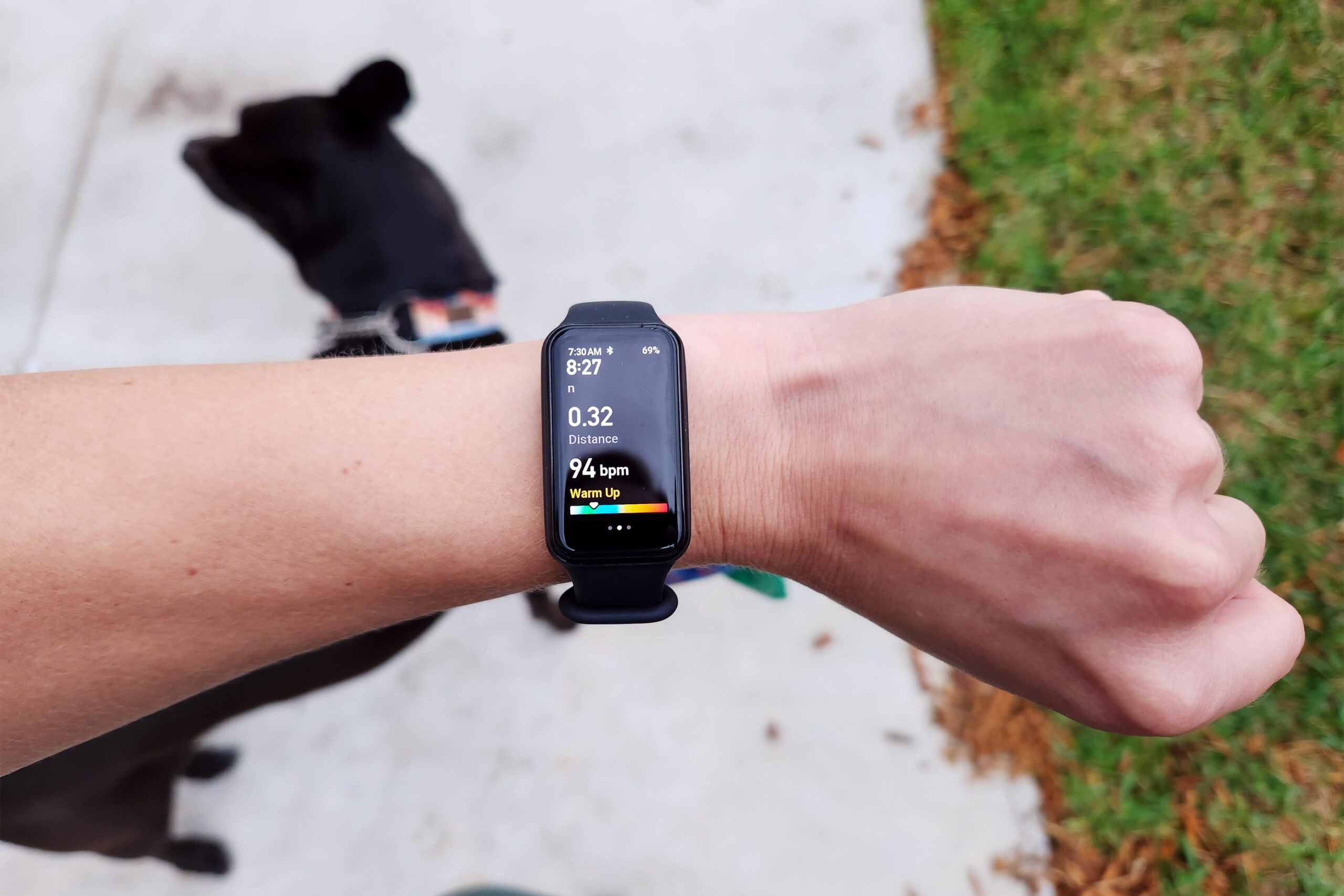
The rise of smartwatches has made health and fitness tracking seem inherently more expensive. Even fairly straightforward watches containing only the most basic sensors tend to be pricey. There used to be many budget options when “Fitbit” was synonymous with fitness tracker, but many seem to have disappeared as convergence devices have increased. Enter Amazfit. The company is relatively new (established in 2015) but already has a robust lineup of budget-friendly activity accessories. And with the Amazfit Band 7, the brand has a bracelet-style tracker that takes a step back from pricier smartwatches so you can track your steps (and other performance metrics) as you move toward your fitness goals. Let’s take a close look at the conveniences and compromises that accompany a $50 fitness watch.
The Amazfit Band 7’s design
While all of Amazfit’s watches are more affordable than most options, the Band 7 falls in Amazfit’s Essential Series lineup, which, as you might guess, is its lowest tier. The Band 7 follows in the footsteps of the Band 5 (there was no Band 6) but presents a larger, more rectangular display, better battery life, and some general software upgrades. There’s no built-in GPS, and there are minor usability issues, but the compromises are minimal and, for most, insignificant. The watch is surprisingly capable for such a low price, with a good amount of health data and tracking opportunities. What it is not, however, is flashy.
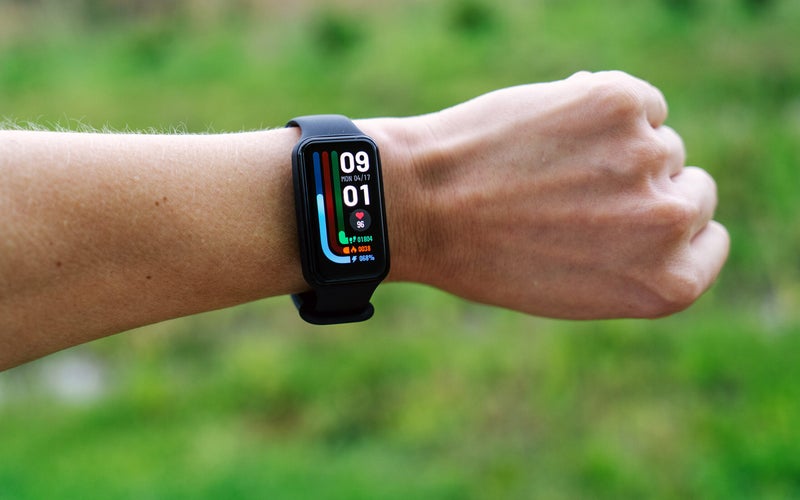
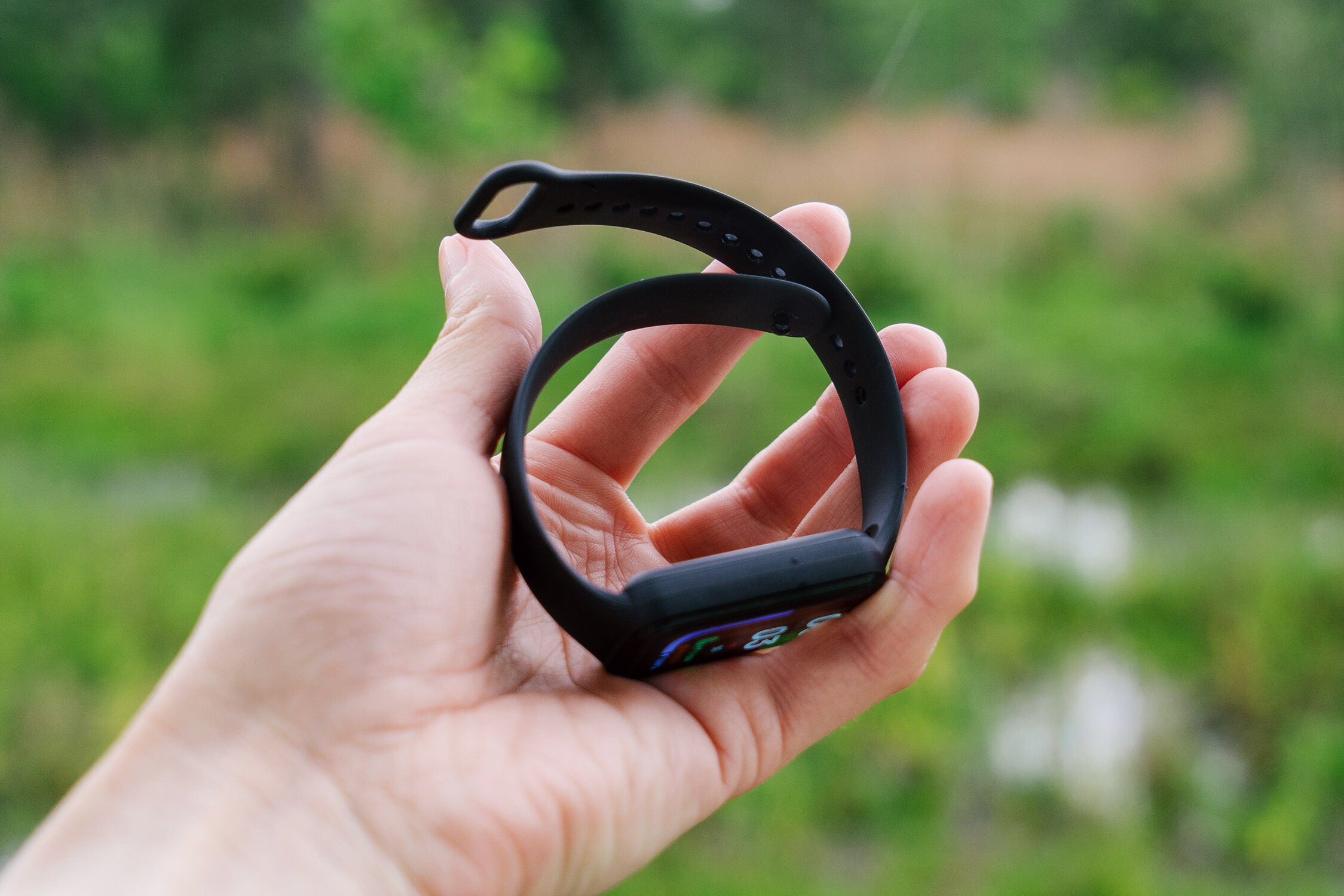
Minimal is the best word to use when describing the design of the Amazfit Band 7. It is a simple rectangular shape with no buttons or design flourishes whatsoever. The band is one seamless piece that secures the watch face, with no special design or color inserts. The stock models are available in beige, pink, or black (the color I received to review). Should you want something else, you can also buy $10 replacement straps in green, blue, pink, or orange.
The watch strap connects with a snap button-type design. That makes it easier to put on, but I also had issues with the edge catching on things resulting in the band unsnapping and the watch coming loose on my wrist. The band is also fairly large. I have small wrists, yes, but I used the second to last hole. Amazfit lists the minimum wrist size as 6.5 inches. So if you have smaller wrists than that, you’ll likely want to stay away from the Band 7 unless you don’t mind wearing it higher on your arm.
Although the band may be a bit long, the watch itself is really slim. It only measures 1.7 x 1 x 0.5 inches, so it looks great, even on my miniature wrists. And it’s low-profile enough that the watch face doesn’t get caught on long sleeves.
The lack of buttons is either really great or really annoying, depending on your preferences. It was a bit of both for me. I like the sleek look of a button-free design. But there were definitely times when having a button would have been nice. For example, if the watch turns off—either because I turn it off or it goes to sleep after not being worn for a few days—you have to connect the watch to a charger to turn it back on because there’s no power button. I found this very annoying, especially if I wanted to pop out for a run or walk.
Display
Despite the budget price, the watch features a rather nice display. It’s a 1.47-inch HD AMOLED display with a resolution of 198×368, 282ppi, and very minimal bezels. I really like the narrow rectangular design, as it provides enough screen real estate to see things easily but doesn’t take up my entire wrist to do so. It just looks really nice to me.
It’s a colorful display and is easy to see in most situations. You have to adjust brightness manually, though, which is tricky if the brightness is turned down and you are out in the sun. You can adjust that setting in the app, but that’s a bit of a pain if you are on a run, for example. The screen is topped with tempered glass and an anti-fingerprint coating. Tempered glass isn’t as durable as other options, such as Gorilla Glass. Yet I haven’t managed to scratch the Band 7 display despite scratching my more expensive, Gorilla Glass-topped Garmin Forerunner 955.
As you may expect, since there are no buttons, the display is a touchscreen, so you can swipe and tap through menus and settings. It is plenty responsive; in fact, I had issues with it being too responsive. When I crossed my arms, there was enough pressure to activate the touchscreen and enter the menu to change the watch face. It got quite irritating.
Sensors
Amazfit fitted the Band 7 with its BioTracker 3.0 PPG biometric sensor. Put simply, PPG sensors use low infrared light to measure how much light is absorbed by blood vessels. This provides a constant measurement of heart rate and blood oxygen levels (SpO2). It can also use that data to calculate and track VO2 Max, stress levels, and sleep. You will have to turn on settings to automatically track SpO2, as it defaults to only manual measurement.
The watch also utilizes a geomagnetic sensor and a three-axis acceleration sensor. It connects to your smartphone via Bluetooth 5.2 BLE, and that’s the extent of its sensors and connectivity.
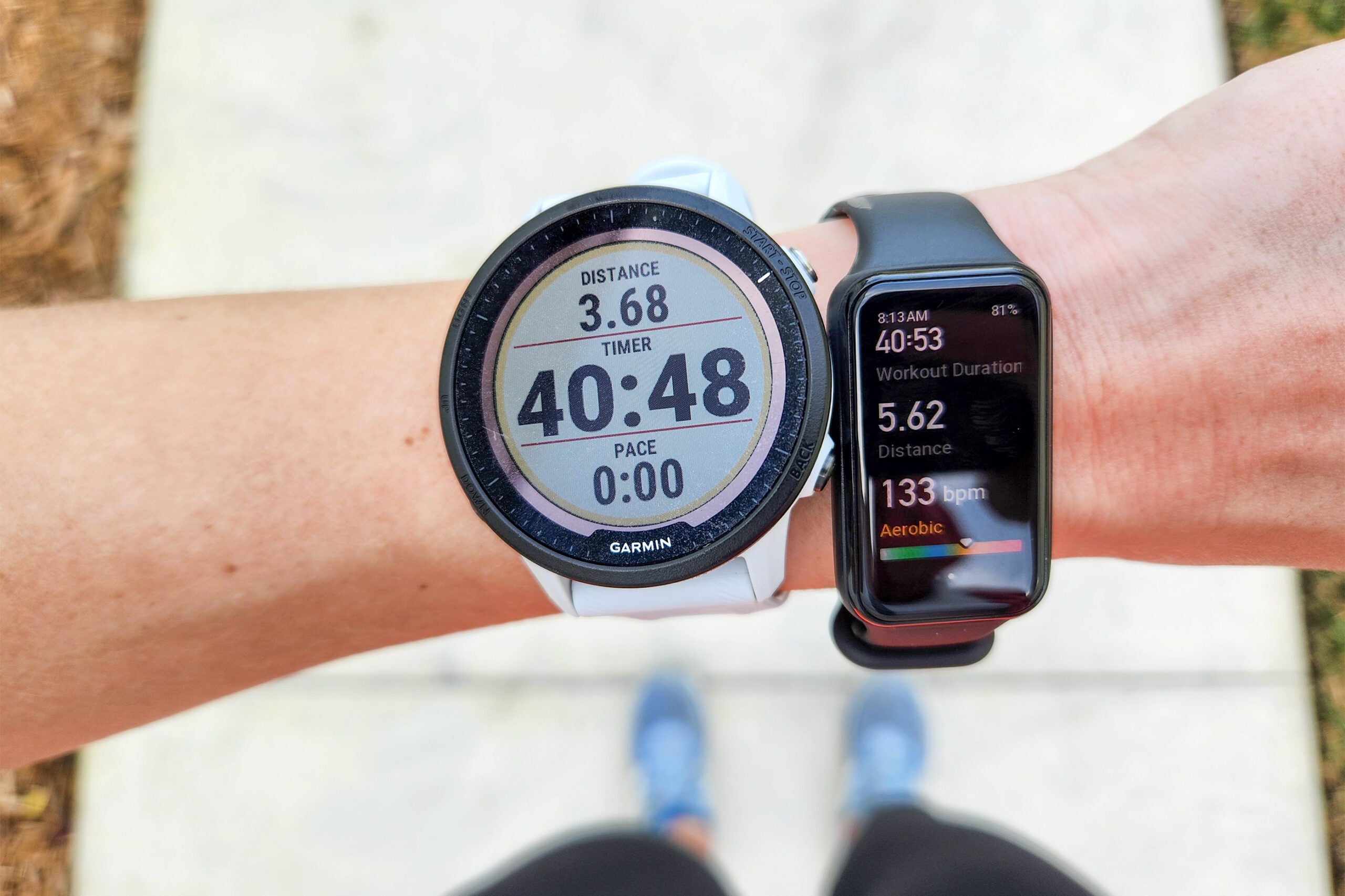
One of the aforementioned compromises due to the budget price is the lack of GPS connectivity in the watch itself. Instead, it relies on tethered GPS, meaning you’ll need your phone for all GPS data. That leads to some accuracy issues compared to watches with built-in GPS, especially multi-band GPS like the Garmin Instinct 2S Solar. If you want your route tracked or need distance data, you must have your phone along. And even with your phone, distance and route information won’t be as accurate as watches with GPS.
Setting up the Amazfit Band 7
Setting up the Amazfit Band 7 is mostly straightforward, albeit a bit tedious. Most of the setup process is done on your phone in the Zepp app (Amazfit is powered by Zepp Health’s health management platform). The initial pairing process with my Samsung Galaxy S22 was very easy, with a simple scan of a QR code on the watch using the app.
From there, however, things get a little bit complicated and a lot annoying. You have to grant a lot of permissions, more than any other watch platform I’ve used before. It seemed to go on forever. I also had a really hard time finding some of the menus for permissions that the Zepp app specified. It mentioned menus that simply do not exist on my phone, even though it says it’s specific to the phone manufacturer. Then, if you want to get notifications on your watch, you have to go through each individual app that you want notifications from. Which, again, was a bit tedious.
The Amazfit Band 7’s features
As a budget device, you’d expect the Band 7 to be extremely limited in functionality and abilities. And while it certainly doesn’t have as robust a feature set as a $500 watch, the watch is surprisingly feature-rich for $50. It won’t be a replacement for serious athletes that need highly accurate information and robust tools, but it’s more than capable for most people.
Battery life
The battery life on the Band 7 is quite surprising, given the low price of the watch. The watch offers a 232 mAh rated capacity, and Amazfit promises up to 18 days of battery life with typical usage. It says heavy usage will result in up to 12 days of battery life. Of course, all this depends on your watch settings as well, as the always-on display and certain settings like stress measuring will eat away at battery life.
In my testing, I got an average of 16 days of battery life. I typically do one dedicated workout (either a run or strength training session) a day with anywhere between 30 minutes to an hour of duration. And I generally track a few short walks per day on top of that because of my dog. I did not have the always-on display running because I wanted to save the battery more, which greatly affected how much battery life I could get.
When the battery did run out, I was able to charge the watch quickly. Amazfit claims that the theoretical charging duration is two hours, and I found that to be accurate. If I needed a quick top-off before a workout, 15 minutes of charging would give me enough juice to record an hour-long session. The charger uses a magnetic design. In line with the watch’s design, it’s a tiny charger, making it easier to bring along on trips than other watches I’ve used.
Activity tracking
The Amazfit Band 7 can track 120 different types of activities. That includes the basics like outdoor and indoor running, hiking, and cycling. But it also can track badminton, belly and square dancing, jumping rope, jiu-jitsu, and even kite-flying or swinging. Essentially, if there’s an activity you want to do, chances are there’s a unique profile for it on the Amazfit Band 7.
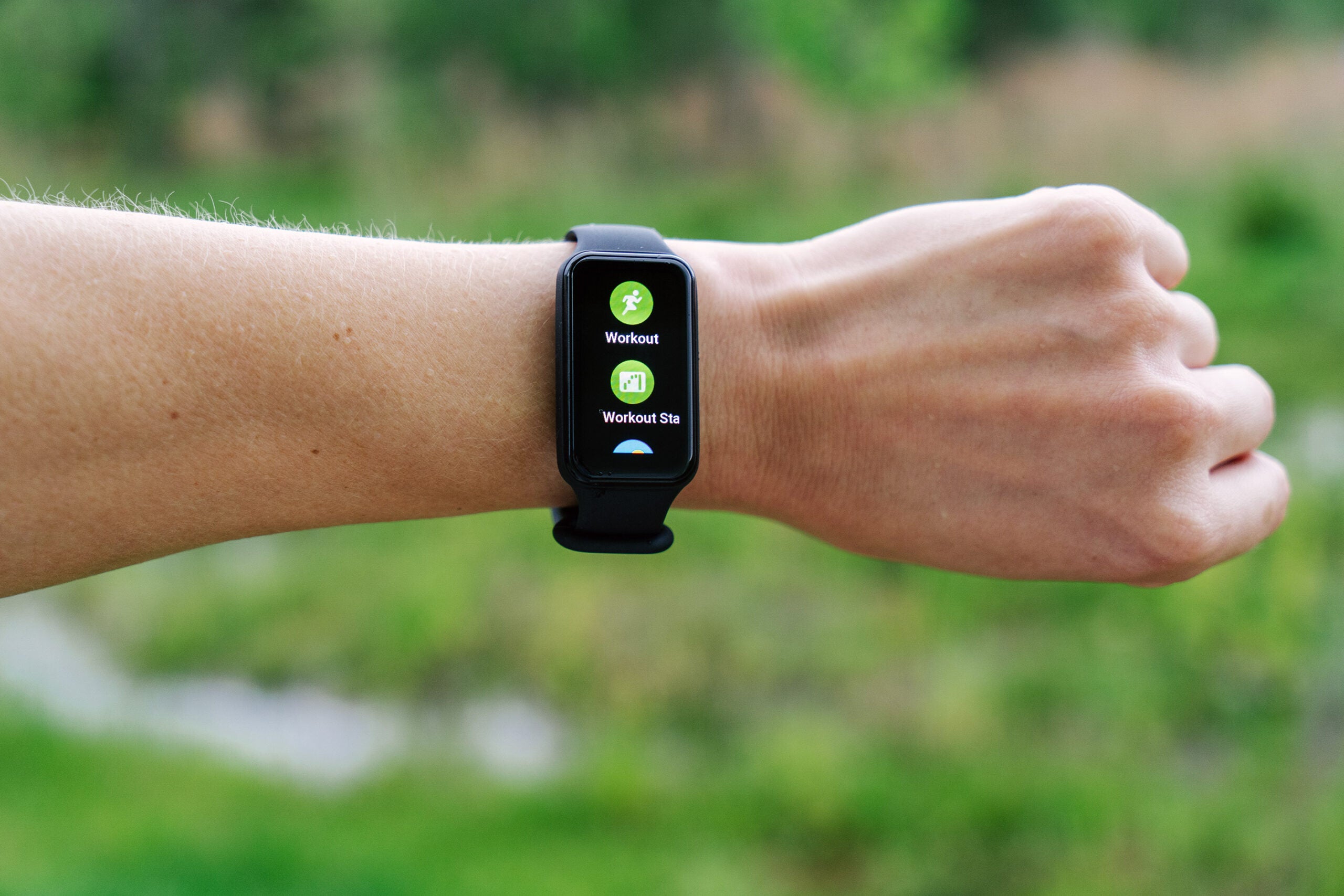
Tracking is easy, though, by default, the workout widget (where all the activities are) is quite low in the list, so you’ll need to scroll a bit. I thought that was an odd default placement since that’s one of the main reasons to get a watch like this. But you can customize that placement in the Zepp app. Then, you simply tap on Workout and choose the type of workout you want.
Before you start tracking, you can also adjust settings by tapping the ellipses above the “Go” button. For example, for outdoor running, you can set a workout goal (miles, time, or calories). You can set workout alerts for different metrics like high heart rate or minimum pace. And you can even set the watch up for interval training, which is a nice feature.
Data collection and insights
The Band 7 is fairly limited in sensors, but it offers the most important ones for basic insights: a PPG biometric sensor, a geomagnetic sensor, and a three-axis acceleration sensor. It uses these three sensors to collect and calculate heart rate, SpO2, VO2 Max, and stress levels.
The watch can also track your sleep, breaking it down to give you insights into how long you slept, REM sleep, and how often you were awake during the night. While it doesn’t apply this information to your training, and it isn’t highly accurate, it can at least give you a rough idea of your sleep.
Your training information and data provide a few key insights: PAI and Training Status. PAI, or Personal Activity Intelligence, uses a simple 100-point scale to reflect how active you are, with the goal of keeping it at or above 100 to reduce your risk of disease. It is based on an algorithm that assesses your age, gender, resting heart rate, maximum heart rate, and accumulated heart rate over seven days. Because an algorithm powers it, it’s dynamic and based on you as an individual instead of using generalizations.
While Training Status and PAI are enough for most users, The Band 7 and Zepp app won’t provide the in-depth data and insights serious athletes want or need. For example, Garmin (what I’m most familiar with) provides training stats such as the training effect of each individual workout, power curves, race predictions, training readiness, and heart rate variability (HRV) information. Most of that isn’t relevant to those simply trying to stay active and healthy, but if you want focused training for performance reasons, the Amazfit Band 7 and companion app likely won’t cut it.
Smartwatch features
On top of all the fitness tracking, the Band 7 provides some smartwatch functionality. It doesn’t provide cellular connectivity, and there is no microphone, which limits its capabilities, though that’s to be expected at this price point. But you can get notifications on the watch from your smartphone from just about any app you use. You can’t interact with those notifications in any way, but you can at least see them to know if it’s something important enough to pick up your phone.
Beyond notifications, the watch also provides access to weather information. And if you are playing music on your phone, you can control it from the watch. I really liked that feature while in the gym working out. If a song started in my UE Fits earbuds that I didn’t want, I could just hit next right on my wrist instead of needing to pick up my phone and sweatily navigate to Spotify.
Zepp app
The Zepp app is clean and clutter-free, with three primary tabs containing settings and data that you may need. The Homepage of the app features data cards to give you snapshots of what you most want to keep track of. For example, it can show steps, sleep, workout history, exercise status, and more. You can customize this, both in terms of which cards are shown and their order, which is nice.
The Health tab is also customizable, though with far fewer options. It primarily shows you a breakdown of your workouts and your target goals (which you can edit). Since all of this can be found on the Homepage, it’s a bit confusing that a separate tab is needed.
The third tab is your Profile, which gives you access to settings, goals, connected accounts, and more. It’s also where you access your devices to change device-specific settings.
The app runs very smoothly on my Samsung Galaxy, and it’s quick to sync the watch when I make changes via the app as well. It doesn’t provide as in-depth insights as the Garmin app and doesn’t offer the social component Garmin does, but Zepp works well and provides basic and necessary information.
The Amazfit Band 7’s usability and accuracy
Overall, the Amazfit Band 7 is straightforward to use. It has its quirks—such as a lack of buttons for input—that make getting used to it a little tricky at first. But most of the controls are intuitive and easy to figure out. The sensitive touchscreen can be a bit annoying but is small in the grand scheme of things.
One aspect that I really love about the Amazfit Band 7 is that it provides help text on the watch itself for certain data sets and features. For example, under Workout Status, if you tap the “i” at the bottom of the screen, a rather thorough explanation of EPOC pops up. Since the budget-friendly watch is largely geared toward those who aren’t exercise experts, these terms may be completely new. Explaining what they mean and why they are important right on the watch is extremely helpful and valuable.
I found the watch’s heart rate monitor to be very accurate, even compared to a dedicated heart rate monitor, which is typically more precise. Likewise, the calculated VO2 Max was in the range it should be for me, though I plan on getting a lab test done for a truly accurate comparison.
I rarely find sleep tracking very accurate, and that was the case with the Amazfit Band 7. There were nights it seemed spot on, but most of the time, it seemed at least slightly off, and nights it was completely incorrect as well. It also tends to think I’m taking a nap if I take the watch off for more than a few minutes.
How the Amazfit Band 7 stacks up against the competition
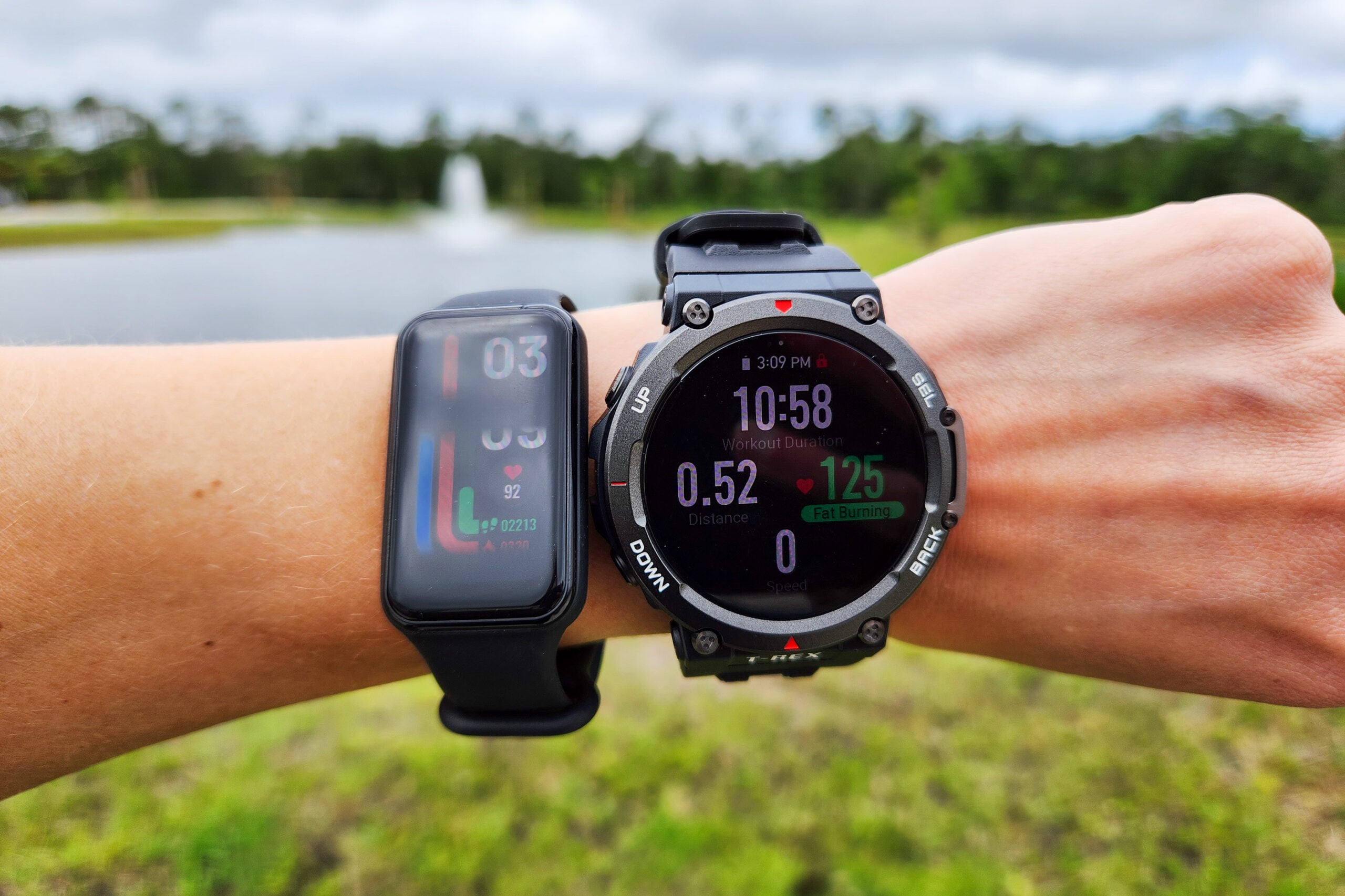
There’s no shortage of fitness watches available, with even Amazfit’s own line of devices quite lengthy. I’ve also been using Amazfit’s T-Rex 2. At $200, the T-Rex 2 is still quite a bargain compared to the likes of a Garmin, though it’s four times more expensive than the Band 7. And in most ways, the price difference is noticeable. The T-Rex 2 is decidedly more aggressive looking and significantly larger. It’s much more rugged, having passed 15 Military-Standards Tests (MIL-STD-810G) to withstand harsh conditions. And it comes with more health data and built-in dual-band positioning. You get a lot more watch in the T-Rex 2, albeit in a very different style that isn’t for everyone.
Garmin’s fitness watches tend to be one of the gold standard options for athletes, and the prices certainly match that. The company has done a fantastic job of managing health and fitness data to provide useful and accurate information for training purposes. Amazfit does a nice job of providing useful insights, but it isn’t as thorough as Garmin, especially in the minimal Band 7 watch. Garmin’s watches offer more robust feature sets and data tracking than the Band 7, yet still offer battery life that’s nearly as much as the simpler Band 7.
So, who should buy the Amazfit Band 7?
I must admit that I was pleasantly surprised by the Amazfit Band 7. After exclusively using fairly expensive fitness watches for the past 10 years, I assumed that such a budget-level watch would be lacking and less impressive. But that was not the case.
The Band 7 has some big wins, no matter what price point you are looking at. It sports a sleek design, lengthy battery life, accurate heart rate measurement, music controls, plenty of fitness-focused features, and a wide array of activity types. Of course, with the low price comes some disadvantages: No built-in GPS, a finicky touchscreen, and a cheap band enclosure design. It also doesn’t provide as in-depth training insights or data compared to more expensive watches. As a result, it isn’t great for serious, focused athletes looking for specific performance improvements. But it offers much more than the $50 price would lead you to believe.
So who’s the Band 7 ideal for? It’s a fantastic choice for those looking for a simple device that can help encourage them to be more active. Not everyone needs access to race predictions and hyper-accurate pace and stride information. But the Amazfit Band 7 can help you learn more about exercise terms and support you in keeping tabs on your activity levels to work toward a healthier, more active lifestyle. And it can do this while functioning as a general smartwatch, making it even more well-rounded.