The U.S. women health laboratory testing market was valued at $72.8 billion in 2021 and is anticipated to reach $106.8 billion by 2030, witnessing a CAGR of 4.30{35112b74ca1a6bc4decb6697edde3f9edcc1b44915f2ccb9995df8df6b4364bc} during the forecast period 2022-2030.
The market is driven by factors such as the increase in the prevalence of infectious diseases and cancer in women, rising awareness regarding women health-related tests, the rising average maternal age leading to increased risk of fetal chromosomal aneuploidies, and the upsurge in reproductive health problems leading to increased demand for laboratory testing in women.
The U.S. women health laboratory testing market is in the developed phase. The advancements in diagnostic technologies including applications of genetic testing in women’s health and the significant number of mergers and acquisitions of companies to attain a better market share are some of the major opportunities in the U.S. women health laboratory testing market.
How can this report add value to an organization?
The different segment of the report helps the reader understand the different type of laboratory tests/services for women’s health available in the market.
Moreover, the study provides the reader with a detailed understanding of tests/services that fall under the different segments, which are hereditary cancer, carrier screening, prenatal screening, and diagnostic testing, reproductive health and infectious diseases, and obstetrics and gynecology.
Growth/Marketing Strategy: The U.S. women health laboratory testing market has witnessed major development by key players operating in the market, such as product launches, business expansions, partnerships, collaborations, merger and acquisitions, funding activities, and regulatory and legal approvals.
The favored strategy for the companies has been regulatory and legal activities to strengthen the position of their product in the U.S. market. For instance, in October 2019, Myriad Genetics, Inc. announced that the U.S. Food and Drug Administration (FDA) approved myChoice CDx for use as a companion diagnostic for Treatment with Zejula in Late-line Ovarian Cancer.
Recent Developments in the U.S. Women Health Laboratory Testing Market
In November 2022, Roche Holdings launched its Cobas 5800, a new molecular diagnostic system to expand access to PCR testing in the U.S. The system can assist in the diagnosis of Infectious diseases, such as HIV, Hepatitis, transplant-associated viral illnesses, and respiratory and STIs.
In February 2022, the Laboratory Corporation of America Holdings established a strategic partnership with Ascension to expand its testing capabilities.
In January 2022, Yourgene announced that it has signed a strategic partnership agreement with EKF Diagnostics Holdings plc a point-of-care business with accredited laboratory testing capabilities in the U.S.
In November 2022, Myriad Genetics announced that it has acquired Gateway Genomics, LLC, a personal genomics company and developer of consumer genetic tests.
In August 2022, Natera, Inc. announced that the company has proactively filed a pre-submission to the FDA for its Panorama non-invasive prenatal test (NIPT) as part of the Q-Sub process.
Market Segmentation
The U.S. women health laboratory testing market (hereditary cancer) is expected to be dominated by the cervical cancer segment.
The U.S. women health laboratory testing market (prenatal screening and diagnostic testing) is dominated by the non-invasive prenatal testing segment.
The U.S. women health laboratory testing market (reproductive health and infectious diseases) is dominated by the HIV testing segment.
The U.S. women health laboratory testing market (by region) is dominated by the South region segment.
Companies Featured
Key Topics Covered:
1 Markets
1.1 U.S. Market Outlook
1.1.1 Product Definition
1.1.2 Inclusion and Exclusion Criteria
1.2 Business Dynamics
1.2.1 Impact Analysis
1.2.2 Business Drivers
1.2.2.1 Increase in the Prevalence of Infectious Diseases and Cancer in Women Leading to Increased Demand for Laboratory Diagnostics
1.2.2.2 Rising Awareness Regarding Women Health-Related Tests
1.2.2.3 Rising Average Maternal Age Leading to Increasing Risk of Fetal Chromosomal Aneuploidies
1.2.2.4 Upsurge in Reproductive Health Problems Leading to Increased Demand for Laboratory Testing in Women
1.2.3 Business Restraints
1.2.3.1 Stringent Regulatory Guidelines Related to Laboratory Testing Hindering the Market Growth in the U.S.
1.2.3.2 Disparity in Awareness of Pregnancy and Fertility Issues in the Different Regions of the U.S.
1.2.4 Business Opportunities
1.2.4.1 Advancement in Diagnostic Technologies, including Applications of Genetic Testing in Women’s Health
1.2.4.2 Healthcare Disparities in the Rural Counties of the U.S.
1.2.4.3 Gap in Healthcare for Women of Reproductive Age with Psychological Distress
1.2.4.4 Significant Number of Mergers and Acquisitions by Companies to Attain a Better Market Share
2 U.S. Women Health Laboratory Testing Market (by Hereditary Cancer)
2.1 Overview
2.2 Breast Cancer
2.2.1 Epidemiology
2.2.2 Testing Market
2.2.3 Testing Market (by Region)
2.3 Cervical Cancer
2.4 Ovarian Cancer
3 U.S. Women Health Laboratory Testing Market (by Carrier Screening)
3.1 Overview
3.1.1 Testing Market
3.1.2 Testing Market (by Region)
4 U.S. Women Health Laboratory Testing Market (by Prenatal Screening and Diagnostic Testing)
4.1 Overview
4.2 Non-Invasive Prenatal Testing (NIPT)
4.3 Maternal Serum Screening (MSS)
4.4 Prenatal Diagnostic Testing
5 U.S. Women Health Laboratory Testing Market (by Reproductive Health and Infectious Diseases)
ResearchAndMarkets.com is the world’s leading source for international market research reports and market data. We provide you with the latest data on international and regional markets, key industries, the top companies, new products and the latest trends.
Media Contact:
Research and Markets Laura Wood, Senior Manager press@researchandmarkets.com
For E.S.T Office Hours Call +1-917-300-0470 For U.S./CAN Toll Free Call +1-800-526-8630 For GMT Office Hours Call +353-1-416-8900
U.S. Fax: 646-607-1904 Fax (outside U.S.): +353-1-481-1716
Dear Annie: Your guidance for “Lost but Nevertheless in Love” was fantastic. Becoming a well being care qualified, I experienced an comprehending of what was transpiring when my spouse begun to enter pre-menopause, and I could assistance her all through this changeover into menopause. I actually have no concept how so quite a few women of all ages go through this with so minimal aid from well being care industry experts. So, thank you for your reaction and supplying a sound rationalization as to what may possibly be transpiring. This sales opportunities me to a different problem. Why do women’s wellbeing care experts not consist of the patient’s partner in educating them? There is no literature in the ready space for adult males to browse to learn additional about their female partners. No practitioner asks me to be a part of them to talk about any foreseeable future prepare of treatment for my spouse so that jointly we can fulfill her needs. So, it doesn’t shock me that the writer does not know what to do to assistance his wife and relaxed his individual fears. I am hopeful that women’s wellbeing education will improve substantially for females and their associates. — Supportive Spouse
Pricey Supportive: Thank you for your letter. Understanding is electrical power, and the far more you can educate yourself from experts about pre- and peri-menopause, the better. That is assuming, of class, that your wife states she would like you to know.
Dear Annie: You gave great suggestions to the partner exasperated by his wife’s behavior of late due to pre-menopause. If I could, I would like to say to him and to her, “See a medical doctor!” I thought I could “tough it out” and tackle it on my have, but last but not least, when my brain was so fogged I couldn’t believe plainly and I was so frustrated, I went to a health care provider, which brought fantastic aid. It was so terrible I could not even make choices. I asked her to come to a decision for me irrespective of whether I desired antidepressants or hormone substitute remedy, which isn’t like me at all. I ordinarily would never go away this sort of a big decision for myself to somebody else, but which is how desperate I felt. She selected antidepressants. I have important sizzling flashes. Nonetheless though, I am so grateful for owning had any aid with the form I was in. Pre-menopause and menopause are some of the most difficult things I’ve at any time performed in my life. A supportive partner, conversing with other ladies, going for walks (even small walks) day by day all really support, and educating yourself on what you are heading by can make all the change, too. My greatest to them both of those! And thank you, Annie, for serving to folks heading through tricky periods. — Grateful
Pricey Grateful: I am happy that you have been able to get enable to ease your signs.
“How Can I Forgive My Cheating Husband or wife?” is out now! Annie Lane’s 2nd anthology — that includes favored columns on relationship, infidelity, interaction and reconciliation — is obtainable as a paperback and e-guide. Visit http://www.creatorspublishing.com for additional information. Send out your questions for Annie Lane to dearannie@creators.com.
The DOD recognizes the complexity and uncertainty facing service members in accessing reproductive health care, to include abortion care. They also recognize health care providers may have concerns about legal and financial risks they may face carrying out their lawful federal duties. Service members may be forced to travel greater distances, take more time off work, and pay more out-of-pocket expenses to access reproductive health care.
DOD Policies
Following the Oct. 20, 2022, memorandum, “Ensuring Access to Reproductive Health Care,” the DOD has released policies on:
Command notification of pregnancy.
Administrative absence for non-covered reproductive health care.
Travel allowances for non-covered reproductive health care.
As Secretary Austin has made clear, the health and well-being of our Service members, the civilian workforce, and DOD families are top priorities for the Department. These new policies:
Reflect the DOD’s commitment to taking care of our people.
Ensure that the entire Force remains ready and resilient.
Ensure service members are able to access non-covered reproductive health care, no matter where they are located.
In the table below, please find links to the policies on the Official Website for DOD Issuances and a fact sheet that explains what it means for you. For an overview of all the policies, please see the Policy Overview Fact Sheet.
Topic
Description
Links
Command Notification of Pregnancy
Provides Service members the time and flexibility to make private health care decisions in a manner consistent with the responsibility of commanders to meet operational requirements and protect the health and safety of those in their care.
Service members may choose to delay pregnancy notification to commanders but must notify no later than 20 weeks gestation.
Administrative Absence for Non-Covered Reproductive Health Care
Service members may be granted an administrative absence for a period of up to 21 days to receive, or to accompany a dual military spouse or a dependent who receives, non-covered reproductive health care without taking leave.
Service members may need to disclose a minimum amount of health information necessary for commanders to authorize the administrative absence.
Official Travel for Non-Covered Reproductive Health Care
Authorizes travel and transportation allowances for a Service member or an eligible dependent, and for an attendant or escort if a Service member or eligible dependent is incapable of traveling alone, who must travel to access non-covered reproductive health care and would otherwise have to pay for that travel themselves.
We’ve provided answers to some commonly asked questions with regard to reproductive health care. The answers here are intended to provide a general overview of departmental policies and are not intended to alter or amend those policies. The answers in this document are intended to apply broadly to the Force as a whole and the term “Service member” is used with that intent. When there is a meaningful distinction between the Active and Reserve component, more specific terms are used to highlight and clarify the distinction.
View the FAQs Online Download a PDF Version
Related Service Links
Need Help Accessing Reproductive Health Care?
Contact Us and tell us about your challenge. Please allow 3-5 business days for a response.
Share imagery to help others get the picture:
You also may be interested in…
Frequently Asked Questions on Reproductive Health Care
Publication
2/16/2023
On Oct. 20, 2022, the Secretary of Defense released a memorandum, “Ensuring Access to Reproductive Health Care,” directing the Department take a series of actions to ensure Service members and their families can access non-covered reproductive health care. On Feb. 16, 2023, the Department of Defense released those directed policies, which will be effective no later than 30 days from Feb. 16, 2023.
The Department of Defense has released the directed policies on command notification of pregnancy, administrative absence for non-covered reproductive health care, and travel allowances for non-covered reproductive health care.
Recommended Content:
Women’s Health | Ensuring Access to Reproductive Health Care
Women make up nearly 20{35112b74ca1a6bc4decb6697edde3f9edcc1b44915f2ccb9995df8df6b4364bc} of the the United States Armed Forces, so having more females in healthcare professions creates a much more effective force. That’s why the Uniformed Services University and Canadian Armed Forces Health Services collaborated recently to advance research on women’s health issues and to optimize care for women in uniform.
Recommended Content:
Women’s Health | Uniformed Services University of the Health Sciences | March | Building Partner Capacity and Interoperability
Overview: Ensuring Access to Non-Covered Reproductive Health Care
Fact Sheet
2/15/2023
These policies reflect our commitment to taking care of our people and ensuring that the entire Force remains ready and resilient. These policies ensure Service members are able to access non-covered reproductive health care regardless of where they are stationed.
Recommended Content:
Women’s Health | Access to Reproductive Health | Contraceptive Care | Ensuring Access to Reproductive Health Care
Travel for Non-Covered Reproductive Health Care Services
Fact Sheet
2/15/2023
This regulation ensures Service members and eligible dependents are eligible for travel and transportation allowances to access non-covered reproductive health care services when timely access to non-covered reproductive health care services is not available within the local area of the member’s permanent duty station, temporary duty location, or the last location the dependent was transported on authorized government orders.
Recommended Content:
Women’s Health | Contraceptive Care | Access to Reproductive Health | Ensuring Access to Reproductive Health Care
Command Notification of Pregnancy
Fact Sheet
2/15/2023
This policy clarifies when a Service member’s pregnancy status is shared with commanders, standardizes and extends the timeframe for Service members to inform their commanders about a pregnancy, and reinforces that commanders must always exercise objectivity and discretion when handling reproductive health care issues.
Recommended Content:
Women’s Health | Contraceptive Care | Access to Reproductive Health | Ensuring Access to Reproductive Health Care
Administrative Absence for Non-Covered Reproductive Health Care
Fact Sheet
2/15/2023
This policy provides Service members the ability to request an administrative absence from their normal duty stations in order to access, or accompany a dual-military spouse or dependent to access, non-covered reproductive health care without being charged leave.
Recommended Content:
Women’s Health | Contraceptive Care | Access to Reproductive Health | Ensuring Access to Reproductive Health Care
It’s a major research advancement in women’s health and females serving in the U.S. military may soon have access to it. See how a new, self-diagnosis and self-treatment kit can help deployed women overseas or in austere environments.
Recommended Content:
Uniformed Services University of the Health Sciences | Research & Innovation | Women’s Health
Women’s Health Equity is a Real Focus for DOD, Mullen Says
Article
12/27/2022
Women’s heath equity is fully invested in by DOD’s actions, acting AD for Health Affairs tells a recent podcast.
Providing safe, excellent, quality care to patients takes incredible work and dedication – especially when it comes to women’s health. Find out what’s happening at Blanchfield Army Community Hospital that landed them a top spot on the Best Hospitals for Maternity Care list.
Recommended Content:
Women’s Health | Children’s Health
Breast Cancer Reminder: Get Your Annual Screening
Article
12/15/2022
Annual mammograms are easy to schedule and can detect very small cancers.
Recommended Content:
Women’s Health | MHS GENESIS
More Inclusive Research Key to Understanding Prevalence of Dementia
Article
12/7/2022
Dementia and its most common form, Alzheimer’s disease, are cognitive disorders that affect more women than men. Although there are various theories on why, more equitable research is needed.
Recommended Content:
Women’s Health | Psychological Fitness | Traumatic Brain Injury Center of Excellence
Cervical Health Awareness Month
Infographic
12/6/2022
Cervical cancer is one of the most common cancers in women, but can be prevented through vaccination and regular screening. Get information on women’s health: https://health.mil/WomensHealth #CervicalHealthAwarenessMonth
Recommended Content:
January | Women’s Health
Birth Defects Prevention Month
Infographic
12/6/2022
Getting enough folic acid in your diet before and during pregnancy is one easy way to help prevent birth defects. Here’s some information from the CDC: https://www.cdc.gov/ncbddd/birthdefects/index.html
Recommended Content:
January | Women’s Health
Military Health System Offers a Variety of Contraceptive Care Services
Article
12/1/2022
The Military Health System offers ample contraceptive care services to help beneficiaries take control of their health, life, and careers.
Recommended Content:
Women’s Health | Contraceptive Care | Access to Reproductive Health | Reproductive Health Toolkit | Walk-In Contraceptive Services Toolkit | Contraceptive Care Toolkit
The appearance of hyperlinks does not constitute endorsement by the Department of Defense of non-U.S. Government sites or the information, products, or services contained therein. Although the Defense Health Agency may or may not use these sites as additional distribution channels for Department of Defense information, it does not exercise editorial control over all of the information that you may find at these locations. Such links are provided consistent with the stated purpose of this website.
You are leaving Health.mil
View the external links disclaimer.
Signal up for our free of charge Wellbeing Test e-mail to receive unique analysis on the 7 days in health and fitness
Get our free Overall health Examine electronic mail
A third of these with a women’s wellness affliction have been made to wait around 3 years or extended for a diagnosis, damning new investigate has disclosed.
The identical review found fifty percent of those gals took a yr or additional to be supplied their diagnosis.
Gynaecologists informed The Independent delays are harming women’s mental wellness and placing their bodily health and fitness at chance.
The report, shared solely with The Unbiased, identified all around 1 in 10 ladies polled who sought health care assistance for women’s well being disorders are nevertheless awaiting a analysis.
Scientists from King Edward VII’s Healthcare facility, an independent charitable healthcare facility, polled just over 1,000 females. They approximated virtually a few million women of all ages in the British isles are grappling with indications of undiagnosed women’s health and fitness problems – with nearly a third still to be specified a formal diagnosis and a quarter possessing not started searching for clinical support.
The research found nearly a single in four women of all ages enduring indications say the health and fitness challenges have harmed their mental well being, whilst almost 50 percent of girls sought to relieve their signs and symptoms by enterprise life style alterations. This included diet plan and exercising, as nicely as curbing time expended doing work and socialising or forking out for different forms of treatment.
Women’s well being ailments bundled in the examine ranged from endometriosis to significant menstrual bleeding, fibroids, urinary incontinence, polycystic ovaries, overactive thyroid, underactive thyroid, ovarian cysts, menopause, fertility difficulties, sexual purpose complications, ovarian cancer, vaginal most cancers, uterine most cancers, vulvar cancer and cervical cancer.
Srdjan Saso, a expert gynaecologist and surgeon who performs with King Edward VII’s Clinic, advised The Impartial: “A delayed diagnosis can signify a significant affect on quality of existence both of those skillfully and personally.
“It can have a substantial impact on a woman’s day-to-working day life and as a result needs to be addressed adequately and seriously. From a more sinister viewpoint, in sure instances, it can be most cancers and we are selecting it up late.”
Dr Saso, who functions at Queen Charlotte’s and Chelsea Hospital in London, warned the lengthy ready situations have been brought on by a selection of issues spanning from the pandemic to wider financial troubles.
“There are also sophisticated historic and social good reasons why women’s wellbeing has been neglected,” he said. “It is one thing as a modern society we require to deal with head-on. We have appear a extended way but we are still not there.”
Leah Deutsch, a expert in obstetrics and gynaecology, instructed The Unbiased the findings were being troubling as she stated they are making an attempt to capture up with backlogs at her medical center and are jogging added clinics to cope with this.
She added: “The women of all ages I see have been waiting for a lengthy time. They are clearly struggling bodily and mentally. It is impacting their function lifetime, their family members life and their all-round properly-remaining.
“I have observed folks who have been ready for someplace involving 6 to 12 months – that is from a GP referral to looking at me. There is an element of desperation in the hope to take care of their complications.”
Dr Deutsch said gynaecological delays are “massively pandemic related” as properly as remaining connected to the “shrinking” NHS workforce thanks to workers “burnout” and enhanced desire for companies.
“People are educating by themselves and trying to get aid while in advance of they may well have been suffering in silence,” Dr Deutsh said. “Clinics for gynaecology and elective techniques were cancelled at the beginning of the pandemic.”
She famous messages centred all-around not overburdening the NHS in the course of the pandemic potentially created some people less inclined to search for aid as she noted the Covid crisis also made some people today anxious about recieving health care in man or woman.
“Women’s wellbeing in typical is an space that is deprioritised,” Dr Deutsch reported. “Women who endure menstrual pain and major menstrual bleeding can generally come to feel there is an perspective amongst the general public and healthcare pros that it is normal. There is a absence of regard for how significant and disabling these situations can be.”
Her remarks appear just after investigate by the Royal College or university of Obstetricians and Gynaecologists last year showed gynaecology waiting lists have endured the most significant improve of all clinical parts.
A spokesperson for NHS England said they are “making substantial development in addressing the Covid backlogs that have inevitably constructed up like by practically doing away with two year waits for care”.
The consultant extra: “And so with workers also referring file figures of patients for tests and checks, our information to females is crystal clear if you are apprehensive about your well being remember to speak to your GP, the NHS is listed here for you – it could be very little but a uncomplicated check out could help save your everyday living.”
MS. STEAD SELLERS: Good morning, and welcome to Washington Post Live. I’m Frances Stead Sellers, a senior writer here at The Washington Post.
My first guests today are going to be talking a lot–about a lot of issues that are unique to women’s health, and first of all, we have Laura Modi, who is the co-founder and CEO of Bobby Organic Infant Formula. We’re also hoping to have Simmone Taitt, who is the founder and CEO of Poppy Seed Health.
And, Laura, let’s start with you right away, if we can. The clip at the end of our introduction was all about the moment when we were at the height of the formula shortage, and I was writing about it then. Could you update us now about where we stand with that shortage and particularly what it’s meant for women?
MS. MODI: Yeah, absolutely. My God, just rewatching that clip brought me back to where we were a year ago, and this Friday will mark one year, one year since there was a recall that has created a national shortage where this country was unable to feed babies. And it’s shocking to think–and I’ve been reporting on this now recently as well–which is we may be getting close to a place where we are out of the stretch, but we are certainly not out of the crisis. And the existential crisis that still exists is that we are one bacteria away from this potentially happening again.
It takes fundamental change in the industry to ensure that we get out of this, and we have just been solving for the shortage. Now we actually need to change our sights to fixing the crisis.
MS. STEAD SELLERS: Laura, let’s dig a little bit deeper into that, “one bacterium away from this crisis.” Explain what’s happening in our manufacturing that makes the system so very vulnerable.
MS. MODI: I mean, “vulnerable” is exactly the word. It’s a very, very fragile industry. So there’s very few manufacturers here in the U.S. that can make infant formula, and when one of those facilities that makes the majority of infant formula in the country is unable to produce, it means that we are really supply-constrained to be able to serve the high demand needed for infant formula.
So what we really need is more manufacturing to ensure that we’re out of this crisis. Now, manufacturing is not the flick of a switch. You can’t just say let’s get them up and running. This takes a lot of capital, multiple years, and requires an immense amount of safety that can’t be overlooked.
The question is, have we actually made any strides as of recently to see more manufacturing progress in this country? We’ve done an amazing job to, say, let’s turn to other countries and ensure that we can get formula in, stocked on shelves, and that babies are being fed. But that’s not a long-term fix.
So one of the things that we’ve been doing is working with Congress to say we need to put a bill aside where we’re saying there is a fund to be able to support more manufacturing in this country, that also introduces competition, which also in a very concentrated industry is exactly what we need to ensure redundancy in the future.
So, hopefully, we will see this bill get introduced and that bill get passed, allowing for more manufacturing in this country.
MS. STEAD SELLERS: So we had a slight technical glitch there. We’ve now got Simmone Taitt. She’s the founder and CEO of Poppy Seed Health. Simmone, welcome. Nice to have you with us too.
MS. TAITT: Thank you so much for having me, and I hope the glitch doesn’t continue to happen.
MS. STEAD SELLERS: Well, we will work through it if we do, but we’re delighted.
And I wanted to start by asking you about Poppy Seed Health. It deals with pregnancy and postpartum loss, and could you tell us the origin story? Tell us how you came up with the idea of producing this app.
MS. TAITT: Sure. So, in 2016, I had my first pregnancy loss on what has been for me a very complicated journey to parenthood, and Poppy Seed Health focuses on delivering that emotional and mental health support that we need just in those moments that we need it the most, which is something that I didn’t have.
After my appointment, I was sent home with no medical, emotional, or mental health support, and if you look at maternal health care in our country today, in the U.S., you will see that there is no way with having the continuity of support and care on the clinical side that really focuses on emotional and mental health support.
So I built Poppy Seed Health with our team to make sure that folks could have this kind of support in 90 seconds or less. Our actual latency these days is just under 10 seconds, and so under 10 seconds, whether you’re pregnant, postpartum, or you’ve experienced a loss, you are able to have a conversation, all text-based, with one of our advocates almost instantaneously.
MS. STEAD SELLERS: Wow. So that gives us a sense of the complexity of some of these journeys, and of course, they’re not equal across racial and socioeconomic backgrounds.
Laura, which brings me to you. You have started an effort, I think, at Bobby to raise awareness about African American maternal mortality, in particular. Could you tell us where that stands and why you felt the need to create this push?
MS. MODI: You know, and I know we’re talking about women’s health, but really this is a human’s rights issue. What we’ve found and we’ve come to learn is that here in the U.S., we have the highest maternal death rate for a high-income nation, and it particularly impacts Black mothers.
And we’ve come to learn about this in multiple ways. Elaine Welteroth, who’s on our Bobby MotherBoard and helps support with a lot of policy changes, went through her own personal journey when she went to have her first kid, when she had come to learn about a Black mother who had died during childbirth, only a year before she gave birth, and it led her on her own research journey to figure out what is the care and support system like in the U.S., because 80 percent of these deaths can be preventable. And they’re not.
MS. STEAD SELLERS: Wow. That’s a shocking, shocking number.
And I know, Simmone, that your own experience led you to become a full-spectrum doula, and I’m now understanding that many Black women are deciding not to deliver in hospitals. What does that mean about what’s going on in this country with delivery and the options open to people and the risks they entail?
MS. TAITT: Well, what it means is that we have a health care system that is broken, right, systematically looking at all of the layers in maternal health care and how we can improve.
For women who look just like me, we’re three to five times more likely to die from preventable things during childbirth, our pregnancies, and then also postpartum. And so it looks for us at Poppy, like, making sure that our advocates are marrying the people that we support every day. Anyone can use Poppy Seed Health, but 50 percent of those doulas, midwives, and nurses identify as BIPOC, and where we are able to connect with folks, a lot of my own experience as a doula and becoming a doula right before I built Poppy Seed Health, it was very important to understand these nuances that exist in our maternal health care system, the racial bias that exists but also the access and equity to care.
And although technology isn’t the only solution, the power of technology allows to bridge these gaps, especially for folks who don’t live as close to their providers or hospitals. As a matter of fact, about 41–it’s about 1,700 counties across the U.S. where people live 90 miles or more away from their closest provider or hospital to get their care.
So, as a doula, I understand these pain points myself. As a birthing person and as a Black woman giving birth in the U.S., I understand what I’m up against, and we’re working very hard to change that.
MS. STEAD SELLERS: Laura, you referred to this as a human rights issue, taking it obviously on to a big plane, but in your experience, what has been the most shocking aspect, the single most shocking aspect of this?
MS. MODI: I think it’s both shocking and upsetting, which is that having the right medical support–and I think, Simmone, you just said this perfectly–has proven to work, but it’s just not accessible to all. And come to learn that, you know, babies born to the richest 20 percent of families are more likely to be born premature and have medical complications, but that they are the ones, due to the affordability and due to the access, actually are the ones who get the better health care system. And their babies will thrive in comparison to what we see to those that don’t have access and particularly impacting Black mothers.
Elaine actually said this very well as well, just around the other type of support systems that are out there. Midwifery care outside of the traditional medical system, here in the U.S., the midwifery workforce is far behind where we are globally. And for a developed nation, where we have–I believe it’s four midwives for every 1,000 births in comparison to 10 times that in Europe is just a glaring stat showing the gap.
MS. STEAD SELLERS: So, Simmone, you know, you’ve worked as a doula. You know the importance of connecting with the people you work with. Talk to us a little bit more broadly about the importance of a diverse maternal workforce around creating success in these stories.
MS. TAITT: So I like to call it the “maternity health care stack,” which means that there has never been a better time for birthing people and women to be able to participate in our own care. And so what that means is that we are looking at a full, broad spectrum of what that looks like for our care. So our bidirectional conversations that should be happening with our providers on the clinical side, of course, should be there.
But then we have access to doulas, and we also have access to midwives. To Laura’s point, it’s not as many in the U.S. as we would like, but we’ve seen over a 200 percent increase in midwifery certifications and licenses going up in the last five to six years. And part of that is because we have this stack that we need to put together for ourselves and also change systematically what’s happening in maternal health care. So that means that you have your village, right, which is your love network or your friends, your family, whatever that looks like, and then where you’re getting your care is a whole body-integrated experience.
We like to focus at Poppy Seed Health on the person that is carrying, not just the baby. The system is really set up and our health care system is set up for that baby, but no one is really paying attention to the person who is carrying. So we want to make sure that you have your nurses, you have your doulas, you have access to midwives, you have access to nutritionists, good foods and nutrition when you’re going through your pregnancy and postpartum journey, and that you have access to the kind of technology, the kind of apps and support that fit into wherever you are in your journey, whenever you need it the most. That’s what we call the “maternal health care stack” at Poppy Seed Health, and we’re seeing this more and more happen with our own members and just everyone who’s planning on having a family.
MS. STEAD SELLERS: Simmone, just because we lost you a little bit at the beginning, I want you to say very quickly, just briefly, how Poppy Seed Health works. I’ve been on the app, but just explain just very quickly.
MS. TAITT: Sure. So three very easy steps. You can download us in the App Store or on Google Play, if you have an Android, and you give us a few easy points of your own self-reporting information of where you are in your journey. You hit that chat request button, and in 90 seconds or less, just about 10 to 15 seconds these days, you are put into a one-on-one private and secure conversation with one of our doulas, midwives, and nurses.
We’re the frontliners on feelings. So you can talk to us about anything that you’d like.
MS. STEAD SELLERS: So that this “frontliners on feelings” is a great phrase, and it brings me right to you, Laura. Talk to us about the importance of understanding and how the conversation has evolved around anxiety and mental health in this crucial period of women’s lives.
MS. MODI: It’s a huge issue, and I can speak more directly from what we’re seeing with new mothers. There is a lot of pressure in society put on them, on what they should do, how they should act, what it means to show up the right way, and very specifically in the world of feeding, there is a path that is considered best and then there’s a path that is considered second best. That is a dangerous narrative to put on women.
What we’ve come to learn is that the real formula in life is everything else going on around that mother, that parent, that woman, and to be able to prescribe a template approach to how we believe this woman should show up and how they should act is wrong, and frankly, it’s irresponsible.
We need to take into account that everyone is going through something very, very different, and I say all of that because if we don’t recognize that, we are absolutely adding further to the mental health crisis, which is mothers, women believing that they should do things a certain way when they are just unsupported to be able to show up that way. And it is getting worse.
MS. STEAD SELLERS: Simmone, do women even know what they need and how they might benefit from mental health care in the postpartum period or even during pregnancy?
MS. TAITT: I’m so happy that you asked that question. We find and we know that when folks come to Poppy, the hardest thing for them to do is just to show up for themselves. As easy as I just explained using Poppy and hitting our green button to chat with someone, that’s still really difficult for folks to do, and that is because you don’t exactly know what you need.
And so having a partner to figure out exactly how you’re feeling and what you think you need is where our support starts and where all support should start for that individual and their own experiences, right? And so, no, I cannot say with confidence that people know what they need, but I can say that we’re changing the cultural narrative around what it means to be able to show up for yourself, to be–to not feel the kind of stigma and shame that typically comes along with not living in this perfect motherhood journey or pregnancy journey or reproductive health journey. And that is really exciting for us to be at the forefront of.
MS. STEAD SELLERS: Simmone, the reproductive health journey has changed considerably in the last 12 months with the Dobbs ruling, which overturned, you know, a half century of constitutionally guaranteed reproductive rights to abortion. How has the conversation changed for you? How are people dealing with a change in how they can approach their own reproductive health?
MS. TAITT: So the conversation for us at Poppy hasn’t changed much. So one of the things that we have always stood by is anyone’s choice as it relates to their bodily autonomy, so that decisions they make about their own body and how they trust themselves as they go through a journey, and at Poppy, we have the only loss support hotline where you can come and within seconds be connected with one of our advocates that can support you immediately that’s trained in loss and also abortion support. That is one of the scenarios where we, of course, have seen an increase since Dobbs was overturned last year, unfortunately, but the conversations are going more like, “I’m thinking about doing this, that’s best for me, my family, and my body,” or “I don’t have the information or the kind of support that I need.”
And like I said, as frontliners on feelings, we are not there to judge you. We are there to support you and to help you, and I think that it’s the most important, more important than ever before, to have these safe spaces in which someone can come and get this nonclinical support that should be a part of your journey and your own decision-making. So we’ve always supported every single path, and I’m really proud that when Dobbs was overturned that we were able to really step up to the plate and do exactly what we love doing, which is supporting people with their emotional and mental health support.
MS. STEAD SELLERS: And this, of course, is the Dobbs ruling that overturned Roe v. Wade.
But, Laura, let me just pick up with you, and I wanted–you raised this issue at the beginning. I’d love to hear what you are hearing and you’re learning from mothers, but also ask you about research dollars. What needs to be done to push more research money into women’s health?
MS. MODI: Someone recently described this, which is that the female body has become this mystery, and you see it in the way research has been done. Do you know that women weren’t required to learn clinical research until ’90, ’93? It wasn’t that long ago. And EVI, which is a fabulous platform that has been doing a lot of work around women’s research, has been describing it as the research that was done on men was then just translated for women who were considered just smaller men. That is insane. That is insane that it has taken us so long to get to a place where we’ve all had to come to terms to say actually women and their systems need to be studied in a different way.
And to piggyback off what Simmone said, I think one of the biggest gaps in areas that needs to be studied the most is around mental health, and we see it getting worse. But now we need to actually study women’s mental health, not just mental health overall and then prescribe it to women. We need to study women’s mental health very carefully.
MS. STEAD SELLERS: Simmone, you’ve spoken so bravely about your own journey, and I know that ACOG, the American College of Obstetricians and Gynecologists, says that one-quarter, as many as one-quarter of pregnancies end in miscarriage. Is there a common message to give to women who go through these sort of difficulties getting pregnant in what is one of the most basic functions of women’s lives? Have you found a way to communicate how to move through these difficult periods?
MS. TAITT: Sure. And you’re right. One in four pregnancies will end in a loss. The majority of those pregnancies, about 80 percent of those pregnancies will be within the first 10 weeks of pregnancy. Just because it’s an early loss doesn’t mean that it is not a loss. And by the way, we have plenty of folks that are going through IVF journeys as well, whose embryo transfers do not stick or also end in loss.
And so my message is always along the lines of it is not your fault, and I say along the lines of that it is not your fault because it can be one of the most emotionally darkest places, especially when you really want that pregnancy or you’ve had multiple losses. It’s the easy thing to do is to blame ourselves and our bodies.
But on the other side of this is encouragement, right? Part of the encouragement is that–check, make sure that you have the kind of access to providers, if you have one, or access to tools to do more research and own what’s actually happening with your body.
We know that in pregnancy loss, so many undiagnosed health issues come out on the other side of being able to have the kind of tests and being able to do the kind of–the kind of–have the kind of conversations with your trusted providers to try and figure out exactly what is happening so that you don’t have to have another loss, but that emotional and mental health support is so, so important.
And I’m tripping over my own words a little bit because I haven’t just had one loss. I’ve had many, so–and every single one has been different. So, anyway, I encourage everyone to know that, you know, we can’t blame ourselves and to go a little bit deeper with our own bodies.
MS. STEAD SELLERS: Thank you, Simmone.
Just one last word. We’re running out of time, but, Laura, I’d like to just take it back to you. Do you have a message? Is there a central message you’d like to leave women with?
MS. MODI: I think it’s more leaving a message to companies. I think the cost of staying silent has never been louder. You see it in new companies that are coming from the ground up and saying, “We are serving women. We are serving moms. It is now our responsibility to actually stand behind them.” So I think the overarching message here is that as companies and anyone who is out there serving women, it is your responsibility to stand for them and get behind their health.
MS. STEAD SELLERS: Thank you both. Laura and Simmone, thank you both so much for joining us here on Washington Post Live.
MS. STEAD SELLERS: And I’ll be back soon–don’t go away–with Dr. Sharon Malone, sometimes known as the Menopause Whisperer. So stay with us.
MS. UMOH: Hi. I’m Ruth Umoh, leadership editor at Fortune.
When it comes to women’s health, menstruation and pregnancy are probably the first things that come to mind. However, menopause and women’s midlife health is equally as important. It is often an overlooked and neglected topic. Here to shine light on the importance of igniting conversations around women’s midlife health is Dr.
Shayna Mancuso, board-certified OB/GYN and medical director at U.S. Medical Affairs at Astellas. Dr. Mancuso has extensive experience and has been practicing for over 28 years.
Thank you so much for joining us today, Dr. Mancuso.
DR. MANCUSO: Thank you so much, Ruth, and as an OB/GYN, of course, this topic is something I’m very passionate about.
MS. UMOH: Of course, of course. So let’s dig in. This is a period in life that can be confusing and frustrating for women. Tell us more.
DR. MANCUSO: Absolutely. So every woman’s experience is truly unique and can vary greatly, and while some women experience mild symptoms through this menopausal transition, others may experience more severe symptoms. And during this transition, the most commonly reported and bothersome symptoms are hot flashes and night sweats, also known as vasomotor symptoms, or VMS, and in fact, up to 80 percent of women suffer from VMS during this time. And this might be surprising, but VMS can last for longer than 10 years, and a single hot flash can last anywhere from about one minute to five minutes.
Also, Black and Hispanic women will experience menopause earlier and longer than Asian and Caucasian women, equating to about two to four years longer than White women.
And when we stop to think about this unpredictability and the disruption that these symptoms can bring, we can start to really understand how it can impact women, affecting their work, their relationships, and even their mood.
MS. UMOH: Why do you think so many women struggle with these symptoms? It seems there’s an undercurrent of that grin-and-bear-it attitude when it comes to menopause and the issues that it can cause.
DR. MANCUSO: Yes. That’s a great question, and I think a large part of it has to do with what has occurred historically.
So I believe most are familiar with the Women’s Health Initiative study, or the WHI, but for those who are not, this trial was designed to examine the benefits and risks of hormone therapy taken for chronic disease prevention in postmenopausal women. And the estrogen and progestin arm of the trial was abruptly halted due to findings, including increased risk of coronary heart disease, stroke, breast cancer, and this instantly triggered this sea of confusion and change regarding how hormone therapy was prescribed by physicians, perceived among patients. And this is a sentiment we continue to see today, two decades later.
And within the past 20 years, there have been many follow-up studies and subsequent sub-analyses of these data that have helped to provide a framework to define characteristics of individuals in whom benefits of hormone therapy may outweigh the risks.
And today hormone therapy is recommended as the most effective treatment for VMS and other symptoms of menopause. However, I believe we have to keep in mind that there are women in which hormone therapy is contraindicated, and there are many who choose not to take hormone therapy. Unfortunately, for these women, there are currently limited non-hormonal treatment options that are both tolerable and effective, so this leaves us with a void. But this has actually, in and of itself, led to advances in scientific research to progress our understanding of why some of these issues may occur, which I find really exciting.
And today we’re seeing advances in midlife women’s health. We have a new understanding of why hot flashes occur, and we know that it may not be just about declining estrogen levels.
MS. UMOH: Yeah. Well, for a long time, we’ve understood that during the menopause transition, some of the symptoms one might start to experience usually results from changes in our hormones. Is this not the case?
DR. MANCUSO: Well, during this transition, our bodies are going through many physiologic changes, and one of these changes occurs in the part of our brain called the “hypothalamus.” When someone experiences a hot flash or VMS, it’s originating in the hypothalamus. The hypothalamus is essentially our internal thermostat and helps to regulate our body temperature, and within the hypothalamus, there are key neurons called “candy neurons,” which play an important role in temperature control.
And so in order to keep your internal thermostat regulated, we rely on a delicate balance of estrogen and a brain chemical called “neurokinin B,” or NKB. Through that menopausal transition, estrogen levels decline, disrupting the balance of NKB, and when unbalanced, candy neurons will then mistakenly tell the body that we are hot, and the hypothalamus triggers this cascade of hot flashes and night sweats.
MS. UMOH: So, essentially, our body’s internal thermostat is getting mixed up?
DR. MANCUSO: Yes. This is one of the events that is happening when a hot flash occurs, and this creates new opportunities for scientists to explore. This is a particular area where Astellas is investing in research in hopes of helping women experiencing VMS due to menopause, and this is part of our commitment to improving women’s health at midlife.
MS. UMOH: Yeah. Well, can you tell us more about what Astellas is doing to prioritize women’s health in midlife?
DR. MANCUSO: Yes, I would love to. So we know that the menopausal transition has traditionally been met with stigma and shame, and today, as more and more women are using their voice, we are starting to see more open and honest discussion of this vital phase in the life span and the challenges that women face with the symptoms that can arise during this time. And as these stigmas are shattered, there still is a great need for education to address the confusion, compassion to address the isolation, and also support for women in midlife where her health is just as critical as it was when she entered puberty or perhaps during a pregnancy.
At Astellas, we are listening and learning from women at this stage of life so we can better understand their needs, and we’re also fostering education among our own employees, the health care community, and the patients that we serve.
And in fact, we have recently introduced resources for women experiencing VMS at a site called “WhatsVMS.com,” where one may go to understand more about hot flashes and night sweats, why they happen, and how to get support, starting with having a conversation with your health care provider.
And finally, we continue to focus on advancing the science to address the unmet needs that exist today for women in midlife.
MS. UMOH: Fantastic. Well, thank you for your insight, Dr. Mancuso.
If our audience has any questions, we recommend speaking with your doctor and checking out WhatsVMS.com. Again, that’s WhatsVMS.com.
Thank you for joining us today, and now back to The Washington Post.
MS. STEAD SELLERS: Hello, and welcome back to Washington Post Live. For those of you just joining us, I’m Frances Stead Sellers, a senior writer here at The Post.
So my next guest is going to be talking about demystifying menopause. It’s Dr. Sharon Malone. She’s an obstetrician and gynecologist. Here I am tripping. Excuse me. A very warm welcome to Washington Post Live, Dr. Malone.
DR. MALONE: Thank you for having me.
MS. STEAD SELLERS: Well, let’s cut straight to the big question. If every woman who’s lucky enough to live to be over 50 goes through menopause, why haven’t we been talking about it for so long?
DR. MALONE: You know, isn’t that a big question?
DR. MALONE: Given the fact that menopause–every person born with ovaries will go through menopause. It is not an optional activity, and women have been going through this forever and looking for solutions forever and have been met with silence, and unfortunately, as Laura was mentioning, that study done in the 1990s was the first large-scale study, the Women’s Health Initiative, where women were involved, and they were attempting to answer some of these questions.
Unfortunately, it went very wrong, let’s just say. The study was poorly designed, and the questions that it sought to answer never really got adequately dealt with.
Now, 55 million women in this country are menopausal at any given time. 6,000 women join those ranks every day, and the notion that you would enter this phase of your life, which fully will encompass a third of your remaining years, with having no information about how to deal with it, what to expect when you get to menopause, and more importantly, what to do about it, because menopause isn’t just–it isn’t just a hot flash. And I think that’s sort of the comic relief that we have about–you know, you think about women sticking their heads in the freezer, but it’s a much more profound set of circumstances that affect women once they enter menopause.
Women–even though we say the average age of women entering menopause is 51–and that means just the age at which you’ve had your last menstrual period, but that process of transitioning to menopause actually starts for women sometimes as early as their late thirties and certainly into their forties. And I think the miscommunication and misunderstanding of what actually these menopausal symptoms are start because women don’t even have any idea what to expect. They haven’t been warned. This is the part of–I say this is the part of women’s lives where misogyny and ageism sort of collide.
There’s a huge stigma because, you know, we don’t talk about it, not only with our doctors so much, but we don’t talk about it amongst ourselves. And so that generational knowledge that would be passed from mother to daughter is not something that really happens on a regular basis, and when you compound that with the fact that this is a really complicated–it’s a complicated time of life. Most doctors–if you look at the fact that 20 million women in this country do not even have access to an OB/GYN, compound that with the OB/GYNs that are out here, only about 28 percent of them feel competent to discuss menopause with their patients. I mean, so you can see it’s a–it’s the perfect storm of women not getting their needs addressed at a time when it is critical to their functioning.
MS. STEAD SELLERS: Dr. Malone, this is a huge section of our life. We’re an aging population. We have extended lives after menopause. Now, are there any advantages about this third act, which is I think how you’ve referred to it? Is it a moment where women can blossom in a different way?
DR. MALONE: Absolutely. I think a lot of it just comes from the–just from the notion of redefining what this phase of life is, and I think that for most women who are entering this menopausal transition, you are usually at the peak of your career. Most of us are–if you have families or whatever it is that you’re doing in life, you are probably, you know, at the pinnacle of where you’re–where you would like to. And it would be unfortunate to have the symptoms of menopause step in and sort of derail that process, and that is where I think a lot of women have become really despondent because they are feeling these things and going to the people that they think that would–could answer these questions and not getting answers.
But I think that what we–and our job right now is to educate women, to let them know what to expect, where to go to get help, and not only that but to model behavior that to just show women that menopausal women, it’s not a time to go, you know, put on a veil and sit in the corner. We are still very vibrant women. It is a phase of life that we should fully embrace and be able to feel good enough and well enough to be able to enter that phase successfully.
MS. STEAD SELLERS: So we saw some celebrities in the beginning with their views about menopause, but actually, you know, there’s a headline that caught my eye recently. It was about a menopausal gold rush and a sort of commercialization of this period. Tell me about that. What’s going on now?
DR. MALONE: Well, isn’t it funny that somehow or the other, you know, the marketplace has just caught up to the fact that, oh, menopausal women buy things? Not only do we buy things, but we’re usually the gatekeepers for just about everything in our household. And so needless to say, now that women are sort of stepping up and demanding answers for these, well, when you demand answers, you are going to get some. Some may be good; some not so good.
And I think that our job is really to make sure that women get the information that they need, be aware of the fact that there are going to be a lot of people out there that are going to sell you everything from anti-aging vitamins and supplements and retreats. You know, and I think that this is a process that whatever works for you works for you.
My concern is that I want women to be able to make informed decisions based on science, not on marketing, that will help them get through this phase, and whatever that needs to be–you know, I try to be the science person to explain to people that, you know, here is the science. You can make the decision about what you would like to do, hormones, no hormones. At a baseline, the lifestyle and prevention issues that women have to take into account are vital, and that is, you know, regular exercise, getting enough sleep, cutting down on alcohol, treating blood pressure, treating, you know, sleeplessness. All of these things are important because whether or not you make this transition to menopause successfully and healthfully is really going to depend on how you enter it. So the healthier you are, the better you’re going to get through this process.
But that being said, there are going to be women who, despite this, are going to say, “I’m doing everything I can possibly do, and I’m still miserable,” and you need to know that there are solutions that are out there.
MS. STEAD SELLERS: Dr. Malone, you refer to yourself as the science person. It’s so important, and I’m wondering if there is some synergy here, if this sort of heightened awareness of menopause, be it commercialized or not, has actually brought more people into your office to ask questions about how to manage this period.
DR. MALONE: Absolutely. You know, I have been doing this–when I tell you I’ve been in practice for–I had been in practice for twenty-eight and a half years when I left my private practice to–well, you know, I thought I was going to retire, but I found another calling. And that is this menopause education piece of it, and I joined a startup called Alloy Women’s Health and basically to do what I had been doing in my office, but at a broader–to appeal to a broader group of women, because you understand that there’s only so much that the medical profession can do in terms of the counseling for menopause.
And let’s be real. Doctors–we are facing a real and severe doctor shortage that is going to get worse within the next 10 years, and what we are–what doctors are asked to do–and particularly OB/GYNs–you’re not only–you’re a primary care doctor, you are a surgeon, you are–you are an obstetrician. So there is a lot that’s really calling upon your time, and menopause a complicated process, and conversation, that must take place over years. It is a preemptive conversation. It is a conversation that you–that needs to go on while a patient is undergoing menopause and also what to do in those years post-menopause.
So I say it is an ongoing conversation. It’s not a one-off, because I think that when women get to this phase of life, what they tend to do is that when you think about the fact that there can be over 34 symptoms of menopause–hot flashes, mood swings, sleeplessness, dry eyes, dry vagina, sex–you know, decrease in sex drive, and the ability to have sex even–these are things–and of course, weight gain, which is always high on women’s lists of things that they’re concerned about, but all of these things lead to something that’s much bigger. And I think that the part that we’ve really got to address is that when women get to menopause and they have–before menopause, they have half the risk of cardiovascular disease that men do. After menopause, women’s risk of cardiovascular disease catches up with that, again, within 10 years. Women have an increased risk of osteoporosis, and again, as we talked about, all the sexual dysfunction issues that come up, they are long‑term big items that women have got to address.
And, you know–and so you can’t have one conversation about menopause and say, okay, well, we’re done with that. No. It is a conversation that must be dealt with on a basis, and it needs to be done by someone who is really interested in the topic because it goes on for years.
MS. STEAD SELLERS: Given that, what are the two most common questions you hear from women when they come in and start addressing menopause with you?
DR. MALONE: You know it’s funny. There are–the big questions are–again, the hot flashes are important because hot flashes are disruptive for a lot of reasons. It’s not just the fact that the hot flashes are uncomfortable. It’s the fact that the hot flashes are uncomfortable. They’re embarrassing. There’s sweat that comes, you know, the sweating that comes with it, and it’s–it disrupts sleep. And women are also very–they’re concerned about the weight gain that starts to happen at menopause, and it’s a particular type of weight gain. It’s not just the fact that I’ve gained 10 pounds and where–is where that 10 pounds goes, and it tends to settle in around the middle. And all of these things are due to the fact that our estrogen levels have started to decrease. They fluctuate during the menopausal transition, and then once you get menopause, they are plummeted. And they will stay low unless and until you address the–them with menopause or start with menopausal hormone therapy or other treatment options.
MS. STEAD SELLERS: So do tell me a little bit more about hormone replacement therapy. I’m a health writer. I’ve seen it before, you know, something that was advocated and then there was a pullback. Where do we stand now? Do you advocate it? What are its benefits?
DR. MALONE: Absolutely. And I’ll tell you, this study that was done in 1993, the Women’s Health Initiative, I think was the undoing of everything, because let’s be clear. Hormone therapy is not new. It’s been around since the ’60s, and just from observational data of women who took hormones, we found that there were certain things that came up. Women had–women who were on hormone replacement therapy had a lower risk of heart disease than women who weren’t on therapy. They felt better. They generally had–their moods were improved. Hot flashes were improved and sexual function. These were things that were known going into the Women’s Health Initiative.
The undoing was the stopping of the study early. After five years in a study that was supposed to go for eight and a half years, they stopped because they said, “Whoa. We are not seeing that supposed decrease in the risk of heart disease that we thought we were going to see, and not only that, but we’re also seeing a slight increase in risk of breast cancer.” And when you say breast cancer and no benefit, I mean, the number of prescriptions for hormone replacement therapy plummeted almost overnight. And I was in practice when that happened, so yes. But with subsequent analysis of that data, we found out that that’s really not true. The population that they studied in the Women’s Health Initiative was really–the hormones were given to older women. The average age of women entering the study was 63. You could be 79 and still be in the study. They had very few women who were typical of who we had been prescribing hormones for, and that’s where we went off the rails with this, because when you said those two things, no–the benefits were outweighed by the harm of using hormone replacement therapy, then it almost–what should I say?–it almost chilled future research into hormone therapy in women. And that is a very, very unfortunate result, and even though a lot of that has been walked back over the subsequent 20 years, it never made it–it never made it to the headlines. It’s a funny thing. You know, you get indicted; you’re on the front page. You get acquitted; you’re on page 20. So that’s sort of what happened with the hormone therapy issue.
But it is quite effective for women that can use hormones, and I think that we have got to demystify that process. We’ve got to take away the fear. I welcome alternatives, because there are women who cannot and should not take hormones, but they are the minority of the women who are symptomatic during menopause. And that’s the message that I really want to get across is that this is something that you not–don’t have to take as a leap of faith. There is actually science behind it. I think there should be more studies that are done with women on menopausal hormone therapy, because remember, it’s not one thing. Estrogen is–estrogen affects many systems in your body, including your brain, your bowel, your skin, your hair, not just your reproductive organs–and osteoporosis as well.
So we are starting now to get some of the information out there to women to say, hey, these are the benefits of hormones. The North American Menopause Society, which is the–sort of the conglomeration of the OB/GYNs and people who really study this and are interested in menopause after women–menopausal treatments after women–and not just hormones, but everything–they have come out with a position statement that says for women between the age–who start hormones between the ages of 50 and 59 and who are fewer than 10 years from their last menstrual period, that the benefits far outweigh the risks. And that’s the–if there’s a message that I want women to understand, it’s don’t an effective option off the table because of fear, because of flawed information, because of bad PR about estrogen. Get educated about it.
And for those people who don’t have access, you know, there is–there are many places that you can go that will give you an even-handed approach to what to do about these menopausal symptoms.
MS. STEAD SELLERS: Dr. Malone, you mentioned this huge number of 55 million American women who are going through menopause. We’re getting a lot of response from readers, and I wanted to bring up a question that we’ve been sent. This question comes from Quynh in Maryland, and Quynh says, as we go from what feels like zero to a hundred with Goop and potentially exploitative, if unregulated, wellness products, what being done to focus on opportunities to set research agendas, develop effective treatments, and promote ways we can destigmatize and support each other? What a great question from Quynh, which really sums up many of the issues you were talking about.
DR. MALONE: I think that is exactly the point, because, you know, once you express a need, the marketplace will respond. So there will be many, many things out there that are untested, unproven, that are going to be marketed to menopausal women, and I say to that, buyer beware. There are organizations that you can go to. You can go to the North American Menopause Society website, Menopause.org. There’s very good information there on not only treatments, but options.
Bear–and just bear in mind that, you know, hormones and other wellness products, do a little research, and you don’t have to do a lot because, you know, you can just go to that and say, “Okay. Well, if you say that this works the way you say it does, where’s the data?” Just say if there’s a–is there a study, or is this someone that–this is something that’s just been cooked up in a marketing campaign? And anything that’s out there, you have to say buyer beware.
Stick with the science. I think that, you know, again, we start from a healthy lifestyle to begin with. Do that, and if you are not still happy with how you are feeling–and menopause for some women can be devastating. For some women, it’s not. So don’t treat the people that don’t have symptoms all for that. But if you do, buyer beware, and know that at least there are people out there that can get you good information.
And remember hormone therapy has been around for 60 years. So there’s not a whole lot out there that we know or don’t know about what the long-term implications are of taking hormones.
We did a–Jen Weiss-Wolf and I did an op-ed in The Washington Post about a year ago, and we’re actually calling on more research, because I think with the bad study, the misinformation that came out of the Women’s Health Initiative, I think that women are owed a do-over. You know, I think that the many questions, the big questions that we have, we know how to treat hot flashes. We know hormones work for that. But the cardiovascular issues, the cognitive, Alzheimer’s, osteoporosis, these are things that are going to require big studies, long-term studies that women need to know the answers to.
And the unfortunate thing about the Women’s Health Initiative, aside from the obvious, is that we would have had the answers to those questions by now, because even though the Women’s Health Initiative was reported out 20 years ago, the study was started 30 years ago. So imagine if we had 30 years of data and over 50,000 women who were in the hormone replacement or placebo arm of that study, what information we could have had by now. It almost–it’s heartbreaking to know that all these big questions we’re still now 20 or 30 years behind.
MS. STEAD SELLERS: Dr. Malone, in the previous segment, we talked about the Dobbs decision that overturned Roe v. Wade. We don’t generally think of that as a decision that affects women in the menopausal years, but has it changed the questions people bring in, the experience of the doctor-patient relationship, or anything else in your experience, particularly in a state like Alabama, where you’re from?
DR. MALONE: Alabama. Yes, it has, because it’s something that you tend not to think of. All right. So women who are in that perimenopausal phase, so between their late 30s late 40s, they are in a period–a relative period of decreased fertility, not no fertility. So when you look at the number of unintended pregnancies, that, you know, the highest incidents of unintended pregnancies, they happen in teens, and they happen in women in their 40s, because there’s this notion that, “Oh, well, I’m 40. I couldn’t get pregnant,” and lo and behold, you know, you find yourself in situations where that is unanticipated.
So the Dobbs decision affects everyone. It’s not just, you know, for when you think about for younger women in their reproductive years, but that decision has implications throughout our reproductive lives until you reach menopause.
MS. STEAD SELLERS: Dr. Malone, thank you so much for joining us today. It’s been a wonderful conversation with you, and I hope we’ll learn more about menopause in time to come.
DR. MALONE: I hope you will too, and thank you for having me.
MS. STEAD SELLERS: Thank you for joining us, and thank you to our viewers for joining us today on Washington Post Live. As you know, if you want to see further programming, you can go to WashingtonPostLive.com. Thanks for joining us.
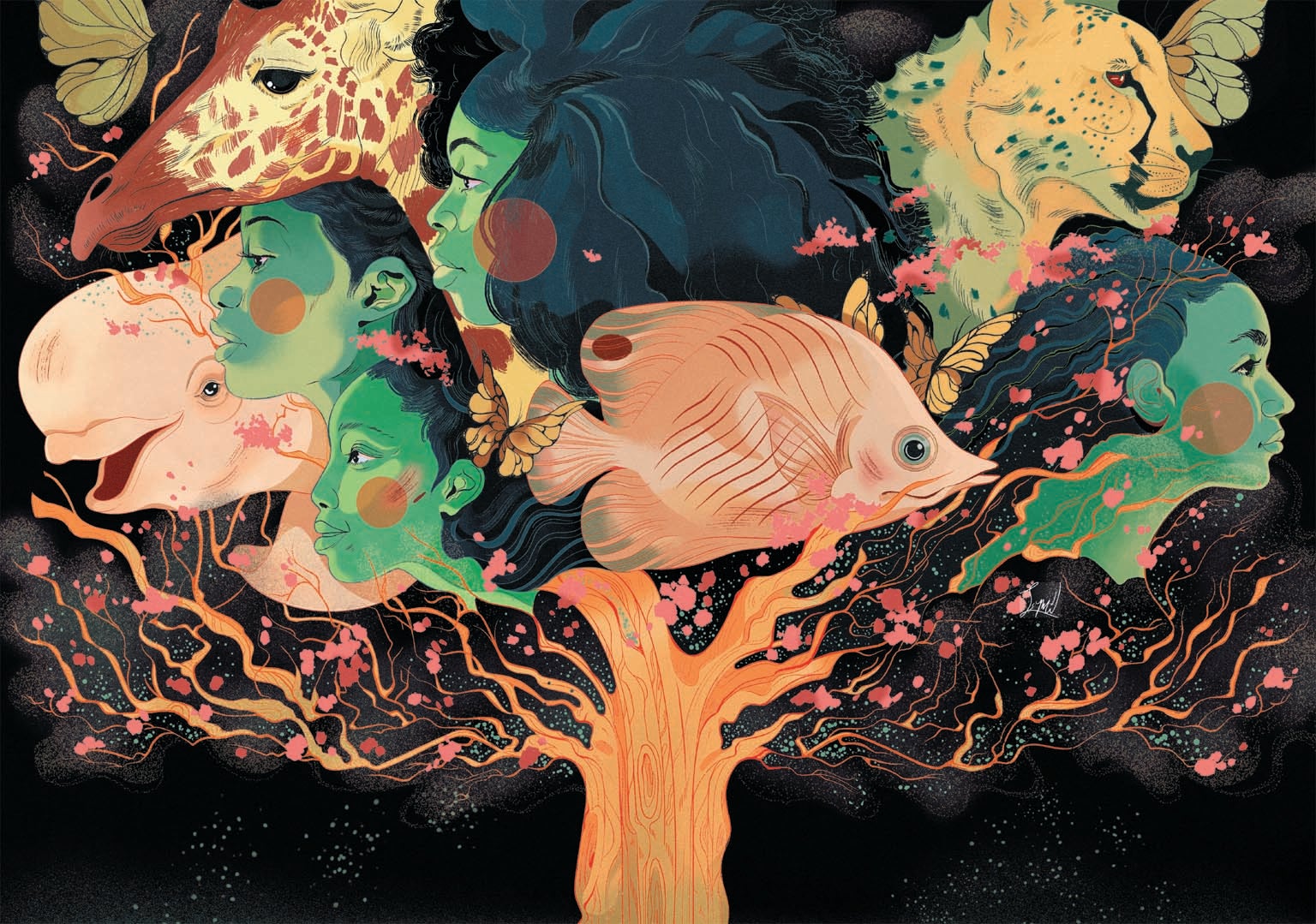
Projected on the massive screen behind me onstage, a herd of giraffes rushes across a sweep of savanna. With the video set to loop, the giraffes gallop endlessly, giving me time to slowly lean across the podium and ask my audience: “Did you spot the pregnant giraffes?” I am delivering a plenary lecture at the 2019 Nobel Conference in Stockholm. The theme of that year’s conference was bioinspired medicine—finding solutions in nature to human health problems—and I wanted to call attention to the connections between women and other female animals.
As a cardiologist and evolutionary biologist, I’d been posing this question about the giraffes to medical students in my courses at Harvard University and the University of California, Los Angeles, for years, so I could tell it had landed as planned. I watched the crowd scan the troop of giraffes for evidence of pregnancy—a baby bump, a lagging mother-to-be. I suspected that few, if any, of the assembled scientists and physicians had considered this question when first taking in the scene. That was precisely my point. Given the importance of female health challenges such as pregnancy to the survival of a species—including our own—shouldn’t the realities of female life in the wild be more than an afterthought for doctors and biomedical researchers?
Predators pose a daily threat to survival for all prey species, and they don’t give pregnant animals a pass. Even in their final, heaviest days of pregnancy, females must evade predators. To do so, they have evolved impressive physiological adaptations.
Consider a giraffe in the last weeks of her nearly 15-month gestation. She has gained hundreds of pounds—her fetus alone weighs up to 150 pounds, but the load is much heavier when you add in the placenta, extra fluid and fat. Yet pregnant giraffes appear to flee as fast as nonpregnant individuals. If they couldn’t, predators would quickly target them as easy prey. That would be the end of the line for that mother, her gestating calf and ultimately the species itself.
As I publicly expressed admiration for the giraffe’s gestational athleticism, I privately cringed a bit recalling how unathletic—how un-giraffe-like—I had felt as a cardiologist in the final weeks of my own pregnancies. I was the slowest doctor in the herd of physicians responding to code blue alerts for medical emergencies at the hospital. I’d become so breathless and exhausted rushing up just two flights of stairs that once, on my way to a cardiac arrest, another physician pulled me aside to express concern for my cardiac health.
I understood why they were worried. Late in pregnancy, women are at risk of developing life-threatening diseases such as preeclampsia and heart failure. Even a healthy pregnancy places significant stress on the heart. The volume of blood that is circulating expands nearly 50 percent. To deal with this increased workload, the cardiac cells and pumping chambers of the heart must grow and transform in size and shape. Cardiologists use the term “remodeling” to describe these changes, but when things go wrong, the consequences are far more serious than a misplaced sofa throwing off the feng shui. Problems with how the heart cells get remodeled during pregnancy are linked to reduced cardiac function and even heart failure soon after delivery.
Fortunately, my cardiac health turned out to be fine: the source of my shortness of breath and fatigue was the nearly 40 pounds of fetus, fluid and fat I’d packed on by the end of the third trimester. Slowing down in the last weeks of pregnancy is perfectly normal for humans—including female cardiologists who can use the elevator instead of sprinting up the stairs.
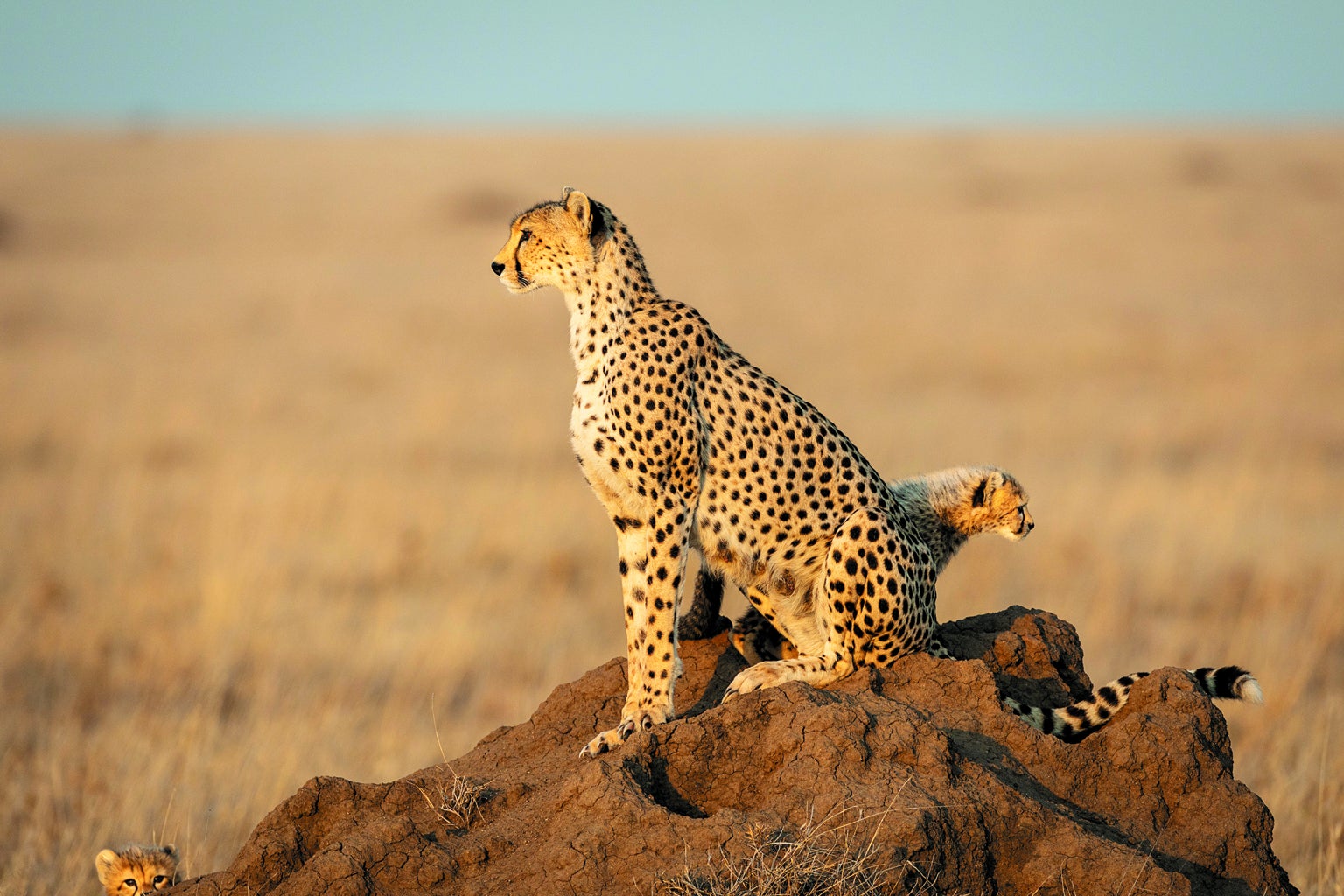
But in the wild, pregnant animals must maintain their speed and stamina to save their lives. For pregnant gazelles, zebras, and other prey species, the ability to flee swiftly protects them from predation. The animals giving chase are often also female and sometimes also pregnant. To avoid starvation, pregnant cheetahs, hyenas, and other predators need to pursue, overtake and capture fleeing prey. A species in which pregnant females can’t evade predators or capture food is doomed to extinction.
I’ve become fascinated by how females of other species have adapted to these challenges. I now study their biology to find possible solutions to women’s health issues ranging from heart failure to breast cancer. This field of research is still emerging, but already it is generating insights that could lead to lifesaving treatments for some of the most prevalent human health concerns.
Cheetahs and other predators need to be able to chase down prey during pregnancy. Credit: StuPorts/Getty Images
Missing Females
A multispecies approach never would have occurred to me as a young professor of medicine in the 1990s. For the first 10 years of my career, I treated many forms of heart disease but always in one species—my own. Then, in 2005, I became a cardiovascular consultant to the Los Angeles Zoo. (Zoo veterinarians occasionally invite physicians to weigh in on diagnoses or assist in medical procedures, especially when the conditions are far more common in humans than in nonhuman animals.) My patient roster expanded to include great apes, bears, lions and raptors, among others. Animal health hadn’t been included in my formal medical education, so the learning curve was steep. The zoo’s veterinarians and the animals themselves became my teachers as I learned that most of the diseases affecting my human patients—cardiovascular disease and cancer among them—can also develop in other species.
Over the years I grew increasingly convinced that species-spanning medicine could reveal insights for my patients that traditional human-centered approaches had not. Partnering with naturalist and science writer Kathryn Bowers, I made it my mission to raise awareness about the relevance of animal health to that of humans, launching educational and professional programs, leading research teams and writing books meant to bring the fields of human medicine, veterinary science and evolutionary biology closer together. The reception to these efforts was mostly positive, but I received a surprising degree of pushback from my own field of medicine. Some physicians seemed resistant to connecting the health of their patients and other species (beyond the transmission of certain diseases from animals to humans). Maybe they took issue with the humbling notion that veterinarians could teach them about their human patients.
Human exceptionalism, I could see, was deeply entrenched in our medical traditions. People haven’t always been comfortable accepting that humans are animals. It has been my experience that human health professionals reflexively assume diseases they treat in their patients are unique to our species. (They aren’t.)
Anthropocentrism wasn’t the only distorted worldview slowing down the progress of medical science. Biomedical research has also long focused on males to the exclusion of females. Until 1993 the National Institutes of Health didn’t require the clinical trials they funded to include women—not even studies of diseases known to be more common in women than men. Mind-bogglingly, it wasn’t until 2015 that the NIH mandated the inclusion of female laboratory animals in preclinical safety studies of new medical treatments. There were rationales for not including females in biomedical studies: researchers wanted to avoid the potentially confounding effects of the estrus cycle, which can introduce variations in physiology and behavior not seen in males, and they wanted to protect potentially pregnant women, and fetuses, from thalidomide-type tragedies. Yet however well intended these investigators might have been, excluding females from studies proved enormously damaging to women’s health.
A cluster of breast cancer cases in beluga whales near Montreal brought attention to a threat to human health. Credit: Paul Souders/Getty Images
To address the gaps in our medical knowledge, I began to focus my species-spanning research on major challenges in women’s health. The health connections between human and nonhuman females weren’t hard to find. I’ve published studies on ovarian cancer in flamingoes, pythons, fish and humans; hosted symposia on menstrual difficulties in great apes (including us), bats and tree shrews; and collaborated with dairy veterinarians who have deep knowledge of lactation in cows to help women with common breastfeeding problems. These experiences have transformed my understanding not only of my patients but of myself as a female. I’ve learned when it comes to certain aspects of my health, I may have more in common with other female animals than with my husband, brother, son or the other men in my life. I call the shared bond that links human and animal females the “sisterhood of species.”
Lions Get Breast Cancer
I first glimpsed the connection among female animals while examining Cookie, a geriatric lioness, at the Los Angeles Zoo in 2021. After an operation, a lion’s heartbeats sound pretty much the same as those of a human who has been through the same procedure. So the clarity of the lub-dup, lub-dups streaming through the stethoscope I had pressed against Cookie’s huge, furry chest reassured me. It meant the dangerous buildup of fluid we had removed from the sac around her heart hadn’t returned. The pathology report on the cause of the fluid buildup wasn’t back yet, however, and the veterinarians were worried that it might be metastatic breast cancer. There were two reasons for this specific concern. First, breast cancer is one of the tumors that sometimes spreads to the heart, creating inflammation and the kind of fluid buildup that had threatened Cookie’s life. The other reason, the veterinarians explained, was that compared with other zoo animals, lions, jaguars, cheetahs, and other cats are especially susceptible to breast cancer.
This connection between human and animal health was personal. Breast cancer is a health concern for many women, and I was no exception. Around the time I first learned about breast cancer in cats, I was being tested for the BRCA mutations following several borderline breast biopsies. The BRCA mutations are well known to put women at increased risk of breast and ovarian cancers. To my amazement, I learned that BRCA mutations also put some dog breeds, including Cavalier King Charles Spaniels, and certain other carnivores at increased risk. In all my years caring for women, as well as some men, with breast cancer, I hadn’t considered what other species might also be vulnerable. In fact, as I showed in a recently published study, breast cancer is a threat across nearly all mammalian lineages, with cases found in creatures ranging from kangaroos and koalas to wombats and water buffalos.
Ultimately Cookie and I were both lucky. Cookie’s fluid buildup turned out not to be cancerous, and she went on to live another four years. I tested negative for BRCA mutations, and my biopsies did not show breast cancer. Other creatures have not fared so well. But we have learned from their misfortune.
Whales don’t usually develop breast cancer—leukemia and lymphoma are the more common cetacean cancers. So when researchers found that 27 percent of the dead belugas they examined in and around the St. Lawrence Estuary near Montreal between 1983 and 1999 had died of breast cancer, their discovery raised questions.
Looking for causes, investigators quickly locked on to several aluminum smelting factories near the estuary that were spewing chemicals known to induce breast and other cancers. The scientists determined that these chemicals probably contributed to the disease not only in the whales but also in humans who lived in the area and exhibited abnormally high cancer rates themselves. Recognizing the breast cancer “epidemic” in mammals living in this urban waterway helped to alert authorities to an environmental hazard that was also threatening human health.
Credit: Dino Pulerà
Like the canaries that British coal miners brought with them to detect the presence of hazardous gases in the mines, the female belugas signaled that contaminants were putting humans at risk. Today rising levels of pollution are implicated in many challenges to women’s health, including cancers, infertility, premature labor, and other disorders of the female reproductive system. Nonhuman female animals living around human communities are increasingly exposed to the same pollutants as women and girls, as the lines that once separated human and animal environments become blurred. Simply stated, the health of female animals is too important to our own to ignore. All female animals—including women and girls—are now canaries for one another. Our coal mine is the planet we share.
Giraffes Avoid Heart Failure
The connection among female animals extends beyond shared vulnerabilities. Some members of the sisterhood have evolved unique physiologies to defend against disease. The remarkable biology of some female animals prevents them from falling prey to diseases that claim millions of women’s lives every year. To understand how and why such unique biology evolved and how it could save women’s lives, consider my new take on the evolution of the giraffe and its improbably long neck.
Rewind to 11.5 million years ago, when the common ancestors of the modern giraffe and its closest evolutionary cousin, the okapi, roamed what is now Africa. Some of those ancestors wandered toward the rain forest and present-day Congo and eventually gave rise to the okapi. Other ancestors migrated toward the savanna and gave rise to the giraffe. Those differing environments helped to produce very different necks in these two lineages. In the rain forest, okapis were able to survive and thrive with perfectly fine albeit unspectacular necks. The ancestral giraffe’s environments, in contrast, lacked dense foliage for hiding. A longer neck would have permitted horizon scanning and earlier detection of predators in an open grassland setting. At the same time, getting taller may have given proto-giraffes better access to sometimes limited foliage.
A downside to having a neck that places the head more than 2.5 meters away from the heart is that this all-important muscle must work harder with each beat to push blood vertically to the brain. This greater pressure on the heart is what we call blood pressure, and in a healthy giraffe, systolic blood pressure (the pressure when the heart is contracting) can exceed 250 millimeters of mercury (mm HG), compared with 120 mm HG or less for a healthy human.
Generally the problem with high blood pressure is that when a muscle like the heart works harder, it thickens. In humans and mice, when hearts thicken this way, they develop scarlike tissue, known as fibrosis. Hearts become stiffer than normal, limiting how far or fast an individual can move. To make matters worse, high blood pressure, also known as hypertension, can damage and weaken the heart over time. In humans, it results in a condition called HFpEF (for heart failure with preserved ejection fraction, pronounced “hef-pef”), which leads to exhaustion, shortness of breath and, potentially, death. HFpEF is the leading cause of heart failure in women, responsible for tens of thousands of deaths a year in the U.S. alone.
On the wide-open savanna, such stiffening could slow an animal down, threatening its survival. Hello, lion; goodbye, giraffe. But giraffes have found a workaround. Despite having blood pressure well above the levels that would earn human patients a stern talking-to from their doctor, both male and female giraffes can gallop at lion-evading speeds, and they appear to be resistant to HFpEF. Recent genomic research hints at how giraffes are able to flout the rules that constrain shorter animals.
The giraffe’s unique biology shields it from the damaging effects of high blood pressure and could inspire treatments for heart disease in women. Credit: Michel and Christine Denis-Huot/Biosphoto/Minden Pictures
In the past few years Chang Liu and his colleagues at Northwestern Polytechnical University in Xi’an, China, have published high-quality genomes of giraffe, okapi and other related animals. They discovered several mutations in the giraffe genome that are not found in the other species. One of the affected genes, FGFRL1, is linked to high blood pressure, which can lead to heart failure in humans. Could giraffe FGFRL1 explain the longer-necked species’ resistance to diseases associated with increased blood pressure?
To find out, the scientists tested two groups of mice to see how each would respond to an infusion of a hormone that causes blood pressure to rise. The first group of mice were “wild type,” meaning that all their genes, including FGFRL1, were mouse genes. The second group had their FGFRL1 sequence edited with CRISPR technology to mimic a giraffe’s. After 28 days of exposure to the blood pressure–raising chemical, the wild-type mice had high levels of fibrosis, a common finding in humans with heart failure caused by hypertension. The hearts of the mice with giraffe FGFRL1, in contrast, appeared nearly fibrosis-free. This finding suggests that giraffes may have evolved a unique ability to suppress some of the damaging fibrosis of the heart.
Giraffes also appear to have evolved mechanisms to shield against other damaging effects of hypertension, including when it occurs during pregnancy. In humans, gestational hypertension—having high blood pressure during pregnancy—is pathological. A leading cause of fetal and maternal mortality, it occurs in up to 25 percent of pregnancies worldwide and is on the rise. For pregnant giraffes, in contrast, higher blood pressure is normal, and neither mothers nor babies seem to suffer any consequences from it. I’ve brought together a team of veterinarians, pathologists and OB-GYNs to uncover the unique biology that protects giraffes from gestational hypertension. We are comparing the placentas of giraffe and okapi, looking for clues to the evolution of this trait.
It will take time to figure out how to use the knowledge we obtain from such studies of female animals to prevent diseases in women. The principle is clear, though: many of the greatest threats to women’s health may have already been neutralized in other species. The fixes are out there, in the bodies of the animals with whom we share our planet. As ingenious as we humans may be, the natural world is even smarter. Evolution’s ability to solve problems is, according to Charles Darwin himself, “immeasurably superior to man’s feeble efforts.”
Rachel Carson is one of my scientific heroes, not only because she launched the modern environmental movement but also because she recognized the powerful connections across species. “In nature,” she wrote, “nothing stands alone.” I would add that no female stands alone. Members of the sisterhood of species are linked by common ancestry and the shared challenges and joys of being a female animal.