Children languish in emergency rooms awaiting mental health care

Children languish in emergency rooms awaiting mental health care

This story includes discussions of suicide. If you or someone you know is in crisis, you can get help from the Suicide and Crisis lifeline by calling or texting 988.


While most kids his age were wrapping up their junior year of high school, Daniel was in a box. 

“It was like I was sitting in a gigantic FedEx box being shipped somewhere,” he said. “But like, add one bed and the door had to be closed at all times.” 

Daniel’s years of mental health struggles, stretching back into his early childhood, came to a head in early 2022. His often-uncontrollable emotional outbursts became unmanageable; he was “unraveling,” his parents said. 

CBS News is only using the first names of former patients interviewed for this story to protect their privacy. 

Fearing Daniel might harm himself, his parents took him to the only place they could: the emergency room. After seven days in the ER, Daniel was discharged; hospital staff felt he was no longer in danger. His parents disagreed.  

“We were like no, no, no, he is so not ready,” his mom Kathe said. “We’ve been waiting and waiting, but he is not ready.” 

Daniel’s therapist even wrote a letter to the hospital saying he wasn’t ready to be released. But the hospital said he needed to go home.  

Ten days later, he was back in the ER — this time at another nearby hospital, where he would stay for 19 days.  

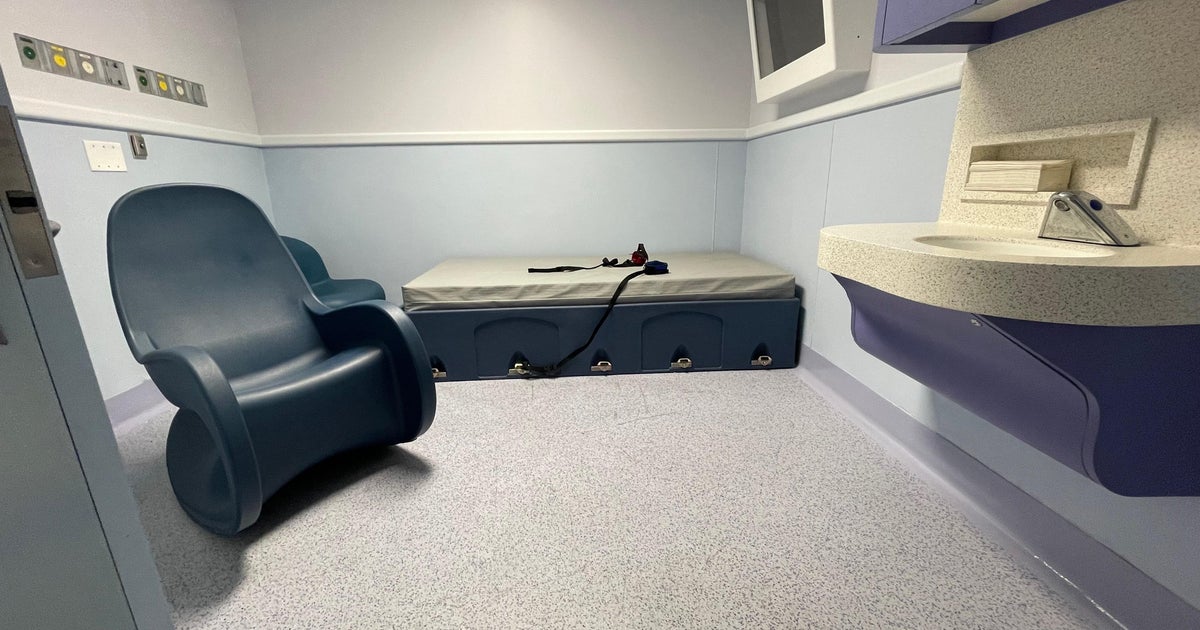
“There’s barely any room in the [hospital] room to walk around,” Daniel, now 18, said. “So I was just sitting on my bed all of the time. I had some rough times there, like it was really difficult to, like, stay put, you know, and that’s what they expected [me] to do.”

Read more: Inside America’s youth mental health crisis 

Instead of the intensive mental health care he needed, Daniel said he got very little help while in the room.  

“Dan, rightfully so, he was like, what am I doing here?” Kathe said. “This is not help. You promised help. Where’s the help?” 

“Severe shortage”

Stories similar to Daniel’s are growing more common in the U.S., fueled by a critical shortage of doctors, therapists and resources to address the needs of kids in crisis. 

In Massachusetts, the number of kids landing in ERs for mental health treatment soared 200{35112b74ca1a6bc4decb6697edde3f9edcc1b44915f2ccb9995df8df6b4364bc}-400{35112b74ca1a6bc4decb6697edde3f9edcc1b44915f2ccb9995df8df6b4364bc} during the pandemic. That same trend is reflected across the country: a 2021 study found the number of kids stuck in ERs awaiting treatment tripled between 2019 and 2021. 

“I do think it is very bad,” said Dr. Muniya Khanna, research scientist at Children’s Hospital Philadelphia and a former faculty member at the University of Pennsylvania’s Department of Psychiatry. “Suicide is now the number two leading cause of death in children 10 to 24. And this trajectory is only getting worse after the COVID pandemic. And so, we are absolutely in a crisis.” 

Experts say it’s a demand and supply issue: demand for mental health services has increased after the pandemic and the supply of trained staff hasn’t increased enough to fulfill the needs. 

Forty U.S. states and Puerto Rico all have “severe” shortages of child psychiatrists, according to data from the American Academy of Child and Adolescent Psychiatry (AACAP) analyzed by CBS News. Only the District of Columbia reported having enough child and adolescent psychiatrists to meet AACAP standards.

RELATED: Half of all Texas school districts have no mental health services 

Amid this lack of formal mental health treatment options, ERs have become the last and only option for many families, according to numerous mental health experts interviewed by CBS News.  

“Kids languish for days, weeks, sometimes even over a year in children’s hospitals around the country,” said Zach Zaslow, vice president of advocacy and community health at Children’s Hospital Colorado. “This is not just a Colorado problem, and it happens because there’s nowhere else that’s safe for them to go.” 

In Colorado, Michaela, who grew up in foster homes, told CBS News she tried get a special therapist to address her anger, anxiety and depression nearly a dozen times. 

“I would be crying out for help,” Michaela said. “I would say I need support. And it wouldn’t happen until I came to a point where it was too late to really come back and not make a bad decision that in the end would hurt me.” 

Michaela said she tried to hurt herself, including several suicide attempts, over those years. She said the system in its current form does not do enough for young people until they reach a crisis point. 

“I think it’s really hard to get into a good therapist or just a therapist in general,” Michaela said. “It doesn’t matter if they’re good or bad.”  

Michaela said she had a total of eight ER visits for mental health crises, and often left the ER without seeing a therapist. The few times she did meet with a mental health expert, she said her therapy was cut short. 

“It did cause me to have to go back [to the ER] again like less than a year later just because I didn’t get the help that I needed,” said Michaela. “And I think it was partly because I left too early.”  

Michaela, who is now 20, said she is proud that she’s “beat the odds” and survived. She now sits on a youth advisory board as part of a partnership between the University of Colorado and Children’s Hospital Colorado. 

“It definitely made me feel like all of that pain and suffering that I had to go through wasn’t a waste,” said Michaela. “Because now I can be the voice of power for so many other young people who are stuck in the same situation that I was and give them hope that I didn’t have then.” 

A revolving door at ERs

Experts told CBS News the use of ERs as stopgap mental health treatment measures simply doesn’t work.  

“For anybody who’s been in an emergency department for more than a few hours, it is not an ideal place to be,” said Dr. Kevin Carney, an emergency room physician at Children’s Hospital Colorado.   

Massachusetts General Hospital in Boston, where Daniel stayed for 19 days, acknowledged the problem, saying in a statement to CBS News that “shortages [of proper mental health treatment options] have forced youth in crisis — and their families — to turn to their local emergency departments where ongoing capacity challenges may mean waiting for days or weeks for appropriate inpatient care to become available.” 

For kids in crisis, ER visits can make matters even worse.  

A December 2022 American Academy of Pediatrics study found more than a quarter of children who went to ERs for mental health issues were hospitalized — either in ERs or in mental health facilities — within six months. And about 26.5{35112b74ca1a6bc4decb6697edde3f9edcc1b44915f2ccb9995df8df6b4364bc} were back in the ER within a week.  

Dr. Sandra DeJong, a psychiatrist and the secretary with the American Psychiatric Association, said if kids don’t get proper care early, their condition can rapidly get worse. 

“My fear is that we really have significant risk for the future,” DeJong said. “Because if we don’t address the needs of particularly young people now, then they are going to grow up to be people who are diminished and don’t have the capacity to function in the way that they could have if they had gotten the treatment.  

“And frankly, they’re going to be expensive to care for because if they go untreated, there are situations that are likely to get worse and then they will need higher intensity care. It’s just not an effective way to approach the problem.” 

Meanwhile, more and more kids find themselves in crisis. Suicide attempts by teen girls jumped more than 51{35112b74ca1a6bc4decb6697edde3f9edcc1b44915f2ccb9995df8df6b4364bc} between 2019 and 2021, according to a study by the CDC. And a recent study published in the journal JAMA Pediatrics found the number of suicide attempts by overdose reported to poison control centers more than doubled between 2000 and 2020.

The number of kids with mental health issues coming to the ER “has been unrelenting,” said Zaslow.  

“And it’s not acceptable,” he added. “It means ultimately, at the end of the day, that there are kids waiting for those beds every single minute as soon as one frees up.”   

Dr. Taylor Louden, medical director at Cook Children’s Medical Center in Fort Worth, Texas, said that in recent years he’s seen more and more young patients come into his ER for mental health problems. 

“We are seeing even younger and younger kids, 8-, 9-year-olds — ages of my kids,” said Louden. “Some are expressing that they want to hurt themselves that they want to die and it’s really tough to hear.” 

Not only are there more kids showing up in ERs, Louden said, but they’re staying longer, too.  

“No one should ever be in an ER longer than a few hours,” he said. “That means that the system is broken, in my mind.” 


Inside an ER’s psych room

04:04

“It’s not acceptable” 

Numerous experts CBS News interviewed said serious investments are needed to increase the mental health resources available to kids in crisis.  

CBS News went to the person in charge of the system in the U.S.: Health and Human Services Secretary Xavier Becerra, who said “we have to do a lot” to fix the problem. 

“It wasn’t until recently that you could get an insurer who actually gave you access to mental health services,” Becerra said. “And we still have a system where mental health is what you get at a primary care physician when you go to a family doctor.  

“That’s got to change. Mental health, it’s got to be part of primary health, not something where you get a referral to a specialist.”  

When asked about children getting stuck in ERs rather than proper mental health treatment facilities, Becerra said it was “not acceptable.” 

“It’s not care,” Becerra said. “It’s housing them until we can get somebody who could give them professional help. They’re crying out and shame on us that we haven’t prepared.”  

Becerra pointed out that several states and the federal government are investing billions of dollars into mental health care. And last summer, the Biden White House announced $300 million to expand mental health services in schools. 

“That’s where the president last year in the State of the Union and again, double down this year has said, Congress, we’ve got to step up, we’ve got to finish the job of making sure that mental health is treated like any other aspect of health,” Becerra said.  

But doctors Khanna and DeJong both said much of this federal spending comes in the form of one-time grants that will eventually expire.  

“Now it’s really time to start investing time and resources on all levels for making that happen more on a regular basis,” said Khanna. 

Attracting more people to work in youth mental health must be part of the equation, DeJong said.  

“You can build all the beds and clinics in the world,” DeJong said. “But if you don’t have enough people to staff them, which is a real problem right now, we’re not going to meet the needs that we’re facing.”   

Secretary Becerra agreed.  

“You just got to put your money where your mouth is. And President Joe Biden is trying to put his money there,” Becerra said. “We need now the partnership with Congress to make it happen.”  


HHS Secretary Xavier Becerra speaks about youth mental health crisis

06:53

Some aren’t waiting on the federal government to help, instead trying new approaches in attempts to address this crisis and meet young people where they are.   

One of those approaches comes in the form of a youth advisory group at Children’s Hospital Colorado. The advisory group consists of teenagers who regularly meet to give advice to therapists and hospital officials about how to meet the needs of young people. 

Another new approach: construction of a new, first-of-its-kind facility at the Cherry Creek School District outside Denver that will combine a mental health medical facility and a school when it’s completed in the fall of 2023.  

When kids in crisis leave ERs 

Finding help after a hospital stay can be even more challenging. 

The Academy of Pediatrics study found just 31.2{35112b74ca1a6bc4decb6697edde3f9edcc1b44915f2ccb9995df8df6b4364bc} of children had a mental health follow-up visit within seven days of leaving the hospital and only about half had a mental health follow-up with a specialist within 30 days of leaving the hospital. 

“I think what is very distressing about this mental health crisis that we’re facing is that while we very much take as part of our responsibility to make sure that we are keeping kids safe and stabilizing them when they’re in crisis or have harmed themselves,” Dr. Carney said. “The very hard thing is knowing that at that point I can’t do anything else for that child.” 

Dr. Glenda Wrenn Gordon knows those statistics firsthand: she and her 18-year-old son lived them.  

Wrenn Gordon said even though she’s an Atlanta-area psychiatrist herself, she was surprised by the effort she had to put in to find help for her son in crisis after she got him to the ER. She said she thought she knew what to do, but still found the system of finding and getting care post-hospital visit to be daunting. 

“We moved very quickly through the ER because I knew exactly what to say and how to say it to get us where we needed to go,” she said. “I was extremely frustrated for how hard it was. I was thinking about these other families. What hope do they have and what it must be like?”  

When asked what she fears most if the system is not changed, Wrenn Gordon was blunt. 

“We will continue to bury our children,” she said. 


Atlanta psychiatrist struggles to find help for her son

02:56

If you or someone you know is in crisis, get help from the Suicide and Crisis Lifeline by calling or texting 988. 

In addition, help is available from the National Alliance on Mental Illness, or NAMI. Call the NAMI Helpline at 800-950-6264 or text “HelpLine” to 62640. There are more than 600 local NAMI organizations and affiliates across the country, many of which offer free support and education programs. 
Can A.I. Treat Mental Illness?

Can A.I. Treat Mental Illness?

Ahead of a different individual go to, Maria recalled, “I just felt that one thing seriously negative was going to materialize.” She texted Woebot, which described the strategy of catastrophic pondering. It can be handy to prepare for the worst, Woebot said—but that planning can go far too considerably. “It assisted me identify this detail that I do all the time,” Maria said. She observed Woebot so effective that she begun looking at a human therapist.

Woebot is just one of quite a few successful cellphone-dependent chatbots, some aimed particularly at psychological health and fitness, many others developed to offer entertainment, convenience, or sympathetic discussion. Currently, thousands and thousands of persons speak to applications and apps such as Happify, which encourages people to “break old styles,” and Replika, an “A.I. companion” that is “always on your aspect,” serving as a good friend, a mentor, or even a romantic spouse. The worlds of psychiatry, remedy, laptop or computer science, and purchaser know-how are converging: more and more, we soothe ourselves with our equipment, even though programmers, psychiatrists, and startup founders layout A.I. systems that evaluate medical data and therapy sessions in hopes of diagnosing, dealing with, and even predicting mental illness. In 2021, electronic startups that focussed on mental wellness secured far more than five billion dollars in undertaking capital—more than double that for any other clinical problem.

The scale of financial investment displays the dimension of the trouble. Approximately a single in 5 American adults has a psychological disease. An approximated 1 in 20 has what’s considered a significant psychological illness—major melancholy, bipolar ailment, schizophrenia—that profoundly impairs the skill to stay, operate, or relate to other people. A long time-aged prescription drugs such as Prozac and Xanax, as soon as billed as groundbreaking antidotes to depression and stress, have proved much less successful than several had hoped care stays fragmented, belated, and insufficient and the in excess of-all stress of psychological health issues in the U.S., as calculated by decades lost to disability, looks to have elevated. Suicide premiums have fallen close to the globe since the nineteen-nineties, but in The united states they’ve risen by about a third. Mental-wellness treatment is “a shitstorm,” Thomas Insel, a previous director of the National Institute of Psychological Health, explained to me. “Nobody likes what they get. No person is content with what they give. It’s a complete mess.” Because leaving the N.I.M.H., in 2015, Insel has labored at a string of electronic-mental-well being providers.

The remedy of psychological illness demands creativeness, insight, and empathy—traits that A.I. can only pretend to have. And nevertheless, Eliza, which Weizenbaum named following Eliza Doolittle, the faux-it-till-you-make-it heroine of George Bernard Shaw’s “Pygmalion,” created a therapeutic illusion despite possessing “no memory” and “no processing power,” Christian writes. What may a program like OpenAI’s ChatGPT, which has been skilled on extensive swaths of the composing on the Net, conjure? An algorithm that analyzes patient data has no interior understanding of human beings—but it may well nevertheless discover actual psychiatric issues. Can synthetic minds mend real ones? And what do we stand to acquire, or get rid of, in letting them attempt?

John Pestian, a personal computer scientist who specializes in the evaluation of medical details, 1st started off applying device studying to research mental illness in the two-1000’s, when he joined the college of Cincinnati Children’s Clinic Healthcare Center. In graduate university, he had constructed statistical models to make improvements to care for sufferers undergoing cardiac bypass operation. At Cincinnati Children’s, which operates the greatest pediatric psychiatric facility in the region, he was shocked by how lots of youthful men and women arrived in after attempting to conclusion their individual life. He needed to know regardless of whether pcs could determine out who was at hazard of self-hurt.

Pestian contacted Edwin Shneidman, a medical psychologist who’d established the American Association of Suicidology. Shneidman gave him hundreds of suicide notes that families had shared with him, and Pestian expanded the collection into what he thinks is the world’s major. Through one of our conversations, he confirmed me a observe created by a younger female. On one facet was an offended concept to her boyfriend, and on the other she dealt with her mothers and fathers: “Daddy be sure to hurry home. Mom I’m so worn out. Please forgive me for anything.” Researching the suicide notes, Pestian found designs. The most prevalent statements were not expressions of guilt, sorrow, or anger, but recommendations: make certain your brother repays the funds I lent him the car is virtually out of gasoline watchful, there’s cyanide in the toilet. He and his colleagues fed the notes into a language model—an A.I. method that learns which words and phrases and phrases are inclined to go together—and then examined its capability to recognize suicidal ideation in statements that men and women made. The benefits advised that an algorithm could recognize “the language of suicide.”

Following, Pestian turned to audio recordings taken from individual visits to the hospital’s E.R. With his colleagues, he designed application to examine not just the terms folks spoke but the appears of their speech. The staff uncovered that folks enduring suicidal feelings sighed much more and laughed considerably less than many others. When speaking, they tended to pause lengthier and to shorten their vowels, producing terms fewer intelligible their voices sounded breathier, and they expressed much more anger and much less hope. In the biggest trial of its variety, Pestian’s workforce enrolled hundreds of clients, recorded their speech, and used algorithms to classify them as suicidal, mentally unwell but not suicidal, or neither. About eighty-5 for each cent of the time, his A.I. product came to the very same conclusions as human caregivers—making it likely beneficial for inexperienced, overbooked, or unsure clinicians.

A several several years in the past, Pestian and his colleagues used the algorithm to produce an application, termed SAM, which could be employed by school therapists. They analyzed it in some Cincinnati general public universities. Ben Crotte, then a therapist dealing with center and significant schoolers, was among the initial to attempt it. When inquiring college students for their consent, “I was incredibly clear-cut,” Crotte advised me. “I’d say, This software in essence listens in on our conversation, data it, and compares what you say to what other persons have claimed, to recognize who’s at hazard of hurting or killing on their own.”

A single afternoon, Crotte met with a large-college freshman who was battling with extreme panic. In the course of their conversation, she questioned irrespective of whether she desired to keep on residing. If she was actively suicidal, then Crotte experienced an obligation to tell a supervisor, who could choose additional motion, this kind of as recommending that she be hospitalized. Soon after chatting much more, he resolved that she was not in instant danger—but the A.I. came to the opposite conclusion. “On the a single hand, I assumed, This thing really does work—if you’d just achieved her, you’d be quite anxious,” Crotte said. “But there had been all these items I understood about her that the app did not know.” The woman experienced no heritage of hurting herself, no specific programs to do something, and a supportive spouse and children. I requested Crotte what may well have took place if he experienced been less familiar with the student, or a lot less knowledgeable. “It would surely make me hesitant to just permit her depart my business,” he informed me. “I’d truly feel anxious about the legal responsibility of it. You have this thing telling you another person is significant danger, and you are just going to enable them go?”

Algorithmic psychiatry consists of numerous sensible complexities. The Veterans Well being Administration, a division of the Division of Veterans Affairs, might be the initially significant wellness-care company to confront them. A several times prior to Thanksgiving, 2005, a twenty-two-calendar year-outdated Army expert named Joshua Omvig returned house to Iowa, immediately after an eleven-month deployment in Iraq, demonstrating indicators of post-traumatic anxiety disorder a month afterwards, he died by suicide in his truck. In 2007, Congress handed the Joshua Omvig Veterans Suicide Avoidance Act, the to start with federal legislation to tackle a long-standing epidemic of suicide among the veterans. Its initiatives—a disaster hotline, a marketing campaign to destigmatize mental ailment, necessary teaching for V.A. staff—were no match for the dilemma. Each individual year, thousands of veterans die by suicide—many occasions the selection of soldiers who die in beat. A group that involved John McCarthy, the V.A.’s director of details and surveillance for suicide avoidance, gathered information about V.A. individuals, applying studies to detect possible risk aspects for suicide, these types of as long-term pain, homelessness, and despair. Their results were being shared with V.A. caregivers, but, among this info, the evolution of healthcare investigation, and the sheer quantity of patients’ records, “clinicians in care have been obtaining just overloaded with signals,” McCarthy explained to me.

How Psychedelic Experiences May Improve Mental Health

How Psychedelic Experiences May Improve Mental Health
Psychedelic Drug

A device studying investigation done by researchers on the non-medical encounters with psychedelic drugs of pretty much 1,000 study respondents confirmed that all those who scored best on questionnaires measuring the mystical and insightful excellent of their experiences, noted reliable aid from symptoms of nervousness and despair.

Mystical and Insightful Psychedelic Knowledge May possibly Enhance Mental Wellbeing

Scientific examine implies a challenging vacation can have a optimistic end result.

According to new exploration, extra mystical and insightful psychedelic drug activities could be linked to an enduring reduction in stress and despair indicators.

Researchers conducted a

“In the clinical research setting, folks are doing everything they can to create a safe and supportive environment. But when challenges do come up, it’s important to better understand that challenging experiences can actually be related to positive outcomes.”

The research was published online recently in the Journal of Affective Disorders.

The study is the first to characterize subtypes of the subjective psychedelic experience and link them to mental health outcomes. The data came from previous work Davis led consisting of an anonymous internet-based survey of people who reported having a moderate to strong psychedelic experience in the past and resulting changes to their symptoms of anxiety and depression – regardless of the level of those symptoms before the psychedelic experience.

The 985 participants whose responses were analyzed in this study described substances they had used and completed questionnaires evaluating the extent to which their psychedelic experience was mystical (evoking a sense of pure awareness, positive mood and/or transcendence of time and space that is difficult to describe in words), psychologically insightful (eliciting acute insight into memories, emotions, relationships, behaviors or beliefs), or challenging. Outcomes assessed in the survey included depression and anxiety symptom levels and ratings of satisfaction with life and psychological flexibility – one’s capacity to act in ways that are consistent with their values regardless of whatever internal or external experience they might have – before and after using the psychedelic.

The sample included users of psilocybin (magic mushrooms), LSD, Ayahuasca, mescaline, peyote cactus and 5-MeO-DMT, the natural psychedelic substance in the venom of the Colorado River toad, with the estimated dose level of the single drug use they recalled.

The data analysis yielded three distinct subtypes of psychedelic experiences:

  • High scoring, combining high scores on the mystical and insightful assessments with moderate scores on the challenging assessment.
  • Low scoring, with low to moderate scores on mystical and insightful experiences and low scores on the challenging scale.
  • Positive scoring, with high scores for mystical and insightful experiences and low scores on the challenging assessment.

“The group that had the highest insightful and mystical experiences and low challenging experiences showed the most benefit in terms of remission of anxiety and depression symptoms and other longer lasting benefits to their life,” said first author Aki Nikolaidis, an affiliate of Ohio State’s Center for Psychedelic Drug Research and Education (CPDRE) and a research scientist in the Center for the Developing Brain at the Child Mind Institute.

When the researchers analyzed only data from participants who had used psilocybin and LSD, the same patterns emerged: Three distinct subtypes that were associated with the same outcomes, including benefits to mental health even after a challenging experience. That replication speaks to the importance of the subjective experience for psychedelics users, Nikolaidis said.

“Identifying subtypes that exist regardless of which psychedelic you take answers an interesting question,” he said. “But the fact that we found that they’re associated with specific outcomes, and replicated that finding, really shows why it’s important to understand the powerful nature of what is happening subjectively and its potential to yield a beneficial outcome.”

A few trends also stood out: The positive scoring group whose experience could be considered optimal – high scores on mysticism and insight and low scores on challenges – tended to be younger than participants in the other groups. Among individuals who scored highest on challenging experiences, there was a higher proportion of people who had taken large doses of the psychedelic drugs. And the low scoring subtype had lower psychological flexibility, anxiety and depression scores before the psychedelic experience, and lower improvements in those symptoms and satisfaction with life than the other two subtypes.

Davis said he will be watching to see if these subtypes of experiences apply in the clinical setting, where psilocybin-assisted therapy is being studied at Ohio State for the treatment of post-traumatic stress disorder among military veterans.

“Finding the variety of other outcomes that these subtypes might be related to is an interesting next step,” he said. “These could include adaptive or functional outcomes in people’s quality of life or well-being, or a better understanding of their life’s purpose or relationships.”

Reference: “Subtypes of the psychedelic experience have reproducible and predictable effects on depression and anxiety symptoms” by Aki Nikolaidis, Rafaelle Lancelotta, Natalie Gukasyan, Roland R. Griffiths, Frederick S. Barrett and Alan K. Davis, 27 December 2022, Journal of Affective Disorders.
DOI: 10.1016/j.jad.2022.12.042

Additional co-authors include Rafaelle Lancelotta of Ohio State, and Natalie Gukasyan, Roland Griffiths and Frederick Barrett of the Center for Psychedelic & Consciousness Research at Johns Hopkins School of Medicine, where Davis is also an affiliate.

This work was supported by the Brain and Behavior Research Foundation, the National Institute of Mental Health, the CPDRE, the Steven & Alexandra Cohen Foundation, and private donors.

The mental health first aiders fighting back in Ukraine

The mental health first aiders fighting back in Ukraine

This was the region of skills of Nathalie Robelot-Timtchenko, a psychological health and fitness specialist specialising in expressive arts therapy based in Cambridge, Massachusetts, who lived in Kyiv from 2014 to 2021.

“When [the invasion] transpired, it was all-around 1am, I believe that, on the 24 February for us [in Cambridge], and it was surprising,” claims Robelot-Timtchenko. “It was genuinely tricky to know how to enable, and what would actually be impactful.”

Robelot-Timtchenko sent out a contact-to-motion on 25 February 2022, trying to get mental wellbeing specialists who would be keen donate their time supplying assistance to people today in Ukraine. She referred to as the initiative Very first Aid of the Soul from her foundation in Cambridge. “In a week we experienced all-around 450 indicator up,” she states, with volunteers dependent all around planet, a lot of in the US and Canada, but also across Europe, to Japan and Australia.

Like the “Good friend. To start with Assist” team, a lack of means on psychological 1st help was 1 of the 1st matters that struck Robelot-Timtchenko.

“That was a person of our first assignments, seeking to make our self-aid kits,” claims Robelot-Timtchenko. “We experienced pretty a big group, maybe 20 experts functioning on just collecting diverse materials.” For instance, the group collated information and facts on how to soothe your children when you happen to be in a annoying atmosphere, this kind of as a bomb shelter, with details about preserving comforting bodily touch and using very simple phrases and phrases to examine the problem and your inner thoughts.

By the initial weeks of March 2022, To start with Aid of the Soul commenced delivering assist groups in a university Robelot-Timtchenko had labored in. “By April we had been giving coaching open to various psychological wellness gurus in Ukraine.” 1 of their very first focuses was psychological initially help, followed by therapies involving motion and relaxation such as yoga, before going into other locations.

Delivering in-person aid has been a essential portion of supporting Ukraine’s resilience. “Just lately we have been in Ukraine in January, I was equipped to do a workshop with kids that have been displaced internally displaced in Ukraine,” claims Robelot-Timtchenko. “These young children have been via hell, to say the the very least, but they nevertheless have smiles on their faces. They are still talking about their superhero followers, and the workshop was about obtaining internal strength and building resilience.

“That is what we are attempting to do, just have a very little bit of hope,” she states.

Regulators may get more flexible on UVMMC mental health care investment

Regulators may get more flexible on UVMMC mental health care investment
hospital
Central Vermont Medical Heart in Berlin. File photo by Erin Mansfield/VTDigger

On its confront, the issue the Green Mountain Care Board will determine more than the coming two months is bureaucratic. But to Vermonters struggling to entry psychological wellbeing procedure for by themselves or loved types, the remedy is everything but mundane.

Really should the board enable Burlington’s University of Vermont Healthcare Center to divert what continues to be of $21 million in surplus wellbeing treatment earnings from 2017 absent from a system to build a new medical center-based mostly inpatient psychiatric facility? 

The choice would be a broader vary of investments to raise mental wellbeing care capacity identified in conjunction with the Vermont Section of Mental Well being. The board is searching for general public comment on the dilemma in advance of a doable March 8 vote. 

The care board’s staff members suggest loosening the board’s specifications. 

“We’re suggesting that those resources could be additional advantageous and far more instantly utilised for the point out if that restriction were broadened,” Sarah Lindberg, the treatment board’s director of overall health systems funds, told its 5 customers at Wednesday’s afternoon meeting. 

Statewide, the unmet need for each emergency and ongoing psychological well being treatment stays significant. “This funding is at chance of getting of considerably less benefit as time goes on,” Lindberg reported. 

Rick Vincent, CFO of the UVM Health Community, wrote in a Feb. 9 letter to the Eco-friendly Mountain Care Board that the network still intends to use the remaining resources, all around $18 million, to address mental well being requirements. 

Leaders of the firm — which includes UVMMC, Central Vermont Health care Heart in Berlin and Porter Medical Middle in Middlebury — “look forward to discussions with you, and others in Condition governing administration, about the best use of the funds,” he wrote. 

The 2017 money have been regarded a surplus for the nonprofit medical center for the reason that the amount of money was increased than the funds that the board and UVMMC had agreed on at the begin of the fiscal yr. The board’s once-a-year funds agreements with the state’s 14 hospitals, which it tracks towards real earning and investing, are a considerable part of its oversight get the job done. 

The April 2018 “enforcement action” expected the $21 million in surplus revenue “be utilised solely for investments that measurably increase inpatient psychological overall health potential in Vermont.” The UVM Overall health Network spent several a long time setting up for a 40-bed facility that would be portion of Central Vermont Medical Centre, which would have added 25 new inpatient beds. 

The task was approximated to charge additional than $150 million and was predicted to add functioning deficits of more than $20 million thanks to the lower than value reimbursement prices for many psychological overall health services. The health network stepped away from the job early previous 12 months, citing big spending budget deficits.

In its 2023 funds arrangement, with the expense of care escalating mainly owing to enhanced staffing charges, the Inexperienced Mountain Treatment Board permitted UVMMC to raise its professional insurance premiums just less than 15{35112b74ca1a6bc4decb6697edde3f9edcc1b44915f2ccb9995df8df6b4364bc}, fewer than the pretty much 20{35112b74ca1a6bc4decb6697edde3f9edcc1b44915f2ccb9995df8df6b4364bc} boost requested by the medical center. The board suggested at that time the healthcare facility could petition to make use of the psychological wellbeing care resources to close the hole. 

UVM Wellness Network’s economical woes, alongside with all those of other overall health care support corporations all over the condition, have not abated. Its 3 hospitals lost a combined $22 million in the initially quarter of the existing fiscal calendar year, Vincent said in his letter. 

Even though acknowledging requirements at each individual degree of psychological overall health treatment, quite a few board associates expressed problems about eliminating the emphasis of the 1-time resources from a new inpatient facility. Devoid of it, they claimed, the technique does not serve people well and success in far more pricey health and fitness care.

“The reality that our crisis departments are clogged with men and women needing psychological wellness treatment companies, often residing in the crisis section for months at a time, tells us there is a desperate have to have for inpatient services,” board member Thom Walsh stated. “They are in the medical center, in the best price doable placing, as we communicate.”

Really don’t miss out on a thing. Sign up listed here to get VTDigger’s weekly e mail on Vermont hospitals, wellness treatment trends, insurance and condition wellbeing care policy.


Opinion | Fetterman’s depression disclosure is a paradigm shift for mental health

Opinion | Fetterman’s depression disclosure is a paradigm shift for mental health

Comment

The place of work of Sen. John Fetterman introduced last Thursday that the Pennsylvania Democrat had checked himself into the clinic for therapy of melancholy. This courageous disclosure marks a extended-overdue paradigm change to regard psychological health and fitness conditions the same way we do physical illnesses.

It may well shock men and women to discover how popular despair is. The Centers for Illness Handle and Prevention studies that through the pandemic, additional than 41 per cent of Us residents seasoned current symptoms of a depressive or anxiousness problem. The National Institute of Mental Wellness estimates that 21 million grownups — about 8.4 {35112b74ca1a6bc4decb6697edde3f9edcc1b44915f2ccb9995df8df6b4364bc} of the population — had at minimum one episode of significant despair in 2020.

These quantities are comparable to the proportion of American grownups diagnosed with hypertension (about 47 per cent) or diabetic issues (about 13 {35112b74ca1a6bc4decb6697edde3f9edcc1b44915f2ccb9995df8df6b4364bc}). But there is deep stigma that helps prevent our culture from with regards to these mental overall health disorders with the exact compassion and urgency as other frequent ailments.

Not very long in the past, a analysis of melancholy was disqualifying for political place of work. In 1972, Missouri senator Thomas Eagleton was pressured to withdraw as the Democratic nominee for vice president right after experiences emerged that he had been hospitalized for depression several years prior to. And as just lately as 2019, Rep. Seth Moulton (D-Mass.), a former Maritime, described it as a “political hazard” to share his personal struggle with write-up-traumatic anxiety ailment.

As the disaster of the opioid epidemic and related “diseases of despair” rose to community awareness, political leaders have spoken about behavioral well being in more own terms. Continue to, the stories they informed had been commonly about some others — close friends, family members customers and constituents. On the rare situations they spoke about their very own problems, it was in the previous tense as a problem they effectively overcame.

The implication is that if somebody has an energetic mental overall health problem that requires cure, they would be unfit for elected workplace. This pervasive stigma tends to make Fetterman’s general public disclosure all the much more commendable.

Fetterman did not have to say that he was hospitalized for depression. Just the week just before, he was admitted to the hospital for lightheadedness to rule out a stroke considering the fact that he had presently suffered from 1 for the duration of his 2022 marketing campaign, in which he was also diagnosed with an irregular heart rhythm and an enlarged heart. His office environment could have been intentionally obscure, expressing he was going in for supplemental assessments, continued observation and treatment changes. No doubt, plenty of public figures have utilised these kinds of language to conceal their psychological overall health diagnoses.

It’s achievable this transparency is an effort to stem criticism comparable to what he faced throughout his Senate campaign that he was not forthright about the extent of his stroke and coronary heart conditions. However, in deciding on to be open up about his despair, Fetterman is educating the public that depression is a health care ailment for which effective treatment exists. Most people today with melancholy can be dealt with with medications, psychotherapy or a mixture. Some require additional intense inpatient treatment. All have been revealed to help manage signs and give individuals back again their life.

I feel it was also crucial that Fetterman’s team said he has experienced despair “on and off” for years. The effortless way out would be to attribute the despair to his the latest stroke. It is approximated that 1 in 3 clients that survived a stroke encounter despair, so it is vital to be on the lookout for melancholy in this large-threat team and other patients with the latest hospitalizations. But the point out of Fetterman’s heritage adds to the understanding of melancholy as a continual disorder.

Yet again, this is not dissimilar to physical ailments. Patients with hypertension or diabetes may well be undertaking effectively for a whilst but then quickly worsen and require an adjustment to manage their condition. That’s not a failure, nor is it a reflection of their will or strength of character.

The similar applies for depression. Regretably, many folks go through from psychological wellness problems in silence. But these health problems are not one thing they just have to cope with any additional than individuals ought to have to cope with large blood tension or diabetic issues without having health care attention. There are treatment options that perform, and it is okay to question for aid.

For these who want to search for remedy, a great position to start out is by speaking with your most important care physician. They can assistance you with an first assessment and referral. Make use of means through do the job or university, these types of as worker help plans or faculty counselors. The federal federal government has also released 988, a 24/7 mobile phone and chat hotline specializing in suicide and crisis assist that can present neighborhood methods for psychological overall health and dependancy assistance.

Fetterman’s office environment has stated that he could be in the medical center for a handful of weeks. When he is discharged, I hope he carries on sharing his journey. It’s one particular that tens of millions of People in america can relate to. His path to restoration could give hope and lastly normalize therapy for mental overall health disorders.