In the early 1950s Marie Nyswander was ready to move on from addiction. She set up a private practice and specialized in treating women afflicted with what she would call one of the “gravest problems of our time”: sexual frigidity. She and her adoring husband were living the good life, hanging out with rich art collectors and members of New York City’s literary scene. But when Nyswander started getting phone calls for help, she got pulled in a very different direction.
[New to this season of Lost Women of Science? Listen to Episode One here first.]
EPISODE TRANSCRIPT
The Lost Women of Science podcast is made for the ear. We aim to make our transcripts as accurate as possible, but some errors may have occurred nonetheless. In addition, important aspects of speech, like tone and emphasis, may not be fully captured, so we recommend listening to episodes, rather than reading transcripts, when possible.
—-
CAROL SUTTON LEWIS: This is the second episode of our series about Marie Nyswander. If you haven’t heard the first episode, stop now and go back and listen to that one. This episode will make much more sense if you do.
And a reminder that this season of Lost Women of Science is for adults. It will occasionally include adult language, and we’ll be talking about drugs and sex. Please, also note that some archival audio includes outdated language about drug addiction. Okay, I think we’re ready!
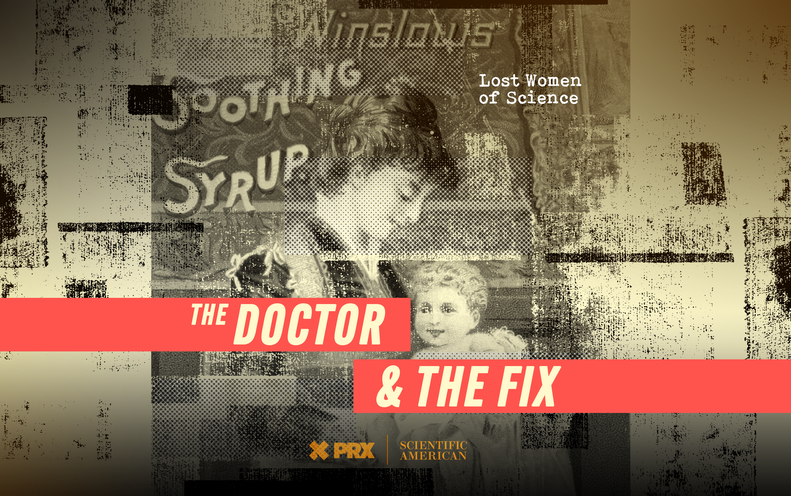
CAROL SUTTON LEWIS: In 1912, the German pharmaceutical company Bayer ran an ad for cough syrup in a Spanish newspaper. The ad features a little girl sitting on a chair with a big bow in her hair. She smiles as a woman spoon feeds her medicine. The caption reads, “la tos desaparece” – “the cough disappears.”
The ad goes on to explain how this syrup will help with everything from bronchitis to laryngitis, even tuberculosis. And then, at the bottom, in big, bold letters, we see the name of the medicine: “Heroína.”
KATIE HAFNER: Just in case you missed that, the miracle cough syrup for kids is heroin.
Bayer—yes, the same company that makes Aspirin—ran multiple ads like this in Spain: one features a boy grabbing at a heroin bottle in his mother’s hands, there’s another that depicts two kids in a standoff, both reaching for a vial of heroin on the table.
American ads were just as sweet, touting heroin’s many benefits, saying it was a non-addictive alternative to morphine. Some ads even suggested heroin for more vulnerable patients who couldn’t handle morphine.
CAROL SUTTON LEWIS: By the time these ads ran in 1912, Bayer might have had some inkling that heroin wasn’t actually so kid-friendly or adult friendly for that matter. It had been selling heroin for over a decade by then, and it was becoming very apparent just how addictive it was. Just one year after these ads ran, the company stopped making heroin for good.
But it was too late. And when Marie Nyswander arrived in New York half a century later, this “cough medicine” was wreaking havoc in the city, and around the world. And though Marie thought she was done with addiction, addiction was far from done with her.
KATIE HAFNER: This is Lost Women of Science. I’m Katie Hafner.
CAROL SUTTON LEWIS: And I’m Carol Sutton Lewis, and this season is the story of Marie Nyswander.
CAROL SUTTON LEWIS: In 1950, Marie was living in New York City, ready to start fresh. After her miserable year at the Narcotic Farm in Lexington, Kentucky, she’d spent a couple of years finishing up her residency at Bellevue Psychiatric Hospital in Manhattan, where she saw even more of the terrors of withdrawal up close—diarrhea, vomiting, fevers, weight loss, pleas from patients that were so heartbreaking, it made the doctors keeping them away from drugs look like monsters. Marie was ready to move on.
CAROL SUTTON LEWIS: Fortunately, during those early years back in New York she’d also done some post-grad training at the New York Medical College, learning all about the hottest psychiatric method of the day: Freudian psychoanalysis.
DAVID COURTWRIGHT: Well, why psychoanalysis then?
MARIE NYSWANDER: Oh, well, you have to remember, that’s again historical.
CAROL SUTTON LEWIS: Back in 1981, Marie told the historian, David Courtwright, it was just that most psychiatrists were into Freud back then.
MARIE NYSWANDER: And the Freudian explanation for behavior seemed to be the most dynamic and correct and true, and we took it just right down the line. It was like a bible. [laughs]
KATIE HAFNER: Marie soon started seeing private clients. And her specialty? What she would later call one of the “gravest problems of our times”? Carol, it was sexual frigidity, of course.
CAROL SUTTON LEWIS: Sexual frigidity? Can we even say that?
KATIE HAFNER: Uh, we said it a lot back then, at least Marie did. And here’s how Marie defined it. Sexual frigidity is “the inability to enjoy physical love to the limits of its potentiality.” In lay person’s terms, the sexually frigid woman can’t orgasm. Or if she can it’s not very good.
So Marie, she was so taken with this particular subject that she later wrote an entire book about it. Are you ready for the title of the book? The Power of Sexual Surrender. It is exactly what it sounds like, a treatise on female submission.
Carol, I have to read you some quotes from this book. I couldn’t believe it was the same Marie Nyswander I had been reading about. I mean, here’s just one quote: “The biological role of woman is motherhood. If a woman cannot dare to accept this aspect of her destiny, she will be deeply defeated in her life.”
And she thought frigidity came from problems in childhood like having an absent father, or worse, a feminist mother.
CAROL SUTTON LEWIS: What?
KATIE HAFNER: Yeah, in this book, I mean, I was pretty surprised. Marie really goes after feminists for disrupting gender norms – claiming feminists make their daughters wanna live like men.
And the book, it staunchly decries women who put their careers first, imagine that. A woman’s most important role, according to Marie, is in the home as a wife and mother.
KATIE HAFNER: So yeah, a very interesting read. Some real contradictions with the life Marie actually lived.
DAVID COURTWRIGHT: Marie was always a career woman.
KATIE HAFNER: David Courtwright again, professor emeritus of history at the University of North Florida.
DAVID COURTWRIGHT: Um, she never had any children, and she was devoted to her patients, to her research, to her writing.
So she’s off in Freud land now in the mid fifties. Okay, uh, and this is also when she meets and marries Leonard Robinson.
CAROL SUTTON LEWIS: Leonard wasn’t her first husband. It turns out Marie actually had quite a bit of experience with marriage and its pitfalls. Because by the time she met Leonard, Marie had already been married and divorced twice. The first marriage, when she was just 16-years-old was to a man named Gordon Woodrow Raleigh, a pre-med student at the University of Utah. We don’t have a lot of details on that, but we do know that marriage lasted no more than a year. And then, while Marie was at medical school at Cornell, she married Charles Miles Berry, an anatomy instructor at the school. We actually asked Cornell whether he’d been her instructor, but they didn’t know. That marriage was short-lived too.
CAROL SUTTON LEWIS: But then, along came husband number three.
KATIE HAFNER: Yes, Leonard Wallace Robinson, another guy who went by all three of his names.
And Carol, just in case anybody thinks we’re being judgmental here, we are definitely not. I mean, we are people—well, I am person—who has been married a few times herself.
Anyway, Leonard was a writer and lecturer at Columbia University. And when Marie breezed into his life, Leonard fell hard, hard enough that he wrote a novel all about her and their relationship. The title is The Man Who Loved Beauty.
KATIE HAFNER: In the book, Leonard – codename “Jonathan” – recounts meeting Marie – codename Elizabeth – at a Columbia faculty party. He describes her blonde hair, her deep, textured voice, and their electric connection on the dance floor.
KATIE HAFNER: And Carol, I wanted you to hear this passage about that meeting on the dance floor. I actually got my husband Bob to read it for us. He was a little bit reluctant at first.
KATIE HAFNER: Okay, take it away
BOB: I wanna guarantee that you’re gonna use it. If I, if I do it, I need a guarantee you’re gonna use it.
KATIE HAFNER: He’s kidding.
BOB: My, my union insists on it.
KATIE HAFNER: Okay
BOB AS LEONARD: The feeling of her body against mine was simply not describable. It was different in kind from all that went before. And many (laugh) had gone before. I had not naiveté left. But with Elizabeth in my arms that night on the dance floor, the great complex mysterious and marvelous body of woman seemed to make itself known to me for the first time, with all its primal attributes streaming from it, passion and purity, and the heavy mystery waiting to be explored.
BOB AS LEONARD: Geez, you should have warned me.
KATIE HAFNER: So as far as Leonard was concerned, they had a fantastic marriage.
CAROL SUTTON LEWIS: In the 50s, Marie is living the good life. She’s got her private practice, she’s married to Leonard, who is absolutely enthralled with her, and she starts hanging out with a fashionable group of art collectors. She even starts collecting art herself.
It sounded like a comfortable life, and it seemed to suit her. But then, she started getting these calls.
EMILY DUFTON: She started getting phone calls from an increasing number of people saying, you know, my son has this problem. My daughter has this problem, my husband has this problem. She was being sought out.
The problem was heroin addiction. During the war, there’d been a temporary interruption in supplies, but in the 50s, heroin was back in full force, and New York City was its capital.
LOW: When I, when I, when I, when I was on dope, it seemed like everybody was on dope.
CAROL SUTTON LEWIS: During an oral history interview decades later, a man named Low recalled how bad things were back in the 50s. Low had grown up in Spanish Harlem, and he remembered being afraid of heroin. He’d seen how it ruined people. They’d go from being well dressed to wearing rags. But then one day, in 1949, a guy at a bar offered Low a free sample. And for whatever reason, that day, he decided to take it.
LOW: And I started to vomit. I vomit so much I couldn’t…
Q: Was this the first time you…
LOW: The first time. And then, when after the vomiting, you have, you, you, you feel a sensation. A sensation that no other high like marijuana or liquid could give you, you just sit down and you be, you’ll be asleep, but you’ll be hearing everything that’s going on.
CAROL SUTTON LEWIS: And that was it. Low kept using heroin until he ran out of money. So he got a second job, and used some more. He was addicted to heroin. And in the 50s and 60s, he had a lot of company.
LOW: It was like an epidemic, like everybody was using it. You know, it seems to me that everybody in every street corner, 10, 25 guys. You know, pedaling, heroin. I said, gee, whiz, I mean, I thought, I thought, that the world would come to an end.
CAROL SUTTON LEWIS: Now, something else that’s happening at this point is the demographics of heroin use is shifting rapidly. That’s actually one of the things we’ve learned—that what an opiate user looks like is always changing. During the 19th century, opiates were actually a middle or upper class white woman’s drug. When Marie was at Lexington in the 40s, opiate users were mostly white men. And in the 50s, the people hardest hit were young, poor, Black and Puerto Rican men.
COMMISSIONER STEVE CANADAY: Narcotics traffic is a dirty business. Its victims are the walking dead. (fade under)
CAROL SUTTON LEWIS: In this WNYC program from 1959, New York City’s police commissioner, Steve Canaday, sounded the alarm. All these drugs were coming into New York City from abroad; thousands were addicted. He urged anyone who had tips about illegal sales to call the narcotics hotline.
COMMISSIONER STEVE CANADAY: Call the Narcotics Squad at DIGBY 4 9 4 3 0. That is DIGBY 4 9 4 3 0
CAROL SUTTON LEWIS: Phone lines were open 24/7.
COMMISSIONER STEVE CANADAY: Action will be immediate, and your identity will be kept in strictest confidence. Give us the leads. We’ll do the rest. Remember, someone you love may be the next victim.
CAROL SUTTON LEWIS: The way Canaday described it, drug addiction was spreading in New York City like a zombie apocalypse.
SAM K. ROBERTS: In the period between 1955 and 1965, the change is certainly dramatic. All the data I’ve seen indicates that it, it was not good. I will say that. It wasn’t Night of the Living Dead, but it wasn’t um, it was not a rare occurrence either.
CAROL SUTTON LEWIS: Samuel Kelton Roberts is an associate professor of history, sociomedical sciences, and African-American and African diaspora studies at Columbia University. And he explains that a lot of that heroin ended up in Harlem thanks to Italian organized crime.
SAM K. ROBERTS: Are you all Godfather fans? You know the film?
CAROL SUTTON LEWIS: Oh yes. Just thinking. Yes. If you know The Godfather, then you know that they could sit around the table with five families.
DON ZALUCHI: I want to control it as a business. To keep it respectable. I don’t want it near schools. I don’t want it sold to children. (table slam) That’s an infamia. In my city we would keep the traffic in the dark people, the colored. They’re animals anyway so let them lose their souls.
SAM K. ROBERTS: That scene is based on reality
CAROL SUTTON LEWIS: After World War II, the sale of heroin in New York was dominated by Italian crime syndicates, with some help from Jewish organized crime. Italian gangsters were able to smuggle in a lot of heroin from their connections in Europe, especially Corsica. So that was the supply side.
And according to Ralph Salerno, a New York City police detective in those days, when it came to distributing the heroin, it wasn’t so much about consciously targeting Black communities, as it was about protecting their own neighborhood.
RALPH SALERNO: In the, in the lower part of Manhattan, the Italian gangster’s image was we keep the drug pushers out of the neighborhood. And they did. And they did. As long as they’re not selling it or allowing it to be sold in their community, whoever they might be selling it to, isn’t that we’re gonna sell it to blacks and therefore it’s, we will not allow it to be sold here.
CAROL SUTTON LEWIS: But the upshot was that soon, the streets of Harlem were flooded with heroin. In some parts, it was easier to get than cigarettes.
SAM K. ROBERTS: Circa 1965, in Harlem, if you had been living there for anything more than about three, four years, you probably knew somebody who had like negative impact of heroin. Not just using and here and there, but like you probably knew had been acquainted with somebody who had had problems.
KATIE HAFNER: So in the 1950s, Marie Nyswander started getting these calls asking for help, as we mentioned before. And she’s kind of an odd choice. Remember, Marie was a Freudian psychoanalyst, spending a good deal of her time teaching women how to enjoy sex. So why were people coming to her about addiction?
CAROL SUTTON LEWIS: Yeah really?
KATIE HAFNER: Well, back when Marie was a resident at Bellevue, she wrote this paper. It was a how-to for drug withdrawal, based on what she saw at Lexington. And in this paper, she explained, for example, how much morphine to give people to ease their symptoms, and then how to slowly wean them off of it, and how to make sure they didn’t smuggle any drugs into the hospital. You know, like practical tips.
And that’s why people turned to Marie. There weren’t a lot of doctors treating addiction in the 50s. In fact, medical schools weren’t even teaching about it.
SAMUEL K. ROBERTS: If you were a first year medical student, you know, at Columbia or Hopkins or Penn or wherever else, certainly during this period, if you raised your hand and said, professor, you know, how do you treat drug addicts? The answer likely would’ve been something to the effect of, you don’t.
KATIE HAFNER: Historian Sam Roberts again.
SAMUEL K. ROBERTS: What was more likely is that you would have social workers who would try to help, um, churches would be involved. You know, sometimes they, you know, depending on the church, you know, they’d help you pray away the demon of addiction. That usually doesn’t work.
KATIE HAFNER: So Marie stood out just by publishing this short paper.
MARIE: Far from being rid of the problem, more calls. How can you walk away when there’s a woman in the hospital on barbiturates? So the intern has cut off from all barbiturates and she’s starting to convulse. You cannot not treat that woman. And on it goes, you see, you’re kind of by default forced into these thing.
KATIE HAFNER: Okay, so Marie wants to help. But, how helpful could she really be? She didn’t have a lot of tools at her disposal, like almost none, and almost nothing was understood about addiction.
And now, in the 50s, Marie was up to her ears in Freud, who actually didn’t have that much to say about addiction. Though, he thought maybe it had something to do with a substitute for masturbation in childhood?
CAROL SUTTON LEWIS: Oh, that Sigmund
KATIE HAFNER: Yes, very on brand for Freud.
In any case, miles away, in the great nation of Canada, a pair of neuroscientists made an accidental and important discovery.
CAROL SUTTON LEWIS: In 1953, in Montreal, two researchers embarked on an experiment that wasn’t supposed to have anything to do with pleasure or addiction. But thanks to a rookie’s mistake, it would change our understanding of both for decades to come.
KENT BERRIDGE: Our understanding of the brain reward system really began with the experiments of Jim Olds and Peter Milner in Montreal at McGill University in the 1950s.
CAROL SUTTON LEWIS: Kent Berridge is a professor at the University of Michigan. His full title is actually the James Olds distinguished professor of psychology and neuroscience. Seventy years later, Jim Olds is still a very big deal.
KENT BERRIDGE: It was thought at the time that a lot of people’s motivation was driven by unpleasant states, like hunger, thirst, drug withdrawal, things you’d rather not be in.
CAROL SUTTON LEWIS: Jim Olds was a postdoc, and he was specifically interested in the arousal system of the brain. Not in the sense of sexual arousal, but arousal meaning kind of overstimulated or agitated.
Jim wanted to show that this kind of arousal is generally not a pleasant thing. So if you stimulate a rat’s arousal system, it will do its best to avoid that experience. That was his plan anyway.
KENT BERRIDGE: It turned out he wasn’t a very good surgeon to start off, and his electrode went to a wrong place. And he turned it on, he expected the rat to want to avoid that stimulation, so he put the rat on a table top and he said to the rat, basically, if you go to one corner of the table, I’m gonna turn this electrode stimulation on. But if you don’t want it, all you have to do is avoid that corner of the table. So he let the rat wander around, explore the table, sometimes going to the corner and getting the stimulation. And to his surprise, the rat didn’t avoid that corner, and it went back to the corner and it ended up staying entirely in that corner so it could get the brain stimulation. And this was a total surprise.
CAROL SUTTON LEWIS: And sure enough, when Peter Milner took an x-ray of the rat, they saw Jim’s electrode had missed the mark by quite a bit. Instead of the brainstem, where Jim was aiming, his electrode ended up roughly in the septal area of the brain, likely in something called the nucleus accumbens.
And Jim and Peter found that rats would do just about anything to stimulate that part of the brain—not just sit on a corner of a table. They’d also press levers, run through mazes, and even endure strong electric shocks, just to get that hit.
And at the time, the takeaway of these experiments was this: if these rats want this kind of stimulation, they must like it. We must have found the brain’s pleasure center.
And maybe that could explain something about addiction. The behavior of these rats at least looked a lot like addiction. So maybe addiction was also about seeking pleasure on a very basic neurological level.
It turned out a lot of this was probably wrong – and we’ll get to that. But this idea, that addiction could be something other than a moral failing or the product of a psychopathic mind, that it could actually come from a fundamental neurological issue – that was the promise of these kinds of discoveries.
KATIE HAFNER: Back in New York, Marie decides she’s going to step up to the plate. So she rolls up her sleeves and gets to work in the neighborhood where she’s needed most, East Harlem. She teams up with the East Harlem Protestant Parish and sets up shop inside a storefront on the first floor of a bleak tenement building on East 103rd Street.
And what she offered was unique. Unlike other addiction programs in the country, you didn’t need to be an inpatient to get treatment, and you didn’t have to quit drugs before she’d see you. That made no sense to her, if the whole point was to treat your drug addiction. Instead, Marie offered therapy to anyone who needed it. Anyone could walk in, have some coffee, sit and talk with Marie. No appointment or payment needed.
CAROL SUTTON LEWIS: It all sounds very noble. And Marie, in her interviews, often reminds us of just how noble it all is. So Katie, not to be horribly cynical, but I got a whiff of a savior complex from some of Marie’s interviews.
KATIE HAFNER: I didn’t get that sense. Well, which interview?
CAROL SUTTON LEWIS: Well, listen. Listen to her.
MARIE NYSWANDER: I think if there had just been one other person in the city that would see addicts, I, I would probably have washed my hands. But there wasn’t anybody, and I just said, you can’t abandon them. At least the way I was raised, you simply can’t abandon someone when there’s nobody to give them a glass of water, you know.
CAROL SUTTON LEWIS: Ok, so when I hear that I hear her saying no one else got it. No one else cared. She was the only one who gave a damn.
SAM ROBERTS: That’s certainly not true. I mean, there were people who gave a damn when she came to New York, um, I think in her social circle, she was the one who gave a damn.
She’s a- a white professional woman. She’s from a middle class family. So I think in her social circles, shit, so probably was the only one who gave a damn.
CAROL SUTTON LEWIS: Heroin just wasn’t hitting the white people downtown the way it was hitting Harlem at this point. And yeah, it seemed like a lot of white people didn’t care, but Marie did.
KATIE HAFNER: And in Harlem, people really appreciated her.
EMILY DUFTON: Oh, man, they just love her. They just, like, eat her up with a spoon. Everyone’s just like this, she’s the greatest.
KATIE HAFNER: What was it about her that made them fall in love with her?
EMILY DUFTON: I think it’s because she really wasn’t pretentious, you know, like she, she was trying to understand the issues that, you know, it’s mostly men, like, mostly like young Black and Puerto Rican men are coming to see her at this storefront. And she’s really trying to understand what it is that’s driving them to these, you know,these harmful habits. And I think she leveled with them, you know. She really came to it with a lot of curiosity and compassion as opposed to like judgment and trying to demean them into better behavior. I think everybody fell in love with her because if she turned her sun beam on you, you’d feel good.
KATIE HAFNER: One of the reasons we know this is thanks to the very long New Yorker article that came out in 1965, written by Nat Hentoff, who was a leading journalist at the time. In fact, one of the most famous jazz critics of the 20th century. And Hentoff got The New Yorker to devote a whole forty-five pages of print to Marie, and later Hentoff expanded those pages into a full biography. It was clear, he deeply admired Marie.
And so did her patients. One man tells Hentoff that Marie was different from the other doctors. She “didn’t put us all in one box, she sorted us out, because she got inside. I could walk in next door and just blow my top if I want to; and believe me, she could blow her top too. I dig her because she swings. She’s really alive.”
The bottom line was that Marie talked to her patients like people, and they loved her for it. And the results?
EMILY DUFTON: The results are terrible. 90{35112b74ca1a6bc4decb6697edde3f9edcc1b44915f2ccb9995df8df6b4364bc} relapse rates.
CAROL SUTTON LEWIS: To Marie’s disappointment, her patients were relapsing at about the same rate as patients at Lexington or Bellevue.
EMILY DUFTON: You’re gonna get about as good a relapse rate as, you know, hospital detoxification with no follow up care apparently, as you will with, you know, psychoanalysis about your mom
KATIE HAFNER: And doing this work, not seeing results she wanted, it was really getting to Marie, as she told David in 1981.
DAVID COURTWRIGHT: You had played about every card in your hand.
MARIE NYSWANDER: Every card. Very frustrated. Very depressed, very. Nothing I could do.
DAVID COURTWRIGHT: All, all the more impressed. Because you were really fond of these people. I mean, that’s, that’s-
MARIE NYSWANDER: I, I respected them, yes, I respected the, the courage to keep going. I would often say, my God, if I were in their shoes, it seems to me I would call Dr. Nyswander and ask her for money and procedure for drugs and in general, make your life miserable. And they never do. They, no matter how miserable they were, they. It made life difficult for me. I was around trying to help ’em. I couldn’t help them. They understood that.
CAROL SUTTON LEWIS: But what if Marie was just using the wrong tools? What if addiction wasn’t a psychological problem at all? Remember those rats being studied by the two researchers up in Canada? The way those rats acted looked a lot like addiction, but they didn’t have mother or father issues or prolonged adolescence, at least not that we knew of.
The problem was in their brain. What if the same thing was happening in people with addiction? If the problem was neurological or physiological, then talk therapy probably wasn’t going to fix it.
And it seems like Marie would have known it wouldn’t all along. At that 1951 hearing in New York that we heard in the first episode, she’d been asked a final question:
SIDNEY TARTIKOFF: I know that you are a very fine practicing psychiatrist. Do you think that psychiatry in and of itself is the answer to the treatment and cure of addicts?
MARIE NYSWANDER: No, no. Far more complicated.
SIDNEY TARTIKOFF: Far more than that?
MARIE NYSWANDER: Far more, actually.
ANOTHER VOICE: It’s just a partial element in the answer?
MARIE NYSWANDER: Oh, yes, yes. A very small part too, probably.
SIDNEY TARTIKOFF: Thank you. Thank you so much, doctor. The meeting stands adjourned. I mean, the hearing until tomorrow at one, thank you.
CAROL SUTTON LEWIS: Marie’s brand of psychiatry wasn’t enough, not on its own. But what was the alternative? If Marie knew about the rats in Canada or the studies that followed, it didn’t seem to shift her practice. And what could she do about a neurological problem anyway? She could only use the tools she had at the time.
KATIE HAFNER: But it turns out another approach was just around the corner. Marie was about to get a call from one Vincent Dole, a researcher at Rockefeller:
VINCENT DOLE: I read as much as I could and I made a point of meeting everybody in the field that pretended any sort of expertise or had been recognized experts. And, uh, actually the only person that made sense to me just as a clinician was, uh, Marie Nyswander.
KATIE HAFNER: Together, Vincent Dole and Marie Nyswander made a discovery that would radically change how we treat addiction in this country. And much to her husband Leonard’s dismay, the Dole-Nyswander alliance would become a powerful one.
CAROL SUTTON LEWIS: The Lost Women of Science podcast is hosted by me, Carol Sutton Lewis.
KATIE HAFNER: And me, Katie Hafner. This episode was produced by Zoe Kurland and Elah Feder, our senior producer, with help from Nora Mathison, Alexa Lim, Hilda Gitchell, and Dominique Janee.
CAROL SUTTON LEWIS: We had fact checking help from Danya AbdelHameid [UB-dell hah-MEED]. All of our music is by Lizzy Younan. D Peterschmidt mixed and designed the sound for this episode.
KATIE HAFNER HAFNER: Amy Scharf is my co-executive producer at Lost Women of Science. We are funded in part by the Alfred P. Sloan Foundation, and Schmidt Futures. Our podcast is distributed by PRX and published in partnership with Scientific American.
CAROL SUTTON LEWIS: For show notes and more about the whole team that makes this show happen, visit lostwomenofscience.org.
KATIE HAFNER HAFNER: Finally, if you like what you’ve heard (or even if you hate it) tell your friends! I know people say that all the time, but seriously, it really helps the show. Text five people right now. Start a chain letter, with those ominous threats at the end that tell people if they don’t write five more people, their lives will be in shambles. Oh wait, no, don’t do that. But the texting is good. We’d really appreciate it.
CAROL SUTTON LEWIS: See you next week!