Apple Health: Top feature for Watch and iPhone

Apple Health: Top feature for Watch and iPhone

Today, April 7 is World Health Day. With that in mind, we’ve got a round-up of some of the most valuable health features to check out (or revisit) on Apple Watch and iPhone, with third-party accessories and apps that sync with Apple Health, tips on avoiding back pain at your desk, and more.

We’ll start out looking at the native health and fitness features on iPhone and Apple Watch and finish up with some third-party accessories and apps that bring features and tracking Apple doesn’t offer. We’ll wrap up with with tips on preventing back pain and neck strain while at your computer and do’s and don’ts for keeping your iPhone clean.

iPhone health features

Apple Health features iPhone

The two main native places to dig into health features with iPhone are with Apple’s:

With the Fitness app, you’ve got a hub for all your fitness and movement data. Swipe down when looking at the main Summary tab to see your various Trends over time.

The Fitness app, naturally, includes Apple Fitness+ if you want to try out the service for the first time or give it another shot if it’s been a while.

Meanwhile, Apple’s Health app stores a broader range of data with categories including activity, body measurements, cycle tracking, hearing, heart, medications, mindfulness, mobility, nutrition, respiratory, sleep, symptoms, vitals, and other data.

All this health data can be manually or automatically saved when using iPhone, Apple Watch, and other Apple Health-supported accessories and apps.

One neat new option that arrived with iOS 16 is the ability to track and manage supplements and medications in Apple’s Health app.

Apple Watch health features

While you can view all of your health and fitness data on iPhone, Apple Watch is a seamless way to track activity, heart health, and much more – which is automatically saved with iPhone. Here are some valuable features to try out or revisit:

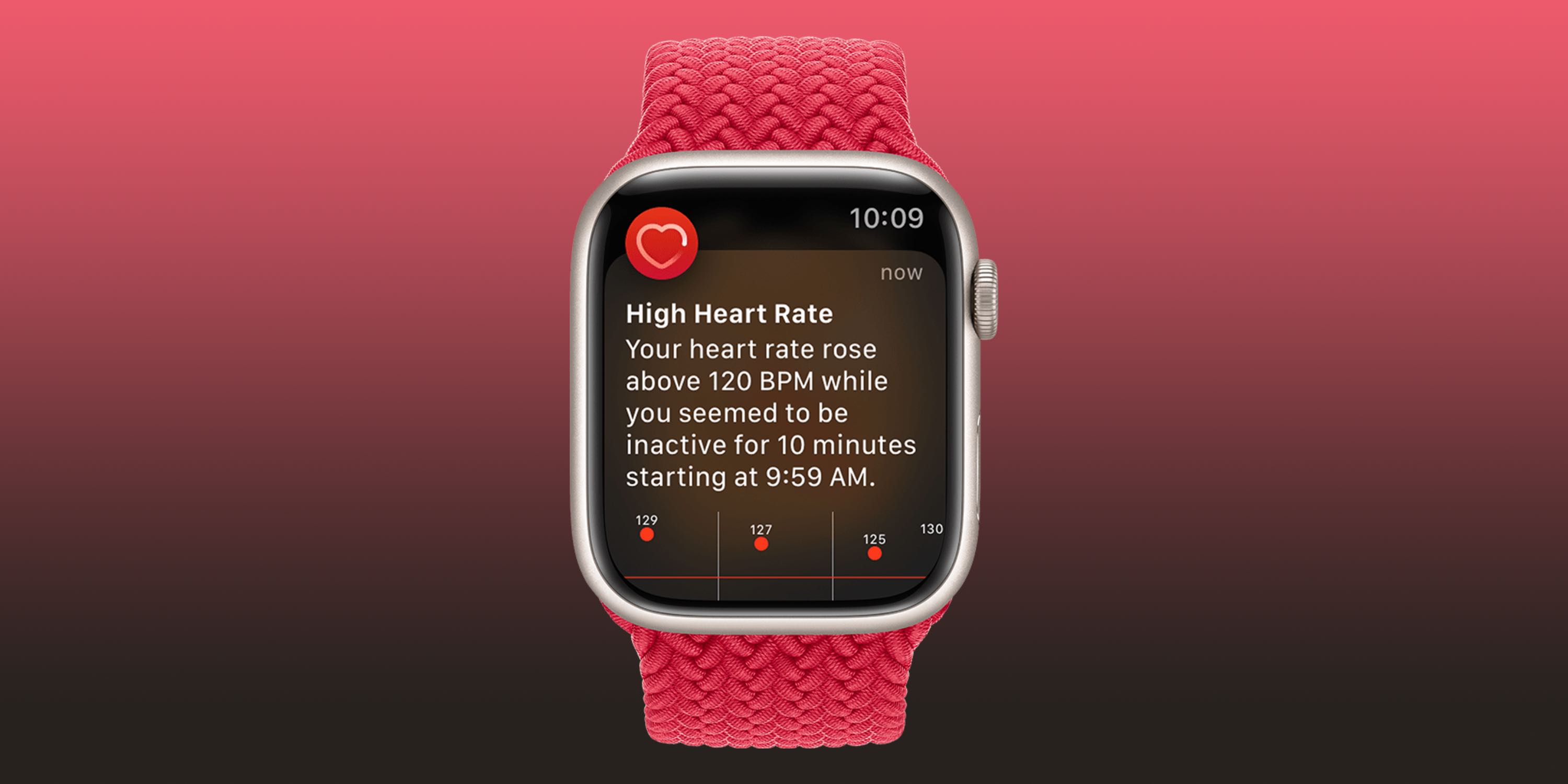
High and low heart rate notifications

Apple Health features Apple Watch
  • If you’d like an alert when your heart rate dips below or rises above a certain threshold and remains there for 10 minutes while inactive, this feature is available for those 13 years old and up.
  • If you didn’t turn it on the first time opening the Heart Rate app or want to change it:
  1. Open the Watch app on your iPhone
  2. Swipe down and choose Heart (under the My Watch tab)
  3. Tap High Heart Rate > pick a threshold
  4. Tap Low Heart Rate > pick a threshold

Irregular heart rhythm notifications

Here’s what this feature does:

“If you receive a notification, the irregular rhythm notification feature on your Apple Watch identified an irregular rhythm suggestive of AFib and confirmed it with multiple readings.
If you have not been diagnosed with AFib by a physician, you should talk to your doctor.

To make sure this feature is set up:

  1. Open the Health app on your iPhone
  2. Choose Browse in the bottom right corner
  3. Now tap Heart
  4. Swipe down and look for Set Up under Irregular Rhythm Notifications
  5. If you don’t see that in the Health app, open the Watch app on iPhone
  6. Swipe down and tap Heart (under the My Watch tab)
  7. Tap the toggle next to Irregular Rhythm

ECG and AFib History

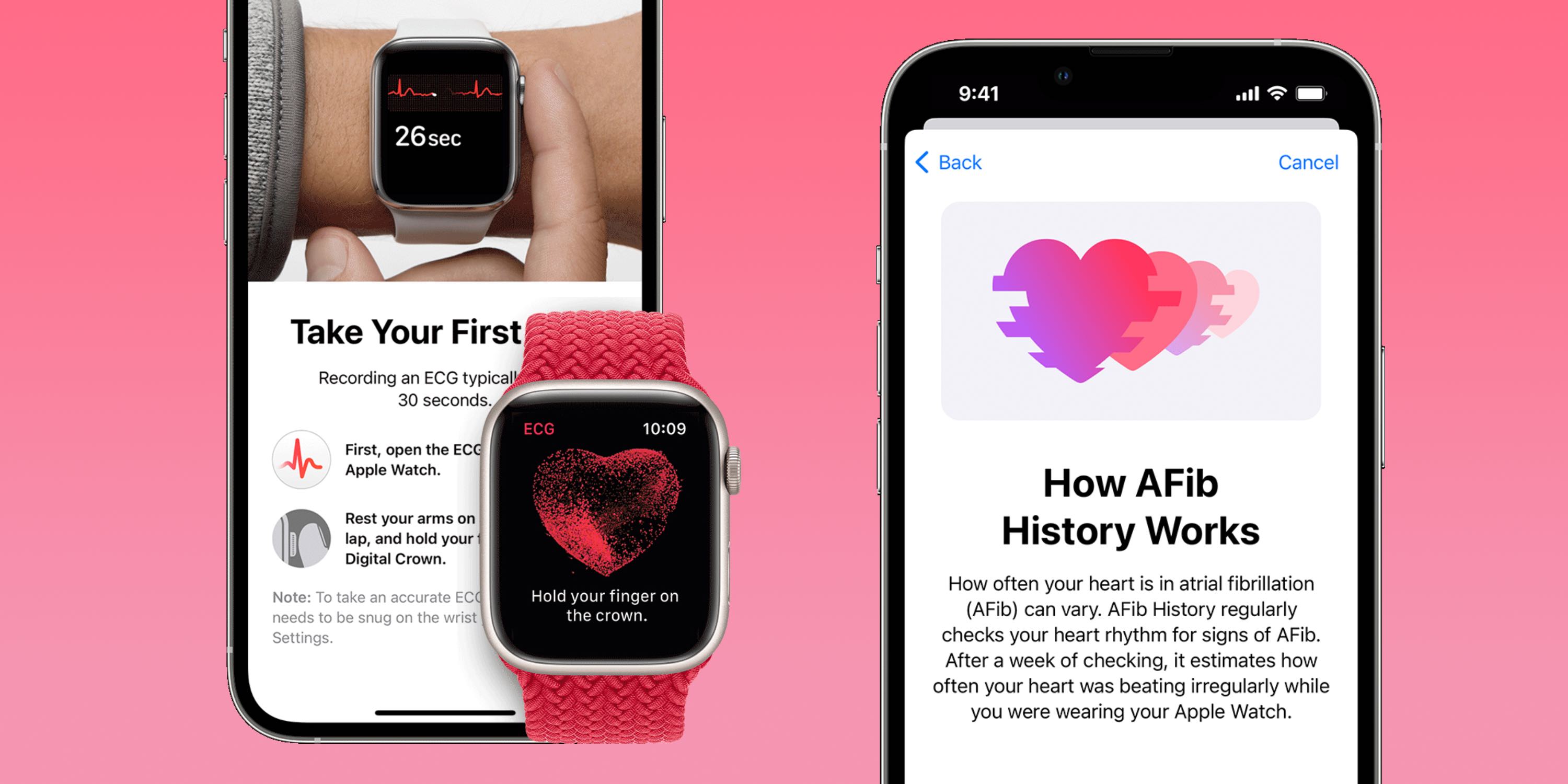
  • The ability to take ECGs with Apple Watch arrived with Apple Watch Series 4 in 2018 starting in the US. In the years since, the valuable and impressive feature has expanded to over 100 countries.
  • ECGs are for Apple Watch users at least 22 years old. If you haven’t used it before or didn’t set it up when you first got your watch:
  1. Open the Health app on your iPhone
  2. Choose Browse in the bottom right corner
  3. Now tap Heart > ECG > Set Up
  4. You can also set up the more recent AFib History feature – this regularly checks for signs of AFib in the background
  5. Head back to the Health app on your iPhone
  6. Browse > Heart > look for Set Up near the bottom under AFib History

Apple highlights that after an ECG “Regardless of the result, if you aren’t feeling well or are experiencing any symptoms, you should talk to your doctor.”

Cardio Fitness

Here’s how Apple describes Cardio Fitness (VO2 max):

“Cardio fitness is a measurement of your VO2 max, which is the maximum amount of oxygen your body can consume during exercise. Your cardio fitness level is a strong indicator of your overall physical health and a predictor of your long-term health.”

Check out how to get going with this or view your data in our full guide:

Cardio Recovery

Like HRV and VO2 max, Cardio Recovery or heart rate recovery is a lesser-known health metric that’s measured by Apple Watch every time you track a workout. Cardio Recovery measures how much your heart rate decreases immediately after exercise. As with heart rate variability, heart rate recovery (HRR) offers a look at your heart health by how fast it responds to the autonomic nervous system.

Learn how to set it up and more in our full guide:

Heart rate variability (HRV)

Heart rate variability (HRV) is automatically captured by Apple Watch but it’s not viewable in the wearable’s native Heart Rate app. You’ll need to head to the iPhone’s Health app > Browse > Heart.

What is HRV? It’s the measurement of how the interval of time between heartbeats changes, measured in milliseconds – notably this is a metric that changes a lot, so looking at broad trends, not daily numbers is most helpful.

HRV is considered by many in the medical field as a powerful indicator of not only current overall health and resilience of the heart and body but also a strong predictor of future mortality.

HRV is also often used as a signal to understand when the body is ready for exercise or rest. All of this is thanks to HRV showing how responsive the heart is to our autonomic nervous system.

Heart data history

On Apple Watch

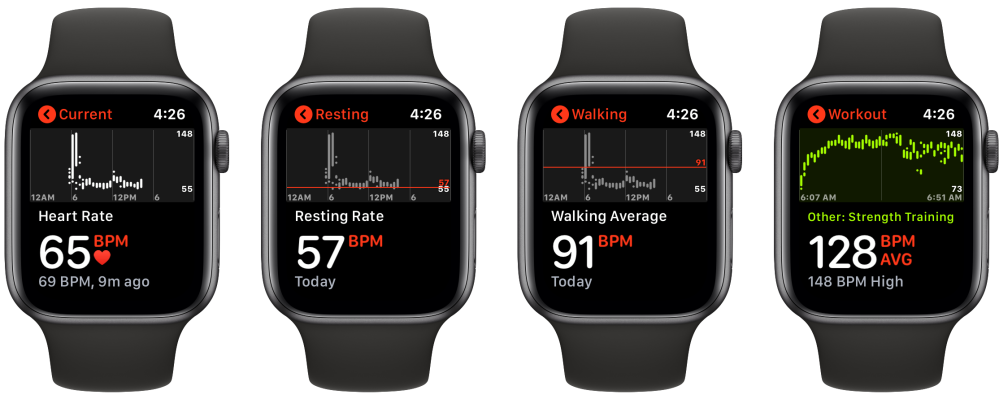
  1. Head to the Heart Rate app on your Apple Watch to see daily data (app with heart icon)
  2. You’ll see your current heart rate, swipe or scroll down with the Digital Crown
  3. Now you can see your resting rate, walking average, workout heart rate, and heart rate recovery data (if you’ve done a workout recently)
How to see heart rate history Apple Watch

Heart rate history on iPhone

Checking your heart rate history captured by Apple Watch on iPhone gives you the most data, here’s where to find it:

  1. Open the Health app on your iPhone
  2. Tap the Browse tab in the bottom right corner, then Heart
  3. On the main page, you’ll see the various heart rate categories. Tap one to see your history
  4. At the top, you can change the data window between hourly, daily, weekly, monthly, and yearly (H, D, W, M, Y)
  5. Toward the bottom, you’ll see heart rate highlights and more information about each type of heart rate data

Further down in the main Heart section, you’ll see more data like Cardio Fitness, ECG results, blood pressure readings, and low/high/irregular heart rate notifications.

Sleep-tracking

Apple Watch includes native sleep tracking but if you want to get richer data, there are a number of great third-party apps you can use. Check out all the details in our full guide:

Apple Health-supported accessories and apps

Compatible with Apple Health, the Withings Body Cardio smart scale is one of my favorite accessories. It even offers a Vascular Age feature that measures the “speed at which the blood pressure pulse propagates through the circulatory system.”

With those measurements, the smart scale is able to determine your arterial stiffness and health with a comparison to the average of people in your age group.

Body Cardio also tracks weight, BMI, body composition (water, fat, bone, and muscle), heart rate tracking, and more.

And if you want a seamless way to measure and track your blood pressure with Apple Health, the Withings BPM Connect is a great option.

There are of course many more accessories that record health data with iPhone, just look for the “works with Apple Health” when you’re looking around.

Some of my favorite apps that work with Apple Health include:

Fitness Stats 2

Posture, computer height, more

For tips and tricks on how to sit properly at your desk, do’s and don’ts for cleang your iPhone, and more, check our these guides:

FTC: We use income earning auto affiliate links. More.

26 Simple Diet and Fitness Tips

26 Simple Diet and Fitness Tips

We all want to be our best, healthiest selves. Still, with so much advice floating around, it can be hard to choose which healthy lifestyle tips are worth trying.


To make your life a bit easier, we’ve rounded up some of our go-to diet and fitness strategies to help you achieve your goals.


Whether you’re heading off to spin class, boot camp, or any other exercise class, it’s always important to hydrate so you can stay energized and have your best workout. But you don’t want to grab just anything for hydration purposes.


Electrolyte-loaded athletic drinks, for example, can be a source of unnecessary calories. So “drinking water is usually fine until you’re exercising for more than one hour,” Jackie Newgent, RD, author of “The Big Green Cookbook,” told Health.


But if you are doing high-intensity exercise for a long period, feel free to go for regular sports drinks. They can give you a beneficial replenishment boost—especially since they typically include minerals, electrolytes, and sometimes vitamins.


If you don’t want the calories but want some flavor, there are lower-calorie sports drinks available, added Newgent, that you could find in the grocery store.


A friend you can work out with is very helpful for staying motivated, but it’s important to find someone who will inspire—not discourage. So make a list of all your exercise-loving friends, then see who fits this criterion, Andrew Kastor, an ASICS running coach, told Health:


  • Can your pal meet to exercise on a regular basis?
  • Are they supportive (not disparaging) of your goals?
  • Will your bud be able to keep up with you or even push your limits in key workouts?


If you’ve got someone that fits all three, make the phone call to start getting fitness plans together. But if you don’t have someone close to you who could be your workout buddy, you may be able to find other ways to exercise with others.


You could check out a local gym or recreation center for more information about group workout classes, personal training sessions, or exercise-focused groups. You could even ask your family members or friends if they know individuals who are also looking for a workout buddy.


Foods like fruits, vegetables, and lean meats can go a long way for your fitness journey.


There are even some delicious, healthy snack options to take advantage of, like hummus, grapes and walnuts, and apple slices with cheese.


Additionally, some key ingredients may make it a lot easier to meet your weight-loss goals. During your next grocery store run, you could also consider placing Newgent’s top three diet-friendly items in your cart:


  • Balsamic vinegar (it adds a pop of low-cal flavor to veggies and salads)
  • In-shell nuts (their protein and fiber keep you satiated)
  • Fat-free plain yogurt (a creamy, comforting source of protein)


“Plus, Greek yogurt also works wonders as a natural low-calorie base for dressings and dips—or as a tangier alternative to sour cream,” said Newgent.


After a grueling workout, there’s a good chance you’re going to be feeling sore thighs and tight calves.


Fortunately, you might get relief from post-fitness aches by using cold water immersion in the form of ice baths. This involves submerging your lower body in a cold bath (50 to 59 degrees Fahrenheit; you may have to throw in some ice cubes to get it cold enough) for 10 to 15 minutes.


“Many top athletes use this trick to help reduce soreness after training sessions,” said Kastor. “An athlete training for an important race should consider getting one to two massages per month to help aid in training recovery.”


Of note, when a person puts their body in cold water, doing so can lead to increased breathing, heart rate, and blood pressure. The body can also lose heat faster in cold water than in air.


In other words, cold water can cause the body to work harder, which may not be good for certain health conditions. People should not use ice baths if they have, for example, the following conditions:


  • Cryoglobulinemia (a condition where antibodies in the blood thicken in the cold)
  • Heart conditions
  • Impaired circulation
  • Open wounds
  • Raynaud’s disease (a condition where blood vessels get narrow due to cold or stress)
  • Type 1 and type 2 diabetes


Cold temperatures might also worsen dysesthesia symptoms (when normal stimuli, like touch, are painful or don’t feel good) or lead to urticaria, or hives.


To be sure ice baths are safe for you, talk with a healthcare provider if you are interested in trying this type of therapy.


Cutting down on sugar can assist you with weight loss—individuals who consume less sugar end up with lower weights.


“To satisfy your sweet tooth without pushing yourself over the calorie edge, even in the late night hours, think ‘fruit first,'” said Newgent.


You can enjoy a sliced apple with a tablespoon of nut butter (like peanut or almond) or fresh fig halves spread with ricotta.


You shouldn’t buy shoes that hurt: “Your shoes should feel comfortable from the first step,” said Kastor.


Your feet swell during the day and stop in the late afternoon, so if you need sneakers, you’ll want to shop when your feet are biggest. Also, make sure the shoes are a little roomy—enough to wiggle your toes, but no more than that.


They should be comfy from the get-go, but they’ll be even more so once you’ve walked or ran 20 to 40 miles in them, said Kastor.


Running with music is a great way to get in a good workout groove. To pick the ultimate playlist, think about what gets you going and that you find uplifting.


“I know several elite athletes that listen to what we’d consider ‘relaxing’ music, such as symphony music, while they do a hard workout,” said Kastor.


The best part about music during a workout is that the right music can make you feel better emotionally, help you perform better, and improve how much oxygen you take in.


It’s normal to want to weigh yourself soon after starting a new diet or fitness routine. “It’s best to step on the scale in the morning before eating or drinking—and before plunging into your daily activities,” said Newgent.


If you’re wondering how often to weigh yourself, be sure to check your weight at a consistent time—possibly every week—for the most reliable number, and don’t let yourself get too discouraged by different results since weight fluctuations are normal.


When you change your diet, portion control can help with weight management.


Portion control requires special attention to your current eating habits. For example, if your steak takes up more than half of your plate, you may want to consider cutting your serving of beef in half.


That’s because it’s best to try and fill half your plate with veggies or a mixture of veggies and fresh fruit, said Newgent, so you can get a healthy mix of proteins, fats, and carbs.


If you know you’ll be partaking in more than one drink, try to order a glass of water between cocktails, said Newgent. Drinking water can help you stay hydrated and feel less thirsty.


But your H20 doesn’t have to be ho-hum. “Make it festive by ordering the sparkling variety with plenty of fruit, like a lime, lemon, and orange wedge in a martini or highball glass,” added Newgent.


When you have a 5K or 10K (or just a regular run) on your calendar, it’s important to plan out what you’re going to eat the morning of—something that will keep you fueled and go down easy.


While everyone is different, “we [tend to] have good luck with a high-carbohydrate breakfast such as a small bowl of oatmeal with fruit or a couple of pieces of toast with peanut butter or cream cheese,” said Kastor.


Also, eat around 200 to 250 (primarily carb) calories about 90 minutes before you warm up for your run, advised Kastor.


And don’t worry about nixing your caffeine fix on race day. “Coffee is great for athletic performances,” added Kastor, as it makes you sharper and may even give you extended energy.


Whenever you go for a run—on a track or trail or during a race—make sure you’ve packed these key staples:


  • A watch or GPS tracker to log your total time
  • A music player
  • A cell phone, if you don’t mind holding onto it
  • A RoadID (a bracelet that includes all your vital info)


If it’s a sunny day, wear sunglasses. “They reduce glare, which can decrease squinting, ultimately releasing the tension in your shoulders,” said Kastor. And that’s a performance bonus because relaxing them helps conserve energy on your runs.


A healthy eating plan has a few characteristics. One of those characteristics is staying within your daily calorie needs when it comes to what you eat and drink. (Of note, everyone’s daily caloric needs will be different.)


If you have a day when you consume more calories than your body needs to function, try not to stress. Keep in mind that it takes a lot of calories to gain a pound of body fat. “So really, that one off day doesn’t usually result in any significant weight gain,” said Newgent.


What you do the next day and the day after is really important. Also, remember that starvation and excessive exercise are not healthy answers for an off day.


If you get off track, you can set up a personal reminder (e.g., on a sticky note or mobile device) to ensure you eat more mindfully on future days. You can also consider doing some meal planning for home or when you’re on the go and aim to maintain a healthy exercise schedule.


It’s easy to get in a diet rut, even if you’re loading up on flavorful fruits and veggies. Fortunately, having plenty of spices, fresh herbs, and citrus at your cooking beck and call can help.


“It’s amazing what a little dash of spice, sprinkle of herbs, pinch of lemon zest, or squirt of lime juice can do to liven up a dish—and your diet,” said Newgent.


Some spices you could consider using include:


If your weight on the scale plateaus or your muscles don’t feel as fatigued, it might be time to increase the intensity of your exercise.


Take if you decide to change your running routine: “The general rule of thumb is to up the amount of miles run, for races half-marathon length and longer, by 5 to 10{35112b74ca1a6bc4decb6697edde3f9edcc1b44915f2ccb9995df8df6b4364bc} each week,” said Kastor.


You might also want to switch up your routine if you’ve been doing the same thing repeatedly, such as using the elliptical, cycling, or exercising with a workout DVD. While these are all great ways to work out, it’s best to add some variety.


You could also do a different type of exercise (e.g., HIIT, cardio, Pilates) every time you work out or dedicate specific days or times for different exercises. That way, you can have more variety throughout your week.


While we’ve all heard that running shoes break down after logging lots of miles (about 300 to 350), you may still be holding on to your favorite pair. But that’s not a good idea.


“Glue has a tendency to break down under ultraviolet light, as do the other materials that make up the shoe,” said Kastor. So even if your sneakers have only 150 miles on them but are more than two years old, recycle them because chances are they’ve already started deteriorating.


It’s good to know what to look for in a sports bra. You’ll want to choose the right type of sports bra based on the exercise you’ll be doing.


“The best sports bras are loose around the chest so you can expand your ribs and diaphragm more effectively. But they should also be form-fitting,” Deena Kastor, an American marathon record holder and 2004 Olympic marathon bronze medalist, told Health.


Just make sure the cup is made of comfy material, like a soft compression fabric—look for descriptions that include the terms “breathability” and “compression.”


You know the feeling: a sharp pain just below the rib cage that always seems to pop up when you’re working out your hardest. It’s called the side stitch, also medically known as exercise-related transient abdominal pain (ETAP).


Side stitches can be a major nuisance—especially when they keep you from completing a workout. Suggested ways to ease the ache have included actions such as:


  • Deep breathing
  • Pushing on the area that hurts
  • Stopping exercise


However, out of those methods, stopping a workout is the most helpful way to get relief from side stitches.


You might also be able to prevent side stitches from happening in the first place. Waiting at least two to four hours to do any physical activity after consuming a lot of foods or drinks can help. You might also consider limiting how much you move your torso—or at least have support (e.g., a wide belt) for any torso movement.


If you plan on picking up the pace during your next workout, you’ll want to eat food that will help keep you going strong.


For breakfast, opt for a high-carbohydrate meal—one similar to what you’ll be eating on race day, so you can find out what foods digest best for yourself.


Try a whole-grain English muffin or a bagel with peanut butter or low-fat cream cheese. Then, have a well-rounded meal post-workout to help with recovery.


Kastor said his favorite meal consisted of one to two slices of French toast with a side of fruit: “The protein-to-carbohydrate ratio is perfect for enhancing my recovery.”


Even if you’ve been eating healthy and exercising, it may be tough to stay on track if your partner, coworkers, or friends don’t share your healthy eating habits.


If your partner loves pizza, try ordering a pie that’s heavy on the veggies and light on the cheese—then supplement it with a side salad.


Also, instead of bringing a super sweet dessert on baked goods day at work, you could take baked pears with cinnamon or mini fruit-and-nut muffins to substitute for brownies and blondies.


At times, you may consider cutting out your carbs to lose weight. But before adding dinner rolls and chips to your “no” list, remember that yummy foods like brown rice, pumpernickel bread, and even potato chips contain resistant starch.


This type of starch has been said to help with weight management by keeping a person feeling fuller for longer. This means you won’t have to eat as much to feel satiated.


Getting the fresh air from exercising outdoors is great, but along with it, you also get harmful UV rays.


To keep yourself shielded while still having fun in the sun, opt for:


  • A sweat-proof sunscreen with SPF 30 or higher
  • A lip balm with SPF 15 or higher
  • A broad-brimmed hat
  • Sports shades


You’ll want to be aware of sunscreens labeled “water resistant,” as they are required to be tested to see how effective they are. Additionally, the FDA stated that “waterproof” sunscreens do not exist—at some point, sunscreens will wash off.


Also, consider trading in your white tee and instead going for a shirt with built-in UV protection. A 30 ultraviolet protection factor (UPF) rating is necessary to be awarded the Skin Cancer Foundation’s “Seal of Recommendation.” A white T-shirt has a rating of 10.


Furthermore, the sun’s rays are at their brightest from 10 a.m. to 4 p.m., so try to plan a before-or post-work sweat session.


It’s hard to avoid that 3 p.m. stomach rumble. While eating something to hold you over until dinner is fine, some choices may be better than others. As often as possible, try to have some fruit, veggies, or snacks with a lot of protein handy.


However, if you find fast food is your only option, pull up the restaurant’s nutrition facts online. You can make an informed decision ahead of time about what to order. “Nearly every quick-service restaurant has a relatively healthful option or two,” said Newgent. Salads, chili, or grilled chicken are all good options.


You can get a chafing rash (caused by moisture and constant friction) on your thighs, around your sports bra, and even under your arms. To prevent the next occurrence, you can try a few anti-chafing products.


For example, you can rub an anti-chafe stick on any spots that have the potential to chafe. Moisture-wicking fabrics help, too. So, if you have a few quick-dry shirts (Nike, Asics, and Under Armour all make them), save those for your long runs or tough workouts when chafing is most likely to occur.


Along with protein and healthy fats, fiber is one of those nutritional elements that keeps you full and fueled all day long. If you’re trying to lose weight, fiber is your best friend.


Of note, for most adults, the recommended amount of fiber you should consume daily is between 21 grams to 30 grams.


Working out at the same time during the week or on the same days can have its benefits.


Researchers of a 2020 review found that for people with overweight or obesity, having consistent exercise times (particularly in the morning) was associated with the experience of weight loss and the creation of exercise habits.


Although it may take a lot to get into the habit of exercise, planning to workout at a set time or place can be advantageous for your health.


Whether you’re just starting or trying to maintain your nutrition and fitness progress, you have many options to help you meet your goals. From changing how you eat to finding the right fitness wear for your exercise routine, you can personalize your journey to a healthier lifestyle using Health‘s tips and strategies.

Exposure therapy could be a promising treatment for adolescents with eating disorders

Exposure therapy could be a promising treatment for adolescents with eating disorders

Whether you’re fearful of canine, needles or enclosed areas, a single of the most helpful interventions for this kind of anxiety dysfunction is publicity therapy in which you confront your concern in a risk-free natural environment. A new review led by scientists at Penn State University of Medication finds that exposure remedy is also a promising remedy for adolescents with having conditions. They uncovered that publicity to feared meals – these kinds of as sweet bars and pizza – aided children who had been in a partial hospitalization system for ingesting problems encounter lessened panic toward food items.

&#13

As a culture that is so seriously affected by food plan culture, our associations with our bodies can be dysfunctional. I came out as gay in significant school, and by the time I bought to school, I observed an greater emphasis on overall body impression among the gay gentlemen. That’s partly what encouraged my interest in looking into and doing work with clients with eating disorders.”

&#13
&#13

Jamal Essayli, assistant professor of pediatrics and of psychiatry and behavioral health

&#13

In accordance to the Nationwide Consuming Problems Affiliation, somewhere around 30 million Americans will struggle with eating problems, like anorexia nervosa, bulimia nervosa, binge-ingesting problem and other individuals, at some point in their lives. In addition to the LGBTQ+ group, adolescents and young grownups are especially susceptible, and the COVID-19 pandemic didn’t assist. Latest analysis by co-author Jennifer Shook, assistant professor of pediatrics at the Penn Point out Faculty of Drugs, and other individuals demonstrated a significant raise in eating disorder-associated inpatient and outpatient visits to crisis departments amongst adolescents and young older people throughout the pandemic.

“When this is an lively space of investigate, the causes of eating problems are ordinarily thought to be a mixture of biological predisposition and natural environment,” said Essayli. “For case in point, acquiring an anxious or perfectionistic predisposition and getting teased about your physique sizing or excess weight can equally maximize a person’s possibility for building an ingesting dysfunction.”

In the present review, which was printed in the Intercontinental Journal of Consuming Disorders, Essayli and his colleagues recruited 54 adolescents with a median age of 14 yrs who were taking part in a partial hospitalization system for feeding on diseases. The method ran five days a week for an ordinary of 8 weeks for every individual. Each working day, the medical crew exposed the individuals to a feared food stuff. For instance, members were being specified a whole-sized candy bar on Mondays, a baked good this kind of as a cookie on Tuesdays, pizza on Wednesdays, a dessert on Thursdays and a breakfast item this sort of as pancakes on Fridays.

“Numerous of these people have been underweight or fat suppressed, and experienced rigorous anxiety about these foods,” reported Essayli. “It was critical for them to find out that there’s absolutely nothing terrible about getting pizza and ice cream at a get together, for case in point, that it really is essentially component of a fulfilling daily life.”

Individuals provided subjective models of distress (SUDS) ratings on a scale from (no distress) to 10 (really high distress) straight away ahead of and right after each individual food exposure. In addition, individuals had been periodically offered the Kid’s Eating Attitudes Take a look at and Worry of Foodstuff Evaluate, which are aimed at determining levels of anxiety about ingesting and food stuff avoidance behaviors. Lastly, the adolescents have been encouraged to examine their thoughts about the exposure problems in weekly therapy periods.

“Just one of the points we wanted to check was no matter whether inside-session and among-session habituation were being critical for bodyweight attain,” claimed Essayli. “Say, you are afraid of canines. If you’re performing exposure remedy by shelling out time around a pet, in-session habituation is when your anxiety decreases when you happen to be with the dog. In between-session habituation is when your stress and anxiety decreases from session to session across times.”

This distinction is crucial, Essayli reported, because the extent to which clinicians really should emphasize or disregard worry-reduction through exposure remedy classes for having diseases was beforehand not known.

Over-all, the crew located that SUDS lessened drastically above time prior to publicity to feared foodstuff, delivering some proof that among-session habituation transpired. Nevertheless, the variance between pre-publicity and publish-exposure SUDS did not reduce more than time, indicating that inside-session habituation did not take place. Hence, the team concluded that among-session habituation, but not in-session habituation, predicted favorable treatment results, together with fat get and advancements on the Kid’s Ingesting Attitudes Exam and Fear of Foods Evaluate.

“Our results supply aid for integrating foodstuff publicity into partial hospitalization systems for adolescents with consuming disorders who are going through excess weight restoration,” said Essayli. “And whilst much more research is required, our final results might start out to aid clinicians ascertain how significantly emphasis to put on in-session habituation and involving-session habituation.”

Other Penn Point out authors on the paper contain Lauren Forrest, assistant professor of psychiatry and behavioral overall health Kathleen Keller, professor of dietary sciences and food items science and Susan Lane-Loney, associate professor of pediatrics and of psychiatry and behavioral overall health. Hana Zickgraf, assistant professor of pediatrics, Emory University, and Emily Stefano, assistant professor, Bariatric and Body weight Management Centre, Wake Forest College, also are authors.

The National Institutes of Well being supported this investigate.

Resource:

Journal reference:

Essayli, J. H., et al. (2023). The effect of between‐session habituation, within‐session habituation, and weight acquire on response to foods exposure for adolescents with taking in problems. Worldwide Journal of Taking in Ailments. doi.org/10.1002/take in.23894.

Abortion clinics face rising legal battles and threats : Shots

Abortion clinics face rising legal battles and threats : Shots

Wellspring Health Access clinic was set to open in June 2022 in Casper, Wyo., when it was damaged by arson in late May, 2022. If it opens this year, the women’s health and abortion clinic would be the only one of its kind in the state.

Mead Gruver/AP


hide caption

toggle caption

Mead Gruver/AP


Wellspring Health Access clinic was set to open in June 2022 in Casper, Wyo., when it was damaged by arson in late May, 2022. If it opens this year, the women’s health and abortion clinic would be the only one of its kind in the state.

Mead Gruver/AP

Thirty years ago, Blue Mountain Clinic Director Willa Craig stood in front of the sagging roof and broken windows of an abortion clinic that an arsonist had burned down early that morning in Missoula, Montana.

“This morning, Missoula, Montana, learned that there is no place in America that is safe from hateful, misguided groups,” she told the crowd of reporters and onlookers.

The 1993 fire at Blue Mountain Clinic was part of a particularly violent period of anti-abortion attacks in the U.S. that continued through the 1990s and 2000s, when clinics were bombed and abortion providers killed. Now, less than a year after the U.S. Supreme Court overturned Roe v. Wade, rhetorical and physical attacks have increased against clinics that still provide abortions in conservative-led states.

The U.S. Justice Department formed a Reproductive Rights Task Force after last year’s Supreme Court decision, in part to bring more attention to anti-abortion violence and threats. Since 2011, the DOJ has prosecuted dozens of criminal and civil cases over obstructing access to, threatening, or damaging abortion clinics. It charged 26 people in 2022 — more than in the previous three years combined.

The FBI is also investigating a series of abortion clinic arsons, primarily in states that have maintained or bolstered abortion access since the June 24 Dobbs v. Jackson Women’s Health Organization decision overturning Roe.

The increase in violence has led abortion-rights advocates to worry that more violence could be coming if the fringes of a fragmented anti-abortion movement become impatient with judicial and political efforts to ban and restrict abortion. Meanwhile, anti-abortion activists worry that vandalism committed at pregnancy resource centers over the past year is an indication that abortion-rights advocates could escalate into violence if states further tighten abortion access.

Violence has been rising since 2020

Violence against abortion providers was already on the rise before the Supreme Court’s decision to end federal protections for abortions, according to the National Abortion Federation. Nationally, from 2020 to 2021, reports of stalking rose 600{35112b74ca1a6bc4decb6697edde3f9edcc1b44915f2ccb9995df8df6b4364bc}, clinic invasions 129{35112b74ca1a6bc4decb6697edde3f9edcc1b44915f2ccb9995df8df6b4364bc}, and assaults 128{35112b74ca1a6bc4decb6697edde3f9edcc1b44915f2ccb9995df8df6b4364bc}, according to the federation. The organization is still aggregating its 2022 figures, which include data from after Roe was overturned, but it expects the upward trends to continue, according to chief program officer Melissa Fowler.

“When a clinic closes, the protesters don’t just pack up and go home,” Fowler said. “A lot of times, they will travel or even move to other communities and states and target the clinics that remain open there.”

There have also been attacks on anti-abortion pregnancy resource centers, which have been vandalized in several states since last year. Police in Minnesota were looking for the vandals responsible for smashing windows and spray-painting in red, “if abortion isn’t safe, neither are you,” at Abria Pregnancy Resources in St. Paul last summer, KSTP reported.

The clinic’s director, Angela Franey, had previously voiced support for the Supreme Court’s Dobbs decision.

Last May in Wyoming, after a draft opinion of the decision was leaked to the press, a new abortion clinic in Casper was set on fire before it could open. Owner Julie Burkhart blamed the incendiary rhetoric of anti-abortion groups.

“They are highly skilled in getting these lone wolves to come in and do their dirty work so that their hands can remain clean,” Burkhart said.

Federal officials recently charged a woman with arson in that case. According to an affidavit, 22-year-old Lorna Green allegedly admitted to lighting the fire at the Wellspring Health Access clinic in her hometown of Casper because “she did not like abortion.”

The clinic plans to open this spring, but its future is uncertain. A state law bans nearly all abortions in Wyoming, though on March 22 a judge temporarily blocked the law while a legal challenge against it is pending.

Vandalism and fear of violence in Montana

In Montana, the most recent attack against an abortion clinic happened in 2014 in Kalispell, about 120 miles north of Missoula by car, where the son of an anti-abortion activist broke into and vandalized All Families Healthcare. He was sentenced to 20 years in prison with 15 years suspended.

All Families Healthcare owner Susan Cahill said she wanted to continue working after the break-in. But her family, fearing for her safety, persuaded her to retire.

“I was quite depressed for a couple of years after the office was destroyed,” Cahill said.

The clinic’s closure created an abortion care desert for four years before another provider took over the practice.

Montana continues to allow access to abortion services because of protections in its state constitution, but clinics that perform abortions are few. Blue Mountain reopened after its 1993 fire, and Planned Parenthood of Montana also provides abortion services in multiple Montana cities. All Families reopened under new owner Helen Weems, in Whitefish, just north of Kalispell in northwestern Montana’s Flathead Valley.

Montana’s Republican governor and Republican-led legislature are now seeking to restrict abortion access. Gov. Greg Gianforte and state Attorney General Austin Knudsen are asking the state Supreme Court to overturn its 1999 decision in the case Armstrong v. State, in which it held that abortion access is protected under the Montana Constitution’s right to privacy.

“It’s time for the Montana Supreme Court to take up the Armstrong case, take another look at it, and reverse it,” Montana Attorney General Austin Knudsen said at a January anti-abortion rally in the Montana Capitol. “It is garbage law and it needs to go.”

Conflicting desires within the anti-abortion movement

Montana state lawmakers are moving legislation that seeks to decouple abortion access from the constitutional right to privacy, along with other measures that would restrict abortion. Gianforte’s administration and conservative lawmakers are also trying to make it more difficult for Medicaid patients to obtain medically necessary abortions.

However, polling suggests most Montanans support abortion access, and voters rejected a 2022 ballot initiative that would have created criminal penalties for health officials who do not work to save the life of an infant born after an attempted abortion or birth, even if the infant has no chance of long-term survival.

A recent survey from the Public Religion Research Institute found a greater percentage of Montanans than of people in any bordering state think abortion should be legal in most or all cases.

The message sent by voters in Montana — and those who passed 2022 ballot measures in support of reproductive rights in California, Kansas, Kentucky, Michigan, and Vermont — has left Republican lawmakers with unexpected challenges, said Mary Ziegler, a law professor at the University of California-Davis who studies the anti-abortion movement.

Those politicians want to avoid upsetting voters, but they also want to pacify the more extreme anti-abortion groups by promising progress through legal means, said Ziegler. With the movement fragmented after Roe was overturned, those in the mainstream anti-abortion movement worry about what the more radical elements might do if their cause isn’t advanced in the courts and statehouses, she said.

“Quite literally the last thing you want is PR where your movement is being associated with violence,” Ziegler said.

Health care providers in Montana said the post-Roe era has been an uneasy time as they defend themselves against legal and political attacks while trying to keep their doors open for patients from Montana and neighboring states where abortion is banned.

“Our patients show up every day because they are desperate to get this care,” said Nicole Smith, the current executive director of Blue Mountain Clinic. “We have to be there and hold the line for them.”

Weems, of All Families Healthcare, said having to constantly fend off legal attacks on abortion care has changed how she thinks of herself.

“It’s felt like there’s been a change in my role from strictly a medical provider to more of a political activist,” she said.

Abortion-rights advocates are working to support medical providers in managing the mental toll these legal attacks take. The newly created Montana Sexual & Reproductive Health Collective is partnering with licensed therapists to provide free emotional and psychological support for providers.

“We don’t want to have to be doing triage on our abortion providers or our abortion-rights community,” said Hillary-Anne Crosby, the group’s leader. “We want to be there every step of the way so it does not get to that crisis point.”

This story comes from NPR’s health reporting partnership with Kaiser Health News (KHN) and Montana Public Radio.

KHN (Kaiser Health News) is a national newsroom that produces in-depth journalism about health issues. Together with Policy Analysis and Polling, KHN is one of the three major operating programs at KFF (Kaiser Family Foundation). KFF is an endowed nonprofit organization providing information on health issues to the nation.

Edited by Matt Volz of KHN and Carmel Wroth of NPR.

From Orgasms to Overdoses: How Marie Nyswander Went from Treating ‘Sexual Frigidity’ to Heroin Addiction

From Orgasms to Overdoses: How Marie Nyswander Went from Treating ‘Sexual Frigidity’ to Heroin Addiction

In the early 1950s Marie Nyswander was ready to move on from addiction. She set up a private practice and specialized in treating women afflicted with what she would call one of the “gravest problems of our time”: sexual frigidity. She and her adoring husband were living the good life, hanging out with rich art collectors and members of New York City’s literary scene. But when Nyswander started getting phone calls for help, she got pulled in a very different direction.

[New to this season of Lost Women of Science? Listen to Episode One here first.]

EPISODE TRANSCRIPT

The Lost Women of Science podcast is made for the ear. We aim to make our transcripts as accurate as possible, but some errors may have occurred nonetheless. In addition, important aspects of speech, like tone and emphasis, may not be fully captured, so we recommend listening to episodes, rather than reading transcripts, when possible.

—-

CAROL SUTTON LEWIS: This is the second episode of our series about Marie Nyswander. If you haven’t heard the first episode, stop now and go back and listen to that one. This episode will make much more sense if you do.

And a reminder that this season of Lost Women of Science is for adults. It will occasionally include adult language, and we’ll be talking about drugs and sex. Please, also note that some archival audio includes outdated language about drug addiction. Okay, I think we’re ready! 

CAROL SUTTON LEWIS: In 1912, the German pharmaceutical company Bayer ran an ad for cough syrup in a Spanish newspaper. The ad features a little girl sitting on a chair with a big bow in her hair. She smiles as a woman spoon feeds her medicine. The caption reads, “la tos desaparece” – “the cough disappears.”

The ad goes on to explain how this syrup will help with everything from bronchitis to laryngitis, even tuberculosis. And then, at the bottom, in big, bold letters, we see the name of the medicine: “Heroína.”

KATIE HAFNER: Just in case you missed that, the miracle cough syrup for kids is heroin. 

Bayer—yes, the same company that makes Aspirin—ran multiple ads like this in Spain: one features a boy grabbing at a heroin bottle in his mother’s hands, there’s another that depicts two kids in a standoff, both reaching for a vial of heroin on the table.

American ads were just as sweet, touting heroin’s many benefits, saying it was a non-addictive alternative to morphine. Some ads even suggested heroin for more vulnerable patients who couldn’t handle morphine.

CAROL SUTTON LEWIS: By the time these ads ran in 1912, Bayer might have had some inkling that heroin wasn’t actually so kid-friendly or adult friendly for that matter. It had been selling heroin for over a decade by then, and it was becoming very apparent just how addictive it was. Just one year after these ads ran, the company stopped making heroin for good.

But it was too late. And when Marie Nyswander arrived in New York half a century later, this “cough medicine” was wreaking havoc in the city, and around the world. And though Marie thought she was done with addiction, addiction was far from done with her.

KATIE HAFNER: This is Lost Women of Science. I’m Katie Hafner.

CAROL SUTTON LEWIS: And I’m Carol Sutton Lewis, and this season is the story of Marie Nyswander. 

CAROL SUTTON LEWIS: In 1950, Marie was living in New York City, ready to start fresh. After her miserable year at the Narcotic Farm in Lexington, Kentucky, she’d spent a couple of years finishing up her residency at Bellevue Psychiatric Hospital in Manhattan, where she saw even more of the terrors of withdrawal  up close—diarrhea, vomiting, fevers, weight loss, pleas from patients that were so heartbreaking, it made the doctors keeping them away from drugs look like monsters. Marie was ready to move on.

CAROL SUTTON LEWIS: Fortunately, during those early years back in New York she’d also done some post-grad training at the New York Medical College, learning all about the hottest psychiatric method of the day: Freudian psychoanalysis.

DAVID COURTWRIGHT: Well, why psychoanalysis then? 

MARIE NYSWANDER: Oh, well, you have to remember, that’s again historical.

CAROL SUTTON LEWIS: Back in 1981, Marie told the historian, David Courtwright, it was just that most psychiatrists were into Freud back then.

MARIE NYSWANDER: And the Freudian explanation for behavior seemed to be the most dynamic and correct and true, and we took it just right down the line. It was like a bible. [laughs]

KATIE HAFNER: Marie soon started seeing private clients. And her specialty? What she would later call one of the “gravest problems of our times”? Carol, it was sexual frigidity, of course.

CAROL SUTTON LEWIS: Sexual frigidity? Can we even say that?

KATIE HAFNER: Uh, we said it a lot back then, at least Marie did. And here’s how Marie defined it.  Sexual frigidity is “the inability to enjoy physical love to the limits of its potentiality.” In lay person’s terms, the sexually frigid woman can’t orgasm. Or if she can it’s not very good.

So Marie, she was so taken with this particular subject that she later wrote an entire book about it. Are you ready for the title of the book? The Power of Sexual Surrender.  It is exactly what it sounds like, a treatise on female submission.  

Carol, I have to read you some quotes from this book. I couldn’t believe it was the same Marie Nyswander I had been reading about. I mean, here’s just one quote: “The biological role of woman is motherhood. If a woman cannot dare to accept this aspect of her destiny, she will be deeply defeated in her life.”

And she thought frigidity came from problems in childhood like having an absent father, or worse, a feminist mother.

CAROL SUTTON LEWIS: What?

KATIE HAFNER: Yeah, in this book, I mean, I was pretty surprised. Marie really goes after feminists for disrupting gender norms – claiming feminists make their daughters wanna live like men.

 And the book, it staunchly decries women who put their careers first, imagine that. A woman’s most important role, according to Marie, is in the home as a wife and mother.

KATIE HAFNER: So yeah, a very interesting read. Some real contradictions with the life Marie actually lived.

DAVID COURTWRIGHT: Marie was always a career woman. 

KATIE HAFNER: David Courtwright again, professor emeritus of history at the University of North Florida.

DAVID COURTWRIGHT: Um, she never had any children, and she was devoted to her patients, to her research, to her writing. 

So she’s off in Freud land now in the mid fifties. Okay, uh, and this is also when she meets and marries Leonard Robinson.  

CAROL SUTTON LEWIS: Leonard wasn’t her first husband. It turns out Marie actually had quite a bit of experience with marriage and its pitfalls. Because by the time she met Leonard, Marie had already been married and divorced twice. The first marriage, when she was just 16-years-old was to a man named Gordon Woodrow Raleigh, a pre-med student  at the University of Utah. We don’t have a lot of details on that, but we do know that marriage lasted no more than a year. And then, while Marie was at medical school at Cornell, she married Charles Miles Berry, an anatomy instructor at the school.  We actually asked Cornell whether he’d been her instructor, but they didn’t know. That marriage was short-lived too.

CAROL SUTTON LEWIS: But then, along came husband number three. 

KATIE HAFNER: Yes, Leonard Wallace Robinson, another guy who went by all three of his names.

And Carol, just in case anybody thinks we’re being judgmental here, we are definitely not. I mean, we are people—well, I am person—who has been married a few times herself. 

Anyway, Leonard was a writer and lecturer at Columbia University. And when Marie breezed into his life, Leonard fell hard, hard enough that he wrote a novel all about her and their relationship. The title is The Man Who Loved Beauty. 

KATIE HAFNER: In the book, Leonard – codename “Jonathan” –  recounts meeting Marie – codename Elizabeth – at a Columbia faculty party. He describes her blonde hair, her deep, textured voice, and their electric connection on the dance floor.

KATIE HAFNER: And Carol, I wanted you to hear this passage about that meeting on the dance floor. I actually got my husband Bob to read it for us. He was a little bit reluctant at first.

KATIE HAFNER: Okay, take it away

BOB: I wanna guarantee that you’re gonna use it. If I, if I do it, I need a guarantee you’re gonna use it.

KATIE HAFNER: He’s kidding. 

BOB: My, my union insists on it.  

KATIE HAFNER: Okay

BOB AS LEONARD: The feeling of her body against mine was simply not describable. It was different in kind from all that went before. And many (laugh) had gone before. I had not naiveté left. But with Elizabeth in my arms that night on the dance floor, the great complex mysterious and marvelous body of woman seemed to make itself known to me for the first time, with all its primal attributes streaming from it, passion and purity, and the heavy mystery waiting to be explored.

BOB AS LEONARD: Geez, you should have warned me.

KATIE HAFNER: So as far as Leonard was concerned, they had a fantastic marriage.   

CAROL SUTTON LEWIS: In the 50s, Marie is living the good life. She’s got her private practice, she’s married to Leonard, who is absolutely enthralled with her, and she starts hanging out with a fashionable group of art collectors. She even starts collecting art herself.

 It sounded like a comfortable life, and it seemed to suit her.  But then, she started getting these calls.

EMILY DUFTON: She started getting phone calls from an increasing number of people saying, you know, my son has this problem. My daughter has this problem, my husband has this problem. She was being sought out. 

The problem was heroin addiction. During the war, there’d been a temporary interruption in supplies, but in the 50s, heroin was back in full force, and New York City was its capital.

LOW: When I, when I, when I, when I was on dope, it seemed like everybody was on dope. 

CAROL SUTTON LEWIS: During an oral history interview decades later, a man named Low recalled how bad things were back in the 50s. Low had grown up in Spanish Harlem, and he remembered being afraid of heroin. He’d seen how it ruined people. They’d go from being well dressed to wearing rags. But then one day, in 1949, a guy at a bar offered Low a free sample. And for whatever reason, that day, he decided to take it.

LOW: And I started to vomit. I vomit so much I couldn’t…

Q: Was this the first time you…

LOW: The first time.  And then, when after the vomiting, you have, you, you, you feel a sensation. A sensation that no other high like marijuana or liquid could give you, you just sit down and you be, you’ll be asleep, but you’ll be hearing everything that’s going on.

CAROL SUTTON LEWIS: And that was it. Low kept using heroin until he ran out of money. So he got a second job, and used some more. He was addicted to heroin. And in the 50s and 60s, he had a lot of company. 

LOW: It was like an epidemic, like everybody was using it. You know, it seems to me that everybody in every street corner, 10, 25 guys. You know, pedaling, heroin. I said, gee, whiz, I mean, I thought, I thought, that the world would come to an end.

CAROL SUTTON LEWIS: Now, something else that’s happening at this point is the demographics of heroin use is shifting rapidly. That’s actually one of the things we’ve learned—that what an opiate user looks like is always changing. During the 19th century, opiates were actually a middle or upper class white woman’s drug. When Marie was at Lexington in the 40s, opiate users were mostly white men. And in the 50s, the people hardest hit were young, poor, Black and Puerto Rican men. 

COMMISSIONER STEVE CANADAY: Narcotics traffic is a dirty business. Its victims are the walking dead. (fade under)

CAROL SUTTON LEWIS: In this WNYC program from 1959, New York City’s police commissioner, Steve Canaday, sounded the alarm. All these drugs were coming into New York City from abroad; thousands were addicted. He urged anyone who had tips about illegal sales to call the narcotics hotline.

COMMISSIONER STEVE CANADAY:  Call the Narcotics Squad at DIGBY 4 9 4 3 0. That is DIGBY 4 9 4 3 0

CAROL SUTTON LEWIS: Phone lines were open 24/7.

COMMISSIONER STEVE CANADAY: Action will be immediate, and your identity will be kept in strictest confidence. Give us the leads. We’ll do the rest. Remember, someone you love may be the next victim.

CAROL SUTTON LEWIS: The way Canaday described it, drug addiction was spreading in New York City like a zombie apocalypse.

SAM K. ROBERTS: In the period between 1955 and 1965, the change is certainly dramatic. All the data I’ve seen indicates that it, it was not good. I will say that. It wasn’t Night of the Living Dead, but it wasn’t um, it was not a rare occurrence either.

CAROL SUTTON LEWIS: Samuel Kelton Roberts is an associate professor of history, sociomedical sciences, and African-American and African diaspora studies at Columbia University. And he explains that a lot of that heroin ended up in Harlem thanks to Italian organized crime.

SAM K. ROBERTS: Are you all Godfather fans? You know the film?

CAROL SUTTON LEWIS: Oh yes. Just thinking. Yes. If you know The Godfather, then you know that they could sit around the table with five families.

DON ZALUCHI: I want to control it as a business. To keep it respectable. I don’t want it near schools. I don’t want it sold to children. (table slam) That’s an infamia. In my city we would keep the traffic in the dark people, the colored. They’re animals anyway so let them lose their souls.

SAM K. ROBERTS: ​​That scene is based on reality

CAROL SUTTON LEWIS: After World War II, the sale of heroin in New York was dominated by Italian crime syndicates, with some help from Jewish organized crime. Italian gangsters were able to smuggle in a lot of heroin from their connections in Europe, especially Corsica. So that was the supply side. 

And according to Ralph Salerno, a New York City police detective in those days, when it came to distributing the heroin, it wasn’t so much about consciously targeting Black communities, as it was about protecting their own neighborhood. 

RALPH SALERNO: In the, in the lower part of Manhattan, the Italian gangster’s image was we keep the drug pushers out of the neighborhood. And they did. And they did. As long as they’re not selling it or allowing it to be sold in their community, whoever they might be selling it to, isn’t that we’re gonna sell it to blacks and therefore it’s, we will not allow it to be sold here.

CAROL SUTTON LEWIS: But the upshot was that soon, the streets of Harlem were flooded with heroin. In some parts, it was easier to get than cigarettes.

SAM K. ROBERTS: Circa 1965, in Harlem, if you had been living there for anything more than about three, four years, you probably knew somebody who had like negative impact of heroin. Not just using and here and there, but like you probably knew had been acquainted with somebody who had had problems. 

KATIE HAFNER: So in the 1950s, Marie Nyswander started getting these calls asking for help, as we mentioned before. And she’s kind of an odd choice. Remember, Marie was a Freudian psychoanalyst, spending a good deal of her time teaching women how to enjoy sex. So why were people coming to her about addiction?

CAROL SUTTON LEWIS: Yeah really?

KATIE HAFNER: Well, back when Marie was a resident at Bellevue, she wrote this paper. It was a how-to for drug withdrawal, based on what she saw at Lexington. And in this paper, she explained, for example, how much morphine to give people to ease their symptoms, and then how to slowly wean them off of it, and how to make sure they didn’t smuggle any drugs into the hospital. You know, like practical tips.

And that’s why people turned to Marie. There weren’t a lot of doctors treating  addiction in the 50s. In fact, medical schools weren’t even teaching about it.

SAMUEL K. ROBERTS: If you were a first year medical student, you know, at Columbia or Hopkins or Penn or wherever else, certainly during this period, if you raised your hand and said, professor, you know, how do you treat drug addicts? The answer likely would’ve been something to the effect of, you don’t.

KATIE HAFNER: Historian Sam Roberts again.

SAMUEL K. ROBERTS: What was more likely is that you would have social workers who would try to help, um, churches would be involved. You know, sometimes they, you know, depending on the church, you know, they’d help you pray away the demon of addiction. That usually doesn’t work.

KATIE HAFNER: So Marie stood out just by publishing this short paper.

MARIE: Far from being rid of the problem, more calls. How can you walk away when there’s a woman in the hospital on barbiturates? So the intern has cut off from all barbiturates and she’s starting to convulse. You cannot not treat that woman. And on it goes, you see, you’re kind of by default forced into these thing.

KATIE HAFNER: Okay, so Marie wants to help. But, how helpful could she really be? She didn’t have a lot of tools at her disposal, like almost none, and almost nothing was understood about addiction. 

And now, in the 50s, Marie was up to her ears in Freud, who actually didn’t have that much to say about addiction. Though, he thought maybe it had something to do with a substitute for masturbation in childhood?

CAROL SUTTON LEWIS: Oh, that Sigmund

KATIE HAFNER: Yes, very on brand for Freud. 

In any case,  miles away, in the great nation of Canada, a pair of neuroscientists made an accidental and important discovery. 

CAROL SUTTON LEWIS: In 1953, in Montreal, two researchers embarked on an experiment that wasn’t supposed to have anything to do with pleasure or addiction. But thanks to a rookie’s mistake, it would change our understanding of both for decades to come.

KENT BERRIDGE: Our understanding of the brain reward system really began with the experiments of Jim Olds and Peter Milner in Montreal at McGill University in the 1950s. 

CAROL SUTTON LEWIS:  Kent Berridge is a professor at the University of Michigan. His full title is actually the James Olds distinguished professor of psychology and neuroscience. Seventy years later, Jim Olds is still a very big deal.

KENT BERRIDGE: It was thought at the time that a lot of people’s motivation was driven by unpleasant states, like hunger, thirst, drug withdrawal, things you’d rather not be in.

CAROL SUTTON LEWIS: Jim Olds was a postdoc, and he was specifically interested in the arousal system of the brain. Not in the sense of sexual arousal, but arousal meaning kind of overstimulated or agitated.

Jim wanted to show that this kind of arousal is generally not a pleasant thing. So if you stimulate a rat’s arousal system, it will do its best to avoid that experience. That was his plan anyway.

KENT BERRIDGE: It turned out he wasn’t a very good surgeon to start off, and his electrode went to a wrong place.  And he turned it on, he expected the rat to want to avoid that stimulation, so he put the rat on a table top and he said to the rat, basically, if you go to one corner of the table, I’m gonna turn this electrode stimulation on. But if you don’t want it, all you have to do is avoid that corner of the table. So he let the rat wander around, explore the table, sometimes going to the corner and getting the stimulation. And to his surprise, the rat didn’t avoid that corner, and it went back to the corner and it ended up staying entirely in that corner so it could get the brain stimulation. And this was a total surprise.

CAROL SUTTON LEWIS: And sure enough, when Peter Milner took an x-ray of the rat, they saw Jim’s electrode had missed the mark by quite a bit. Instead of the brainstem, where Jim was aiming, his electrode ended up roughly in the septal area of the brain, likely in something called the nucleus accumbens.

And Jim and Peter found that rats would do just about anything to stimulate that part of the brain—not just sit on a corner of a table. They’d also press levers, run through mazes, and even endure strong electric shocks, just to get that hit. 

And at the time, the takeaway of these experiments was this: if these rats want this kind of stimulation, they must like it. We must have found the brain’s pleasure center.

And maybe that could explain something about addiction. The behavior of these rats at least looked a lot like addiction. So maybe addiction was also about seeking pleasure on a very basic neurological level.

It turned out a lot of this was probably wrong – and we’ll get to that. But this idea, that addiction could be something other than a moral failing or the product of a psychopathic mind, that it could actually come from a fundamental neurological issue – that was the promise of these kinds of discoveries. 

KATIE HAFNER: Back in New York, Marie decides she’s going to step up to the plate. So she rolls up her sleeves and gets to work in the neighborhood where she’s needed most, East Harlem. She teams up with the East Harlem Protestant Parish and sets up shop inside a storefront on the first floor of a bleak tenement building on East 103rd Street. 

And what she offered was unique. Unlike other addiction programs in the country, you didn’t need to be an inpatient to get treatment, and you didn’t have to quit drugs before she’d see you. That made no sense to her, if the whole point was to treat your drug addiction. Instead, Marie offered therapy to anyone who needed it.  Anyone could walk in, have some coffee, sit and talk with Marie. No appointment or payment needed. 

CAROL SUTTON LEWIS: It all sounds very noble. And Marie, in her interviews, often reminds us of just how noble it all is. So Katie, not to be horribly cynical, but I got a whiff of a savior complex from some of Marie’s interviews.

KATIE HAFNER: I didn’t get that sense. Well, which interview?

CAROL SUTTON LEWIS: Well, listen. Listen to her. 

MARIE NYSWANDER: I think if there had just been one other person in the city that would see addicts, I, I would probably have washed my hands. But there wasn’t anybody, and I just said, you can’t abandon them. At least the way I was raised, you simply can’t abandon someone when there’s nobody to give them a glass of water, you know.

CAROL SUTTON LEWIS: Ok, so when I hear that I hear her saying no one else got it. No one else cared. She was the only one who gave a damn.

SAM ROBERTS: That’s certainly not true. I mean, there were people who gave a damn when she came to  New York, um, I think in her social circle, she was the one who gave a damn. 

She’s a- a white professional woman. She’s from a middle class family. So I think in her social circles, shit, so probably was the only one who gave a damn.

CAROL SUTTON LEWIS: Heroin just wasn’t hitting the white people downtown the way it was hitting Harlem at this point. And yeah, it seemed like a lot of white people didn’t care, but Marie did. 

KATIE HAFNER: And in Harlem, people really appreciated her. 

EMILY DUFTON: Oh, man, they just love her. They just, like, eat her up with a spoon. Everyone’s just like this, she’s the greatest. 

KATIE HAFNER: What was it about her that made them fall in love with her? 

EMILY DUFTON: I think it’s because she really wasn’t pretentious, you know, like she, she was trying to understand the issues that, you know, it’s mostly men, like, mostly like young Black and Puerto Rican men are coming to see her at this storefront. And she’s really trying to understand what it is that’s driving them to these, you know,these harmful habits. And I think she leveled with them, you know. She really came to it with a lot of curiosity and compassion as opposed to like judgment and trying to demean them into better behavior. I think everybody fell in love with her because if she turned her sun beam on you, you’d feel good. 

KATIE HAFNER: One of the reasons we know this is thanks to the very long New Yorker article that came out in 1965, written by Nat Hentoff, who was a leading journalist at the time. In fact, one of the most famous jazz critics of the 20th century. And Hentoff got The New Yorker to devote a whole forty-five pages of print to Marie, and later Hentoff expanded those pages into a full biography. It was clear, he deeply admired Marie.  

And so did her patients. One man tells Hentoff that Marie was different from the other doctors. She “didn’t put us all in one box, she sorted us out, because she got inside. I could walk in next door and just blow my top if I want to; and believe me, she could blow her top too. I dig her because she swings. She’s really alive.” 

The bottom line was that Marie talked to her patients like people, and they loved her for it. And the results?

EMILY DUFTON: The results are terrible. 90{35112b74ca1a6bc4decb6697edde3f9edcc1b44915f2ccb9995df8df6b4364bc} relapse rates.

CAROL SUTTON LEWIS: To Marie’s disappointment, her patients were relapsing at about the same rate as patients  at Lexington or Bellevue.

EMILY DUFTON: You’re gonna get about as good a relapse rate as, you know, hospital detoxification with no follow up care apparently, as you will with, you know, psychoanalysis about your mom

KATIE HAFNER: And doing this work, not seeing results she wanted, it was really getting to Marie, as she told David in 1981.

DAVID COURTWRIGHT: You had played about every card in your hand. 

MARIE NYSWANDER: Every card. Very frustrated. Very depressed, very. Nothing I could do. 

DAVID COURTWRIGHT: All, all the more impressed. Because you were really fond of these people. I mean, that’s, that’s-

MARIE NYSWANDER: I, I respected them, yes, I respected the, the courage to keep going. I would often say, my God, if I were in their shoes, it seems to me I would call Dr. Nyswander and ask her for money and procedure for drugs and in general, make your life miserable. And they never do. They, no matter how miserable they were, they. It made life difficult for me. I was around trying to help ’em. I couldn’t help them. They understood that. 

CAROL SUTTON LEWIS: But what if Marie was just using the wrong tools? What if addiction wasn’t a psychological problem at all? Remember those  rats being studied by the two researchers up in Canada? The way those rats acted looked a lot like addiction, but they didn’t have mother or father issues or prolonged adolescence, at least not that we knew of.

The problem was in their brain. What if the same thing was happening in people with addiction? If the problem was neurological or physiological, then talk therapy probably wasn’t going to fix it. 

And it seems like Marie would have known it wouldn’t all along. At that 1951 hearing in New York that we heard in the first episode, she’d been asked a final question:

SIDNEY TARTIKOFF: I know that you are a very fine practicing psychiatrist. Do you think that psychiatry in and of itself is the answer to the treatment and cure of addicts?

MARIE NYSWANDER: No, no. Far more complicated. 

SIDNEY TARTIKOFF: Far more than that? 

MARIE NYSWANDER: Far more, actually. 

ANOTHER VOICE: It’s just a partial element in the answer?

MARIE NYSWANDER: Oh, yes, yes. A very small part too, probably. 

SIDNEY TARTIKOFF: Thank you. Thank you so much, doctor.  The meeting stands adjourned. I mean, the hearing until tomorrow at one, thank you.

CAROL SUTTON LEWIS: Marie’s brand of psychiatry wasn’t enough, not on its own. But what was the alternative? If Marie knew about the rats in Canada or the studies that followed, it didn’t seem to shift her practice. And what could she do about a neurological problem anyway? She could only use the tools she had at the time. 

KATIE HAFNER: But it turns out another approach was just around the corner. Marie was about to get a call from one Vincent Dole, a researcher at Rockefeller:

VINCENT DOLE: I read as much as I could and I made a point of meeting everybody in the field that pretended any sort of expertise or had been recognized experts. And, uh, actually the only person that made sense to me just as a clinician was, uh, Marie Nyswander.

KATIE HAFNER: Together, Vincent Dole and Marie Nyswander made a discovery that would radically change how we treat addiction in this country. And much to her husband Leonard’s dismay, the Dole-Nyswander alliance would become a powerful one.

CAROL SUTTON LEWIS:  The Lost Women of Science podcast is hosted by me, Carol Sutton Lewis.

KATIE HAFNER: And me, Katie Hafner. This episode was produced by Zoe Kurland and Elah Feder, our senior producer, with help from Nora Mathison, Alexa Lim, Hilda Gitchell, and Dominique Janee.

CAROL SUTTON LEWIS: We had fact checking help from Danya AbdelHameid [UB-dell hah-MEED]. All of our music is by Lizzy Younan. D Peterschmidt mixed and designed the sound for this episode. 

KATIE HAFNER HAFNER: Amy Scharf is my co-executive producer at Lost Women of Science. We are funded in part by the Alfred P. Sloan Foundation, and Schmidt Futures. Our podcast is distributed by PRX and published in partnership with Scientific American.

CAROL SUTTON LEWIS:  For show notes and more about the whole team that makes this show happen, visit lostwomenofscience.org. 

KATIE HAFNER HAFNER: Finally, if you like what you’ve heard (or even if you hate it) tell your friends! I know people say that all the time, but seriously, it really helps the show. Text five people right now. Start a chain letter, with those ominous threats at the end that tell people if they don’t write five more people, their lives will be in shambles. Oh wait, no, don’t do that. But the texting is good. We’d really appreciate it.

CAROL SUTTON LEWIS: See you next week!

Opinion: When it comes to happiness, Jewel says society has it all wrong

Opinion: When it comes to happiness, Jewel says society has it all wrong

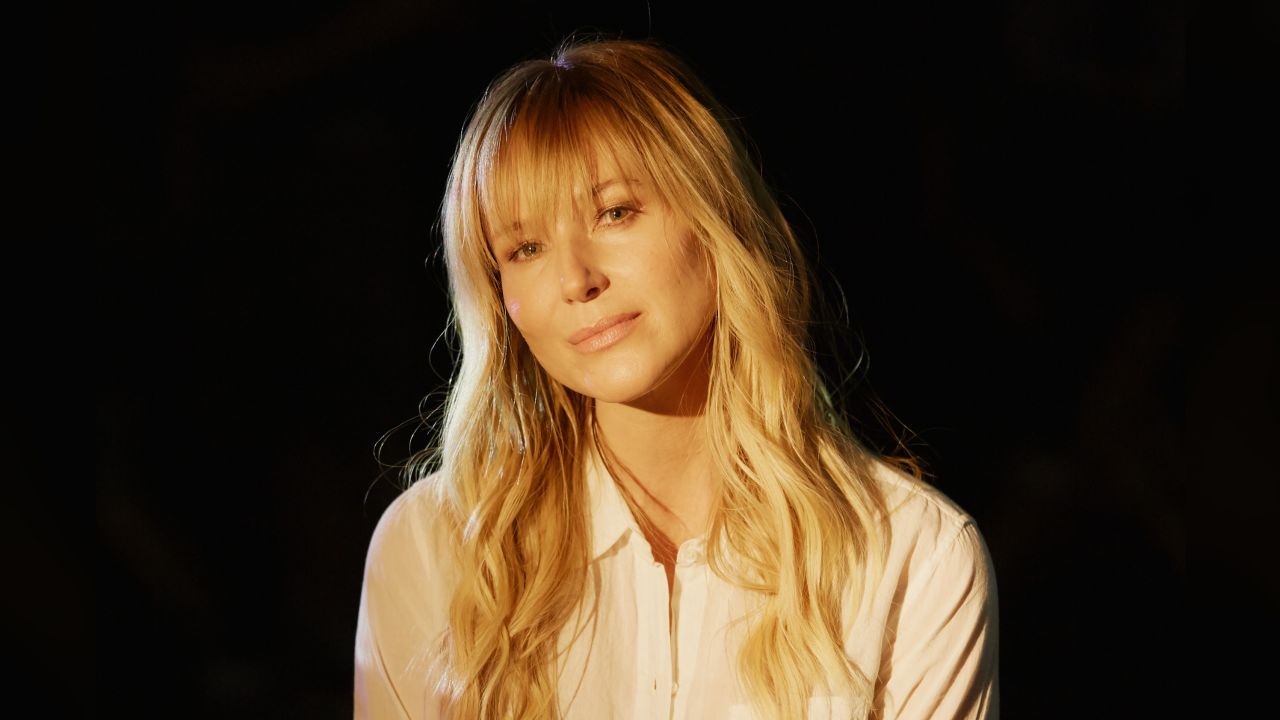
Editor’s Note: Jewel Kilcher is a singer, songwriter and author living in the Rockies. She’s an advocate for psychological overall health guidance and allows supply free means via NotAloneChallenge.org. Her Inspiring Kids Basis performs to remodel the life of at-hazard youth struggling with stress and anxiety and melancholy. And she not too long ago co-launched Innerworld, a peer-to-peer virtual psychological health and fitness group. Adhere to her on Twitter, Instagram and TikTok @jewel. The sights expressed right here are her very own. Read through extra opinion on CNN.


CNN
 — 

Just in excess of two yrs back now, I dropped my pricey pal Tony Hsieh, the longtime visionary CEO of Zappos. The company, largely because of Tony, was renowned for its aim on staff perfectly-getting and consummate client support.

Jewel Kilcher

Getting rid of Tony was a shock to the earth. He died from complications of smoke inhalation, owning been trapped in a fireplace. Tragically, the news of his dying was accompanied by revelations of his psychological wellness struggles.

Tony and I have been making a organization collectively when he died. It was aimed at generating the future frontier of corporate society, a single that would assist provide lasting joy by featuring mental health instruments for the workplace. It was the kind of enterprise that, I believe that, could have assisted him.

Mental health challenges like the kinds Tony faced are significantly far too common in today’s society. Psychological health is a non-partisan, world wide problem that is not nevertheless commonly recognized or acknowledged. Meanwhile, a 2022 CNN-Kaiser Family members Basis survey observed that 90{35112b74ca1a6bc4decb6697edde3f9edcc1b44915f2ccb9995df8df6b4364bc} of US grownups consider the nation is undergoing a psychological overall health crisis, and 1 out of 4 adults believes get the job done is a big resource of strain. And according to the Entire world Well being Organization, despair costs the world financial system $1 trillion each and every year in shed productivity.

In our collective hurry to embrace intellect and conquer new territory and frontiers, it appears to be far too lots of in company The us have missed psychological and psychological well being — important elements for prolonged-time period good results.

In the not-so-distant foreseeable future, every single household, corporation, college and corporation must have a chief psychological wellbeing officer, or a strategic plan for the psychological wellbeing of those people in their treatment. This is how we can not only make investments in men and women as students and staff, but as human beings with brains and emotions. And it is how we can make very good on the classic expense we, as a modern society, have made in determining and cultivating exceptional talents by not only encouraging them have the sources they need to have in college or get the job done to excel, but, much more importantly, the means they require to be joyful.

When I was growing up, I definitely did not have access to all those resources. I moved out on my own when I was 15, understanding comprehensive effectively that statistically, little ones like me stop up repeating the cycle of abuse and habit that induced me to leave home in the first position. To be pleased, an individual who is caught up in a cycle of distress — whether it requires psychological well being, dependancy or poverty — has to find out a new way of becoming. I could see that just as I experienced a genetic inheritance that might predispose me to diabetes, I also had an psychological inheritance that may possibly predispose me to psychological overall health troubles.

I wished to believe that I could conquer the odds. But that intended I needed a program that could possibly tip the scales in my favor. I wanted to learn a new psychological language, but regrettably I did not have the means for suitable psychological overall health treatment or a school to teach me. So I established off on my own to see if happiness was in truth a learnable skill.

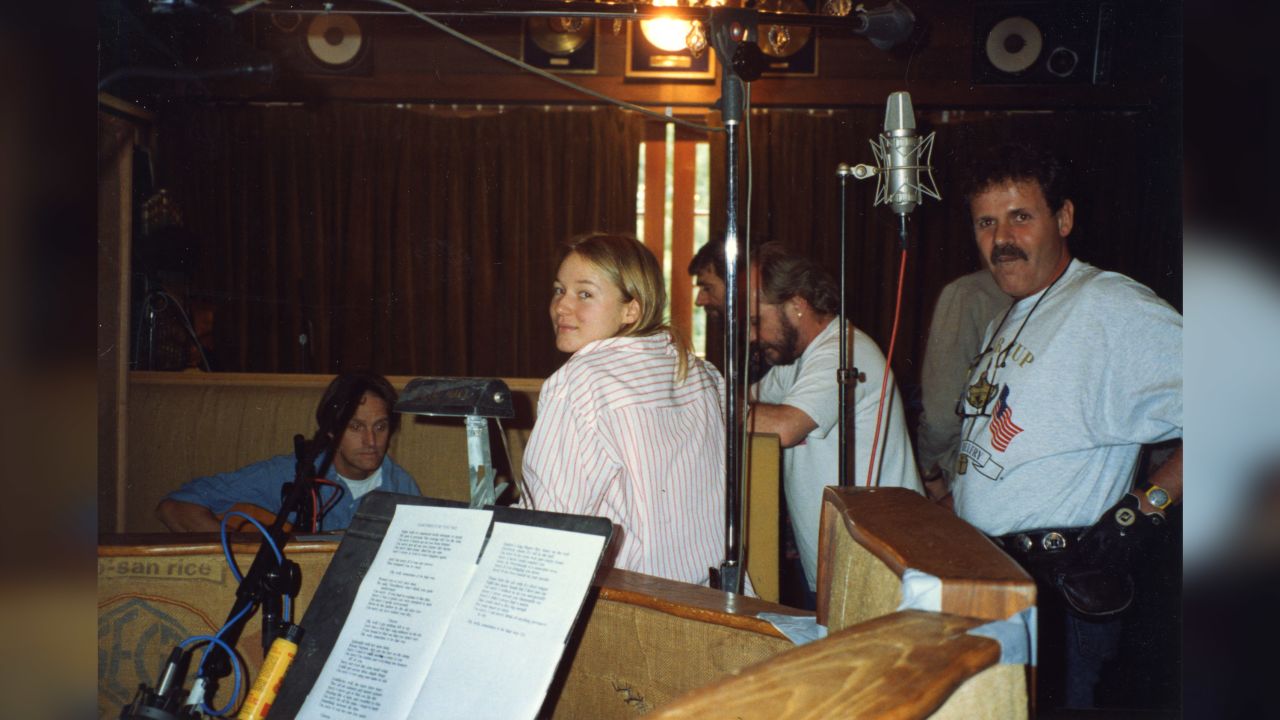
Jewel's recordings at Neil Young's personal studio in Redwood City, California in 1994.

I commenced to build a set of practicable competencies to coach my mind to behave in different ways — starving previous practices, even though creating new types. I wrote songs like “Who Will Save Your Soul,” about my life’s mission to understand about becoming responsible for my possess pleasure. And I wrote “Hands” in an endeavor to quit shoplifting, and when my palms reached out to steal, or my concern of heading hungry and homeless took hold, I uncovered to place pen to paper and create alternatively. Even while I uncovered these expertise on my individual, I hope that in the near future, firms will be in a position to offer you resources that provide a range of resources to enable staff cope with mental health difficulties.

Twenty-1 years in the past, I created the nonprofit Inspiring Kids Basis to enable young children who slide through the cracks of classic psychological well being systems. Below the oversight of a clinician, the system provides behavioral health instruments and a detailed prepare to inspire kids to figure out who they are and who they want to become. And Innerworld, a different business I just lately co-founded, delivers psychological overall health options available to everyone. People today from all walks of lifetime can come across productive mental wellbeing assist for a large variety of issues, from generalized anxiousness to social anxiousness, pressure, grief and melancholy, among the other individuals.

Jewel with a group of youth from her Inspiring Children Foundation in 2022.

It turns out that, certainly, pleasure is a learnable talent. No matter our histories, we can all heal, develop and be large-doing men and women in healthful strategies. But it unquestionably allows to have an employer’s support.

It is time for a lot more leaders in company The usa to increase a new line item to their profit and reduction statements. The psychological wellness and nicely-getting of each staff, from the mailroom to the C-suite, is paramount.